Three Quarters of Pedestrian Deaths Happen After Dark. Your Reflective Vest Is in the Wrong Place.
In This Series: Road, Transit & Child Safety
- Nobody Skips the Car Seat. The Deaths Are in the Exceptions.
- Half of the People Who Die in Crashes Were Not Wearing a Belt
- A Child Physically Cannot See a Car Coming at 30 mph. Start There.
- Sixty-Four Per Cent of Seriously Injured British Bus Passengers Were Never in a Crash. And the Bus Is Still About Four Times Safer Than the Car.
Disclosure: this article contains affiliate links, marked (paid link). If you buy through one we may earn a commission, at no extra cost to you. As an Amazon Associate I earn from qualifying purchases. It costs you nothing and it does not change what we recommend.
Key takeaways · 12 min read
- 7,148 U.S. pedestrian deaths in 2024 — falling, but still about 20% above 2016.
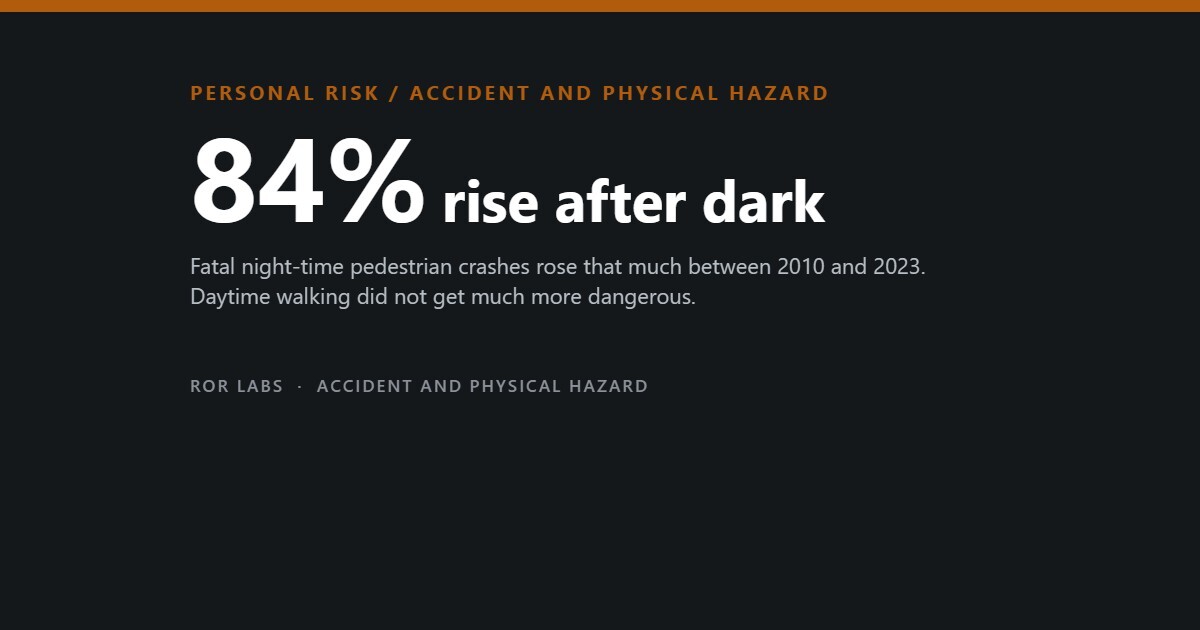
- More than three quarters happen after dark. Fatal night crashes rose 84% from 2010 to 2023.
- 65% of deaths occurred where there was no sidewalk; the increase is concentrated on urban arterials.
- SUVs and pickups accounted for 54% of pedestrian fatalities in 2023, against 37% for cars.
In 2024, 7,148 people were killed walking on American roads. That was a 4.3% improvement on the year before and the second consecutive annual fall, which is genuinely good news, and it still leaves the figure nearly 20% above where it stood in 2016 after a peak in 2022 that was the worst in forty years.
Underneath that headline is a pattern so lopsided it almost reads as a mistake. More than three quarters of those deaths happen after dark, and fatal night-time pedestrian crashes rose 84% between 2010 and 2023. Daytime walking did not get much more dangerous over that period. Night-time walking did.
That single split reorganises the advice. It means the useful question is not “how do I walk safely” but “what specifically fails in the dark” — and the answer involves the road, the vehicle and where you put reflective material, in roughly that order. One of the findings below is that the standard high-visibility vest is close to the least effective way to use the reflective material you are already carrying.
The whole problem is darkness
Where pedestrian deaths actually happen
U.S. pedestrian fatalities. The dark share is the number that has moved.
Sources: Governors Highway Safety Association, Pedestrian Traffic Fatalities by State: 2024 Preliminary Data; NHTSA Fatality Analysis Reporting System.
The geography is equally specific. Analysis by AAA found that almost the entire increase in pedestrian deaths has occurred on urban arterial roads, after dark — the wide, fast, multi-lane roads that carry traffic across a city while also serving shops, bus stops and homes. In the cities studied, a majority of deaths happened more than four miles from the centre, concentrated in economically disadvantaged neighbourhoods where crossings are far apart, sidewalks are missing and lighting is poor.
The road type that produces the deaths
An arterial is engineered for two incompatible jobs at once.
Sources: AAA Foundation research on urban arterial pedestrian fatalities (2025); Governors Highway Safety Association (2024 data); Insurance Institute for Highway Safety.
The vehicles got taller and flatter
The second structural change is what is coming down the road. In 2023, light trucks — SUVs and pickups — accounted for 54% of pedestrian fatalities, against 37% for passenger cars. That shift matters because of physics, and the Insurance Institute for Highway Safety has now quantified how much.
IIHS researchers examined 17,897 crashes involving a single vehicle and a single pedestrian, matched to 2,958 vehicle models through their VINs, alongside 121 in-depth crash investigations. They measured two things about the front of each vehicle: how high the leading edge of the hood sits, and how steeply the front slopes.
Front-end geometry changes the odds of dying
Increase in pedestrian fatality risk, relative to a vehicle with a hood 30 inches or lower and a sloping front.
Source: Hu, W. et al., Insurance Institute for Highway Safety, study of vehicle front-end profiles and pedestrian injury severity (2024); 17,897 crashes, 2,958 vehicle models.
The mechanism is not subtle. A low, sloping bonnet strikes an adult in the legs and rotates them onto the hood, which is survivable. A tall, vertical front strikes the pelvis or chest, pushes the person down and forward rather than up, and puts them under the vehicle. The same crash at the same speed produces a different outcome because of the shape of the thing that hit you.
This is worth saying plainly because it is the part of the problem that no amount of pedestrian behaviour addresses. You cannot walk more carefully to change the geometry of an approaching vehicle. It is a regulatory and design question, and the honest summary is that vehicle fronts in the United States have been moving in the wrong direction for two decades.
Why automatic braking has not fixed it yet
The obvious answer to a visibility problem is a machine that sees better than a person. Pedestrian automatic emergency braking is now common, and in daylight it works well. The IIHS added a night-time version of its pedestrian autobrake evaluation for exactly the reason this article exists — the daylight test was measuring performance in the conditions where the deaths were not happening — and found that few vehicles excel at it.
What the systems are up against in the dark
The same detection problem a driver has, with the same physics.
Sources: Insurance Institute for Highway Safety, night-time pedestrian autobrake evaluations and headlight ratings programme.
The reflective vest is the wrong shape
Here is the finding that changes what you should actually buy. Vision researchers have spent two decades testing pedestrian conspicuity on closed roads at night, and one experiment holds the amount of reflective material constant — 304 square centimetres in every condition — while changing only where it is placed on the body.
Placement turned out to matter enormously, because the human visual system has dedicated machinery for recognising biological motion: the characteristic swing of limbs around joints. Mark the ankles, knees, wrists and elbows and a driver does not see a bright patch, they see a walking person, and they see it much sooner.
Same material, very different distances
Distance at which drivers responded to a pedestrian at night. Every condition used the identical area of retroreflective material.
Source: Wood, J.M., Tyrrell, R.A. et al., “The conspicuity of pedestrians at night: how much biological motion is enough?” Journal of Vision; and related on-road conspicuity studies, Journal of Safety Research.
The same literature includes a second, less comfortable result: pedestrians consistently and substantially overestimate how visible they are to drivers at night. People assume that because they can see the car’s headlights clearly, the driver can see them. The headlights are a bright source pointed at you; you are an unlit object in front of a dark background. The asymmetry is enormous and it is invisible from the pavement.
What actually helps, in order
Ranked by how much risk each one removes
The first four are free.
Sources: IIHS; GHSA; AAA Foundation for Traffic Safety; conspicuity research in Journal of Vision and Journal of Safety Research.
What to buy, and where to put it (paid link)
Placement matters more than quantity. Ankles beat chest.
Browse on Amazon →
Browse on Amazon →
Browse on Amazon →
Browse on Amazon →
What we are deliberately not linking. First, the plain reflective vest as a standalone solution. It is not useless — it is far better than nothing on a moving pedestrian, and it is required kit in many workplaces — but the research above shows the same material does considerably more work on your limbs, and a vest sold as the complete answer is overselling itself. Second, spray-on reflective coatings. The retroreflectivity they achieve is low compared with proper retroreflective tape, and it degrades with washing and wear, which makes their performance impossible to rely on over time. Third, and most important: none of this is a substitute for the route. Every product on this page is a small correction applied after the two decisions that actually matter — which road you walk along, and where you cross it.

Questions people ask
Is walking against traffic safer?
Where there is no sidewalk, yes — facing traffic is the standard recommendation because it lets you see an approaching vehicle and step aside, rather than relying entirely on a driver seeing you. It is a mitigation for a road that should have had a sidewalk, not a solution, and nearly two thirds of pedestrian deaths happen in exactly that situation.
Do flashing lights work better than steady ones?
Flashing attracts attention more effectively but makes distance and speed harder to judge, and it is genuinely disorienting for oncoming drivers at close range. The common compromise — a steady front light so people can judge where you are, and a flashing rear light for attention — is reasonable, though the evidence here is thinner than most cyclists assume.
Are phones the cause of this?
Distraction is real on both sides of the windscreen, and it is a poor explanation for this particular pattern. Phone use did not suddenly become a night-time-only activity, and the increase is overwhelmingly concentrated after dark on one class of road. Darkness, road design and vehicle geometry explain the shape of the data better than distraction does.
Does any of this apply outside the United States?
The physics and the vision science transfer completely: darkness, headlight reach, biological motion and impact speed do not care about jurisdiction. The vehicle-fleet finding is more American — light trucks are a smaller share of the fleet in Europe, Japan and Korea, and pedestrian-protection rules there have constrained front-end design more tightly. The night-time concentration of deaths, however, shows up in national statistics almost everywhere.
What should I do about children walking home in winter?
Children are shorter, which puts them below the sightline over a tall bonnet, and they judge vehicle speed poorly until roughly adolescence. Reflective material on the ankles of school shoes and on a backpack, a clip light, and a walked-through agreement about which crossing to use are worth more than a general instruction to be careful. Route beats vigilance for adults too; it beats it by more for children.
The short version
- 7,148 U.S. pedestrian deaths in 2024 — falling, but still about 20% above 2016.
- More than three quarters happen after dark. Fatal night crashes rose 84% from 2010 to 2023.
- 65% of deaths occurred where there was no sidewalk; the increase is concentrated on urban arterials.
- SUVs and pickups accounted for 54% of pedestrian fatalities in 2023, against 37% for cars.
- A hood above 40 inches raises fatality risk about 45%; a flat hood adds about 25% at any height.
- Night-time pedestrian autobrake is much weaker than the daylight version — few vehicles do it well.
- Reflective material on the ankles and joints was seen from roughly two to five times further than the same material in a vest.
- Pedestrians systematically overestimate their own visibility. Seeing headlights is not being seen.
- The two decisions that matter most are which road and where you cross it. Both are free.
This article summarises crash statistics and vision research. It is not legal advice about right of way, which varies by jurisdiction, and nothing here shifts responsibility onto people who are killed while walking — the largest levers in this subject are road design, lighting and vehicle regulation, none of which are individual choices.
On the links above: some are affiliate links, marked (paid link). If you buy through one we may earn a commission at no additional cost to you. As an Amazon Associate I earn from qualifying purchases. We link to product searches rather than specific items so that recommendations do not break as models change, and we say plainly when we are choosing not to link something. Full policy: Affiliate Disclosure.
Sources
- Governors Highway Safety Association. Pedestrian Traffic Fatalities by State: 2024 Preliminary Data. (7,148 deaths in 2024, down 4.3%; nearly 20% above 2016; more than three quarters after dark; 84% rise in night-time fatal crashes 2010–2023; light trucks 54% of 2023 pedestrian fatalities; 65% of deaths where no sidewalk existed.)
- Hu, W. et al. “The effect of front-end vehicle height on pedestrian death risk.” Insurance Institute for Highway Safety, 2024. (17,897 crashes; 2,958 vehicle models; 121 in-depth crash records; +45% for hoods over 40 inches; +26% for blunt 30–40 inch fronts; +25% for flat hoods.)
- Insurance Institute for Highway Safety. “Few vehicles excel in new nighttime test of pedestrian autobrake” and headlight ratings programme.
- AAA Foundation for Traffic Safety / AAA. Research on pedestrian fatalities on urban arterial roads at night, February 2025.
- Wood, J.M., Tyrrell, R.A., et al. “The conspicuity of pedestrians at night: how much biological motion is enough?” Journal of Vision. (304 cm² of retroreflective material held constant; response distances of 113.5 m for full biomotion and 88.9 m for ankles only when walking; 63.2 m biomotion, 45.4 m ankles and wrists, 30.6 m black clothing and 23.8 m vest when standing.)
- Tyrrell, R.A., Wood, J.M., Carberry, T.P. “On-road measures of pedestrians’ estimates of their own nighttime conspicuity.” Journal of Safety Research, 2004.
- National Highway Traffic Safety Administration. Fatality Analysis Reporting System.