Dietary fat food sources and the limit that stayed at 10%
Key takeaways · 9 min read
- There is no recommended amount for total fat; the US range is 20% to 35% of energy, with saturated fat below 10%.
- The 2026 US guidelines kept the 10% limit while naming butter and beef tallow as cooking options.
- A tablespoon of butter holds 7.3 grams of saturated fat, a third of the daily limit; coconut oil holds 11.2.
- Cutting saturated fat reduced cardiovascular events by about 17% in trials, with no clear effect on deaths.
In this article
The US Dietary Guidelines published in January 2026 kept the old limit on saturated fat: “In general, saturated fat consumption should not exceed 10% of total daily calories.” In the same document, a paragraph on cooking fats says “other options can include butter or beef tallow.”
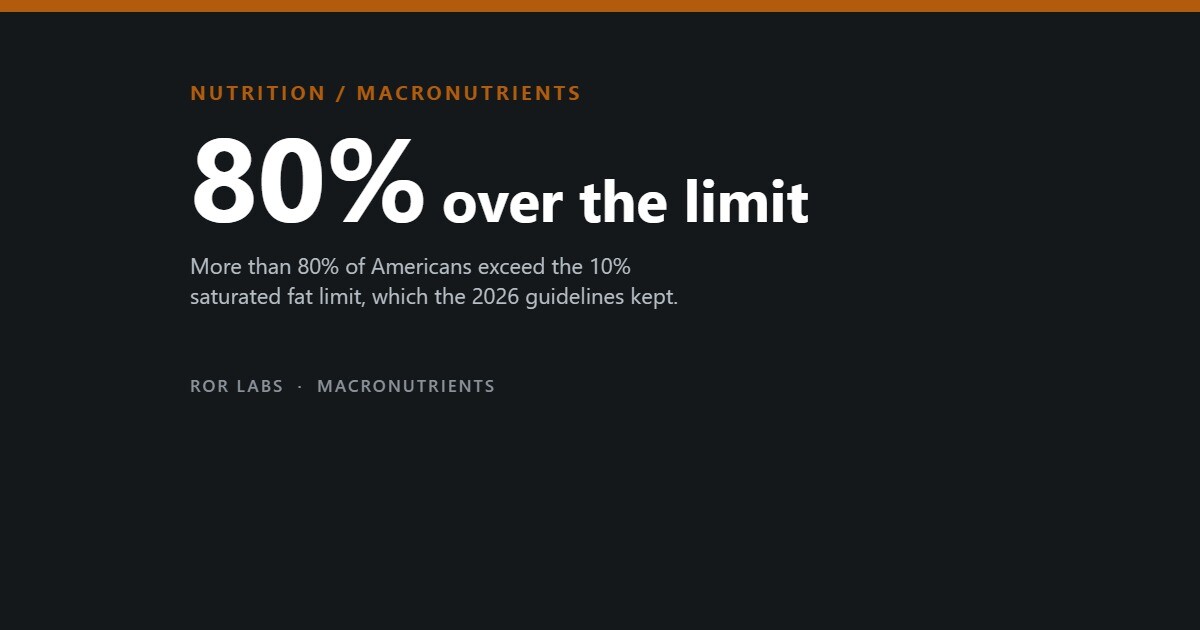
By the USDA’s own figures, a level tablespoon of butter holds 7.3 grams of saturated fat and one of beef tallow 6.8. On a 2,000-calorie diet the 10% limit is about 22 grams. National survey data already put the average American at 11.9% of calories from saturated fat, and more than 80% of the population above the limit.
This article covers what fat does and the reference numbers, which fats carry what, what the saturated fat trials actually found — including two old trials whose missing data were recovered decades later — and the one fat on which the evidence is settled.
What fat does, and the numbers behind it
Fat is the densest source of energy, at nine calories a gram. It carries the fat-soluble vitamins A, D, E and K, forms part of every cell membrane, and supplies two fatty acids the body cannot make: linoleic acid, an omega-6, and alpha-linolenic acid, an omega-3. The long-chain omega-3s were covered in the omega-3 article.
The reference numbers for fat
US and WHO reference values for adults, with average US intakes.
Source: National Academies DRI tables; WHO guideline on fats (17 July 2023); NCI Cancer Trends Progress Report, NHANES 2021–2023.
There is no recommended amount for total fat, because the Institute of Medicine found too little data to set one. It set adequate intakes for the two essential fatty acids instead, and an acceptable range of 20% to 35% of energy. The WHO’s 2023 guideline recommends total fat at 30% or less, saturated fat below 10% and trans fat below 1%, and says to replace them with polyunsaturated fat, plant monounsaturated fat or high-fibre carbohydrate.
The same tables set ranges for the essential fatty acids: omega-6 linoleic acid at 5% to 10% of energy and omega-3 alpha-linolenic acid at 0.6% to 1.2%. Adequate intake for alpha-linolenic acid is 1.6 grams a day for men and 1.1 for women; for linoleic acid it is 17 and 12 grams for adults up to 50.
Americans eat more than either range. In the most recent national data, total fat supplied 36.8% of calories and saturated fat 11.9%, against a Healthy People 2030 target of 8.4%. Neither figure has changed significantly since 2017.
Three fats by the spoonful
Every fat on a tablespoon ranking is close to 100% fat, so the series’ usual table would tie. The useful question is how much of each spoonful is saturated. Oils are weighed at 13.6 grams and butter at 14.2 grams.
Saturated fat in one level tablespoon
USDA FoodData Central, SR Legacy, nutrient 606. Percentages are of the 20 g Daily Value.
Source: USDA FoodData Central. Palm oil (FDC 171015) 6.7 g and lard (FDC 171401) 5.3 g per tablespoon.
Coconut oil, ghee and butter are the three. A single tablespoon of coconut oil holds more than half the Daily Value for saturated fat, and one of butter about a third. Olive oil and canola, the oils the guidelines name first, carry a fraction of that; most of their fat is monounsaturated or polyunsaturated.
That is why the choice of cooking fat is not trivial arithmetic. A day’s cooking with two tablespoons of butter uses up two thirds of the saturated fat limit before any cheese or meat is eaten.
What the new guidelines said
The 2025 to 2030 guidelines kept the 10% limit, and the health secretary, Robert F. Kennedy Jr., said so directly. They also listed meats, eggs, full-fat dairy, nuts, olives and avocados as sources of healthy fats, told readers to prioritise oils with essential fatty acids such as olive oil, and named butter and beef tallow as other options.
The reaction split along a familiar line. Alice Lichtenstein of Tufts disputed describing butter or tallow as good sources of healthy fats. The American College of Cardiology’s nutrition work group said that following the recommended servings would likely push saturated fat above 10%. The document is internally consistent on paper and difficult to follow in practice — a fair summary of the saturated fat debate itself.
What the saturated fat trials found
The best summary is the 2020 Cochrane review, which pooled 15 randomised trials with 56,675 participants who were asked to cut saturated fat for at least two years.
Cutting saturated fat: two reviews
Risk ratios against usual diet. Below 1.00 favours cutting saturated fat.
Source: Hooper et al., Cochrane Database Syst Rev CD011737.pub3 (2020), events 95% CI 0.70–0.98; Steen et al., Annals of Internal Medicine (2025), MI 0.70–1.06.
Cutting saturated fat reduced combined cardiovascular events by 17%, with moderate-certainty evidence. About 56 people would need to cut back for four years to prevent one event. There was no clear effect on deaths, from any cause or from heart disease. The effect depended on the replacement: polyunsaturated fat or carbohydrate looked useful, monounsaturated fat was unclear.
A 2025 re-analysis in the Annals of Internal Medicine, covering 17 trials and 66,337 people, found much the same risk ratios and concluded that for people at low baseline risk, the absolute benefits fell below the authors’ thresholds for importance. The American Heart Association’s 2017 advisory reads the same trials more strongly: replacing saturated fat with polyunsaturated vegetable oil cut cardiovascular disease by about 30%, it said, while replacing it with refined carbohydrate and sugar did not.
Two trials that were not fully reported
Two old trials complicate the story. The Minnesota Coronary Experiment, run from 1968 to 1973, randomised 9,423 people in mental hospitals and a nursing home to replace saturated fat with corn oil, rich in linoleic acid. Its full results were never published. In 2016 researchers recovered the original data.
The recovered trials
Results from records located decades after the trials ended.
Cholesterol: −13.8% vs −1.0%
Each 30 mg/dL drop: 22% higher risk of death
No mortality benefit in any subgroup
Safflower oil and margarine replacing saturated fat
Death from any cause: HR 1.62 (1.00–2.64)
Cardiovascular death HR 1.70
Source: Ramsden et al., BMJ 353:i1246 (2016); Ramsden et al., BMJ 346:e8707 (2013).
Cholesterol fell as expected, but the diet produced no survival benefit, and each 30 mg/dL fall in cholesterol went with a 22% higher risk of death. A 1981 thesis on the trial suggested the excess deaths were concentrated in people over 65, though the recovery team could not test that statistically. The Sydney Diet Heart Study, recovered in 2013, found higher death rates in men told to replace saturated fat with safflower oil and a margarine. Critics note that both trials had unusual populations and designs that would not pass today’s standards. Neither overturns the pooled evidence; both show it is thinner than it looks.
On the positive side, PREDIMED tested a Mediterranean diet with extra-virgin olive oil or nuts in 7,447 high-risk Spanish adults. Its 2013 paper was retracted because about 10% of participants were not individually randomised, and it was re-analysed in 2018 with hazard ratios of 0.69 for olive oil and 0.72 for nuts. A later Cochrane review rated the evidence low quality: fewer strokes, little effect on deaths.
The fat on which the evidence is settled
Industrial trans fat, from partially hydrogenated oils, is the one fat nobody defends. In the United States the FDA ruled in 2015 that partially hydrogenated oils were no longer generally recognised as safe, with compliance from 2018 and final extensions to 2021. Denmark restricted trans fat from January 2004; over the next three years its cardiovascular death rate fell by about 14 per 100,000 a year more than a synthetic comparison. In New York State, counties that restricted trans fat saw 6.2% fewer admissions for heart attack and stroke than counties that did not.
The scale of the change is easy to forget. A 2006 review estimated that industrial trans fat supplied 2% to 3% of the calories Americans ate, well above today’s WHO ceiling of 1% for all trans fat combined. The WHO’s recommended legal limit, the form most national bans take, is 2 grams of industrial trans fat per 100 grams of total fat. Unlike the saturated fat question, this one was settled by removing the ingredient and watching what happened.
The WHO reported in May 2025 that nearly 60 countries, covering 46% of the world’s population, now have best-practice trans fat policies, up from 11 countries seven years earlier. It still attributes more than 278,000 deaths a year to trans fat.
Keeping intake where it should be
The evidence supports a simple order of priorities: avoid industrial trans fat, which is now mostly gone from US food; favour olive oil, canola and other liquid oils, nuts and seeds; and treat butter, ghee, coconut oil and tallow as flavourings rather than everyday cooking fats. Cutting saturated fat helps most when it is replaced with polyunsaturated fat or whole-food carbohydrate, and least when it is replaced with refined starch and sugar.
Questions people ask
How much fat should I eat?
US guidance puts total fat at 20% to 35% of energy and saturated fat below 10%. The WHO recommends 30% or less total fat.
Is butter healthy now?
The 2026 guidelines list it as a cooking option but keep the 10% saturated fat limit. One tablespoon holds about a third of that limit.
Does cutting saturated fat prevent heart disease?
Trials show about 17% fewer cardiovascular events, with no clear effect on deaths, and the benefit depends on what replaces it.
Is coconut oil a healthy fat?
It is about 82% saturated fat, more than butter. A tablespoon holds over half the Daily Value.
Is trans fat still in food?
Industrial trans fat was removed from the US food supply by 2021. Small natural amounts remain in meat and dairy.
The short version
- There is no recommended amount for total fat; the US range is 20% to 35% of energy, with saturated fat below 10%.
- The 2026 US guidelines kept the 10% limit while naming butter and beef tallow as cooking options.
- A tablespoon of butter holds 7.3 grams of saturated fat, a third of the daily limit; coconut oil holds 11.2.
- Cutting saturated fat reduced cardiovascular events by about 17% in trials, with no clear effect on deaths.
- Two recovered trials found no benefit from replacing saturated fat with linoleic-rich oils.
- Trans fat bans in Denmark and New York were followed by fewer heart deaths and admissions.
This is a summary of published research, not medical advice. If you have heart disease, high cholesterol, diabetes, or take cholesterol-lowering medicine, talk to your doctor or a registered dietitian before making major changes to the fats in your diet.
Further reading: Hooper et al., Cochrane Database of Systematic Reviews CD011737.pub3 (2020), for the trial evidence on saturated fat. Ramsden et al., BMJ 353:i1246 (2016), for the recovered Minnesota data. Sacks et al., Circulation 136:e1–e23 (2017), for the American Heart Association’s case.
- The Case for Keto, Gary Taubes (2020). The strongest popular argument against the low-fat consensus. Worth reading as the other side; it leans on mechanism more than on trials.
- Metabolical, Robert Lustig (2021). A paediatric endocrinologist on processed food and metabolic disease. Forceful, and more critical of sugar than of fat.
- Rationality, Steven Pinker (2021). On how to weigh evidence when experts disagree — which describes the saturated fat literature exactly.
Sources
National Academies DRI macronutrient tables; FDA, linoleic acid nutrient content claims notice. — World Health Organization, updated guidelines on fats and carbohydrates (17 July 2023). — National Cancer Institute, Cancer Trends Progress Report: fat consumption, NHANES 2021–2023. — 2025 Dietary Guidelines Advisory Committee Scientific Report (December 2024). — USDA FoodData Central, SR Legacy, nutrients 204 and 606; FDC identifiers are printed in the figure. — US Departments of Agriculture and Health and Human Services, Dietary Guidelines for Americans 2025–2030 (January 2026). — STAT News (8 January 2026); Harvard T.H. Chan School of Public Health, The Nutrition Source (9 January 2026); American College of Cardiology nutrition work group statement (27 January 2026). — Mozaffarian D, Katan MB, Ascherio A, et al. New England Journal of Medicine 354:1601–1613 (2006). — WHO trans fat fact sheet (24 January 2024). — Hooper L, Martin N, Jimoh OF, et al. Cochrane Database of Systematic Reviews CD011737.pub3 (2020). — Steen JP, Klatt KC, Guyatt GH, et al. Annals of Internal Medicine, doi:10.7326/annals-25-02229 (2025). — Sacks FM, Lichtenstein AH, Wu JHY, et al. Circulation 136:e1–e23 (2017). — Ramsden CE, Zamora D, Majchrzak-Hong S, et al. BMJ 353:i1246 (2016). — Ramsden CE, Zamora D, Leelarthaepin B, et al. BMJ 346:e8707 (2013). — Estruch R, Ros E, Salas-Salvadó J, et al. New England Journal of Medicine 378:e34 (2018). — Rees K, et al. Global Heart (2020). — FDA, final determination regarding partially hydrogenated oils (2015). — Restrepo BJ, Rieger M. American Journal of Preventive Medicine 50(1):69–76 (2016). — Brandt EJ, Myerson R, Perraillon MC, Polonsky TS. JAMA Cardiology 2(6):627–634 (2017). — World Health Organization, trans fat elimination progress release (19 May 2025).