Fear of Losing a Job Tracked Depression About as Closely as Losing One Did. The Heart Disease Estimate, Once Adjusted, Starts at No Effect.
Key takeaways · 11 min read
- Fear of job loss, in people who still have the job, is associated with worse health across a large and consistent literature. The effect sizes are modest.
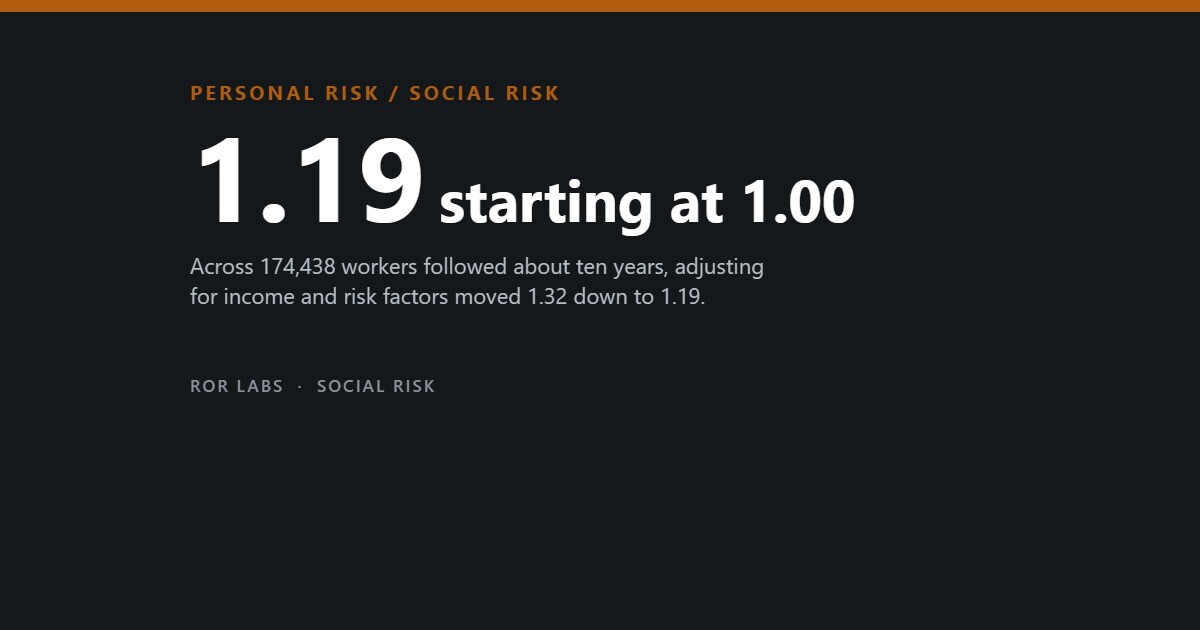
- Coronary heart disease: 1.32 across 174,438 workers adjusted for age; 1.19 once socioeconomic status and risk factors are included, with the interval starting at 1.00.
- Diabetes: 1.19 adjusted for age and sex across 140,825 workers, falling to 1.12 on full adjustment. Most of the fall comes from socioeconomic status.
- Mental health is the best-evidenced outcome: odds ratio 1.52, graded moderate certainty.
Across seventeen cohort studies and up to 174,438 workers followed for an average of 9.7 years, the people who said they feared losing their jobs went on to develop coronary heart disease at 1.32 times the rate of those who did not. Adjust for the fact that they were also poorer, smoked more and were heavier, and the figure falls to 1.19 — with a confidence interval that runs from 1.00 to 1.42.
That lower bound is the whole subject in one number. It sits exactly on no effect. The association is real enough to keep turning up and small enough that the honest description of it changes depending on which model you run.
This article is about the people who still have the job. Not redundancy, not unemployment — the anticipation. It is a large literature with a consistent direction, a modest size, and one causal-inference study that dissolves most of it.
The anticipation and the event
The most quoted finding in this field is a comparison. A meta-analysis of twenty prospective cohort studies, reported across fifteen articles, looked at depressive symptoms and put perceived job insecurity alongside actual unemployment in the same analysis.
Job insecurity came out at an odds ratio of 1.29. Unemployment came out at 1.19. The confidence intervals overlap heavily and nobody should read this as insecurity being worse than joblessness. What it does support is the weaker and more interesting claim: on this outcome, expecting the loss and sustaining it were not far apart.
Fearing it against living it
Odds of subsequent depressive symptoms, prospective cohort studies. Higher is worse.
Kim and von dem Knesebeck, International Archives of Occupational and Environmental Health, 2016. 20 cohort studies within 15 articles. The authors note effects were strongest in studies of respondents under 40 and in unadjusted models.
A companion review by the same authors took thirteen studies that measured both exposures in the same sample, producing twenty-four head-to-head analyses. Sixteen were statistically significant for job insecurity. Sixteen were statistically significant for unemployment. Which of the two looked worse depended on the health outcome being measured.

The heart disease number, before and after adjustment
The largest study of a hard clinical endpoint pooled individual participant data from thirteen cohorts with four published studies. It deliberately excluded indirect measures — organisational downsizing, an announced factory closure, a temporary contract — and used only what workers said about their own prospects.
Among men the relative risk was 1.24 and did not reach significance. Among women it was 1.47 and did. Combined, 1.32. Adjusting for sex, socioeconomic status, smoking, alcohol, body mass index and physical activity brought it to 1.19, with the interval starting at 1.00. Heterogeneity across the cohorts was moderate.
One association, four ways of looking at it
Incident coronary heart disease, high versus low self-reported job insecurity. 1,892 events.
Virtanen and colleagues, BMJ 347:f4746, 2013. Up to 174,438 participants, mean follow-up 9.7 years (range 3.2–21.2). I² = 40.7%, p = 0.014. No evidence of effect modification by sex, age, national unemployment rate, welfare regime or the type of insecurity measured.
The authors describe the association as modest and say plainly that it is partly attributable to worse socioeconomic circumstances and less favourable risk-factor profiles among the insecure. They also say the attenuation is ambiguous: socioeconomic status might be confounding the relationship or might be part of the pathway. Nothing in the design separates those.
Diabetes has the same shape
The same consortium ran the same design on incident diabetes across nineteen cohorts and 140,825 participants, with 3,954 new cases over a mean 9.4 years. Adjusted for age and sex, the odds ratio was 1.19. Adding socioeconomic status, obesity, physical activity, alcohol and smoking pulled it to 1.12, which remained significant but barely.
Most of that attenuation came from socioeconomic status alone. It is the same story as the heart disease paper, with the same unresolved question about whether adjusting away poverty is removing a confounder or removing the mechanism.
Incident diabetes, 19 cohorts
Ferrie and colleagues, CMAJ 188(17–18):E447, 2016. Heterogeneity low to moderate: I² = 24% and 27%.
Mental health is where the evidence is strongest
If the cardiovascular findings are modest and fragile, the mental health findings are neither. A systematic review that screened 3,328 records and kept sixteen longitudinal studies of adequate quality found an odds ratio of 1.52 for the effect of job insecurity on mental health, and graded the evidence moderate on a four-point scale.
The same review is the clearest statement of what is not established. For temporary employment and for unpredictable working hours — the two things most people mean when they say precarious work — it rated the evidence very low, one out of four. The perception of insecurity has been studied far more rigorously than the contractual arrangements that are supposed to produce it.
What the grading says
GRADE certainty of evidence for effects on mental health, longitudinal studies.
Rönnblad and colleagues, Scandinavian Journal of Work, Environment & Health, 2019. 3,328 records screened; 16 studies met the inclusion and quality criteria.
A separate review of persistent precarious employment — insecurity lasting twelve months or more — screened 12,940 records, included fifty studies and meta-analysed twenty-nine of them. Persistent precarity was associated with poor self-rated health at an odds ratio of 1.53. The authors also report that risk of bias was generally high, in eighteen of the fifty studies.

Where in the body it seems to act
A mediation analysis in the Whitehall II cohort followed 3,917 British office workers who were free of heart disease when they reported on job insecurity in the late 1990s. The total association with later coronary heart disease was a hazard ratio of 1.32, marginally significant at a lower bound of 1.00.
Decomposing it, about thirty per cent ran through psychological distress. Nothing ran through smoking, heavy drinking or physical inactivity. Nothing ran through sleep disturbance. Nothing ran through allostatic load, the composite biological stress measure the study had collected for exactly this purpose. Job insecurity was related to disturbed sleep; that relationship simply did not carry through to the outcome.
An earlier analysis of the same cohort found that the worst self-reported health belonged to those exposed to chronic insecurity, and something else worth noting: among people whose job security was restored, negative effects persisted, particularly psychological ones. The exposure did not switch off when the circumstance did.
What the evidence does not show
Four things cut against the summary above, and the first is serious enough that a careful reader should weigh it against everything else on this page.
The one attempt at causal identification mostly dissolves the effect. An economics study used data on men from twenty-two European countries and an instrumental-variable strategy: workers should perceive more security where employment is strongly protected by law, and more so in industries where that protection binds harder. Estimated without that correction, job insecurity appeared to worsen almost every health outcome measured. Estimated with it, the damaging effect survived for a narrow set — headaches or eyestrain, and skin problems. For the rest, the association was not significant at conventional levels. One study, one instrument, men only. But it is the closest thing to a causal estimate this literature has, and it does not look like the observational picture.
The same data, with and without an instrument
Men, 22 European countries, 2010 European Working Conditions Survey.
Caroli and Godard, Health Economics, 2016. The instrument is employment protection legislation interacted with an industry’s natural rate of dismissals.
Causation runs both ways. A review of fifty-seven longitudinal studies published since 1987 found strong evidence that insecurity influences wellbeing over time — and also evidence, for several outcomes, that the health measure predicts later reported insecurity. People in poor health have reason to feel less secure, and they are right to.

The exposure is self-reported, and the thing reporting it is a person. The heart disease authors raise this themselves: there is a live debate about whether self-reported job insecurity reflects an objective situation or an individual’s appraisal of it. A disposition towards negative appraisal would produce exactly this pattern of associations without any causal arrow from the labour market. An older meta-analysis adds a measurement wrinkle in the other direction: studies using single-item measures of insecurity appear to underestimate the relationships.
Nobody agrees what precarious employment is. A 2019 editorial in the same journal as the strongest review states flatly that an internationally accepted scientific definition is lacking. A systematic review of fifty-three studies found results for working-time arrangements and downsizing inconclusive, and noted the absence of consensus as a reason. A pooled figure across studies that each defined the exposure differently is a real number attached to an unstable concept.
Questions people ask
Is an insecure job worse than no job?
The direct comparison above found the two produced broadly similar risks, with the balance depending on the outcome. That is not the same as saying the insecure job is worse, and no study here randomised anyone into either state.
Does the effect go away if the threat passes?
In the one cohort that measured this, people who regained job security still showed residual effects, particularly psychological ones, compared with those whose jobs had been secure throughout. That is a single finding in a single cohort of British civil servants.
Are some workers more affected?
The depression meta-analysis found effects strongest among respondents under 40. An older meta-analysis found the behavioural consequences more damaging for manual than for non-manual workers. The heart disease study found no clear modification by sex, age, national unemployment rate or welfare regime.
How much of this is just poverty?
A large share. In both consortium analyses, most of the attenuation on adjustment came from socioeconomic status. Whether that means poverty confounds the relationship or carries it is not answerable with the designs used.
Does a stronger safety net change it?
The heart disease meta-analysis tested for effect modification by national unemployment rate and welfare regime and found none. The instrumental-variable study, by contrast, uses cross-country differences in employment protection as its whole identification strategy, which assumes those differences matter. The two findings are not easy to reconcile.
The short version
- Fear of job loss, in people who still have the job, is associated with worse health across a large and consistent literature. The effect sizes are modest.
- Coronary heart disease: 1.32 across 174,438 workers adjusted for age; 1.19 once socioeconomic status and risk factors are included, with the interval starting at 1.00.
- Diabetes: 1.19 adjusted for age and sex across 140,825 workers, falling to 1.12 on full adjustment. Most of the fall comes from socioeconomic status.
- Mental health is the best-evidenced outcome: odds ratio 1.52, graded moderate certainty.
- The contractual arrangements usually meant by “precarious work” — temporary contracts, unpredictable hours — are graded very low certainty. The feeling is better studied than the cause of it.
- On depressive symptoms, perceived insecurity (1.29) and actual unemployment (1.19) came out close together.
- About 30 per cent of the cardiovascular association ran through psychological distress. None of it ran through smoking, drinking, inactivity, sleep or measured biological stress load.
- The single study that attempted causal identification found the effect survived for headaches, eyestrain and skin problems, and for little else.
- Reverse causation is documented, the exposure is self-reported, and there is no agreed definition of precarious employment. All three push in the direction of a smaller true effect than the raw associations suggest.
This describes what published cohort studies and meta-analyses have found about job insecurity and health. It is not medical advice and not a clinical tool; nothing here can tell any individual what their own risk is, and the figures are population averages from studies whose participants were mostly European and North American employees. If worry about work is affecting your sleep, your mood or your health over a sustained period, that is worth raising with a doctor rather than resolving from a risk estimate. Where the evidence cannot settle a question — above all whether the association is causal — that is said rather than resolved.
Further reading: the 2013 BMJ meta-analysis is open access and its forest plot is the single most useful page in this subject. The 2019 Scandinavian review is the place to see how thin the evidence on contract type actually is. The instrumental-variable paper is technical, but its introduction states the identification problem more clearly than any of the epidemiology.
- Deaths of Despair and the Future of Capitalism, Anne Case and Angus Deaton (2020). The most careful book-length attempt to connect what has happened to work with what has happened to mortality. Contested on the mechanism; the data work is the reason to read it.
- Work Won’t Love You Back, Sarah Jaffe (2021). Reported rather than statistical, and openly argumentative. Useful for what the survey item “I might lose my job” feels like from inside a life.
- How to Make the World Add Up, Tim Harford (2020). Published in the United States as The Data Detective. The chapter on what adjustment does to an estimate is the best short explanation of why the number above moves when the model changes.
Sources
- Virtanen, M., Nyberg, S.T., Batty, G.D. et al., “Perceived job insecurity as a risk factor for incident coronary heart disease: systematic review and meta-analysis”, BMJ 347:f4746, 2013. (13 cohorts with individual participant data plus 4 published studies; up to 174,438 participants, mean follow-up 9.7 years, range 3.2–21.2; 1,892 incident cases. Age-adjusted relative risk 1.32, 95% CI 1.09 to 1.59; men 1.24, 0.98 to 1.57; women 1.47, 1.07 to 2.02. Adjusted for sociodemographic and risk factors, 1.19, 1.00 to 1.42. Among those aged 50 or more, 1.26, 1.02 to 1.57. I² = 40.7%, p = 0.014. Indirect exposures — downsizing, anticipated closure, temporary contracts — were excluded by design. The authors state the association is partly attributable to poorer socioeconomic circumstances and note that adjustment variables may confound or mediate.)
- Ferrie, J.E., Virtanen, M., Jokela, M. et al., “Job insecurity and risk of diabetes: a meta-analysis of individual participant data”, CMAJ 188(17–18):E447, 2016. (19 prospective cohorts, 140,825 participants from Australia, Europe and the United States, mean follow-up 9.4 years, 3,954 incident cases. Age- and sex-adjusted OR 1.19, 1.09 to 1.30. Multivariable-adjusted, in the 15 studies with complete covariates (n = 108,525; 2,850 cases), OR 1.12, 1.01 to 1.24. I² = 24% and 27%. Prevalence of high job insecurity ranged from 6.3% to 40.3% across cohorts; most attenuation came from socioeconomic status.)
- Rönnblad, T., Grönholm, E., Jönsson, J. et al., “Precarious employment and mental health: a systematic review and meta-analysis of longitudinal studies”, Scandinavian Journal of Work, Environment & Health, 2019. (3,328 unique records; 16 studies of sufficient quality. Moderate-quality evidence, GRADE 3 of 4, for an adverse effect of job insecurity on mental health: summary OR 1.52, 95% CI 1.35 to 1.70. Very low quality evidence, GRADE 1 of 4, for temporary employment and unpredictable work hours.)
- Kim, T.J. and von dem Knesebeck, O., “Perceived job insecurity, unemployment and depressive symptoms: a systematic review and meta-analysis of prospective observational studies”, International Archives of Occupational and Environmental Health, 2016. (20 cohort studies within 15 articles. Job insecurity OR 1.29, 1.06 to 1.57; unemployment OR 1.19, 1.11 to 1.28. Effects strongest in studies of respondents under 40 and in unadjusted models.)
- Kim, T.J. and von dem Knesebeck, O., “Is an insecure job better for health than having no job at all?”, BMC Public Health, 2015. (13 studies out of 375 screened, each measuring both exposures in the same sample. Of 24 head-to-head analyses, 16 were statistically significant for job insecurity and 16 for unemployment, with which looked worse depending on the health measure.)
- Pulford, A., Thapa, A., Thomson, R.M. et al., “Does persistent precarious employment affect health outcomes among working age adults? A systematic review and meta-analysis”, Journal of Epidemiology and Community Health 76(11):909, 2022. (12,940 records screened, 50 studies included, 29 meta-analysed. Persistent precarious employment associated with poor self-rated health, OR 1.53. Risk of bias was generally high, in 18 of the included studies.)
- Magnusson Hanson, L.L., Rod, N.H., Vahtera, J. et al., “Job insecurity and risk of coronary heart disease: mediation analyses”, Psychoneuroendocrinology, 2020. (Whitehall II, 3,917 participants free of CHD reporting job insecurity in 1997–99. Total hazard ratio 1.32, 95% CI 1.00 to 1.75; direct 1.22, 0.92 to 1.63; indirect 1.08, 1.01 to 1.15 — about 30% of the relationship mediated by psychological distress. No mediation via smoking, heavy alcohol use, physical inactivity, sleep disturbance or allostatic load, although job insecurity was itself related to disturbed sleep.)
- Ferrie, J.E., Shipley, M.J., Stansfeld, S. and Marmot, M., “Effects of chronic job insecurity and change in job security on self reported health…”, Journal of Epidemiology and Community Health 56(6):450, 2002. (Whitehall II, 931 women and 2,429 men answering in 1995/96 and again in 1997/99. Highest self-reported morbidity among those chronically insecure; among those who regained security, residual negative effects remained, particularly psychological. Blood pressure rose among women who lost job security.)
- Caroli, E. and Godard, M., “Does job insecurity deteriorate health?”, Health Economics, 2016. (Men in 22 European countries, 2010 European Working Conditions Survey. Instrumental-variable strategy based on employment protection legislation interacted with an industry’s natural rate of dismissals. Without accounting for endogeneity, job insecurity appeared to worsen almost all health outcomes; with the instrument, the damaging effect was confirmed only for headaches or eyestrain and skin problems, with other outcomes insignificant at conventional levels.)
- De Witte, H., Pienaar, J. and De Cuyper, N., “Review of 30 years of longitudinal studies on the association between job insecurity and health and well-being: is there causal evidence?”, Australian Psychologist 51(1), 2016. (57 longitudinal studies published since 1987. Strong evidence for normal causation on exhaustion, general mental wellbeing, self-rated health and somatic complaints; for job satisfaction, work engagement and psychosomatic complaints the pattern also admits reversed causation.)
- Sverke, M., Hellgren, J. and Näswall, K., “No security: a meta-analysis and review of job insecurity and its consequences”, Journal of Occupational Health Psychology 7(3):242, 2002. (Moderator analyses suggest relationships are underestimated in studies relying on single-item measures of job insecurity, and that behavioural consequences are more detrimental among manual than non-manual workers.)
- Utzet, M., Valero, E., Mosquera, I. and Martín, U., “Employment precariousness and mental health, understanding a complex reality: a systematic review”, International Journal of Occupational Medicine and Environmental Health, 2020. (1,522 papers screened, 54 articles covering 53 studies. Most studies of job insecurity, temporariness and multidimensional measures reported significant associations; results for working-time arrangements and downsizing were inconclusive. Notes the absence of consensus on the definition of precarious employment.)
- Ervasti, J. and Virtanen, M., “Research strategies for precarious employment”, Scandinavian Journal of Work, Environment & Health, 2019. (Editorial. States that an internationally accepted scientific definition of precarious employment is lacking, and that most research effort has gone to proximal psychosocial working conditions rather than employment conditions themselves.)