
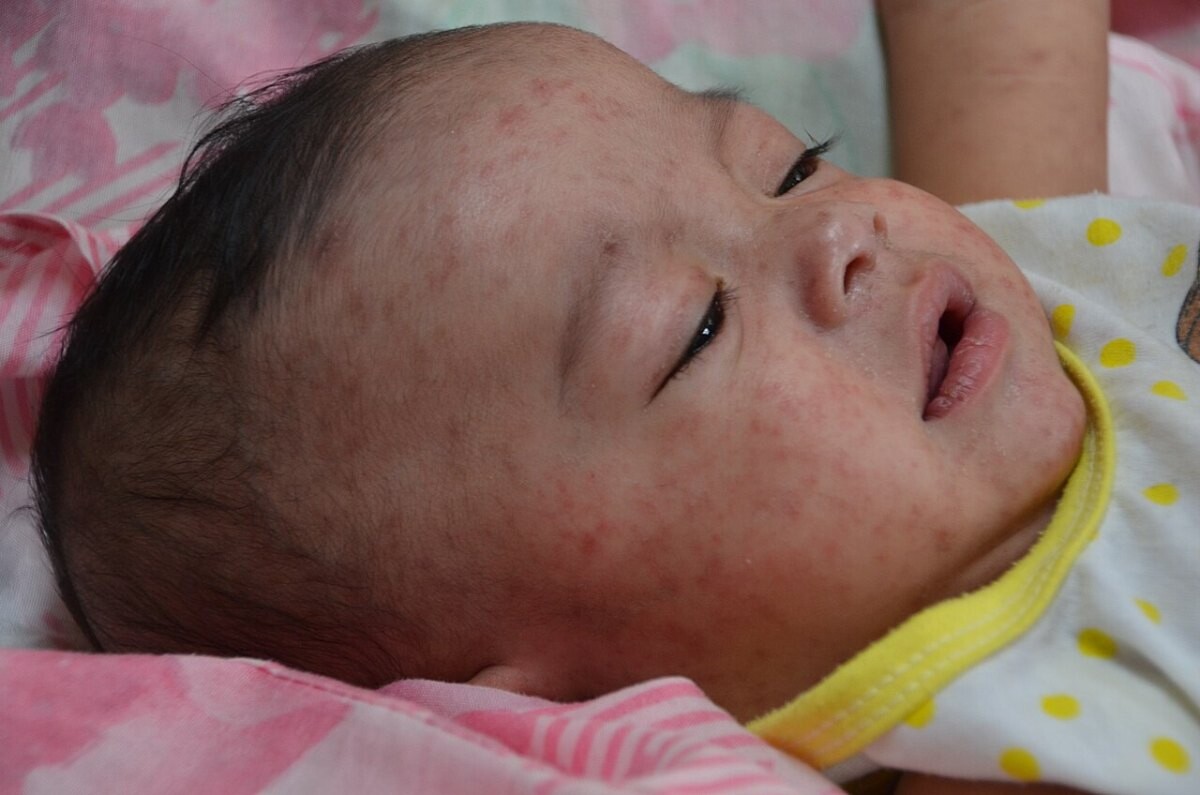
Trend summary
- Diseases that vaccines had pushed to the margins are back in Britain, while some others are falling.
- England recorded 2,911 measles cases in 2024, the most since 2012, and 736 in the first five months of 2026, with two child deaths. The WHO has confirmed the UK has lost its measles-elimination status.
- Whooping cough hit a record 14,879 cases in England in 2024, with 11 infant deaths.
- Other trends are better: new sexually transmitted infections fell 8.3% in 2025 and TB cases levelled off.
What the numbers show
Measles cases in England rose from 91 in 2015 to 2,911 in 2024 before falling to 960 in 2025 (UKHSA). Based on the 2024 outbreak, the WHO judged that measles was spreading endemically again, and the UK lost its elimination status for the second time. Whooping cough reached 14,879 confirmed cases in 2024, 59% above the previous peak in 2012.
Elsewhere the picture is better. TB notifications were 5,424 in 2025, down 1.1%, and new STI diagnoses fell 8.3% to 334,151. Antibiotic resistance is moving the wrong way: 20,484 resistant bloodstream infections in 2024, nearly 400 a week.
What is driving it
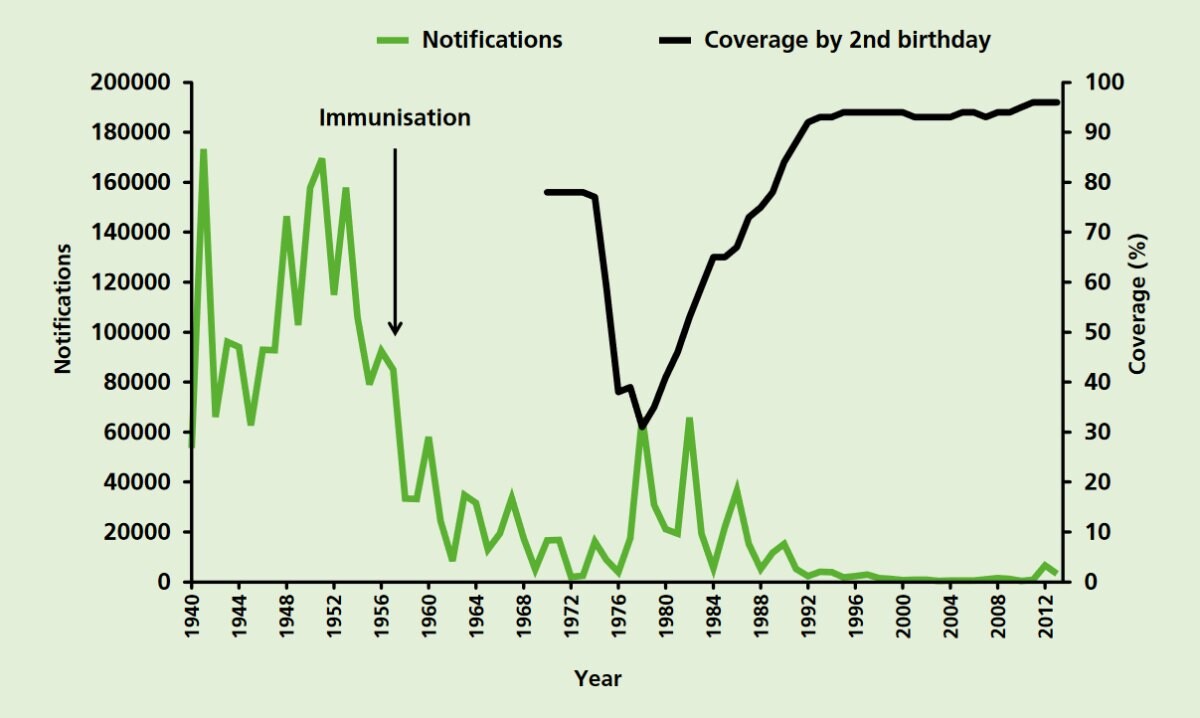
Vaccine coverage has slipped. In 2024-25, 88.9% of two-year-olds had a first MMR dose and 83.7% of five-year-olds had both, well below the 95% needed to stop measles spreading and down from peaks in 2015-16 (COVER data). Whooping cough peaks every three to five years, and the 2024 epidemic hit babies hardest where mothers had not been vaccinated in pregnancy: 26 of 32 infant deaths since 2012 were in that group.
Policy and budget changes
The main government measures and money figures behind this risk, newest first. Each item links to the official text we checked; where only a news report was available, the source says so.
Main policy changes
- 1 January 2026 MMRV replaces MMR; second dose moved to 18 months. The childhood schedule changed so that the MMRV vaccine, which adds chickenpox protection, replaced MMR, and the second dose moved from 3 years 4 months to a new 18-month appointment for children born on or after 1 July 2024. (UK Health Security Agency (blog.gov.uk))
- 4 August 2025 England: first national gonorrhoea vaccination programme. England: sexual health clinics began offering the 4CMenB vaccine free to people at highest risk of gonorrhoea, such as gay and bisexual men with multiple recent partners and a recent bacterial STI. (Department of Health and Social Care / UKHSA (GOV.UK))
- 1 July 2025 Infant MenB and pneumococcal doses rescheduled. The second MenB dose for babies moved earlier, from 16 to 12 weeks, and the first pneumococcal dose moved from 12 to 16 weeks, the first step in a wider reshaping of the childhood schedule. (UK Health Security Agency (blog.gov.uk))
- 1 September 2024 RSV vaccination begins for pregnant women and over-75s. New NHS programmes against respiratory syncytial virus (RSV) began, offering a single dose to women from 28 weeks of pregnancy to protect newborns, and to adults turning 75, with a catch-up for those aged 75 to 79. (UKHSA and NHS England (GOV.UK))
- 8 May 2024 Five-year national action plan on antimicrobial resistance. The government published the UK’s 2024 to 2029 national action plan on antimicrobial resistance, aiming to cut inappropriate antibiotic use in people and animals, strengthen surveillance and widen the subscription model for new antibiotics. (Department of Health and Social Care (GOV.UK))
- September 2019 HPV vaccine extended to boys. Boys in school year 8 (aged 12 to 13) began to be offered the HPV vaccine free in England, as girls already were, to prevent HPV-related cancers. (Public Health England (GOV.UK))
Budget and costs
- 28 January 2025 Infections take a fifth of hospital bed days: £5.9bn. A UK Health Security Agency board paper estimated that over 20% of secondary care bed days in England in 2023/24 were due to infectious disease or infections, at a cost to the NHS of £5.9 billion. That excludes GP care and wider economic costs. (UK Health Security Agency, Advisory Board paper (GOV.UK))
- 16 May 2024 Up to £85m to fight antibiotic resistance abroad. The government pledged up to £85 million to help other countries tackle antimicrobial resistance, including up to £50 million in Africa and up to £25 million covering the Caribbean. This followed £210 million invested in 2022 through partnerships across Asia and Africa. (Department of Health and Social Care (GOV.UK))
Recent cases
- 11 June 2026: UKHSA confirms two measles deaths in children in 2026, with 736 cases in England by 8 June (UKHSA).
- 26 January 2026: the WHO confirms the UK has lost its measles-elimination status (LSHTM).
- July 2025: a child dies of measles at Alder Hey Children’s Hospital in Liverpool during an outbreak in the North West (Redbridge Council).
Our read: what the numbers add up to
The overall picture is mixed, and it would be wrong to call it a general rise in infection. What has clearly turned is the group of diseases that childhood and maternal vaccines keep in check. Measles went from 91 cases in 2015 to 2,911 in 2024, enough for the WHO to judge it endemic again, and whooping cough reached a record 14,879 cases, 59% above the previous peak. Meanwhile new STI diagnoses fell 8.3% to 334,151 in 2025 and TB notifications slipped 1.1% to 5,424.
Read together, the coverage figures explain most of the measles story. With 83.7% of five-year-olds fully protected against a 95% threshold, and coverage down from peaks in 2015-16, outbreaks become a question of when rather than if. The fall to 960 cases in 2025 probably reflects the lull that follows a large outbreak rather than real recovery, and 736 cases by 8 June 2026, with two child deaths, suggests that lull is ending. Whooping cough is partly cyclical, peaking every three to five years, but the fact that 26 of 32 infant deaths since 2012 were in babies whose mothers had not been vaccinated in pregnancy shows where the harm concentrates. Antibiotic resistance is the slower, quieter problem: 20,484 resistant bloodstream infections and 2,379 deaths in 2024.
The caveats: the 2026 figures cover only part of the year, and the STI and TB improvements are single-year changes that can reverse. What would confirm or change the reading is the next round of COVER data; if MMR coverage does not climb back towards 95%, I would expect further measles waves. My bottom line is that the UK’s infection risk has not broadly worsened, but the vaccine-preventable part of it has, and that is also the part most within reach to fix.
Press releases and official reports, 2023–2026
Five key releases a year for the last four years, newest first. Most come from UK government departments, regulators, accident investigators and national statistics; a few news reports are included where they are the clearest public record of an event. Releases from 2007–2022 are in the expandable list after 2023.
2026
- 11 Jun 2026UKHSALatest measles figures published as two deaths confirmed in 2026
- 2 Jun 2026UKHSASTIs fall with syphilis among gay and bisexual men lowest in a decade
- 28 May 2026UKHSASalmonella cases in England at a decade high
- 16 Mar 2026UKHSACases of invasive meningococcal disease notified in Kent
- 29 Jan 2026UKHSATuberculosis notifications in England stabilise in 2025
2025
- 22 Dec 2025UKHSALaboratory confirmed cases of pertussis in England: annual report for 2024
- 13 Nov 2025UKHSANearly 400 antibiotic-resistant infections each week in 2024
- 11 Nov 2025UKHSAFlu vaccine providing important protection despite new subclade
- 29 Aug 2025DHSC & UKHSAFree chickenpox vaccination offered for first time to children
- 31 Jul 2025UKHSALatest data shows measles cases remain high
2024
- 30 Oct 2024UKHSANew mpox strain identified in England
- Sep 2024NHS EnglandLandmark moment as NHS kicks off first ever RSV jab rollout
- 18 Jul 2024UK Covid-19 InquiryModule 1 Report – The resilience and preparedness of the United Kingdom
- 9 May 2024UKHSAWhooping cough cases continue to rise
- 19 Jan 2024UKHSAMeasles outbreak could spread warns UKHSA Chief Executive
2023
- 27 Nov 2023UKHSAUKHSA detects human case of influenza A(H1N2)v
- 22 Sep 2023UKHSATuberculosis (TB) cases continue to rise in England in 2023
- 15 Sep 2023UKHSAUniversity freshers urged to use condoms amid record levels of gonorrhoea
- 14 Jul 2023UKHSALondon at risk of measles outbreaks with modelling estimating tens of thousands of cases
- 23 Mar 2023UKHSAPolio vaccine catch-up campaign for London as sewage surveillance findings suggest reduced transmission
View 20 years of major UK infectious disease press releases (2007–2026)79 more from 2007–2022, up to five a year, newest first
2022
- 8 Dec 2022UKHSAUKHSA publishes strategy outlining plans to eliminate mpox transmission
- 2 Dec 2022UKHSAUKHSA update on scarlet fever and invasive group A strep
- 22 Jun 2022UKHSAPoliovirus detected in sewage from North and East London
- 14 May 2022UKHSAMonkeypox cases confirmed in England – latest updates
- 21 Feb 2022Prime Minister's OfficePrime Minister sets out plan for living with COVID
2021
- 27 Nov 2021DHSCFirst UK cases of Omicron variant identified
- 1 Oct 2021UKHSAUK Health Security Agency launches with a relentless focus on keeping the nation safe
- 12 Jul 2021Prime Minister's OfficePrime Minister confirms move to Step 4
- 22 May 2021PHEVaccines highly effective against B.1.617.2 variant after 2 doses
- 4 Jan 2021Prime Minister's OfficePrime Minister announces national lockdown
2020
- Dec 2020NHS EnglandLandmark moment as first NHS patient receives COVID-19 vaccination
- 2 Dec 2020MHRAUK medicines regulator gives approval for first UK COVID-19 vaccine
- 28 Aug 2020ONSDeaths involving COVID-19 by local area and socioeconomic deprivation: deaths occurring between 1 March and 31 July 2020
- 23 Mar 2020Prime Minister's OfficePrime Minister's statement on coronavirus (COVID-19): 23 March 2020
- 31 Jan 2020DHSCCMO confirms cases of coronavirus in England
2019
- 31 Oct 2019PHE165 new antibiotic resistant infections every day in England
- 19 Aug 2019PHEAn estimated one in seven 5 year olds not immunised against MMR
- 7 Jun 2019PHEListeria cases being investigated
- 4 Jun 2019PHEPeople urged to practise safer sex after rise in STIs in England
- 9 Jan 2019PHENew strategy for a measles and rubella free future
2018
- 8 Sep 2018PHEMonkeypox case in England
- 23 Aug 2018PHEMERS-CoV case in England
- 11 May 2018PHEMeasles outbreaks across England
- 28 Mar 2018PHEResistant gonorrhoea case demonstrates importance of safe sex
- 23 Mar 2018PHETuberculosis (TB) cases fall by over a third in last 6 years
2017
- 22 Dec 2017PHEShingles vaccine programme reduces cases and chronic complications
- 24 Oct 2017PHETaking antibiotics when you don't need them puts you at risk
- 18 Oct 2017PHEIncrease in cases of Legionnaires' disease in Palmanova, Mallorca
- 20 Sep 2017PHELondon turns the tide on an 8 year surge of gonorrhoea
- 28 Mar 2017PHEEngland world leaders in the use of whole genome sequencing to diagnose TB
2016
- 17 Aug 2016PHEPHE publishes report on syphilis
- 10 Aug 2016PHECyclospora outbreak linked to Mexico
- 5 Jul 2016PHEE. coli O157 national outbreak update
- 5 Jul 2016PHENew STI figures show continued increases among gay men
- 17 Apr 2016PHESafe sex reminder as antibiotic resistant gonorrhoea investigations continue
2015
- 16 Dec 2015PHEMeningococcal disease cases peak in winter: PHE urges vaccination
- 1 Oct 2015PHETB rates in England continue to decline
- 3 Sep 2015PHENew whooping cough figures prompt call for pregnant women to get immunised
- 28 Aug 2015PHENational childhood immunisation programme boosted by MenB vaccine
- 7 Jan 2015Department of HealthHealth minister updates Parliament on UK's preparedness for Ebola
2014
- 18 Nov 2014PHEHIV infections continue to rise
- 25 Sep 2014PHESmall decrease, but TB rates remain unacceptably high
- 23 Aug 2014Department of HealthEbola: Department of Health statement
- 15 Aug 2014PHEPHE investigating national outbreak of Salmonella
- 3 Jul 2014PHECrimean-Congo haemorrhagic fever case identified in UK
2013
- 4 Dec 2013PHELevels of healthcare-acquired MRSA and C. difficile infections remain stable
- 26 Sep 2013PHEHighest MMR vaccine coverage in 25 years
- 10 Sep 2013Department of HealthUK 5 Year Antimicrobial Resistance Strategy 2013 to 2018
- 25 Apr 2013PHE / NHS England / DHNational MMR vaccination catch-up programme announced in response to increase in measles cases
- 9 Apr 2013PHEMeasles at highest level for 18 years
2012
- 27 Dec 2012Department of HealthCampaign warns people to 'Catch it. Bin it. Kill it' to stop the spread of flu
- 16 Nov 2012Department of HealthAntibiotic resistance poses alarming threat
- 10 Nov 2012Department of HealthBabies to be protected against common diarrhoea bug
- 28 Sep 2012Department of HealthPregnant women to be offered whooping cough vaccination
- 25 Jul 2012Department of HealthFlu vaccination programme extended to all children
2011
- 16 Nov 2011Department of HealthFurther advice needed on vaccinating healthy children against flu
- 10 Nov 2011Department of HealthUK one of best prepared for pandemic
- 3 Oct 2011Department of HealthWinter flu vaccination programme begins
- 18 May 2011FCOTravel health advice on dengue fever and chikungunya
- 8 Mar 2011Cabinet OfficePublication of independent review into the response to the 2009 swine flu pandemic
2010
- 16 Dec 2010Department of HealthFlu vaccination for pregnant women: letter to the Royal College of Midwives and the Royal College of Obstetricians and Gynaecologists
- 3 Dec 2010Department of HealthPandemic influenza preparedness programme: Statistical Legacy Group – a report for the Chief Medical Officer
- 28 Sep 2010Department of HealthDealing with delays in deliveries of flu vaccine, winter 2010
- 1 Jul 2010Cabinet OfficeIndependent review into the response to the 2009 swine flu pandemic
- 1 Jul 2010Department of HealthLessons Learned From The H1N1 (swine flu) Pandemic
2009
- 16 Oct 2009Department of HealthGovernment response to the House of Lords Science and Technology Committees on Pandemic Influenza
- 15 May 2009PHE (originally DH)Measles: Don't let your child catch it
- 1 May 2009Communities and Local GovernmentFaith communities and pandemic flu: guidance
- 27 Mar 2009Department of HealthPandemic flu: guidance for businesses
2008
- 2 Nov 2008HPA (now UKHSA)PVL-Staphylococcus aureus infections: diagnosis and management
- 28 May 2008HPA (now UKHSA)Mumps: risk in pregnancy, infection in healthcare settings and MMR vaccine
- 19 May 2008Cabinet OfficePlanning for a possible flu pandemic: a framework for planners preparing to manage deaths
- 15 Apr 2008Department of HealthPandemic flu infection control: intensive care units
- 4 Mar 2008Department of HealthThe benefits of microfibre cloth and steam cleaning technology
2007
- 3 Dec 2007Cabinet OfficePreparing for pandemic flu: 2007 guidance for local planners
- 22 Nov 2007HPA (now PHE page)Respiratory viruses
- 15 Aug 2007Department of HealthTuberculosis – the disease, its treatment and prevention
- 1 Jul 2007HPA (now UKHSA)Norovirus: managing infection in cruise ships
- 16 Mar 2007Department of HealthNew healthcare workers: clearance for hepatitis B and C, TB, HIV
Some early years list fewer than five items. Many UK government releases from that period are no longer online at their original addresses, and we only list items we could open and check.
Photo list
How this page is built. Figures come from the official statistical releases linked above; where agencies publish provisional numbers we say so, because they are revised. UK statistics are often published separately for England, Wales, Scotland and Northern Ireland, so we say which area each figure covers. Photos are public-domain, Creative Commons or Open Government Licence images credited in each caption; file photos are illustrative and are not from the events described unless the caption says so. This page tracks trends and is not personal safety, medical, legal or financial advice.