
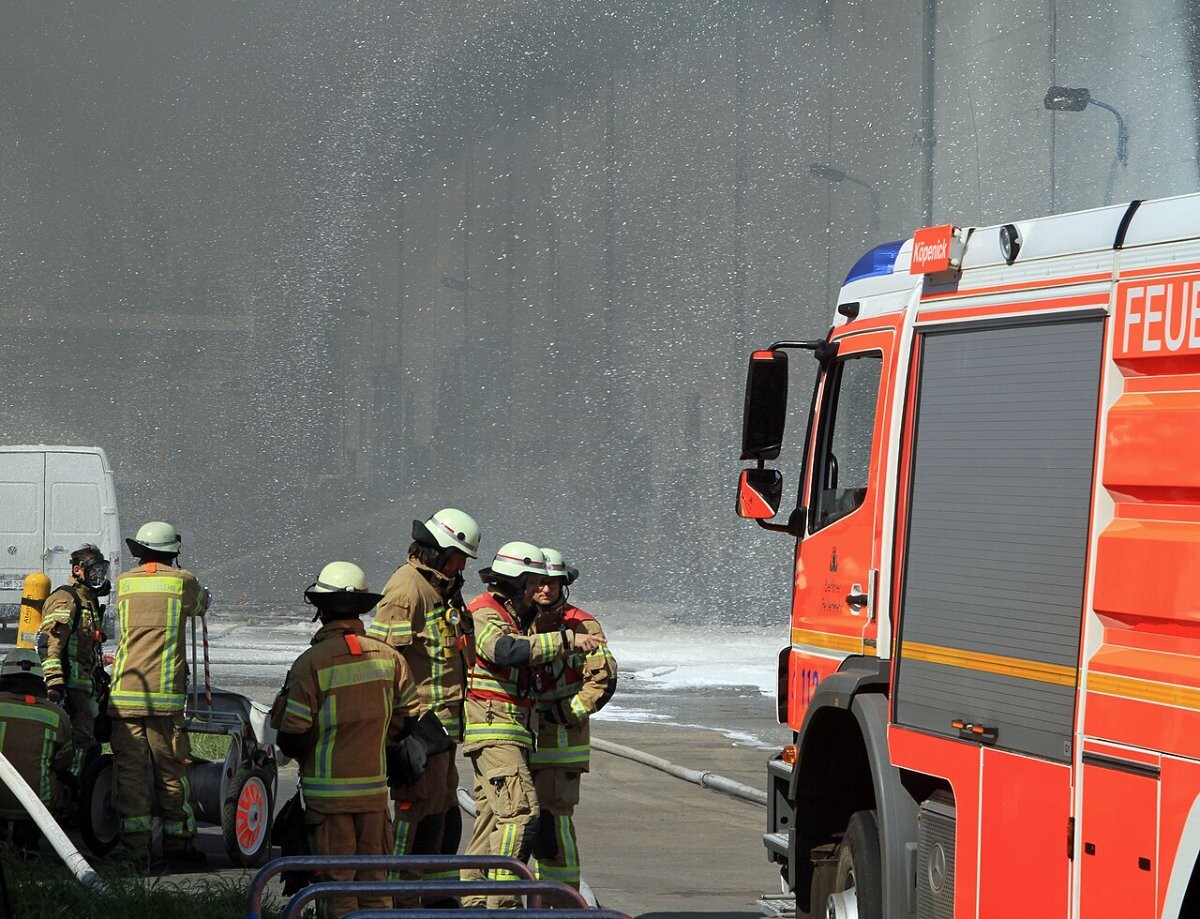
Trend summary
- Germany has far fewer deadly fires than a generation ago, but each building fire now costs more, large industrial fires have become more expensive, and 2024–2026 brought a run of deadly fires in hospitals and care homes.
- Home and building insurers paid €2.2 billion for about 320,000 fire claims in 2024, up from just over €1.5 billion for about 350,000 claims in 2019 (GDV, the German insurers’ association).
- Large fire losses (over €1 million each) cost insurers €1.7 billion in 2023, a provisional figure, with 21 fires costing more than €20 million each, against 4 in 2022 (GDV).
- Hospital and care-home fires killed at least four people in Uelzen (January 2024), three in Hamburg (June 2025) and two in Ludwigslust (July 2026); a care-home fire in Berlin-Kreuzberg in September 2026 killed one and injured at least 25.
What the numbers show
Germany has no single national count of building fires. Each federal state (Land) runs its own fire services, so the clearest nationwide picture comes from insurers and from the cause-of-death statistics. The German insurers’ association GDV says household contents and residential building insurers paid about €2.2 billion for some 320,000 fire claims in 2024 (GDV, November 2025, in German). Its earlier releases give about 350,000 claims and just over €1.5 billion for 2019, about 300,000 and €1.6 billion for 2020, about 330,000 and just under €1.6 billion for 2021, and about 280,000 and about €2 billion for 2022. The number of fires has moved up and down, but the bill has risen steadily: the extra fires around Advent and Christmas cost a record average of €4,900 each in 2024, which the GDV puts down mainly to costly apartment fires.
Large fires in factories and businesses swing the totals. The GDV’s damage-prevention report puts large fire losses (each over €1 million, adjusted for inflation) at a provisional €1.7 billion in 2023, above the 20-year average of €1.5 billion and well up on €1.0 billion in 2022. The costliest single fire in 2023, at a precision metalworking plant, cost €175 million, and 21 fires each cost more than €20 million (GDV report 2023/2024, in German). Deaths have fallen over the long run: the Federal Statistical Office (Destatis) recorded 343 deaths from smoke, fire and flames in 2019, down 56% from 766 in 1980 (FeuerTrutz, citing Destatis, in German). The fire-protection association vfdb now collects detailed reports of building fire call-outs from fire brigades to fill the gaps in official data (FeuerTrutz, September 2025, in German).
What is driving it
For businesses, the cost of a fire is driven by lost production as much as by the damage itself. The GDV warns that fires in recycling plants and refuse lorries are rising, partly because lithium-ion batteries thrown away with other waste catch fire when crushed (GDV, April 2025, in German). In September 2026 investigators blamed a battery for a fire at a recycling yard in Herdecke (WDR, in German), and a fire on an industrial estate in Freiburg in October 2025 destroyed about 60,000 square metres of businesses and caused at least €50 million of damage (TÜV SÜD review of 2025, in German).
The deadliest recent fires have hit buildings where people cannot easily escape on their own. After three people died in a fire at Hamburg’s Marienkrankenhaus in June 2025, experts asked whether hospitals should fit sprinklers (Der Spiegel, in German); after a fatal fire in a Reutlingen care home in January 2023, the patient protection foundation Stiftung Patientenschutz said there had been more than 140 fires in care homes for older people in 2022, killing 16 residents, and called for sprinklers (Der Spiegel, in German). High-rise safety has been checked since the Grenfell Tower fire in London in 2017: Wuppertal emptied a tower with a flammable facade in June 2017, Dortmund cleared the 800-resident Hannibal complex that September and Duisburg cleared two towers in 2019 (DW). The federal building minister asked the states to find buildings at risk, and a list was passed to the Conference of State Building Ministers (Bauministerkonferenz) (WirtschaftsWoche, in German).
Recent cases
- 1 October 2026: after a fire destroyed the vehicle hall of the volunteer fire brigade in Offenbach an der Queich, with seven vehicles lost and damage estimated at €5 million, it emerges that the hall had no fire detectors (SWR, in German).
- 19 September 2026: a man dies and at least 25 people are injured, most with smoke poisoning, when fire breaks out in a patient’s room at a care facility in Berlin-Kreuzberg; about 160 firefighters attend (rbb24, citing Berlin Fire Brigade, in German).
- 2 July 2026: two patients die when fire breaks out in a room at the Helene von Bülow hospital in Ludwigslust and spreads into the roof; many patients and staff are evacuated (DW).
Press releases and official reports, 2023–2026
Five key releases a year for the last four years, newest first. Most come from German federal and state government agencies, regulators, accident investigators and national statistics; a few news reports are included where they are the clearest public record of an event. Many official releases are published only in German; for those we give an English translation of the title and mark the link (in German). Releases from 2007–2022 are in the expandable list after 2023.
2026
- 1 Oct 2026SWRNo fire detectors in Offenbach fire brigade’s vehicle hall (in German)
- 19 Sep 2026rbb24Man dies in fire at care facility in Kreuzberg, at least 25 injured (in German)
- 25 Aug 2026DGUV“Don’t let anything catch fire”: teach fire risks from the start of vocational training (in German)
- 2 Jul 2026DWHospital fire in northern Germany kills two
- 29 Apr 2026DWFiretrucks swarm Cologne Cathedral after smell of smoke
2025
- 27 Nov 2025GDVInsurers warn of fire damage in the Advent and Christmas season, with average claim at a record level (in German)
- 12 Aug 2025Der TagesspiegelInvestigation after major operation: cause of the big fire at the Grunewald blasting site remains unclear (in German)
- 30 Jul 2025ZDFheuteSolingen arson attack: maximum sentence for the defendant (in German)
- 1 Jun 2025DWThree dead in fire at Hamburg hospital (in German)
- 25 Apr 2025GDVFire protection: GDV guide helps recycling firms manage risk (in German)
2024
- Sep 2024GDVDamage prevention in property insurance 2023/2024 (in German)
- 6 Jun 2024Der SpiegelOyten, Lower Saxony: two dead in care home fire (in German)
- 27 Mar 2024DWSolingen house fire was arson, prosecutors say
- 18 Jan 2024Kölner Stadt-AnzeigerLeverkusen: Currenta explosion now being investigated from Dortmund (in German)
- 5 Jan 2024Der SpiegelUelzen: at least four people die in hospital fire, many injured (in German)
2023
- 29 Nov 2023GDVTake care in Advent: fire risk rises again (in German)
- 4 Aug 2023Der SpiegelGroßröhrsdorf: fire almost completely destroys baroque church in Saxony (in German)
- 29 Jul 2023DWBerlin police probes arson after 2 jumped from building
- 17 Apr 2023Düsseldorf University HospitalFire in an operating room at Düsseldorf University Hospital (in German)
- 18 Jan 2023Der SpiegelReutlingen: patient protection foundation calls for sprinklers in care homes (in German)
View 20 years of major German building fire press releases (2007–2026)46 more from 2007–2022, up to five a year, newest first
2022
- 23 Nov 2022GDVInsurers count fewer fires in the Advent season (in German)
- 7 Nov 2022FeuerTrutzAnalysis of fire death trends in Germany (in German)
- Oct 2022DGUVIndispensable for fire safety at work (in German)
- 4 Aug 2022DWBerlin: Fire at police munitions facility in Grunewald
- Jul 2022GDVDamage prevention in property insurance 2021/2022 (in German)
2021
- 1 Dec 2021GDVFires increase in the Advent and Christmas season (in German)
- 4 Aug 2021Chemie TechnikAnother body found after explosion in Leverkusen (in German)
- 28 Jul 2021DWToxic smoke after explosion in Leverkusen? (in German)
- 16 Jun 2021DGUVFirefighting at real fires assessed as safe (in German)
- 9 Mar 2021GDVElectric cars in underground car parks: no higher fire risk found (in German)
2020
- 24 Nov 2020GDVMore fires in the Advent and Christmas season (in German)
- Jun 2020GDVDamage prevention in property insurance 2019/2020 (in German)
- 11 May 2020FeuerTrutzReport on the vfdb fire damage statistics (in German)
- 19 Feb 2020MerkurKrefeld ape house: shocking details of the New Year’s Eve fire disaster (in German)
- 30 Jan 2020Westdeutsche ZeitungRuling: Wuppertal high-rise evacuation was lawful (in German)
2019
- 13 Apr 2019DW11,519 defects and dangerous plastic wall plugs (in German)
- 15 Feb 2019DWFire risk prompts high-rise evacuations
2017
- 3 Dec 2017DWFour dead in house fire in Saarbrücken (in German)
- 21 Sep 2017DWApartment complex evacuated in Dortmund
- 10 Jul 2017WirtschaftsWocheFacade fires: low-rise homes are at risk too (in German)
- 29 Jun 2017DemoWhy the city of Wuppertal is evacuating a high-rise (in German)
- 27 Jun 2017DWWuppertal high-rise at risk because of its insulation (in German)
2016
- 17 Oct 2016DWAt least 2 dead following explosion at German BASF plant
- 17 Sep 2016DWFire injures five in Germany migrant home
- 12 Sep 2016DWArsonists target refugee homes
- 16 Mar 2016DWRespectable citizens as arsonists (in German)
- 4 Mar 2016DWArson attack in Nauen: NPD member under suspicion (in German)
2015
- 7 Sep 2015DWMore fires in refugee accommodation (in German)
- 21 Aug 2015DWOvernight arson attacks target refugee shelters
- 4 Aug 2015DWHigh-rise bunker in flames (in German)
- 18 Jul 2015DWTwo fires in one night (in German)
- 5 Apr 2015DWDay two after the Tröglitz fire (in German)
2014
- 25 Jun 2014DWGermany’s most embarrassing building site (in German)
- 12 May 2014Der SpiegelBacknang fire with eight dead: investigation closed (in German)
2013
- 10 Mar 2013DWApartment fire kills eight
- 10 Mar 2013Der SpiegelEight dead in major fire in Backnang (in German)
- 9 Jan 2013DWFlight canceled
2012
- 1 Dec 2012DWFire victims remembered
- 27 Nov 2012DWDeadly fire caused by gas leak
- 26 Nov 2012DWWorkshop fire kills 14
- 14 Aug 2012DWAirport opening still unclear (in German)
- 31 Mar 2012DWExplosion rocks chemical park in the Ruhr (in German)
2008
- 23 Jul 2008Der TagesspiegelInvestigation closed: cause of the Ludwigshafen fire remains unclear (in German)
- 7 Feb 2008DWRace relations
- 6 Feb 2008Der SpiegelLudwigshafen fire disaster: police find Nazi slogans on the burnt-out building (in German)
- 4 Feb 2008Der SpiegelHouse fire in Ludwigshafen: “pure panic on their faces” (in German)
Some early years list fewer than five items. Many older German government releases are no longer online at their original addresses, and we only list items we could find and check.
Photo list
How this page is built. Figures come from the official statistical releases linked above; where agencies publish provisional numbers we say so, because they are revised. German statistics are often published separately by each federal state (Land) and some only in German, so we say which area and period each figure covers and translate titles. Photos are public-domain or Creative Commons images credited in each caption; file photos are illustrative and are not from the events described unless the caption says so. This page tracks trends and is not personal safety, medical, legal or financial advice.