Lithium-Ion Battery Fires at Home: What the Research Actually Shows
In This Series: Home Hazards & Indoor Environment
- The Safe Level of Air Pollution Keeps Moving Down
- The Mould Is Not the Problem. The Water Is.
- Nine Million Homes Still Drink Through a Lead Pipe
- It Looks Exactly Like Flu, Except for the Fever
- The Leading Cause of House Fires Is a Pan Nobody Is Watching
- Your Gas Stove and the Air in Your Kitchen: What the Measurements Found
- Power Outages Are Getting Longer. The Generator Is the Dangerous Part.
Disclosure: this article contains affiliate links, marked (paid link). If you buy through one we may earn a commission, at no extra cost to you. As an Amazon Associate I earn from qualifying purchases. It does not change what we recommend — here is how that works.
Key takeaways · 12 min read
- Roughly half of reported incidents happened while the battery was charging.
- From first visible smoke to an unsurvivable room: about 30 seconds.
- Certification is the intervention with the clearest evidence behind it — New York’s deaths fell from 18 to 1 in two years.
- You cannot guarantee a cell never fails. You can decide where it is standing when it does.
At about a quarter past midnight on 26 June 2026, firefighters were called to a basement apartment on 91st Avenue in Jamaica, Queens. An e-bike battery had been left charging indoors. Five people were hurt. A 48-year-old man died in hospital roughly two weeks later.
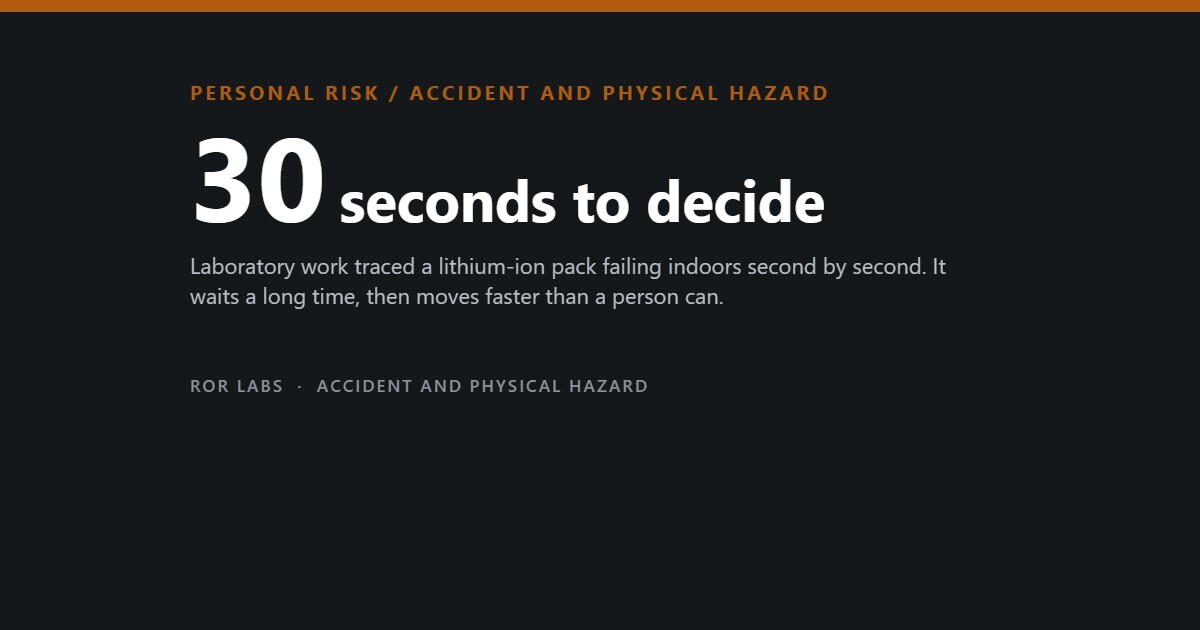
It is the kind of story that reads like bad luck. It is not. Laboratory work published in the past eighteen months has traced, second by second, exactly what happens when a lithium-ion pack fails indoors — and the picture it produces is uncomfortably specific. The fire does not creep. It waits a long time, then moves faster than a person can.
This is what the research, the incident databases and the fire services actually show, and what follows from it for anyone who charges a battery in the place they sleep.

What happens in the room: the 30 seconds that decide everything
The most useful evidence does not come from news footage. It comes from a series of full-scale experiments run by the Fire Safety Research Institute (FSRI) with the Fire Department of the City of New York, published in Fire Technology in 2025. Researchers drove e-scooter battery packs into thermal runaway — by overcharging them and by heating them externally — inside an instrumented residential structure, and measured what happened to the room and to anyone in it.
Two findings matter more than the rest.
The failure takes a long time to arrive. In one experiment, a scooter left on an overcharge did not reach thermal runaway until roughly an hour and fifty minutes in. A standalone pack heated externally took about 45 minutes; another, overcharged, about 65 minutes. For most of that period there is nothing to see, smell or hear. The device simply sits there.
Then it arrives all at once. Once smoke became visible, the researchers recorded ignition of the vented gas about 13 seconds later. In the closed-bedroom scenario, roughly 20 seconds separated the first visible smoke from a battery-gas explosion that blew out the bedroom windows, and flashover — the point at which the whole room ignites and survival is no longer possible — occurred within 30 seconds of that first smoke. In the living-room scenario, sustained battery gas ignited within about 10 seconds and the pressure rise failed the window frames.
The authors put the consequence plainly: occupants may not be able to react fast enough to escape.
From first smoke to unsurvivable: about 30 seconds
Sequence recorded in FSRI/FDNY full-scale experiments on e-scooter battery packs in thermal runaway
Source: Fire Safety Research Institute & FDNY, “Quantifying the Fire Hazard from Li-Ion Battery Fires Caused by Thermal Runaway in E-scooters,” Fire Technology (2025), doi:10.1007/s10694-025-01707-z
A companion paper published in Fire Technology in February 2026 tested the same scenarios in a sprinklered home. Sprinklers did not stop the battery from failing — nothing in the room can — but after activation they prevented flashover and kept the fire from spreading to the rest of the room’s contents. The fire stayed where it started. That is the difference between a destroyed device and a destroyed household.
What the incident data counts
In June 2026 the U.S. Consumer Product Safety Commission proposed making battery safety standards mandatory for micromobility products. The rulemaking notice contains the clearest national picture available: between 2019 and 2023 the agency logged 227 incidents involving lithium-ion battery failures in these products, with 39 deaths and 181 injuries. Fire was involved in 86% of them, and every one of the 39 deaths came from a fire.
The detail that should change your behaviour is this one: 120 of those 227 incidents happened while the battery was charging. Those charging incidents alone account for 18 deaths and 102 injuries.
Half of all reported incidents happened while the battery was charging
U.S. micromobility lithium-ion battery incidents reported to the CPSC, 2019–2023
Source: U.S. Consumer Product Safety Commission, notice of proposed rulemaking, 91 FR 38162 (24 June 2026)
The trend is not flattening. FDNY reported 235 lithium-ion battery fires in the first seven months of 2026, against 138 in the same period of 2025 — a 70% increase, and the highest the city has recorded. London Fire Brigade attended 206 e-bike and e-scooter fires in 2025, also a record, of which 171 involved e-bikes.
Fires are up 70% in New York — and the growth is happening outdoors
FDNY lithium-ion battery fire responses, January–July
Source: FDNY, reported July 2026
London recorded 206 e-bike and e-scooter fires in 2025
Fires attended by London Fire Brigade, by device type
Source: London Fire Brigade, published 28 January 2026
The paradox: more fires, far fewer deaths
Here is the part that gets lost in the headlines. While New York’s fire count climbed, its death toll collapsed — from 18 deaths in 2023 to one in 2025.
New York City battery-fire deaths fell 94% in two years
Deaths from lithium-ion battery fires, New York City, by year
Source: UL Standards & Engagement, using FDNY data (2026)
Two things changed. New York’s Local Law 39 of 2023 made it illegal to sell, lease or distribute e-mobility devices in the city unless they meet recognised safety standards — UL 2849 for e-bike electrical systems, UL 2272 for other personal e-mobility devices, and UL 2271 for the battery packs themselves. The city paired enforcement with public charging pilots and a trade-in scheme that let delivery riders swap uncertified devices for certified ones.
And the fires moved. FDNY’s outdoor, non-structural battery fires jumped from 48 to 137 year on year, and the city’s chief fire marshal has pointed to where these fires happen as the biggest change. A battery that fails on a sidewalk injures nobody. The same battery failing beside a bed kills.
That is the whole lesson of the last three years compressed into one sentence: you probably cannot stop a bad cell from failing, but you have almost complete control over where it is when it does.
What to actually do at home
1. Move the charging spot before you buy anything

This is free and it is the single highest-value change. FDNY’s guidance is specific: plug the charger directly into a wall outlet rather than an extension lead or power strip; charge outdoors if you have any option to; never charge in a bedroom; and keep the device away from your apartment door, bedroom doors, and windows that open onto a fire escape.
The logic follows straight from the experiments. A pack that fails 30 seconds from unsurvivable does not give you time to solve a problem — it gives you time to leave. Anything that sits between you and the door is the wrong place.
Charge where a failure costs you a floor, not an exit
Fire-service guidance on where a lithium-ion battery should and should not charge
Source: FDNY, “Be FDNYSmart” lithium-ion battery guidance
2. Buy certification, not features
New York’s death curve is the closest thing we have to a controlled experiment on consumer batteries, and what it tested was certification. The CPSC’s proposed federal rule would extend the same three standards nationwide. Until it does, the certification mark is doing the work of a regulation that does not exist yet.
- UL 2849 — the complete electrical system of an e-bike, including charger and battery together.
- UL 2272 — electrical systems for scooters, hoverboards and other personal e-mobility devices.
- UL 2271 — the battery pack itself, including user-replaceable packs.
Two practical rules follow. Use the charger and adapter that came with the device — mismatched chargers are heavily represented in incident reports. And treat a cheap replacement pack from a marketplace listing as the single riskiest object in your home; a battery is not a commodity part.
Making the charging spot survivable (paid link)
None of this stops a cell from failing. It changes what the failure lands on.
The one we are not linking to: the charger and the battery pack themselves. Use the charger that came with the device, and buy replacement packs from the manufacturer — mismatched chargers and marketplace packs are exactly what the incident reports are full of. That advice is worth more than a commission.
3. Put the alarm where the battery is
A smoke alarm cannot outrun a 30-second flashover from across the apartment, but one directly above the charging area gives you the seconds that matter. If your device charges in a garage, hallway or utility space with no alarm in it, that gap is the most consequential one in your home.
The sprinkler study is worth remembering here too: where a residential sprinkler was present, the fire stayed in its room. Most homes will never retrofit sprinklers, but for anyone building or renovating, that finding is a straightforward argument.
Detection and escape (paid link)
Thirty seconds is enough time to leave, and only if something wakes you.
A pack in thermal runaway makes its own oxygen. No extinguisher on this list will put one out — they buy you a path to the door, which is the only thing you need.
We have removed the suppression products that used to be linked here. A lithium-ion cell in thermal runaway supplies its own oxygen, burns far above the temperature a domestic extinguisher or blanket is rated for, and can reignite after it appears out. The correct response is to leave and call the fire service, so we are not selling equipment that implies you should stay and fight it.
4. Learn the five signs — and retire the battery when you see one
Packs usually warn you before they fail catastrophically. The warning is quiet and easy to rationalise away.
Five signs a battery should never be charged again
Stop using the device, move it away from anything that burns, and dispose of it properly
Source: FDNY and New York State Division of Homeland Security and Emergency Services guidance
5. Know what you will do — because you will not have time to decide

If a battery is venting, do not try to carry it, smother it or put it in water. A pack in thermal runaway generates its own oxygen and its own fuel; it does not go out because you have covered it. If it is safe to do so, move it away from anything flammable, then leave and call the emergency number. Close the door behind you — the closed-bedroom experiment is also a demonstration of how much a shut door contains.
6. Dispose of dead packs properly
Household bins and kerbside recycling are the wrong destination, and in New York City it is illegal. A damaged pack crushed in a collection truck is how battery fires start in waste facilities. Bag each battery individually or tape the terminals, and take them to a designated drop-off point.
If you rent, or live in a building
Most of the fatal incidents in the record share a shape: a device charging in a space where people sleep, often a converted or basement unit, often with a single way out. If that describes your home, the ranking of what helps changes. A working alarm in the charging space and a charging location that is not on your escape route outrank every accessory you could buy.
It is also worth asking your building what its policy is. Several cities now restrict charging in shared corridors and stairwells for exactly the reason the floor plan above illustrates.
Questions people ask
Is it safe to charge a battery overnight?
The experiments give the honest answer. A pack can charge quietly for well over an hour before it fails, and then move from first smoke to an unsurvivable room in about 30 seconds. Charging while asleep removes the only advantage you have, which is the ability to leave. If you must charge overnight, do it in a space you do not sleep in, with a working alarm in that space, and not on your escape route.
Are e-bikes more dangerous than e-scooters?
In London’s 2025 figures, e-bikes accounted for 171 of 206 incidents against 35 for e-scooters. That gap reflects how many of each are in use and how they are used — delivery riding means large packs, heavy charge cycles and, often, aftermarket parts — more than it reflects an inherent difference in chemistry.
What about phones and laptops?
Same chemistry, very different scale. A phone holds a few watt-hours; an e-bike pack holds hundreds. The failure mode is identical, but the energy released — and therefore the size of the fire — is not remotely comparable. The warning signs in the card above apply to every lithium-ion device you own.
Will the new federal rule fix this?
The CPSC’s proposal was published on 24 June 2026 and the public comment period closed on 24 August 2026; a final rule has not been issued. Even once it exists, it governs what may be sold — not the uncertified devices already in millions of homes. Those remain a household decision.
The short version
- Roughly half of reported incidents happened while the battery was charging.
- From first visible smoke to an unsurvivable room: about 30 seconds.
- Certification is the intervention with the clearest evidence behind it — New York’s deaths fell from 18 to 1 in two years.
- You cannot guarantee a cell never fails. You can decide where it is standing when it does.
Sources
- Fire Safety Research Institute & FDNY, “Quantifying the Fire Hazard from Li-Ion Battery Fires Caused by Thermal Runaway in E-scooters,” Fire Technology, 2025. doi:10.1007/s10694-025-01707-z
- Fire Safety Research Institute, “Examining the Impact of Residential Fire Sprinklers on E-Scooter Fires Initiated by Thermal Runaway of Lithium-Ion Batteries,” Fire Technology, 18 February 2026. doi:10.1007/s10694-025-01808-9
- U.S. Consumer Product Safety Commission, “Safety Standard for Lithium-Ion Batteries Used in Micromobility Products,” notice of proposed rulemaking, 91 FR 38162, 24 June 2026. Federal Register
- FDNY, “Be FDNYSmart when using any devices powered by lithium-ion batteries.” fdnysmart.org
- UL Standards & Engagement, “Deaths From NYC E-Bike Fires Fell to One in 2025.” ulse.org
- London Fire Brigade, “Record number of e-bike and e-scooter fires across London in 2025,” 28 January 2026. london-fire.gov.uk
- FireRescue1, “FDNY reports NYC’s first lithium-ion battery fire death of 2026,” July 2026. firerescue1.com
This article is general safety information, not professional fire-safety or engineering advice. Follow the guidance of your local fire service and your building’s rules.
Some links in this article are affiliate links, marked (paid link). If you buy through one, ROR Labs may earn a commission at no additional cost to you. As an Amazon Associate I earn from qualifying purchases. No company paid for a mention here, and no product was received in exchange for coverage. See our Affiliate Disclosure.