The Safe Level of Air Pollution Keeps Moving Down
In This Series: Home Hazards & Indoor Environment
- The Mould Is Not the Problem. The Water Is.
- Nine Million Homes Still Drink Through a Lead Pipe
- It Looks Exactly Like Flu, Except for the Fever
- Lithium-Ion Battery Fires at Home: What the Research Actually Shows
- The Leading Cause of House Fires Is a Pan Nobody Is Watching
- Your Gas Stove and the Air in Your Kitchen: What the Measurements Found
- Power Outages Are Getting Longer. The Generator Is the Dangerous Part.
Disclosure: this article contains affiliate links, marked (paid link). If you buy through one we may earn a commission, at no extra cost to you. As an Amazon Associate I earn from qualifying purchases. It costs you nothing and it does not change what we recommend.
Key takeaways · 8 min read
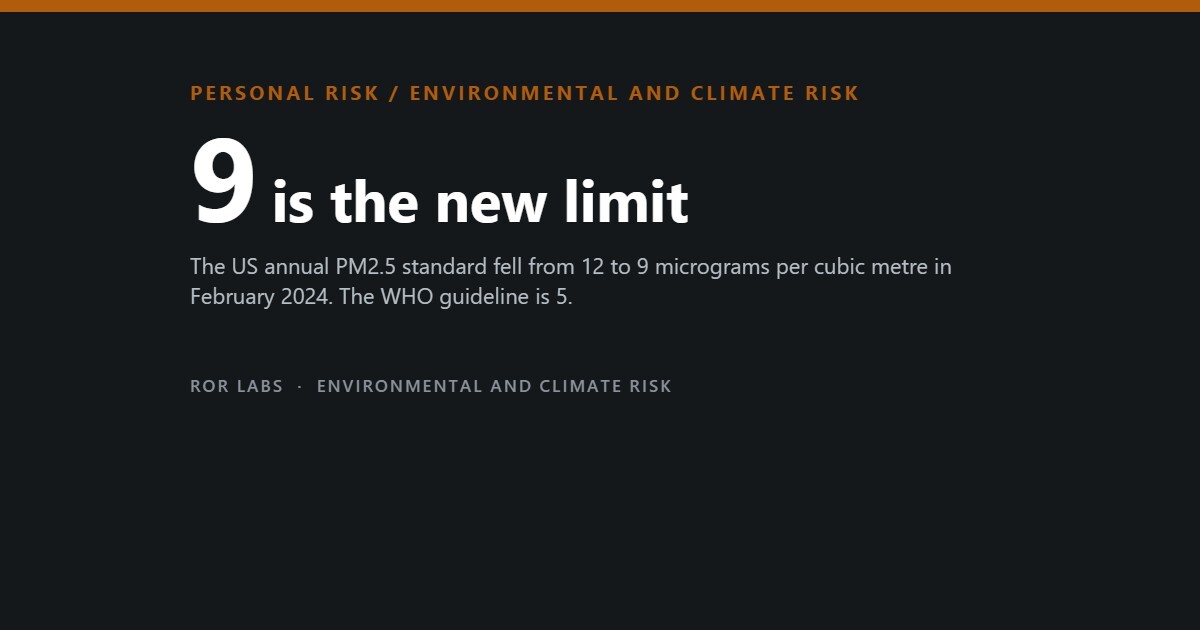
- The EPA cut the annual PM2.5 standard from 12 to 9 µg/m³ in February 2024, estimating up to 4,500 fewer premature deaths a year.
- It moved because studies found harm below the old standard — there is no clean threshold where the risk stops.
- Most PM2.5 deaths are cardiovascular, not respiratory. The particles cross into the blood.
- Wildfire smoke has reversed clean air progress in 35 states, erasing about a quarter of gains made since 2000 — and it is unregulated.
Air pollution is the rare risk that improved dramatically without most people noticing. American air got substantially cleaner between 1970 and about 2016, quietly, through regulation. It is one of the great public health wins of the last century.
Two things have happened since. The evidence caught up and showed that the level we had declared safe was not safe. And a source nobody regulates started undoing the progress.
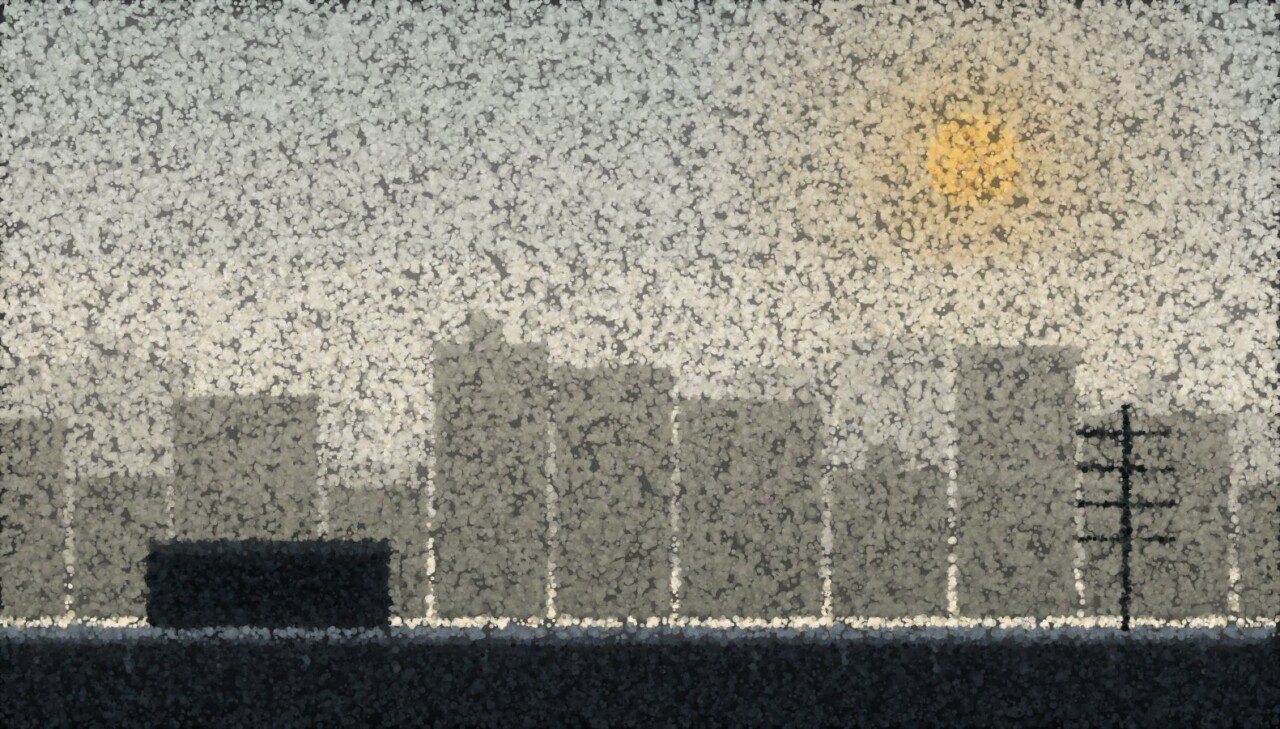
The safe level moved, because the harm did not stop
PM2.5 is particulate matter under 2.5 micrometres across — roughly a thirtieth the width of a human hair. That size is the whole story. Larger particles get caught in your nose and throat. These do not. They travel to the deepest part of the lung, and the smallest cross into the bloodstream.
The U.S. annual standard, before and after February 2024
Annual average PM2.5, micrograms per cubic metre. Lower is cleaner.
Sources: U.S. Environmental Protection Agency, revised annual PM2.5 NAAQS (February 2024); WHO Global Air Quality Guidelines (2021).
Standards get tightened for a reason, and the reason here is unusually clear. The Health Effects Institute funded three large studies specifically designed to look at low concentrations — the range everyone assumed was fine. All three found positive associations between mortality and PM2.5 below 12 µg/m³, the level that had been the legal standard.
The U.S. arm followed 68 million Medicare enrollees. It also found the mortality effect was larger among older Hispanic, Asian and particularly African American adults than among older white adults — a reminder that average exposure figures conceal who is actually breathing it.
Why 2.5 micrometres is the number that matters
Where particles of different sizes stop.
Sources: Health Effects Institute low-exposure studies; U.S. EPA integrated science assessment for particulate matter.
Wildfire smoke is undoing the progress
The Clean Air Act worked by regulating sources: power stations, vehicles, industry. Smoke drifting across a continent from a burning forest is not a regulated source, and it has become large enough to reverse the trend.
What wildfire smoke has done to U.S. air quality
Stanford analysis published in Nature, September 2023.
Source: Burke M, Childs ML, Wara M, et al. “The contribution of wildfire to PM2.5 trends in the USA.” Nature, 20 September 2023.
This changes the practical advice in a specific way. Chronic background exposure is a policy problem — you address it by where you live and how you vote, not by shopping. But smoke episodes are acute, forecastable and short, which makes them the one part of this risk an individual household can genuinely act on.
What a filter actually achieves
Air purifiers are sold with a lot of vague wellness language, so it is worth looking at what happens when one is tested properly. In 2025 a randomised crossover trial put HEPA filtration and sham filtration into the homes of 154 adults living near highways, a month each with a washout month between.
HEPA filtration and blood pressure: a real trial result
154 adults near major roads, randomised crossover, one month per arm.
Source: Brugge D, Eliasziw M, Thanikachalam M, et al. “Effect of HEPA Filtration Air Purifiers on Blood Pressure: A Pragmatic Randomized Crossover Trial.” JACC, 6 August 2025. doi:10.1016/j.jacc.2025.06.037
That is an honest result and worth reading carefully in both directions. It is real, measured, and randomised — which is more than almost any wellness device can claim. It is also small, and it only appeared in the group whose blood pressure was already elevated. If you were expecting a purifier to transform your health, this is the actual size of the effect.
Note also what a HEPA filter does and does not catch. It is a mechanical trap for particles, so it works on smoke, dust and pollen. It does nothing for gases — nitrogen dioxide, ozone, VOCs — which need activated carbon or ventilation. We made the same point in our article on gas stoves, and it is the most common misunderstanding in this whole product category.
What actually helps, ranked
By effect size, not by cost
The largest levers are structural. The purchasable ones sit lower down and matter most during smoke episodes.
Sources: Burke et al., Nature (2023); EPA PM2.5 guidance; Brugge et al., JACC (2025).
For smoke season (paid link)
Sized to one room. Whole-home purification is mostly marketing.
Browse on Amazon →
Browse on Amazon →
Browse on Amazon →
Two things we will not link. Ozone generators and “ionisers” sold as air purifiers — ozone is itself a regulated pollutant and a lung irritant, and using it to clean indoor air means adding one pollutant to remove another. And consumer PM2.5 monitors, which vary wildly in accuracy; your local AirNow reading is free and better calibrated than most of them.
Questions people ask
Is my air actually bad, or am I worrying about nothing?
Look it up rather than guessing — AirNow in the US and equivalent national services elsewhere publish local PM2.5 free. Most people in most places are in the range where this is a modest long-term risk factor rather than a daily problem. The exceptions are people beside major roads, in wildfire regions, and in homes with indoor combustion.
Should I exercise outside when air quality is poor?
Exercise increases how much air you move through your lungs, so it raises your dose. On a heavy smoke day, moving the session indoors is sensible. As a general rule, though, the health benefit of regular exercise outweighs typical urban pollution exposure by a wide margin in the cohort studies — do not let air quality become a reason to stop moving.
Do house plants clean the air?
No, not at any realistic density. The famous NASA experiment was conducted in sealed chambers, and the extrapolation to rooms requires an implausible number of plants per square metre. Keep them because they are pleasant.
Can I make a cheap filter myself?
Yes — a box fan with furnace filters taped into a cube (the “Corsi-Rosenthal box”) has been measured performing comparably to commercial units at a fraction of the price, and it was developed specifically for smoke and airborne particles. It is loud and it is ugly, and it works.
The short version
- The EPA cut the annual PM2.5 standard from 12 to 9 µg/m³ in February 2024, estimating up to 4,500 fewer premature deaths a year.
- It moved because studies found harm below the old standard — there is no clean threshold where the risk stops.
- Most PM2.5 deaths are cardiovascular, not respiratory. The particles cross into the blood.
- Wildfire smoke has reversed clean air progress in 35 states, erasing about a quarter of gains made since 2000 — and it is unregulated.
- A randomised trial found HEPA filtration lowered systolic pressure by 2.8 mm Hg in people with already-elevated readings, and did nothing for those with normal pressure.
- HEPA catches particles, not gases. For NO2 or VOCs you need carbon or ventilation.
- The biggest personal lever is not adding combustion indoors, and after that, filtering one room during smoke episodes.
- Ozone generators and ioniser “purifiers” add a pollutant. Avoid.
On the links above: some are affiliate links, marked (paid link). If you buy through one we may earn a commission at no additional cost to you. As an Amazon Associate I earn from qualifying purchases. We link to product searches rather than specific items so recommendations do not break as models change, and we say plainly when we are choosing not to link something. Full policy: Affiliate Disclosure.
Sources
- U.S. Environmental Protection Agency. Revised annual PM2.5 National Ambient Air Quality Standard, February 2024.
- Health Effects Institute. Low-exposure PM2.5 mortality research programme; statement supporting the revised standard, 13 February 2024.
- Burke M, Childs ML, Wara M, et al. “The contribution of wildfire to PM2.5 trends in the USA.” Nature, 20 September 2023.
- Brugge D, Eliasziw M, Thanikachalam M, et al. “Effect of HEPA Filtration Air Purifiers on Blood Pressure: A Pragmatic Randomized Crossover Trial.” Journal of the American College of Cardiology, 6 August 2025. doi:10.1016/j.jacc.2025.06.037
- World Health Organization. Global Air Quality Guidelines, 2021 revision.