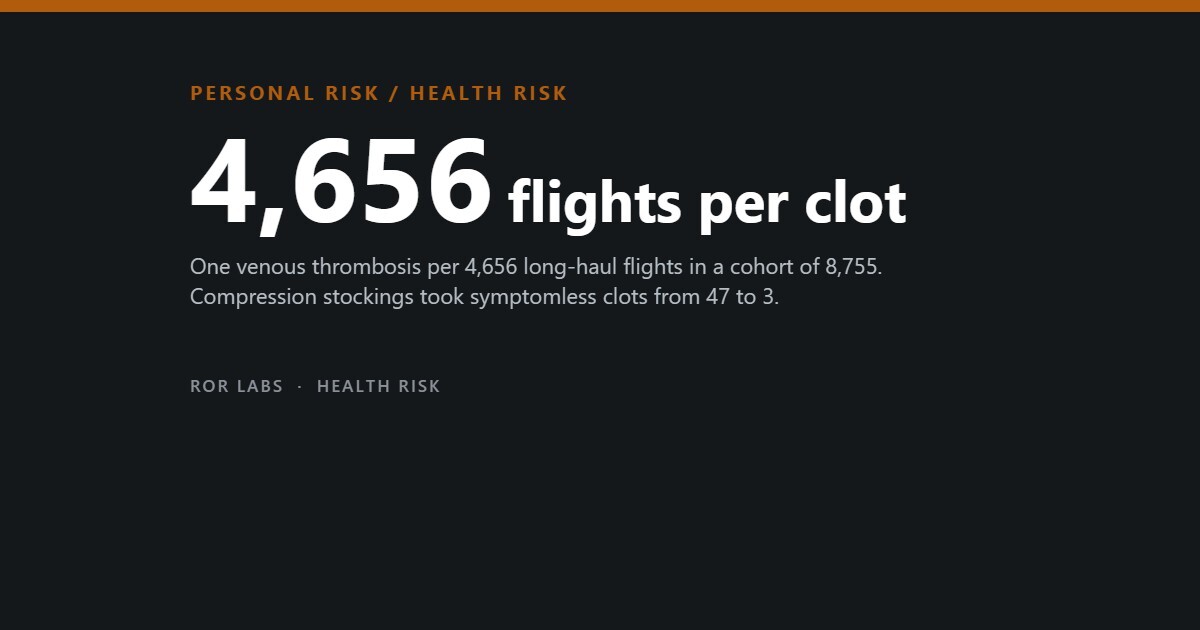
One Clot per 4,656 Long-Haul Flights. Stockings Took the Silent Ones from 47 Down to 3.
Key takeaways · 12 min read
- Long-haul travel roughly doubles the risk of a venous clot, from a small baseline. Absolute figures: about 1 in 6,000 per journey over four hours (WHO), or one per 4,656 flights in an employed cohort.
- Risk peaks in the first two weeks after landing and takes about eight weeks to return to baseline. Several flights in a month stack rather than reset.
- Compression stockings cut symptomless DVT from 47 cases to 3 across randomised trials — odds ratio 0.10, high-certainty evidence.
- The honest caveat: the trials found no deaths, no pulmonary emboli and no symptomatic clots in either group. The proven benefit is on a surrogate outcome.
The phrase “economy class syndrome” has done a lot of damage, because it points at the wrong variable. What raises the risk of a clot on a long flight is not the seat pitch or the ticket price. It is sitting still for hours, and then, for several weeks afterwards, having sat still for hours.
Two things are true at once here and most coverage picks only one. The first is that the absolute risk is small: a cohort study following 8,755 employees of international organisations found roughly one venous thrombosis per 4,656 long-haul flights. The second is that a Cochrane review of randomised trials found compression stockings reduced symptomless clots from 47 cases in the control group to 3 in the stocking group — an odds ratio of 0.10, rated high-certainty evidence. A tiny risk, and an intervention that removes most of it.
That combination is unusual enough to be worth setting out properly, along with the caveat that most articles leave out: what the trials actually detected was clots that produced no symptoms. Nobody in any of those trials had a pulmonary embolism, a symptomatic clot, or died. That matters for how much weight the result can carry, and we will get to it.

How big the risk actually is
The World Health Organization ran a research programme on this called WRIGHT — WHO Research Into Global Hazards of Travel. Its 2007 conclusion was that the risk of venous thromboembolism approximately doubles after travel of four hours or more, while the absolute risk remains low, on the order of 1 in 6,000 for a single journey of that length.
A separate cohort study published in PLOS Medicine the same year put numbers on the shape of that risk over time. Among 8,755 employees followed for 38,910 person-years, the incidence of venous thrombosis in the eight weeks after a long-haul flight was 3.2 per 1,000 person-years, against a baseline of 1.0. The risk was concentrated early — 4.7 per 1,000 person-years in the first two weeks — and returned to baseline by eight weeks.
Incidence of venous thrombosis per 1,000 person-years
Cohort of 8,755 employees of international organisations, 38,910 person-years of follow-up.
Source: Kuipers, S. et al., “The absolute risk of venous thrombosis after air travel: a cohort study of 8,755 employees of international organisations”, PLOS Medicine, 2007.
The two headline absolute figures — roughly 1 in 6,000 and 1 in 4,656 — are close but not identical, and it is worth saying why rather than picking the scarier one. They come from different populations and slightly different definitions of exposure. The WHO figure covers seated immobility of four hours or more in general; the cohort figure is per long-haul flight in a working-age, employed population. Neither is the number for you.
Who the risk is concentrated in
Average risk is a poor guide here, because the studies found the risk clustering in identifiable groups. Some of those groups are surprising.
Factors that raised the risk in the published studies
| Factor | What the studies found |
|---|---|
| Oral contraceptive use | Incidence of 6.6 per 1,000 person-years during the exposure window in the cohort study — the highest single subgroup rate reported. |
| Being short | Travellers under about 165 cm had a markedly raised incidence rate ratio. The proposed mechanism is that the seat edge presses into the back of the thigh when the feet do not reach the floor. |
| Being tall | The WHO programme identified height above about 1.9 m as a risk factor too, presumably through cramped leg position. Both tails of the distribution, not one. |
| Under 30 years old | Counter-intuitively, the cohort study reported a high incidence rate ratio in this group — though with very wide confidence limits, so read it as a signal rather than a measurement. |
| Obesity | Identified by the WHO programme; higher risk associated with body mass index above 25 in the cohort. |
| Inherited clotting disorders | Identified by the WHO programme as raising travel-related risk. Most people who have one do not know. |
Sources: WHO Research Into Global Hazards of Travel (WRIGHT) project, 2007; Kuipers et al., PLOS Medicine, 2007.
What the stockings trials actually showed
This is the strongest piece of evidence in the whole area, and also the one that needs the most careful reading. The Cochrane review by Clarke and colleagues pooled 12 randomised trials with 2,918 participants, all on flights longer than five hours. Among the 2,637 participants with follow-up data in the stocking trials, screening found 50 cases of symptomless deep vein thrombosis.
Symptomless deep vein thrombosis, stockings against no stockings
Pooled across randomised trials, 2,637 participants with follow-up, flights over five hours.
Source: Clarke, M.J. et al., “Compression stockings for preventing deep vein thrombosis in airline passengers”, Cochrane Database of Systematic Reviews, 2021.

Now the caveat, which is the part that gets dropped in most retellings. The outcome measured was symptomless DVT — clots found by scanning passengers who felt nothing. Across all of those trials, the review reports no deaths, no pulmonary emboli and no symptomatic deep vein thromboses at all, in either group. The events everyone actually fears were too rare to appear even in nearly three thousand people.
So what the evidence shows with high certainty is that stockings prevent a thing that is reliably detectable and plausibly connected to the thing you care about — not that they have been shown to prevent a pulmonary embolism. That is a real limitation, and it is the honest reason to describe the benefit as strong evidence on a surrogate outcome rather than proof of lives saved. It is also why the intervention is easy to recommend: the evidence quality is high, the cost is low, and the downside is close to nothing.
What to do on a long flight
In descending order of evidential support
Sources: Cochrane review of compression stockings in airline passengers, 2021; WHO WRIGHT project, 2007; Kuipers et al., PLOS Medicine, 2007.
Below-knee graduated compression stockings
This is one of very few consumer products on this site with a Cochrane review rating its evidence at the top of the scale.
See graduated compression stockings on Amazon (paid link)
Two cautions worth taking seriously. If you have peripheral arterial disease, diabetic neuropathy, or any condition affecting circulation or sensation in the legs, compression is a question for your doctor before it is a purchase — it is not universally safe. And a stocking that hurts, digs in at the top, or leaves deep marks is the wrong size, not a stocking that is working.
Five things sold for flight circulation that we are not recommending
The pattern across all five is the same: a plausible mechanism substituted for a measured outcome. The stockings are the exception precisely because someone did the trials.
Questions people ask

Four hours, eight hours — where is the line?
The WHO programme used four hours or more of seated immobility as its threshold, and the stocking trials used flights of more than five hours. There is no cliff edge at any particular hour; risk rises with duration. The practical reading is that anything over about four hours is in the zone the research was measuring, and that a five-hour flight followed by a three-hour drive is not a four-hour exposure.
Is business class actually safer?
Not for the reason the phrase “economy class syndrome” implies. Cabin class does not appear in the risk factor lists; duration and immobility do. A flat bed does let you change position and lie down, which plausibly helps, and a wider seat removes the thigh-pressure problem for shorter passengers. But someone who sleeps motionless for eleven hours in business class has not avoided the exposure, and someone in economy who walks the aisle every hour and wears stockings has largely addressed it.
I have already flown and my calf aches. What now?
Aching calves after a long flight are common and usually nothing. The pattern that warrants a same-day medical opinion is one leg — swelling, pain, warmth or redness that is clearly asymmetric — particularly in the first two weeks after landing, which is when the incidence peaks. Sudden shortness of breath, chest pain that is worse on breathing in, or coughing blood is an emergency and should go to emergency services, not to a search engine. Do not massage a suspected clot and do not wait it out to see.
Do I need stockings if I am young and healthy?
For most healthy adults on an occasional long flight the absolute risk is genuinely small, and it is reasonable to decide it is not worth the trouble. Two things argue the other way. The cohort study found a raised rate ratio in travellers under 30, with very wide confidence limits — weak evidence, but not evidence of safety. And the intervention costs about the price of a coffee, has high-certainty evidence behind it and essentially no downside for a person with healthy legs. That is a favourable trade even when the baseline risk is low.
Does compression need to stay on after landing?
The trials tested the stockings during the flight, so that is what the high-certainty evidence covers. Wearing them on the onward journey is reasonable and harmless if they fit properly, but there is no trial evidence telling you to wear them for the four to eight weeks that the risk stays elevated. What the timeline argues for during those weeks is ordinary movement rather than more equipment, and awareness of the one-sided leg symptoms above.
The short version
- Long-haul travel roughly doubles the risk of a venous clot, from a small baseline. Absolute figures: about 1 in 6,000 per journey over four hours (WHO), or one per 4,656 flights in an employed cohort.
- Risk peaks in the first two weeks after landing and takes about eight weeks to return to baseline. Several flights in a month stack rather than reset.
- Compression stockings cut symptomless DVT from 47 cases to 3 across randomised trials — odds ratio 0.10, high-certainty evidence.
- The honest caveat: the trials found no deaths, no pulmonary emboli and no symptomatic clots in either group. The proven benefit is on a surrogate outcome.
- The driver is immobility and duration, not cabin class. “Economy class syndrome” names the wrong variable.
- Higher risk: oral contraceptive use, obesity, height under about 1.6 m or over 1.9 m, inherited clotting disorders.
- Buy graduated stockings with a stated mmHg. Get up and walk. Put a bag under your feet if they do not reach the floor.
- Swelling or pain in one calf after a flight is a doctor’s appointment. Sudden breathlessness or chest pain is an emergency.
This article summarises published research on travel-related venous thromboembolism. It is general information and not medical advice, and it cannot account for your own history. Compression garments are not safe for everyone — peripheral arterial disease, diabetic neuropathy and some skin conditions are contraindications — and anyone with a previous clot, a known clotting disorder, active cancer, recent major surgery, or a pregnancy should discuss a specific long flight with a doctor rather than relying on any general guidance, including this. Nothing here is advice about medication.
On the links above: some are affiliate links, marked (paid link). If you buy through one we may earn a commission at no additional cost to you. As an Amazon Associate I earn from qualifying purchases. We link to product searches rather than specific items so that recommendations do not break as models change, and we say plainly when we are choosing not to link something. Full policy: Affiliate Disclosure.
Sources
- Clarke, M.J., Broderick, C., Hopewell, S., Juszczak, E. and Eisinga, A., “Compression stockings for preventing deep vein thrombosis in airline passengers”, Cochrane Database of Systematic Reviews, 2021. (Twelve randomised trials, 2,918 participants, flights over five hours; 2,637 participants with follow-up data; symptomless DVT in 3 of the stocking group against 47 of the control group, odds ratio 0.10, 95% CI 0.04 to 0.25, high-certainty evidence; superficial vein thrombosis 4 against 12 of 1,804, odds ratio 0.45, 95% CI 0.18 to 1.13, moderate certainty; significant reduction in oedema at low certainty; no deaths, pulmonary emboli or symptomatic deep vein thromboses reported in any trial.)
- Kuipers, S., Cannegieter, S.C., Middeldorp, S., Robyn, L., Büller, H.R. and Rosendaal, F.R., “The absolute risk of venous thrombosis after air travel: a cohort study of 8,755 employees of international organisations”, PLOS Medicine, 2007. (38,910 person-years of follow-up; incidence 3.2 per 1,000 person-years within eight weeks of long-haul flight against a baseline of 1.0; one event per 4,656 long-haul flights; 4.7 per 1,000 person-years in the first two weeks, returning to baseline by eight weeks; incidence rate ratio 7.7, 95% CI 1.6 to 38.4, for travellers under 30; incidence 6.6 per 1,000 person-years among women using oral contraceptives; raised incidence rate ratio among travellers under 165 cm and among those with body mass index above 25.)
- World Health Organization, WHO Research Into Global Hazards of Travel (WRIGHT) project, results announced June 2007. (Risk of venous thromboembolism approximately doubling after travel of four hours or more; absolute risk of the order of 1 in 6,000; risk factors including obesity, height above 1.9 m or below 1.6 m, oral contraceptive use and inherited clotting disorders; risk remaining elevated for about four weeks after travel.)