The Safety Surface Under the Climbing Frame Lost to Sand, Five to One, in a Randomised Trial.
Key takeaways · 14 min read
- 213,000+ US children a year in emergency departments for playground equipment injuries, mostly aged 5–12.
- Climbers 36%, swings 30%, slides 20%. Three quarters are falls. Fractures are 35% of injuries and over 90% of admissions.
- The only randomised trial of surfacing: arm fractures 1.9 per 100,000 student-months on sand against 9.4 on engineered wood fibre — but only 22 fractures in total, borderline significance, and no difference in overall injuries.
- Impact standards test head injury from a vertical drop. The injury that fills the emergency department is a broken arm. Those are not the same test.
The surface under a climbing frame is the one part of a playground that exists purely for safety. Nobody plays on it. It is there to catch children, it costs a great deal, and the material chosen is usually engineered wood fibre — the pale shredded chips that meet the impact standard and drain well and look tidy.
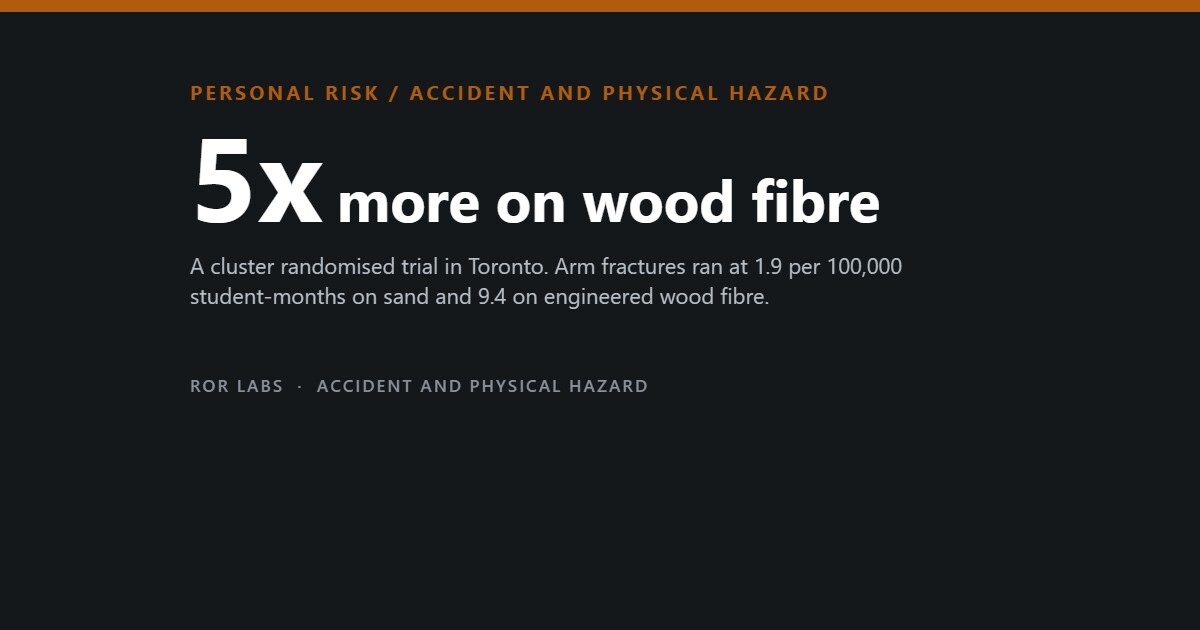
In 2009 a cluster randomised trial put that surface against plain granitic sand across a set of Toronto schools. Arm fractures from falls onto the surface ran at 1.9 per 100,000 student-months on sand and 9.4 on engineered wood fibre — roughly a fivefold difference, in the direction nobody expected.
That result comes with real caveats, and we will go through them honestly, because the total number of fractures involved was small. But it is the only randomised trial of playground surfacing anyone has run, and it points at something worth understanding: the impact standard the industry certifies against measures head injury from a vertical drop, and most playground injuries are not that. This article is about where the 213,000 annual emergency visits actually come from, what the evidence supports, and two things — one item of safety equipment and one design instinct — that make children less safe rather than more.
Where the injuries come from
More than 213,000 children under 18 are treated in US emergency departments each year for playground equipment-related injuries. The bulk of them are aged 5 to 12. The mechanism is overwhelmingly simple.
Which equipment, and what happens
Share of playground equipment-related emergency department visits, US children.
Source: national study of US playground equipment-related injuries treated in emergency departments, Center for Injury Research and Policy, Nationwide Children’s Hospital.
Note the shape of that second number. Fractures are a third of all injuries but more than nine tenths of the ones serious enough to admit. The playground problem, stated precisely, is broken arms.
The one randomised trial, and what it found
Andrew Howard and colleagues enrolled 37 Toronto elementary schools that were due to replace their playground surfacing anyway, and randomly assigned each to receive either engineered wood fibre or granitic sand. Twenty-eight schools completed the trial with new surfaces, covering 15,074 students. Injuries were collected prospectively over more than two years. The primary outcome was upper extremity fractures caused by falls onto the surface.
Arm fractures from falls onto the surface
Rate per 100,000 student-months, among schools that installed their assigned surface.
Source: Howard, A.W. et al., “School Playground Surfacing and Arm Fractures in Children: A Cluster Randomized Trial Comparing Sand to Wood Chip Surfaces”, PLOS Medicine, 2009.
Now the caveats, which matter
We are not going to hand you that number without the parts that weaken it. There are four, and any one of them would be enough for a reasonable person to want the trial repeated.
Four reasons to hold this loosely
The honest summary: one randomised trial, borderline significance, pointing the opposite way from industry practice. That is worth knowing and not worth ripping out a playground over.
There is also a mechanism worth stating, because it explains why the result is not as strange as it sounds. Impact-attenuating standards are written around head injury from a vertical drop — the critical fall height at which a headform experiences forces associated with life-threatening injury. That is the right thing to test for the worst outcome. It is not the thing that breaks an arm. A wrist arrives at the ground at an angle, with a body behind it, and what matters is how far the surface displaces under a small hard contact area. Loose sand moves. Compacted wood fibre resists.
The depth is the part that fails
Whatever material is under the equipment, it only works at depth, and loose-fill surfacing migrates. It gets kicked out from under swings, scuffed away at slide exits, and compacted along the paths children actually run. Those are exactly the landing zones. A playground inspected in April and used all summer is a different playground in September, and nothing about the certification reflects that.
This is the practical takeaway that survives all the caveats above: the maintained depth of the surface under the landing zones is a more useful thing to look at than the material. If you can see the hard base through the fill under a swing or at the bottom of a slide, the surface is not doing the job it was specified to do, whichever material it is.
The helmet that has to come off
This one is short, it is not widely known, and it has killed children.
In 1999 the US Consumer Product Safety Commission issued a warning after a 3-year-old boy in Pennsylvania died while wearing his bicycle helmet on playground equipment. He became wedged sliding through the structure and the helmet strap strangled him. A 7-year-old girl in Canada had died the same way two years earlier, caught in an opening in a play structure. The agency also had four non-fatal cases — two children climbing trees, two on playground equipment.
The mechanism is the helmet itself. A helmet turns a child’s head into a shape that passes through a gap and then does not come back out, and the chin strap is already around the neck. Play structures are full of openings sized for a head without a helmet on it.
Helmet on the bike. Helmet off everywhere else.
The CPSC chair put it as plainly as it can be put: children should always wear a helmet while riding their bikes — but when a child gets off the bike, take off the helmet.
If you supervise a school run, a scout group or a birthday party where children arrive by bike, this is the single highest-value sentence in this article.
The other failure: playgrounds too dull to use
Everything above pushes toward making playgrounds safer. There is a countervailing body of evidence that deserves equal weight, because the risk-elimination instinct has its own cost.
A 2015 systematic review examined risky outdoor play — play at height, rough and tumble, and children moving independently without an adult in sight — across studies covering roughly 50,000 participants aged 3 to about 13. The evidence base is uneven, and the review says so: only one eligible study addressed play at height, and the strongest evidence sits under independent mobility. But what it found ran consistently in one direction. Children with greater independent mobility were substantially more physically active; in one study, girls with high independent mobility were 4.5 times more likely to reach recommended activity levels. Rough and tumble play was associated with better motor development and social competence.
The authors have a name for what the standards-driven playground has become: “Kit, Fence, Carpet” — a certified structure, a boundary, and a rubber mat — and their objection is that it has limited appeal. A playground children do not want to use produces no injuries and no benefit. Their framing of the trade-off is worth quoting directly: injuries are an inevitable side effect of physical activity, and physical activity is not optional for a healthy childhood.
Two errors, opposite directions
Sources: Howard et al., PLOS Medicine, 2009; Brussoni, M. et al., “What is the Relationship between Risky Outdoor Play and Health in Children? A Systematic Review”, International Journal of Environmental Research and Public Health, 2015.
What to actually look at
A ninety-second check, in order of how much it matters
| Check | Why it is in this position |
|---|---|
| 1. Helmets off before the equipment | The only item on this list with documented deaths behind it, and the only one that costs nothing and takes one second. |
| 2. Depth under the landing zones | Under the swings, at the bottom of the slide, around the base of climbers. Hard base showing through means the surface is not doing its job regardless of material. |
| 3. Height of what they are climbing | Falls are three quarters of the injuries and fall height is the term that scales the energy. Equipment installed for older children sitting in a space used by four-year-olds is the common mismatch. |
| 4. Drawstrings, scarves, necklaces | Same failure mode as the helmet strap: anything around the neck plus any gap. Winter is the season for this. |
| 5. Where you stand | Under the climber, not on the bench. Supervision that prevents a fall has to be within reach of the equipment with the highest fall height, which is usually the climbing structure. |
| 6. Whether it is interesting enough | Genuinely on the list. A playground children abandon after ten minutes has costs that do not show up in injury statistics. |
Sources: US Consumer Product Safety Commission helmet strangulation warning, 1999; playground injury epidemiology from the Center for Injury Research and Policy; Brussoni et al., 2015.
We are not selling you playground safety equipment
The two interventions with the best support in this article — take the helmet off, and keep the surface at depth — are both free.
Questions people ask
Should I ask our school to replace the wood chips with sand?
On one borderline trial, no. That is not enough evidence to justify the cost, and the same trial found no difference in total injuries. What is worth raising is maintenance: whether the surface is being topped up to specified depth, particularly under swings and at slide exits, and who checks. That costs little, has a clearer mechanism, and applies whichever material is already installed. If a school is replacing surfacing anyway and asks which to choose, the trial is a legitimate thing to put in front of them — with its caveats attached.
My child hates having the helmet taken off at the park. Is this really a big deal?
Two documented deaths and four near-misses is not a large number, and the absolute risk to any one child on any one afternoon is very small. It is on this list because the cost of avoiding it is a single sentence and one second, which makes the trade-off unusually lopsided. Framing that works with children: the helmet is bike equipment, and it comes off when the bike stops, the same way a seatbelt does.
Is a rubber unitary surface better than loose fill?
It has a real advantage that has nothing to do with impact: it does not migrate, so it cannot end up below depth, and it is accessible to wheelchairs. Those are good reasons to choose it. On the injury question we do not have a randomised comparison against sand, so anyone telling you it is definitively safer is going beyond the evidence. What we can say is that the failure mode people actually encounter with loose fill — scattered and thin exactly where children land — is one that rubber does not have.
What about home playground equipment?
Same physics, and usually worse execution. Home sets are frequently installed straight onto grass or bare soil, both of which are poor surfaces, and the required loose-fill depth surprises people — it is measured in tens of centimetres, not a scattering. If you install equipment at home, the surfacing volume is the part of the budget most often underestimated. Grass is not a surface; it compacts within a season and is hardest exactly under the swing.
Sports and recreation injuries in general are their own subject and we will come back to them; this article is about the equipment.
How closely should I be supervising?
Close enough to the highest thing they can fall off, and no closer than that. The evidence in this article cuts both ways deliberately: a fall from the climbing structure is where the fractures come from, so that is where an adult is worth having; but the same review that documents playground injury also documents that children who move independently get substantially more physical activity. Standing under the climber is useful. Following a nine-year-old around the whole playground is not, and has costs of its own.
The short version
- 213,000+ US children a year in emergency departments for playground equipment injuries, mostly aged 5–12.
- Climbers 36%, swings 30%, slides 20%. Three quarters are falls. Fractures are 35% of injuries and over 90% of admissions.
- The only randomised trial of surfacing: arm fractures 1.9 per 100,000 student-months on sand against 9.4 on engineered wood fibre — but only 22 fractures in total, borderline significance, and no difference in overall injuries.
- Impact standards test head injury from a vertical drop. The injury that fills the emergency department is a broken arm. Those are not the same test.
- Maintained depth under the landing zones beats the choice of material, and it is the thing that degrades over a summer.
- The helmet comes off before the climbing frame. Two children have died of strangulation by helmet strap on play equipment; four more survived it.
- A playground nobody wants to use has costs that do not appear in injury statistics. Children with more independent mobility are markedly more active.
- Nothing on the list of things that work is a purchase.
This article summarises published injury epidemiology, one randomised trial and one systematic review. It is general information rather than a safety inspection, and it is not a substitute for the playground standards that apply where you live, which differ between countries. If a child has fallen and there is deformity, an inability to use the limb, loss of consciousness, vomiting or drowsiness, that is a matter for medical assessment rather than an article.
Further reading: Last Child in the Woods — Richard Louv (Algonquin Books, 2005). The book that put the shrinking radius of childhood on the agenda. Be warned that its central phrase, “nature-deficit disorder”, is the author’s coinage rather than a diagnosis, and the argument runs ahead of the evidence in places — read it for the framing, not for the causal claims. Find it on Amazon (paid link)
On the links above: some are affiliate links, marked (paid link). If you buy through one we may earn a commission at no additional cost to you. As an Amazon Associate I earn from qualifying purchases. We link to product searches rather than specific items so that recommendations do not break as models change, and we say plainly when we are choosing not to link something. Full policy: Affiliate Disclosure.
Sources
- Howard, A.W., Macarthur, C., Rothman, L., Willan, A. and Macpherson, A.K., “School Playground Surfacing and Arm Fractures in Children: A Cluster Randomized Trial Comparing Sand to Wood Chip Surfaces”, PLOS Medicine, 2009. (37 schools enrolled, 28 completing with new surfaces, 15,074 students; upper extremity fractures from falls onto the surface at 1.9 per 100,000 student-months on granitic sand, 95% CI 0.04–6.9, against 9.4 on engineered wood fibre, 95% CI 3.7–21.4, p ≈ 0.049; 2 fractures on sand and 20 on wood fibre; 19 of 28 schools compliant with assignment; overall injury rates similar between groups.)
- National study of playground equipment-related injuries treated in US emergency departments, Center for Injury Research and Policy, Nationwide Children’s Hospital. (More than 213,000 children under 18 treated annually; majority aged 5–12; climbers 36%, swings 30%, slides 20%; more than three quarters of injuries caused by falls; fractures 35% of all injuries and more than 90% of those requiring admission.)
- US Consumer Product Safety Commission, “After Recent Death CPSC Warns Against Wearing Bike Helmets on Playgrounds”, 1999. (Death of a 3-year-old boy in Pennsylvania on 4 February 1999 and of a 7-year-old girl in Canada in 1997, both by strangulation on the helmet strap after becoming caught in play equipment; four additional non-fatal incidents, two involving tree climbing; guidance that helmets be worn while cycling and removed when the child leaves the bike.)
- Brussoni, M., Gibbons, R., Gray, C., Ishikawa, T., Sandseter, E.B.H., Bienenstock, A., Chabot, G., Fuselli, P., Herrington, S., Janssen, I., Pickett, W., Power, M., Stanger, N., Sampson, M. and Tremblay, M.S., “What is the Relationship between Risky Outdoor Play and Health in Children? A Systematic Review”, International Journal of Environmental Research and Public Health, 2015. (21 papers from 8 countries, approximately 50,000 participants aged 3 to 12.99; strongest evidence base under independent mobility; girls with high independent mobility 4.5 times more likely to meet recommended activity levels in one study; positive associations for rough and tumble play with motor development and social competence; critique of “Kit, Fence, Carpet” playgrounds.)