Resisting a Robbery: What the Evidence Shows
Key takeaways · 11 min read
- Fewer than half of violent crimes in the US are reported to the police, so research relies on victim surveys.
- Early studies suggested resisting a robbery protected property but increased injury.
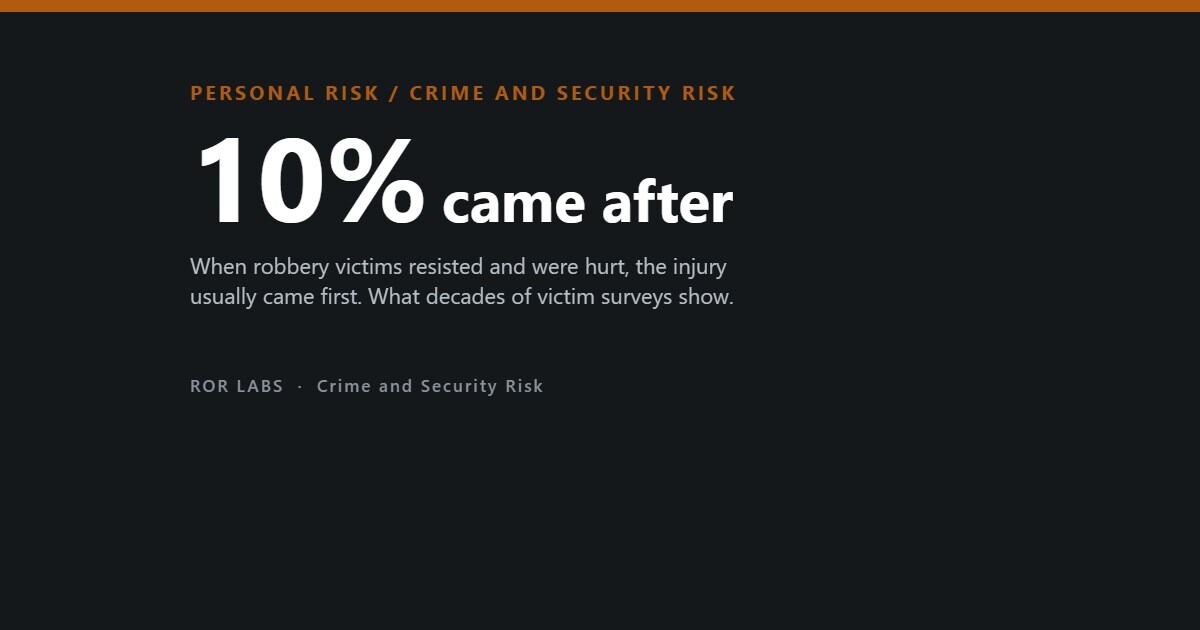
- A study of 27,595 crimes found the injury came after resistance in only 10% of cases where both happened.
- Non-physical resistance, such as running or calling for help, has the lowest injury rates across studies.
The standard advice for a street robbery is simple: hand it over. Police forces, travel guides and self-defence instructors say much the same thing. Property can be replaced; you cannot.
It is sensible advice, and for most people in most robberies it is probably right. But it is not quite what the research says. The best American data suggest that people who resist are, on average, less likely to lose their property and no more likely to be hurt. The reasons are subtler than either side of the argument usually admits.
This article looks at what decades of victimisation surveys show about resisting robbery and assault, why the early studies seemed to point the other way, and where the evidence is weakest. The number that changed the debate comes from a 2004 study of 27,595 crimes: when a victim both resisted and was injured, the injury came after the resistance in only 10% of cases.
How common is it?
The main source of American data on robbery and assault is the National Crime Victimization Survey, run by the Bureau of Justice Statistics with the Census Bureau since 1973. It interviews a large sample of households about crimes they experienced, whether or not they told the police.
In 2024, 1.45% of Americans aged 12 or older experienced at least one violent victimisation, about the same as the year before. The overall rate was 23.3 violent victimisations per 1,000 people. Only 11.2 per 1,000 were reported to the police, so fewer than half of these crimes ever appear in police statistics.
That is why almost all research on how victims respond comes from the survey rather than from police records. The survey asks a simple question: did you do anything, while the incident was going on, to protect yourself or your property? If the answer is yes, it asks what, and whether it happened before or after any injury.
One limitation matters from the start. The survey only interviews survivors. People killed in robberies cannot be asked what they did. Robbery killings are rare compared with robberies, but this gap means the survey can say little about the rarest and worst outcomes.
Violent crime in the United States, 2024
People aged 12 or older, National Crime Victimization Survey.
Bureau of Justice Statistics, Criminal Victimization, 2024, September 2025.

What the early studies found
Research on victim resistance began in earnest in the 1980s, using earlier versions of the same survey. The findings were mixed, and they shaped the advice that is still given today.
Richard Block and Wesley Skogan, in 1986, looked at encounters between strangers that could have become robberies. Forceful resistance, such as fighting back, was linked to robbers succeeding less often. But robbery victims who resisted forcefully were more likely to be attacked. Non-forceful resistance, such as running away or shouting, was linked to both fewer completed robberies and fewer attacks.
Eduard Ziegenhagen and Dolores Brosnan, analysing 3,679 robberies in 13 cities, found that resistance was not often associated with serious injury but was linked to preventing the robbery. They argued that advice to submit could be harmful.
Gary Kleck and Miriam DeLone, using more than 4,500 robberies from 1979 to 1985, found that almost any kind of self-protection reduced the chance that the robber got away with the property. Two kinds of resistance seemed to increase injury: unarmed physical force, and trying to attract attention or scare the robber off.
The overall picture from this first generation of studies was that resisting helped protect property but might increase the chance of being hurt, especially if it involved physical force. That trade-off is the basis of the standard advice.
The sequence problem
The early studies had a weakness that was hard to see in the data. They recorded whether a victim resisted and whether a victim was injured, but not always which came first.
That matters. If a robber hits someone and the victim then fights back, the injury did not result from the resistance. But in a simple analysis, the victim counts as someone who resisted and was injured, and resistance looks dangerous.

Jongyeon Tark and Gary Kleck addressed this directly. In a 2004 paper in Criminology, they analysed 27,595 personal contact crimes recorded in the survey from 1992 to 2001, covering robberies, assaults and sexual assaults, and 16 different kinds of self-protective action.
They found that self-protection in general, both forceful and non-forceful, reduced the likelihood of property loss and of injury compared with doing nothing. And they found that in crimes where the victim both resisted and was injured, the injury followed the resistance in only 10% of cases. In the other 90%, the victim was hurt first or at the same time. Much of the apparent link between resistance and injury, they concluded, came from getting the order of events backwards.
When a victim resisted and was hurt, which came first?
Personal contact crimes where both self-protection and injury occurred, 1992 to 2001.
Tark J, Kleck G, Criminology, 2004. 27,595 incidents from the National Crime Victimization Survey.
Not all resistance is the same
Later studies separated different kinds of self-protection and found that the type matters, and so does who the offender is.
Ronet Bachman and colleagues studied assaults against women and paid close attention to the sequence of events. The probability of injury was lowest when women used non-physical strategies such as arguing or reasoning with the offender. That held for all kinds of offenders. But in assaults by intimate partners, women who physically resisted were more likely to be injured.
A 2022 study by Bachman of assault victims aged 65 and over found something similar. Older victims who used only verbal or passive resistance were about 57% less likely to be injured than those who did nothing or who resisted physically.
The pattern across studies is fairly consistent. Running away, calling for help, and talking or arguing are generally associated with lower injury rates. Physical resistance without a weapon has the least consistent record, and in some settings is associated with more injury.
What different studies found about resisting
Studies of robbery and assault using US victimisation surveys.
| Study | Focus | Main finding |
|---|---|---|
| Block and Skogan, 1986 | Stranger robbery | Non-forceful resistance linked to fewer attacks |
| Kleck and DeLone, 1993 | Robbery, 1979–85 | Most resistance cut property loss |
| Bachman and colleagues, 2002 | Assaults on women | Verbal strategies had the lowest injury |
| Tark and Kleck, 2004 | 27,595 crimes | Injury followed resistance in 10% of cases |
| Bachman, 2022 | Victims aged 65+ | Verbal or passive resistance: 57% less injury |
Violence and Victims; Journal of Quantitative Criminology; Journal of Family Violence; Criminology.
What robbers say
Victim surveys see robbery from one side. A few studies have asked robbers themselves.
The best known is by Richard Wright and Scott Decker, who interviewed 86 active armed robbers in St Louis in the 1990s for their book Armed Robbers in Action. The robbers described the gun as a tool for getting compliance quickly, not as something they wanted to use. Their aim was to create enough fear that the victim would hand over money without delay.
But they also described using violence when victims hesitated, argued or fought back, to re-establish control. From the robber’s side, resistance was a problem to be solved, sometimes with force.
This does not contradict the survey data so much as explain why the averages hide so much variation. A robber who is nervous, armed and in a hurry may respond to resistance very differently from one who is opportunistic and ready to run. The victim rarely knows which kind they are facing.
What about guns?
Some of the studies above found that resistance with a gun was among the most effective ways to prevent property loss and injury. This is the most politically charged part of the literature, and the numbers deserve care.
Defensive gun use is rare in the survey. David Hemenway and Sara Solnick, in Preventive Medicine in 2015, examined more than 14,000 incidents from 2007 to 2011 where the victim was present. A gun was used in self-defence in 127 of them, or 0.9%. After any protective action, 4.2% of victims were injured. After defensive gun use, 4.1% were. In robberies and other crimes aimed at property, 55.9% of victims who took some protective action lost property, compared with 38.5% of those who used a gun and 34.9% of those who used another weapon.
A 2024 analysis in the American Journal of Public Health by David McDowall and colleagues estimated that American crime victims reported using a gun defensively in about 61,000 to 65,000 incidents a year, a level that has been nearly constant since the late 1980s. That is small compared with the millions of crimes the survey records each year.
Supporters and critics of gun ownership read these figures differently, and other surveys produce far higher estimates of defensive gun use. What the national victimisation survey shows is that armed self-defence is uncommon and, in its data, not clearly more protective against injury than other kinds of action.
Property lost after different protective actions
Crimes aimed at property where the victim was present, 2007 to 2011.
Hemenway D, Solnick SJ, Preventive Medicine, 2015. Injury after any protective action was 4.2%, after gun use 4.1%.
At work: when the robbery is of a shop
Commercial robberies are different. The property belongs to an employer, and staff are often trained not to resist. The evidence supports that training.
Jennifer Jones, Carri Casteel and Corinne Peek-Asa studied police reports of commercial robberies in a large US city from 2008 to 2012. Employees resisted in nearly half of the robberies. Active resistance was associated with a 49% higher prevalence of employee injury. Robberies where goods were taken were more likely to involve resistance and injury, while those where only cash was taken were less likely to involve injury.
Here the calculation is clearer than on the street. The employee has little personal stake in the money, the robber may be more determined, and a shop has cameras and records that help police afterwards. Training staff not to resist is one of the few robbery-prevention measures with consistent support.
Employee resistance in commercial robberies
Police reports, large US metropolitan city, 2008 to 2012.
Jones J, Casteel C, Peek-Asa C, Journal of Occupational and Environmental Medicine, 2015.
Why the evidence is hard to act on
Even the best studies here are observational. Victims were not randomly assigned to resist or comply, and the people who resist may differ in size, fitness, confidence and circumstances from those who do not.
The situation matters too. A victim facing a single unarmed teenager in daylight near other people is in a very different position from one facing several armed adults in an empty car park. Averages across thousands of incidents do not tell any one person what to do in a particular moment.
And the survey cannot see the worst outcomes. People killed during robberies are missing from victimisation data, so if resistance occasionally provokes lethal violence, the survey would not show it.
That is why most safety guidance still leans towards compliance, especially when a weapon is present, while noting that running away, shouting and calling for help are generally reasonable if they are possible.
What the evidence does not show
It does not show that resisting is always safer. The averages hide large differences between situations, and the survey excludes those who were killed.
It does not show that fighting back unarmed is a good idea. That form of resistance has the least consistent record and in some settings is linked to more injury.
It does not settle the debate about guns. Defensive gun use is rare in the national survey, and its estimated effect on injury is similar to other protective actions.
And it does not mean the standard advice is wrong. Handing over property remains a reasonable default, especially when an offender is armed.
Questions people ask
Should you resist a robbery?
There is no single right answer. Survey data suggest that resisting reduces property loss and does not, on average, increase injury, but they exclude people who were killed, and the safest choice depends on the situation.
Does fighting back make injury more likely?
Early studies suggested so. A 2004 study found that when victims resisted and were injured, the injury came after the resistance in only 10% of cases.
What kind of resistance is safest?
Non-physical strategies such as running away, calling for help, or talking to the offender are generally associated with the lowest injury rates.
How common is defensive gun use?
In the national victimisation survey, a gun was used in self-defence in about 0.9% of incidents where the victim was present.
What should shop staff do?
Research on commercial robberies found that active resistance by employees was linked to 49% more injuries. Training staff not to resist has consistent support.
The short version
- Fewer than half of violent crimes in the US are reported to the police, so research relies on victim surveys.
- Early studies suggested resisting a robbery protected property but increased injury.
- A study of 27,595 crimes found the injury came after resistance in only 10% of cases where both happened.
- Non-physical resistance, such as running or calling for help, has the lowest injury rates across studies.
- For shop staff, active resistance was linked to 49% more injuries, and non-resistance training has consistent support.
This article summarises published research on victim resistance. It is not safety or legal advice. In an emergency, call your local emergency number. Local police and victim support services can give guidance suited to where you live.
Further reading. Tark and Kleck, ‘Resisting Crime: The Effects of Victim Action on the Outcomes of Crimes’, Criminology, 2004, is the most thorough study of the sequence problem. Hemenway and Solnick, Preventive Medicine, 2015, gives the clearest picture of how rare armed self-defence is in survey data.
- The Violence Project, Jillian Peterson and James Densley (2021). Two criminologists on what data from thousands of violent incidents reveal about how and why violence happens.
- Fear: An Alternative History of the World, Robert Peckham (2023). A historian on how fear shapes individual and collective decisions, including decisions about crime.
- Survival of the Friendliest, Brian Hare and Vanessa Woods (2020). An evolutionary account of aggression and cooperation, and of why most encounters do not turn violent.
Sources
- Bureau of Justice Statistics. Criminal Victimization, 2024. September 2025.
- Block R, Skogan WG. Resistance and nonfatal outcomes in stranger-to-stranger predatory crime. Violence and Victims, 1986;1(4):241–253.
- Ziegenhagen EA, Brosnan D. Victim responses to robbery and crime control policy. Criminology, 1985;23(4):675–695.
- Kleck G, DeLone MA. Victim resistance and offender weapon effects in robbery. Journal of Quantitative Criminology, 1993;9(1):55–81.
- Tark J, Kleck G. Resisting crime: the effects of victim action on the outcomes of crimes. Criminology, 2004;42(4):861–910. doi:10.1111/j.1745-9125.2004.tb00539.x.
- Bachman R, Saltzman LE, Thompson MP, Carmody DC. Disentangling the effects of self-protective behaviors on the risk of injury in assaults against women. Journal of Quantitative Criminology, 2002;18(2):135–157.
- Bachman R. When older assault victims fight back: investigating the effects of self-protective behaviors on the probability of injury. 2022.
- Wright RT, Decker SH. Armed Robbers in Action: Stickups and Street Culture. Northeastern University Press, 1997.
- Hemenway D, Solnick SJ. The epidemiology of self-defense gun use: evidence from the National Crime Victimization Surveys 2007–2011. Preventive Medicine, 2015;79:22–27. doi:10.1016/j.ypmed.2015.03.029.
- McDowall D, Wiersema B, Loftin C, McCleary R. Levels and changes in defensive firearm use by US crime victims, 1987–2021. American Journal of Public Health, 2024;114(12):1384–1387. doi:10.2105/AJPH.2024.307838.
- Jones J, Casteel C, Peek-Asa C. Employee resistance and injury during commercial robberies. Journal of Occupational and Environmental Medicine, 2015;57(5):531–536. doi:10.1097/JOM.0000000000000396.