Nine Million Homes Still Drink Through a Lead Pipe
In This Series: Home Hazards & Indoor Environment
- The Safe Level of Air Pollution Keeps Moving Down
- The Mould Is Not the Problem. The Water Is.
- It Looks Exactly Like Flu, Except for the Fever
- Lithium-Ion Battery Fires at Home: What the Research Actually Shows
- The Leading Cause of House Fires Is a Pan Nobody Is Watching
- Your Gas Stove and the Air in Your Kitchen: What the Measurements Found
- Power Outages Are Getting Longer. The Generator Is the Dangerous Part.
Disclosure: this article contains affiliate links, marked (paid link). If you buy through one we may earn a commission, at no extra cost to you. As an Amazon Associate I earn from qualifying purchases. It costs you nothing and it does not change what we recommend.
Key takeaways · 7 min read
- Up to 9 million U.S. homes are still served by lead pipes. The EPA gave systems 10 years from October 2024 to replace them.
- Estimated annual benefits include 900,000 infants protected from low birthweight and 200,000 IQ points not lost.
- There is no known safe level of lead for children, and the damage is not reversible.
- Check your utility’s service line inventory — publishing it was required by the 2024 rule.
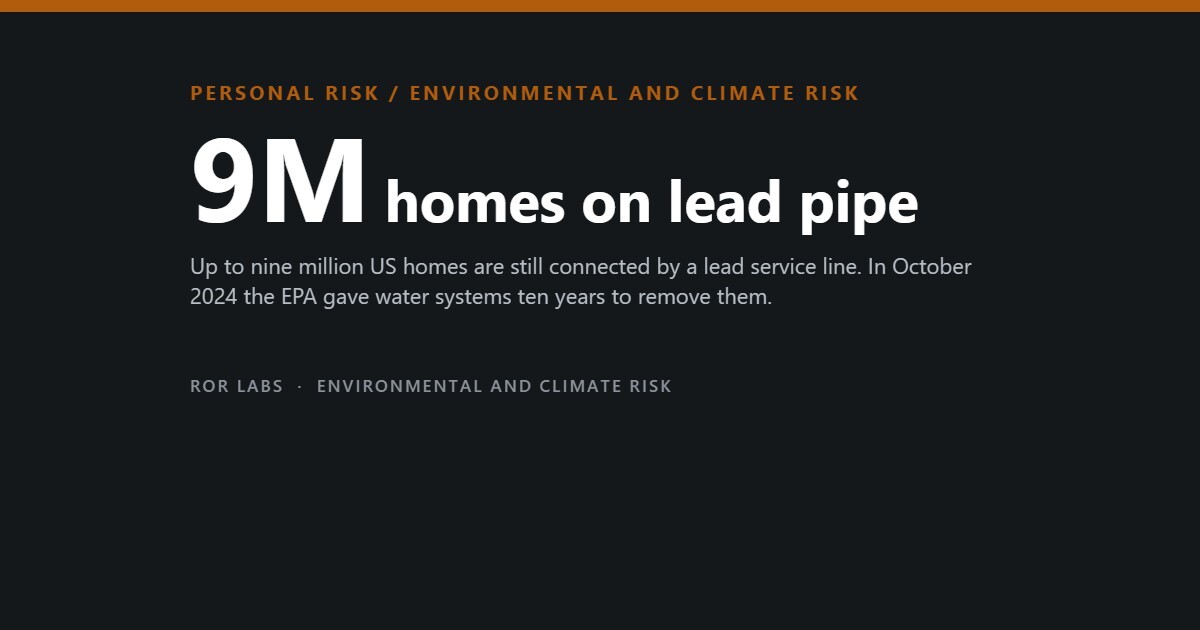
Lead water pipes are a nineteenth-century problem that America is still finishing in the twenty-first. Up to nine million homes are still connected to the water main by a lead pipe, and in October 2024 the EPA gave water systems ten years to remove essentially all of them.
Ten years is a long time to wait if the pipe is yours. This article is about how to find out whether it is, what the exposure actually does, and which of the things people buy in the meantime does anything.

What the replacement rule expects to prevent
EPA estimated annual benefits of removing lead service lines
Lead and Copper Rule Improvements, finalised 8 October 2024.
Source: U.S. Environmental Protection Agency, final Lead and Copper Rule Improvements, 8 October 2024.
Two things about lead make it different from most hazards covered on this site. There is no known safe level of lead exposure for children — the effects on developing brains appear at the lowest levels anyone can measure, with no threshold below which harm stops. And the damage is not reversible. Removing the source stops further loss; it does not restore what was lost.
That combination is why the response here is unusually decisive compared with, say, the graded advice we give about air pollution or diet. There is no dose to optimise. The answer is removal.
Finding out what your pipe is made of

The service line is the pipe running from the water main under the street into your building. Under the 2024 rule, water systems were required to produce public inventories of their service line materials — so for many addresses this is now a lookup rather than an investigation.
Three steps, in order of effort
Most people get an answer at step one or two.
Sources: EPA Lead and Copper Rule Improvements (2024); EPA guidance on identifying lead service lines.
What to do while you wait for the pipe to go
Lead does not dissolve steadily into water. It leaches most when water sits still in the pipe for hours, and it spikes when the pipe is physically disturbed — which is why partial replacements and nearby roadworks can make things temporarily worse rather than better.
Measures that work, and the one that does not
Ranked by how much they reduce actual exposure.
Sources: EPA lead in drinking water guidance; EPA Lead and Copper Rule Improvements (2024).
And the one that does not: boiling. Boiling kills bacteria, and against lead it does the opposite of helping. Water evaporates and the lead does not, so a long boil leaves a slightly more concentrated solution than you started with. It is a persistent and dangerous piece of folk wisdom, because it feels like it should work.
If you have a lead line, or do not know yet (paid link)
One specification matters more than any brand: NSF/ANSI 53, certified for lead.
Browse on Amazon →
Browse on Amazon →
Browse on Amazon →
We are not linking home lead test strips. They are unreliable at the concentrations that matter for children, and a false reassurance here is worse than no test. If you want your water tested, many utilities will do it free on request and some health departments run testing programmes — and a certified laboratory result is the only one worth acting on. We are also not linking whole-house filtration for this: lead enters at the service line, so filtering at the drinking tap is where the exposure actually is.

Questions people ask
Should my child be tested for lead?
If you have a lead service line, or live in older housing with deteriorating paint, this is worth raising with your paediatrician. A blood lead test is simple and gives a real answer about your child rather than about your plumbing. In many areas testing is routine at certain ages or free for children on public insurance.
Is bottled water the safer option?
As a short-term measure during known disruption, yes. As a long-term answer it is expensive, generates a great deal of plastic, and is regulated to standards that are not obviously stricter than tap water. A certified filter costs far less over a year and addresses the same exposure.
Is the water safe for washing and bathing?
Yes. Lead is not meaningfully absorbed through intact skin, so showering, bathing and hand-washing are fine even where drinking water is affected. The exposure route is swallowing it. Watch small children in the bath who might drink the water.
Who pays to replace my side of the pipe?
It varies enormously. The 2024 rule pushes water systems toward full replacement including the private portion, and substantial federal funding was attached — $2.6 billion announced alongside the rule. Many utilities now cover the whole line or offer subsidies. Ask before assuming you will be billed, and ask whether your address is scheduled.
The short version
- Up to 9 million U.S. homes are still served by lead pipes. The EPA gave systems 10 years from October 2024 to replace them.
- Estimated annual benefits include 900,000 infants protected from low birthweight and 200,000 IQ points not lost.
- There is no known safe level of lead for children, and the damage is not reversible.
- Check your utility’s service line inventory — publishing it was required by the 2024 rule.
- Or do the scratch and magnet test: soft shiny grey, magnet does not stick, is lead.
- Use an NSF/ANSI 53 certified filter. “Improves taste” certification does nothing for lead.
- Flush the tap after water has stood, and use cold water only for drinking, cooking and formula.
- Boiling concentrates lead. It does not remove it.
- Bathing and washing are fine. Swallowing is the exposure route.
This article summarises published regulatory guidance and is not medical advice. If you are concerned about a child’s lead exposure, a blood lead test through your doctor gives a direct answer.
On the links above: some are affiliate links, marked (paid link). If you buy through one we may earn a commission at no additional cost to you. As an Amazon Associate I earn from qualifying purchases. We link to product searches rather than specific items so recommendations do not break as models change, and we say plainly when we are choosing not to link something. Full policy: Affiliate Disclosure.
Sources
- U.S. Environmental Protection Agency. Final Lead and Copper Rule Improvements, 8 October 2024, and accompanying news release on lead pipe replacement requirements and funding.
- U.S. Environmental Protection Agency. Basic information about lead in drinking water; guidance on identifying lead service lines.
- NSF/ANSI Standard 53 — drinking water treatment units, health effects (lead reduction certification).