Gaming Disorder: What the Evidence Shows
Key takeaways · 10 min read
- Gaming disorder has been an official WHO diagnosis since 2022 and requires real harm, not just long hours.
- Prevalence estimates run from 0.3% to 10%, mainly because of different questionnaires and samples.
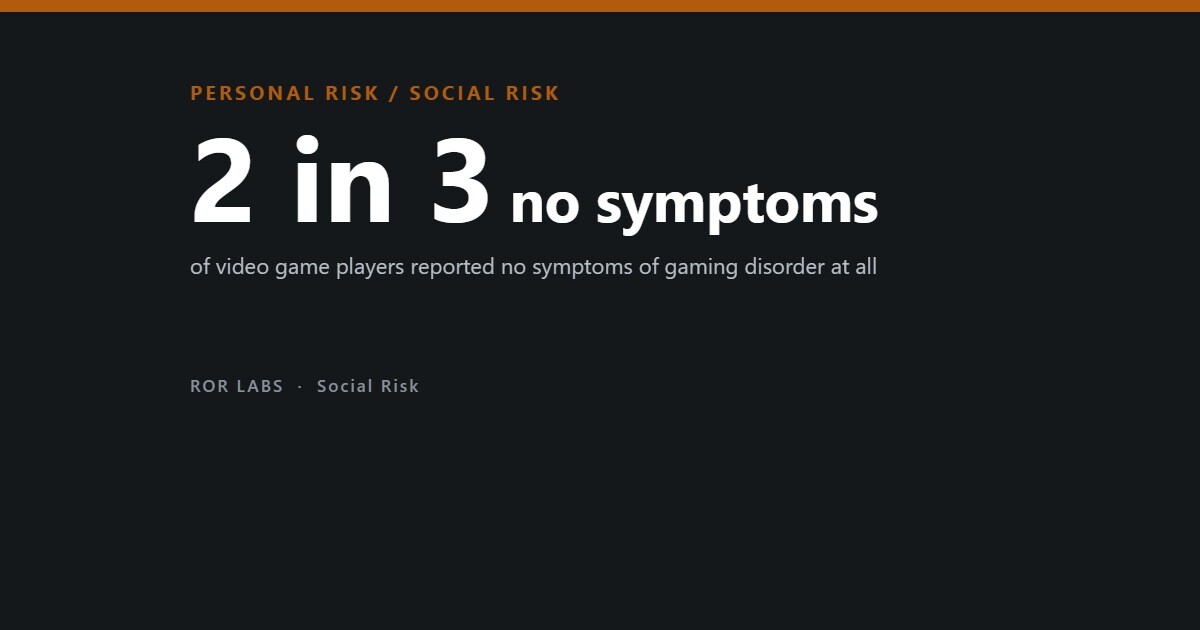
- In one large study, two out of three players reported no symptoms at all.
- Around 40% of those who screen positive still do so later; most young people move on.
Ask how many young people are addicted to video games and you can get almost any answer. One respected study says fewer than one player in a hundred might qualify. A meta-analysis says about three in a hundred. Another, published in 2026, says one child in ten. All three are measuring something they call gaming disorder.
Since 2022, gaming disorder has been an official diagnosis in the World Health Organization’s International Classification of Diseases. Clinics treat it, parents worry about it, and one country has written national rules to limit how long children may play. Yet the researchers who study it still disagree, sometimes sharply, about how common it is and how best to measure it.
This article looks at what the diagnosis actually requires, why prevalence estimates differ by a factor of thirty, what happens to young people who meet the criteria, and what the evidence says about the most ambitious attempt to control it: China’s limits on children’s play.
What the diagnosis requires
The WHO added gaming disorder to the 11th revision of its classification, ICD-11, in 2019, and the revision came into force in January 2022. The definition has three core features: impaired control over gaming, giving gaming increasing priority over other interests and daily activities, and continuing or escalating despite negative consequences. The pattern must cause significant impairment in personal, family, social, educational or work life, and it is normally evident for at least 12 months.
The American Psychiatric Association took a more cautious route. Its manual, DSM-5, listed ‘Internet gaming disorder’ in 2013 as a condition needing further research, with nine proposed criteria, of which five within a year would suggest a problem. Several of those criteria were borrowed from gambling disorder, such as preoccupation and tolerance.
That difference matters, because most prevalence studies do not use clinical interviews. They use questionnaires, and the questionnaire decides the answer. A child who thinks about games a lot and plays more than planned can tick several boxes on a checklist based on the DSM criteria without their life being harmed at all. The WHO definition was written partly to avoid that: heavy or passionate play is not enough.
One condition, answers from 0.3% to 10%
In 2017, Andrew Przybylski, Netta Weinstein and Kou Murayama ran four preregistered surveys with 18,932 people in the American Journal of Psychiatry. Among those who played games, more than two out of three reported no symptoms at all. Between 0.3% and 1.0% of the general population might qualify for a potential acute diagnosis.
In 2021, Matthew Stevens and colleagues pooled 53 studies with 226,247 participants from 17 countries. They found a worldwide prevalence of 3.05%. When they kept only studies with more rigorous sampling, the estimate fell to 1.96%, with a very wide uncertainty range.
More recent pooled estimates are much higher. A 2025 meta-analysis of 84 studies of adolescents in Public Health in Practice reported 8.6%, and a 2026 meta-analysis of 19 studies of children and adolescents in Child and Adolescent Psychiatry and Mental Health reported 10%. Both found extreme differences between the studies they combined.
How common is gaming disorder?
Five estimates, depending on who was sampled and how it was measured.
Przybylski AK et al, American Journal of Psychiatry, 2017; Stevens MWR et al, Aust N Z J Psychiatry, 2021; Satapathy P et al, Public Health in Practice, 2025; Barboza JJ et al, Child Adolesc Psychiatry Ment Health, 2026.
Why the estimates differ so much
The biggest source of difference is the measuring instrument. Christopher Ferguson, Mark Coulson and Jane Barnett showed this in 2011, in a meta-analysis of 33 studies. Measures that copied the approach used for problem gambling produced higher prevalence estimates, and those cases were less often linked to other mental health problems. The most precise measures produced an overall rate of 3.1%.
Other differences add up. Samples drawn only from gamers produce higher rates than samples of the whole population. Small studies and online convenience samples tend to produce higher rates than large representative ones. Studies from parts of East Asia have often reported higher figures than those from Europe or North America. And boys are affected more often than girls in almost every study: a 2018 meta-analysis by Jia Yuin Fam found 6.8% among adolescent boys and 1.3% among girls.
None of this means the problem is imaginary. It means that a single headline number, whether low or high, tells you more about the method than about the children.
What most players report
Four preregistered surveys with 18,932 people in international cohorts.
Przybylski AK, Weinstein N, Murayama K, American Journal of Psychiatry, 2017;174(3):230–236.
The argument over the diagnosis
When the WHO proposed the diagnosis, a group of scholars led by Espen Aarseth published an open debate paper in the Journal of Behavioral Addictions in 2017. They argued that the evidence base was not yet strong enough, that the criteria leaned too heavily on substance use and gambling, and that a formal diagnosis risked turning ordinary play into a disease and causing moral panic.
Others replied just as firmly. Mark Griffiths and colleagues argued in the same journal that problematic gaming clearly exists, that the people affected need help, and that a formal diagnosis would support treatment and research. Many clinicians who work with young people and their families took the same view.
Much of the disagreement narrowed over time. Critics accept that some people’s play is linked to real problems. Supporters accept that most heavy play is harmless and that many cases come with depression, anxiety or attention difficulties. In a 2025 paper on the boundary between normal play and disorder, Daniel King and colleagues noted that the ICD-11 guidelines themselves say gaming as routine, to build skills, to change mood, to relieve boredom or to spend time with friends is not enough for a diagnosis.
The open question is which comes first. A young person who is anxious or isolated may retreat into games; games may also crowd out sleep, school and friends. Most studies cannot separate the two, and the answer is probably different for different people.
Does it last?
If gaming disorder were like most addictions, many of the young people who met the criteria would still meet them a year or two later. The evidence suggests that many do not.
In a German panel study published in Addiction in 2014, Michael Scharkow, Ruth Festl and Thorsten Quandt followed 902 people aged 14 to over 40 for two years. Only nine, about 1%, showed symptoms of problematic game use in all three annual surveys, and no one was classified as addicted in all three.
A 2025 meta-analysis by An-Pyng Sun and colleagues in Addictive Behaviors Reports found that around 40% of people who screened positive at the start still did so at follow-up. The authors argued that this level of stability is similar to gambling disorder or personality disorders, and should not stop the condition being recognised. Read another way, it also means that most young people who screen positive are not stuck there.
How many still have the problem later?
Follow-up studies of people who screened positive for problem gaming.
Sun AP et al, Addictive Behaviors Reports, 2025; Scharkow M, Festl R, Quandt T, Addiction, 2014.
What the playtime data show
Most research asks people how long they play, and people are bad at estimating it. In 2021, Niklas Johannes, Matti Vuorre and Andrew Przybylski worked with Electronic Arts and Nintendo of America to match survey answers with the actual logged play of people playing two games. They found a small positive link between play time and wellbeing, not a negative one.
A 2024 registered report in Technology, Mind, and Behavior went further. Nick Ballou and colleagues tracked the real play time of 414 adult Xbox players across all their games for 12 weeks. Within individuals, changes in play time and changes in wellbeing were not meaningfully related in either direction.
These are adult players, and the studies say nothing about the minority whose play has become a problem. But they undercut the idea that the number of hours alone is the danger. Hours matter when they push out sleep, school, work and other people.
Studies that measured real play time
Logged play rather than self-reported hours.
| Study | Players | Play time and wellbeing |
|---|---|---|
| Johannes, 2021 (EA and Nintendo) | Players of two games | Small positive link |
| Ballou, 2024 (Xbox, 12 weeks) | 414 adults | No meaningful link either way |
Johannes N, Vuorre M, Przybylski AK, Royal Society Open Science, 2021; Ballou N et al, Technology, Mind, and Behavior, 2024.
China’s time limits: the largest experiment
China has tried the most direct approach. Rules introduced in 2019 limited players under 18 to 90 minutes of online gaming on weekdays and three hours on holidays, banned play between 10pm and 8am, and capped spending. In August 2021, the national press and publication regulator went much further: minors could play online games only between 8pm and 9pm on Fridays, weekends and public holidays, with real-name registration used to enforce it.
China’s limits on online gaming for under-18s
National rules for game companies.
| 2019 rules | 2021 rules | |
|---|---|---|
| Weekdays | 90 minutes | None, except Friday |
| Weekends and holidays | 3 hours on holidays | 8pm to 9pm only |
| Night-time ban | 10pm to 8am | All other hours |
National Press and Publication Administration of China, 2019 and 2021 notices; see also Xiao LY, Journal of Behavioral Addictions, 2024.
Did it work? The best-known attempt to find out, by David Zendle and colleagues in Nature Human Behaviour in 2023, analysed play data from one segment of the Chinese games market and found no evidence that heavy gaming fell after the 2019 rules. Its title became a widely quoted summary.
That study has since been sharply challenged. In a paper published in Collabra: Psychology in 2026, Veli-Matti Karhulahti and colleagues argued that the data contained no information on players’ ages, so the study could not, even in principle, measure the effect of a rule aimed at minors. The authors of the original study have disputed the criticism. The honest summary is that nobody has yet shown clearly whether China’s limits reduced problem gaming, and children who are determined to play can use adults’ accounts.
South Korea offers a smaller lesson. Its ‘shutdown law’, introduced in 2011, blocked under-16s from online games between midnight and 6am. It was abolished in 2021, after years of criticism that it was easy to evade and did little for the young people it was meant to protect.
What helps in practice
Because the problem is usually entangled with other things, the most useful questions for families are about function and harm, not hours. Is the young person sleeping? Going to school? Keeping friends, including offline ones? Are there signs of low mood or anxiety that the gaming might be covering? Shared rules about devices at night, and play that happens in family spaces rather than behind a closed door, are cheap and reversible.
For the minority whose lives are being damaged, treatment exists, usually a form of cognitive behavioural therapy that also addresses anxiety, depression or family conflict. The evidence for treatment is still developing, but the first step is the same as for any worry about a young person’s mental health: talk to a GP or a qualified clinician. We looked at the wider screen time evidence in our article on screen time and adolescents.
Questions people ask
Is gaming disorder a real diagnosis?
Yes. The WHO added it to ICD-11, in force since 2022. It requires impaired control, rising priority and continued play despite harm, usually for 12 months.
How common is gaming disorder?
Estimates range from under 1% to about 10%, depending mainly on the questionnaire used and who was sampled. Rigorous samples tend to give 1% to 3%.
Are boys more affected than girls?
Yes, in almost every study. One meta-analysis found 6.8% among adolescent boys and 1.3% among girls.
Do children grow out of it?
Often. Around 40% of those who screen positive still do so at follow-up, which means most do not.
Did China’s gaming limits work?
It is not clear. The best-known study found no drop in heavy play, but critics say its data could not identify minors.
The short version
- Gaming disorder has been an official WHO diagnosis since 2022 and requires real harm, not just long hours.
- Prevalence estimates run from 0.3% to 10%, mainly because of different questionnaires and samples.
- In one large study, two out of three players reported no symptoms at all.
- Around 40% of those who screen positive still do so later; most young people move on.
- Whether China’s strict limits on children’s play reduced problem gaming remains unproven.
This article summarises published research on gaming disorder. It is not a diagnostic tool and is not medical advice. If you are worried about a young person’s gaming, mood or sleep, talk to a GP, a paediatrician or a qualified mental health professional.
Further reading. Stevens and colleagues, ‘Global prevalence of gaming disorder’, Australian & New Zealand Journal of Psychiatry, 2021, is the most cited pooled estimate. Aarseth and colleagues, Journal of Behavioral Addictions, 2017, sets out the case against the diagnosis.
- Unlocked, Pete Etchells (2024). A psychologist on what research can and cannot tell us about screen time, games and young people.
- The Anxious Generation, Jonathan Haidt (2024). A social psychologist argues that phones and social media harmed a generation; a useful contrast, since many researchers dispute his reading.
- Dopamine Nation, Anna Lembke (2021). A psychiatrist on compulsive behaviour, from drugs to screens, and the patients she treats.
Sources
- World Health Organization. International Classification of Diseases, 11th Revision, 6C51 Gaming disorder. In force from 1 January 2022.
- Przybylski AK, Weinstein N, Murayama K. Internet gaming disorder: investigating the clinical relevance of a new phenomenon. American Journal of Psychiatry, 2017;174(3):230–236. doi:10.1176/appi.ajp.2016.16020224.
- Stevens MWR, Dorstyn D, Delfabbro PH, King DL. Global prevalence of gaming disorder: a systematic review and meta-analysis. Australian & New Zealand Journal of Psychiatry, 2021;55(6):553–568. doi:10.1177/0004867420962851.
- Satapathy P, Khatib MN, Balaraman AK, and colleagues. Burden of gaming disorder among adolescents: a systemic review and meta-analysis. Public Health in Practice, 2025;9:100565. doi:10.1016/j.puhip.2024.100565.
- Barboza JJ, Bonilla Asalde C, Rivera-Lozada O, and colleagues. Global prevalence of internet gaming disorder in children and adolescents. Child and Adolescent Psychiatry and Mental Health, 2026;20:90. doi:10.1186/s13034-026-01083-8.
- Ferguson CJ, Coulson M, Barnett J. A meta-analysis of pathological gaming prevalence and comorbidity with mental health, academic and social problems. Journal of Psychiatric Research, 2011;45(12):1573–1578. doi:10.1016/j.jpsychires.2011.09.005.
- Aarseth E, Bean AM, Boonen H, and colleagues. Scholars’ open debate paper on the World Health Organization ICD-11 Gaming Disorder proposal. Journal of Behavioral Addictions, 2017;6(3):267–270. doi:10.1556/2006.5.2016.088.
- Scharkow M, Festl R, Quandt T. Longitudinal patterns of problematic computer game use among adolescents and adults: a 2-year panel study. Addiction, 2014;109(11):1910–1917. doi:10.1111/add.12662.
- Sun AP, Ho CH, Kuss DJ, and colleagues. The temporal stability of problematic gaming and gaming disorder: a systematic review and meta-analysis. Addictive Behaviors Reports, 2025;21:100592. doi:10.1016/j.abrep.2025.100592.
- Johannes N, Vuorre M, Przybylski AK. Video game play is positively correlated with well-being. Royal Society Open Science, 2021;8(2):202049. doi:10.1098/rsos.202049.
- Ballou N, Sewall CJR, Ratcliffe J, and colleagues. Registered report evidence suggests no relationship between objectively tracked video game playtime and well-being over 3 months. Technology, Mind, and Behavior, 2024;5(1):28–42. doi:10.1037/tmb0000124.
- Zendle D, Flick C, Gordon-Petrovskaya E, and colleagues. No evidence that Chinese playtime mandates reduced heavy gaming in one segment of the video games industry. Nature Human Behaviour, 2023;7(10):1753–1766. doi:10.1038/s41562-023-01669-8.
- Karhulahti VM, Huntington-Klein N, Ballou N, Ropovik I. ‘No evidence that Chinese playtime mandates reduced heavy gaming’: Zendle et al. (2023) cannot support its claims due to a flawed design. Collabra: Psychology, 2026;12(1):161080. doi:10.1525/collabra.161080.
- Fam JY. Prevalence of internet gaming disorder in adolescents: a meta-analysis across three decades. Scandinavian Journal of Psychology, 2018;59(5):524–531. doi:10.1111/sjop.12459.
- Griffiths MD, Kuss DJ, Lopez-Fernandez O, Pontes HM. Problematic gaming exists and is an example of disordered gaming. Journal of Behavioral Addictions, 2017;6(3):296–301. doi:10.1556/2006.6.2017.037.
- King DL, Billieux J, Behm S, and colleagues. Toward resolving normality-disorder boundary issues in gaming disorder research. Journal of Behavioral Addictions, 2025. doi:10.1556/2006.2024.00081.