Escalator Injuries: What the Evidence Shows
Key takeaways · 10 min read
- Falls cause most escalator injuries: 94.6% of casualties on the Beijing subway, 97.6% in an Istanbul study.
- Older adults are the most affected; in the US their injury rate was 7.8 per 100,000 a year, against 2.6 for children.
- News coverage emphasises children and entrapment, but injury counts point to older adults and falls.
- Carrying luggage, looking after a companion and not holding the handrail were the commonest causes in Taipei.
The escalator stories that make the news are the frightening ones: a child’s foot caught at the side of a step, a handrail that pulls in a sleeve, a staircase that suddenly runs backwards. They happen, and they are the reason escalators carry warnings about soft shoes and loose clothing.
But they are not what fills emergency departments. When researchers count the people treated after escalator accidents, in the United States, in China, in Taiwan, in Turkey, the same pattern appears. Most of them fell. Many of them were older adults. And many were carrying something, or walking, or not holding on.
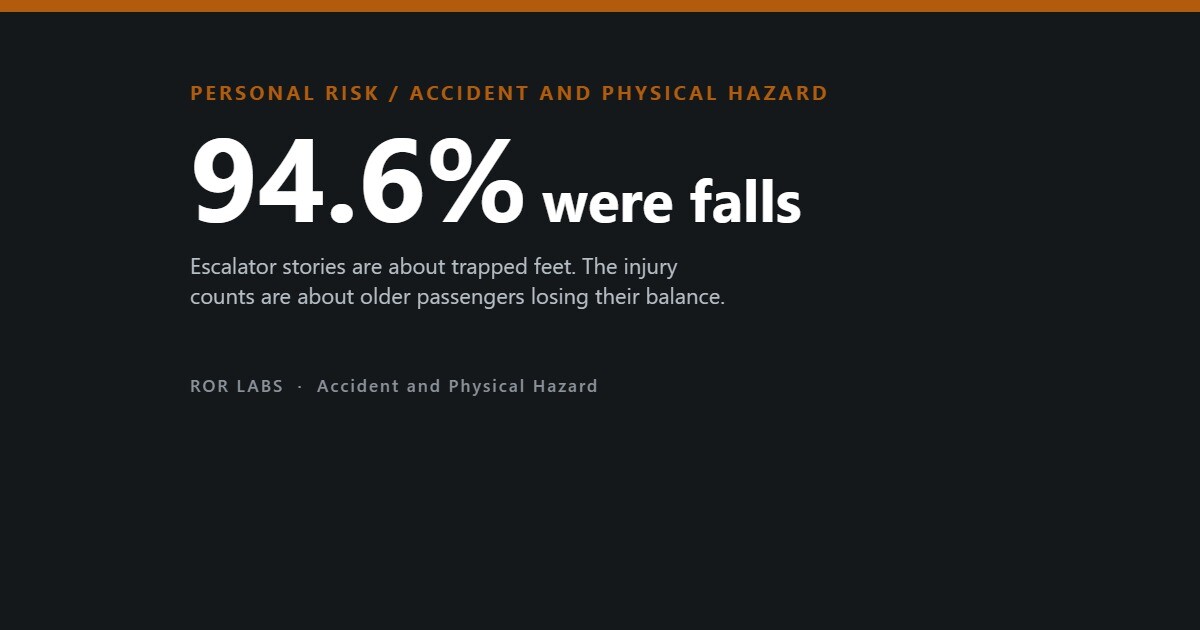
This is what the evidence shows about escalator injuries: how they happen, who they happen to, why the public picture is skewed, and what happens when a crowded escalator fails. One number sums it up: in 799 escalator accidents on the Beijing subway, 94.6% of the casualties were falls.
How escalator injuries actually happen
Escalators move an enormous number of people. An engineering review by Thomas Bress and colleagues estimated that the United States has more than 33,000 escalators carrying around 245 million people a day, and about 10,000 escalator injuries a year treated in emergency departments. Per ride, the risk is very small. Across a population, it adds up to a steady stream of patients.
The mechanism is consistent across countries. Zhiru Wang and colleagues analysed accident data provided by the Beijing subway for 2016 to 2018: 799 escalator accidents with 895 casualties. Falls made up 94.6% of them. Entrapment, electric shock and fright together accounted for the rest.
On Istanbul’s Marmaray line, which has some of the deepest stations in Europe, Abdullah Algın and colleagues reviewed 82 patients treated at a nearby hospital. Eighty of them had fallen, 97.6%. Two had a limb trapped. Nobody died.
In the United States, Joseph O’Neil and colleagues used the national injury surveillance system to study adults aged 65 and over from 1991 to 2005. They estimated 39,850 escalator injuries in that group, and 84.9% were a slip, trip or fall.
Most escalator injuries are falls
Share of escalator injuries or casualties caused by a fall, in four data sets.
Algın and colleagues, Annals of Saudi Medicine, 2019; Wang and colleagues, International Journal of Environmental Research and Public Health, 2020; O’Neil and colleagues, Accident Analysis and Prevention, 2008; McGeehan and colleagues, Pediatrics, 2006.

Who gets hurt
Older adults, above all. In O’Neil’s US study, the injury rate for people aged 65 and over was 7.8 per 100,000 a year, and it doubled over the 15 years studied. The average age of the injured was 80, and 73.3% were women. Head injuries made up a quarter of the total, and both head injuries and hospital admissions became more common with age.
A prospective study of 104 escalator injuries at a Korean emergency department by Dong Hoon Lee and colleagues found a similar picture. More than half, 56.7%, were aged 65 or over, and only 11 were children under 15. Most of the older patients were hurt while standing still on the moving steps. Among those under 65, almost half were hurt while walking on a moving escalator.
In the Guangzhou metro, Hongwei Li and colleagues analysed 967 escalator accidents from 2013 to 2015. Passengers aged 66 and over were the most likely to be seriously injured, and existing health conditions and rainy weather were both associated with more severe outcomes.
Children are hurt too, but less often. Jennifer McGeehan and colleagues estimated about 26,000 escalator injuries among US children and teenagers from 1990 to 2002, around 2,000 a year, a rate of 2.6 per 100,000. Children under five had the highest numbers.
Injury rates by age, United States
Emergency-department-treated escalator injuries per 100,000 people a year.
O’Neil and colleagues, Accident Analysis and Prevention, 2008; McGeehan and colleagues, Pediatrics, 2006. Different periods; national estimates from the National Electronic Injury Surveillance System.
Why the picture in the news is different
Entrapment is real, and it is the kind of injury that is worst for young children. In McGeehan’s US data, falls were still the most common mechanism overall, but entrapment accounted for a larger share among children under five than among older children. Soft rubber clogs and sandals have been repeatedly linked to feet caught at the side of the steps.

What gets reported is another matter. Kefan Xie and Zimei Liu analysed Chinese news reports about escalator incidents and counted the words that appeared most often. “Child” appeared 249 times, more than “elder” at 161. “Entrap” and “stuck” appeared 112 times between them.
The injury data point the other way. Older adults dominate the emergency department counts, and falls dominate the mechanisms. News is drawn to the unusual and the vivid; a grandmother losing her footing at the top of an escalator is common enough that it rarely makes a headline.
That matters because the advice follows the attention. Warnings about soft shoes and loose clothing protect against entrapment. They say little to the older passenger with a bag in one hand, whose risk is losing balance as the step starts or stops moving.
What the news talks about
Frequency of selected keywords in Chinese news reports about escalator incidents.
Xie and Liu, International Journal of Environmental Research and Public Health, 2019. Counts of words in news coverage, not counts of injuries.
What people were doing when they fell
The most detailed look at causes comes from Taipei. Chia-Fen Chi, Tin-Chang Chang and Chi-Lin Tsou investigated 194 escalator accidents at heavy-capacity metro stations in 2000, when the accident rate was about 0.815 per million passenger trips.
The largest group, 38 accidents, involved passengers doing something else at the same time: carrying luggage in 24 cases, looking after a companion in nine. Loss of balance accounted for 26, not holding the handrail for 20, passengers who were unwell for 18, and being struck by another passenger for 16.
A Bayesian analysis of metro escalator accidents in China by Yingying Xing and colleagues found another pattern: passengers were more likely to be involved in an accident when travelling with a companion. The authors suggested two reasons. Older passengers tend to travel with someone, and a companion who tries to catch a falling person can fall too. Conversation also distracts.
None of these causes is exotic. They are the ordinary business of moving through a station: a suitcase, a child, a phone, a rush for a train, a hand that is not free for the rail. That is why escalator safety is mostly a question of what people are carrying and whether they can hold on.
Causes of 194 escalator accidents, Taipei metro
In-depth investigation of escalator riding accidents at heavy-capacity stations, 2000.
Chi, Chang and Tsou, Accident Analysis and Prevention, 2006. Accident rate about 0.815 per million passenger trips.
What helps
The measures that follow from this evidence are mostly unglamorous. The Taipei investigators drew their prevention measures directly from the causes they found: announcements and signs asking passengers to hold the handrail, discouraging heavy luggage and trolleys on escalators, and steering people who are unsteady or carrying loads towards lifts. The largest single group of accidents involved a passenger whose hands or attention were already taken.
For older passengers, the advice matches what works for falls in general. Holding the rail gives a second point of support at the moment the step starts to rise or flatten, which is where balance is most often lost. A lift is not a lesser option; for someone with a bag, a walking aid or uncertain balance it is the safer one.
For children, the protection is different, because their main extra risk is entrapment. Standing in the middle of the step, away from the side panels, holding an adult’s hand and avoiding soft rubber footwear addresses the injuries that are most severe for them.
When a crowded escalator fails
Mechanical failures are rare, but when they happen on a full escalator the result is a crowd problem. In March 2025, an ascending escalator packed with passengers at Taft Avenue station on Manila’s MRT-3 line malfunctioned after its main drive chain broke. Passengers fell on top of one another, and at least ten were injured.
In October 2018, an escalator at Repubblica metro station in Rome sped up and collapsed passengers into a heap at the bottom, injuring around 20 people, many of them football fans travelling to a match. In 2017, an escalator in a Hong Kong shopping centre suddenly reversed and ran downward, injuring 18.
The common factor is load. An escalator that stops or reverses with a few people on it is a scare; one that does so packed from top to bottom turns into a pile-up, because each person who falls knocks down the next. Metro researchers call these cascading accidents. The practical defence is crowd management at the top and bottom, not anything a single rider can do.
How often escalators kill
Rarely, and mostly not passengers. A report for the Center for Construction Research and Training, using US Bureau of Labor Statistics data from 1992 to 2009, estimated about 31 deaths a year involving elevators and escalators combined. About half were workers installing, repairing or maintaining the equipment. Elevators accounted for about 90% of the deaths.
For escalators, falls were again the most common cause of death, about three quarters, followed by entrapment. O’Neil’s study of older US adults found no deaths at all among the estimated 39,850 injuries, although a fall down moving metal steps can cause serious head injuries and fractures.
Deaths involving lifts and escalators, United States
Estimates from Bureau of Labor Statistics data, 1992 to 2009.
Center for Construction Research and Training, Deaths and injuries involving elevators and escalators, 2013. About half of all deaths were workers.
What the evidence does not show
It does not show that entrapment is harmless. It is less common than falling, but it is concentrated in young children and can cause severe injuries, including amputations. Safety codes such as the US ASME A17.1 standard added periodic tests of the gap between step and side panel in 2000 for that reason.
It does not show that escalators are more dangerous than stairs. None of the studies here compared them per trip, and escalators remain a very safe way to move large numbers of people.
And the doubling of the older adult injury rate in the United States comes from one surveillance-based study ending in 2005. It may reflect how injuries were recorded as well as how they happened, and more recent national analyses have not updated that figure directly.
Questions people ask
How do most escalator injuries happen?
By falling. In the Beijing subway 94.6% of escalator casualties were falls, and in US adults aged 65 and over 84.9% of injuries were a slip, trip or fall.
Who is most at risk on escalators?
Older adults. In the US, adults 65 and over had an injury rate of 7.8 per 100,000 a year, three times the rate among children and teenagers.
Are children at risk of getting trapped?
Yes, especially children under five and those wearing soft rubber shoes. Entrapment is a larger share of their injuries than of anyone else’s. Keep children standing in the middle of the step and holding a hand.
Is it safer to walk or stand on an escalator?
In a Korean emergency department study, almost half of injured people under 65 were hurt walking on a moving escalator. Standing and holding the handrail is the position the safety advice is built around.
What should older people do?
Hold the handrail, keep a hand free by carrying less or using a lift with heavy bags, and take the lift if balance is uncertain. Most injuries in older adults were falls.
The short version
- Falls cause most escalator injuries: 94.6% of casualties on the Beijing subway, 97.6% in an Istanbul study.
- Older adults are the most affected; in the US their injury rate was 7.8 per 100,000 a year, against 2.6 for children.
- News coverage emphasises children and entrapment, but injury counts point to older adults and falls.
- Carrying luggage, looking after a companion and not holding the handrail were the commonest causes in Taipei.
- When a crowded escalator fails, the danger is a pile-up; deaths remain rare.
This article summarises published research on escalator injuries. It is not safety guidance for any particular station or building. If you have concerns about balance or falls, ask your doctor, and report faulty escalators to the operator.
Further reading. O’Neil and colleagues, ‘Escalator-related injuries among older adults in the United States, 1991–2005’, Accident Analysis and Prevention, 2008, is the clearest account of who is hurt. Chi and colleagues, Accident Analysis and Prevention, 2006, is the most detailed look at causes.
- Nuts and Bolts, Roma Agrawal (2023). A structural engineer on the seven small inventions behind modern machines, including the springs and gears that make moving stairs possible.
- Engineering in Plain Sight, Grady Hillhouse (2022). An illustrated guide to the infrastructure people walk past every day and rarely think about until it fails.
- Ageless, Andrew Steele (2020). A biologist on the science of ageing, and why the people most at risk of a fall are also the fastest-growing part of the population.
Sources
- Bress T, Kennedy E, Kupkovits RA. Escalator risk and assessment of safety review. ASME International Mechanical Engineering Congress, 2018. doi:10.1115/IMECE2018-87889.
- Wang Z, Bhamra R, Wang M, Xie H, Yang L. Critical hazards identification and prevention of cascading escalator accidents at metro rail transit stations. International Journal of Environmental Research and Public Health, 2020;17:3400.
- Algın A, Gülaçtı U, Erdoğan MÖ, and colleagues. Escalator-related injuries in one of the deepest subway stations in Europe. Annals of Saudi Medicine, 2019. doi:10.5144/0256-4947.2019.112.
- O’Neil J, Steele GK, Huisingh C, Smith GA. Escalator-related injuries among older adults in the United States, 1991–2005. Accident Analysis and Prevention, 2008. doi:10.1016/j.aap.2007.08.008.
- McGeehan J, Shields BJ, Wilkins JR, Ferketich AK, Smith GA. Escalator-related injuries among children in the United States, 1990–2002. Pediatrics, 2006. doi:10.1542/peds.2005-1822.
- Lee DH, Kim CW, Kim SY, Lee SJ. An analysis of escalator-related injuries in an emergency department. Hong Kong Journal of Emergency Medicine, 2010. doi:10.1177/102490791001700302.
- Li H, Wang Y, Xing Y, Zhao X, Wang K. Contributing factors affecting the severity of metro escalator injuries in the Guangzhou Metro, China. International Journal of Environmental Research and Public Health, 2021;18:651.
- Xie K, Liu Z. Factors influencing escalator-related incidents in China: a systematic analysis using ISM-DEMATEL method. International Journal of Environmental Research and Public Health, 2019;16:2478.
- Chi CF, Chang TC, Tsou CL. In-depth investigation of escalator riding accidents in heavy capacity MRT stations. Accident Analysis and Prevention, 2006. doi:10.1016/j.aap.2005.12.010.
- Xing Y, Chen S, Zhu S, Lu J. Analysis factors that influence escalator-related injuries in metro stations based on Bayesian networks: a case study in China. International Journal of Environmental Research and Public Health, 2020;17:481.
- Center for Construction Research and Training (CPWR). Deaths and injuries involving elevators and escalators. 2013.
- GMA News. 10 passengers hurt as MRT-3 escalator malfunctions. March 2025.
- NZ Herald. Ten injured when escalator malfunctions at train station in the Philippines. 2025 (also summarising the 2018 Rome and 2017 Hong Kong incidents).