Influenza: What the Evidence Shows
Key takeaways · 13 min read
- Flu is estimated to cause 290,000 to 650,000 respiratory deaths a year worldwide, but another model puts the figure as low as 99,000. All of these are modelled estimates, not counts.
- The US 2024–25 season was the most severe since 2017–18: an estimated 710,000 hospital admissions, 45,000 deaths and 290 reported deaths in children, the most in a regular season since 2004.
- Older people, young children, pregnant women and people with chronic illness carry most of the risk, yet over half of the children who died with flu-related brain inflammation had no underlying condition.
- In an Ontario study, heart attack admissions were about six times more frequent in the week after a laboratory-confirmed flu infection.
Most of us treat flu as a routine part of winter, and for most people it is: a week of fever, aches and cough. But the 2024–25 season in the United States was the most severe in seven years, more children died than in any ordinary season on record, and Japan saw more flu patients per clinic than at any time since 1999.
The sections below cover how many people flu kills and how those numbers are made, who is most at risk, what flu can do to the heart and, rarely, the brain, how well vaccines and antivirals work, and where bird flu fits. Earlier articles here covered how respiratory viruses actually spread and deaths in cold weather.
Flu is a serious illness for the old, the very young and people with chronic disease, and occasionally for healthy adults and children too, though nearly every large number in this field is an estimate from a model or an observational study.
How many people flu kills
Most flu deaths are never confirmed by a test. People die of pneumonia, heart failure or a stroke after the virus has gone, and death certificates rarely name influenza. So agencies estimate. The World Health Organization’s figure of 290,000 to 650,000 respiratory deaths a year comes from a CDC-led modelling study that WHO adopted in late 2017. WHO also puts severe cases at 3 to 5 million a year.
Other teams reach different answers for the same world. The GLaMOR project estimated 294,000 to 518,000 respiratory deaths a year for 2002–2011, close to the CDC figure. The Global Burden of Disease study counted only lower respiratory infections caused directly by flu and arrived at 99,000 to 200,000. The GLaMOR authors say the gap comes mainly from which deaths each team chose to count.
Three models, three answers
Estimated influenza-associated deaths worldwide per year, by research group. All are modelled; none is a count.
Source: Paget et al., Journal of Global Health (2019), comparing the CDC-led, GLaMOR and GBD estimates; WHO fact sheet on seasonal influenza (2025).
In the US, CDC estimates that flu caused 9.4 million to 51 million illnesses, 120,000 to 710,000 hospital admissions and 6,300 to 52,000 deaths each year between 2010 and 2025. The model rests partly on FluSurv-NET, a hospital surveillance network covering about 9% of the population. Arguments over whether these figures are too high or too low are arguments about modelling, since the deaths themselves are not counted.

The severe 2024–25 season
CDC classed 2024–25 as a high-severity season for every age group, the first since 2017–18. Its end-of-season estimates, still preliminary, are 51 million illnesses, 710,000 hospital admissions and 45,000 deaths. The cumulative hospitalisation rate reached 127.1 per 100,000 people, about double the median for the seasons since 2010–11, and 89.1% of patients in hospital had at least one underlying condition.
A season well above the usual
Cumulative flu hospitalisation rate per 100,000 people, FluSurv-NET, United States.
Source: CDC, MMWR 74(34), 11 September 2025; preliminary data through 30 April 2025. FluSurv-NET covers about 9% of the US population.
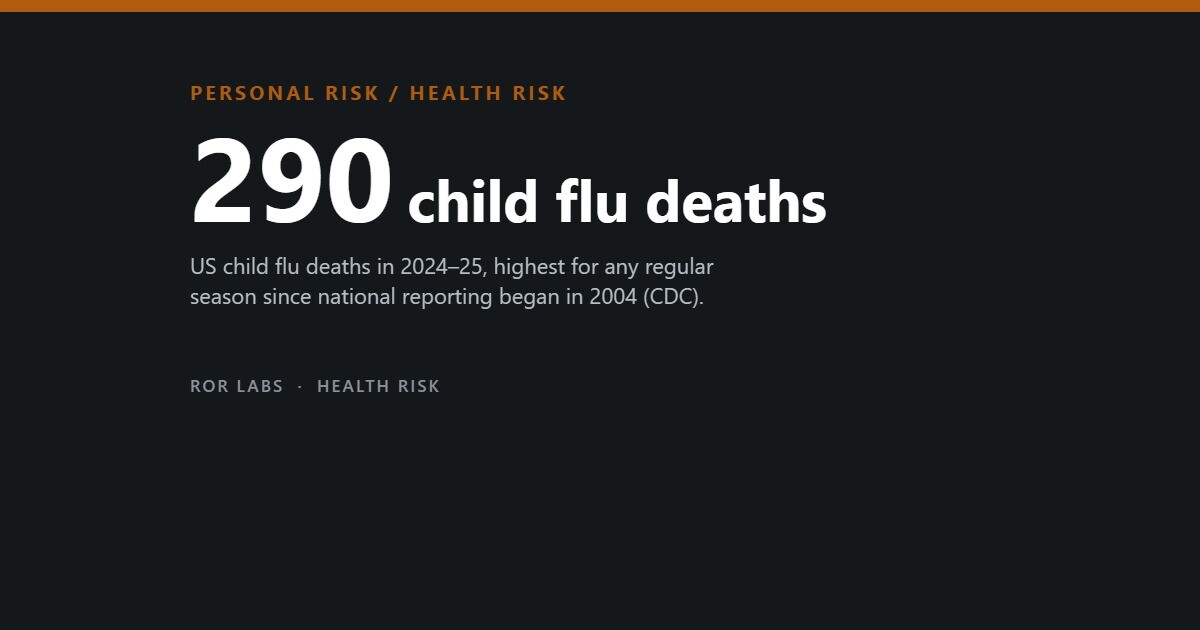
By February 2026 CDC had received 290 reports of flu-associated deaths in children for the season, the most for any regular season since reporting began in 2004, and because many such deaths are never reported, CDC’s own model puts the true number at about 790.
Japan had a similar winter. In the week to 29 December 2024 its roughly 5,000 sentinel clinics reported an average of 64.39 flu patients each, the highest since records began in 1999, and 317,812 cases in that one week (Japan Times, 9 January 2025). During that season the Taiwanese actress Barbie Hsu, 48, died while on a family holiday in Japan. Her sister, Dee Hsu, said the cause was influenza-induced pneumonia (Reuters, 3 February 2025).
Her fame made the death news, though such cases happen every winter. In Oceanside, California, Lauren Caggiano, a 49-year-old grandmother whose family said she had no underlying medical conditions, died on 19 February 2025 after flu led to pneumonia, sepsis and organ failure (10News San Diego, 4 March 2025). San Diego County had recorded 150 flu deaths that season by late February, more than twice the season before.
When flu reaches the brain
In late January 2025 CDC began hearing of children with acute necrotising encephalopathy (ANE), a rare and severe form of influenza-associated encephalopathy in which the brain swells rapidly after a fever. CDC looked back at 1,840 flu deaths in children since 2010–11: 166 of them (9%) involved encephalopathy or encephalitis. In 2024–25 the share was 13%, or 9 of 68, by early February.
Median age was 6, 54% had no underlying condition, and only 20% had been vaccinated that season, so these were mostly not frail children. A US working group then gathered 41 children with flu-associated ANE from 23 hospitals over the 2023–24 and 2024–25 seasons. In JAMA in July 2025 it reported that 11 (27%) died, a median of three days after symptoms began.
Often healthy, seldom vaccinated
Children with severe flu-related brain illness in two US studies.
Sources: Fazal et al., MMWR (2025), 166 fatal cases 2010–11 to 2024–25; IA-ANE Working Group, JAMA (2025), 41 children at 23 hospitals.
There is no dedicated national surveillance for ANE in the US, so CDC says it cannot tell whether the 2024–25 reports were above the usual level. Japanese doctors have described influenza encephalopathy in children for decades; a Hokkaido series of 89 cases between 1994 and 2002 recorded 33 deaths.
The 2025–26 season also killed children. On 6 January 2026 Boston’s Public Health Commission reported flu-associated deaths of two children under the age of two, the city’s first child flu deaths since 2013, urging parents to seek care at once for trouble breathing or extreme lethargy. By early May CDC had 158 child deaths for the season; about 85% of eligible children with known status had not been fully vaccinated.
Who is most at risk
WHO lists pregnant women, children under five, older people, people with chronic heart, lung, kidney, metabolic, neurological, liver or blood conditions, and people with weakened immune systems. CDC’s list adds children under two in particular, women up to two weeks after giving birth, nursing-home residents, people with asthma or diabetes, and adults with a body mass index of 40 or more.
In 2024–25 the US hospitalisation rate among people aged 75 and over was 598.8 per 100,000, nearly five times the rate for all ages. In the GLaMOR global estimate, two-thirds of flu deaths were in people aged 65 and over, although the share varied widely by region, from 36% in sub-Saharan Africa upwards.
Healthy people are not exempt, as the brain-illness figures show, but the practical rule is simple: if you are in a high-risk group, or caring for a young child, and flu symptoms start, contact a doctor early rather than waiting. WHO advises that people at high risk be treated with antivirals as soon as possible.
Flu and heart attacks
Heart disease deaths have long been seen to rise during flu epidemics. The cleanest test came from Jeffrey Kwong and colleagues in Ontario, published in the New England Journal of Medicine in 2018. They took adults with laboratory-confirmed flu between May 2009 and May 2014 and compared each person with themselves: heart attack admissions in the week after a positive test against the rest of a two-year window.
There were 364 admissions for acute myocardial infarction in 332 patients, and 20 fell in the first week. That gave an incidence ratio of 6.05, roughly a sixfold rise, which was gone after the first week. The ratio was higher with influenza B than with influenza A, and smaller but still raised for RSV and other respiratory viruses, which suggests that infection and inflammation in general can tip an unstable artery over.
The first week after infection
Incidence ratio for heart attack admission in the 7 days after a positive test, compared with the same people at other times. Baseline = 1.
Source: Kwong et al., New England Journal of Medicine (2018); self-controlled case series in Ontario, 364 admissions in 332 patients. Ratios, not absolute risks.
The design cancels out fixed traits such as smoking or genes, but it only sees people who were tested, who tend to be older and sicker. An earlier English study found heart attack risk 4.19 times higher in the three days after a GP visit for any acute respiratory infection. Chest pain during or just after flu needs emergency care rather than waiting it out.
How well the vaccine works
Flu vaccines are reformulated every year to match the strains expected to circulate, and how well they work depends on that forecast. CDC’s Flu VE Network estimates have ranged from 19% in 2014–15 to 60% in 2010–11. The preliminary figure for 2024–25 was 56%.
Effectiveness changes every season
Adjusted overall flu vaccine effectiveness, selected US seasons, US Flu VE Network.
Source: CDC, Past Seasons’ Vaccine Effectiveness Estimates (accessed November 2026). Test-negative observational design.
These figures come from test-negative studies. Among people who seek care for a respiratory illness and are tested, the odds of a positive flu test are compared between vaccinated and unvaccinated people. The design is efficient and cancels some biases, but it is observational, and CDC’s authors list unmeasured confounding, such as prior vaccination and underlying illness, among its limitations.
In the 2025–26 season a drifted H3N2 strain known as subclade K differed antigenically from the vaccine virus, and by the interim analysis 83% of characterised H3N2 viruses belonged to it. Effectiveness against hospital admission was 41% in children and 30% in adults.
Protection was lower than hoped but not zero: CDC’s models estimate that vaccination prevented about 180,000 hospital admissions and 12,000 deaths in 2024–25. Those numbers are modelled from the effectiveness estimates and carry the same caveats.
Antivirals and the argument over them
Two main kinds of antiviral are used for flu: neuraminidase inhibitors such as oseltamivir, and baloxavir, which blocks a different viral enzyme. Their value has been argued over for more than a decade, because trials and observational studies point different ways.

In 2014 a Cochrane team led by Tom Jefferson obtained full clinical study reports from manufacturers and regulators, covering 20 oseltamivir trials with 9,623 participants. Oseltamivir shortened symptoms in adults by about 16.8 hours, from 7 days to 6.3. It did not significantly reduce hospital admissions, its effect on pneumonia rested on unverified self-reports, and it increased nausea and vomiting.
Observational data on very ill patients look better. A pooled analysis of 29,234 people admitted to hospital with pandemic H1N1 flu in 2009–10 linked neuraminidase inhibitors with lower odds of death (adjusted odds ratio 0.81), and 0.50 when started within two days. Roche, which makes oseltamivir, funded it through an unrestricted grant, and the authors acknowledge residual confounding by severity.
Baloxavir brings a newer claim. In a Roche-funded trial in 15 countries, treating the infected person cut laboratory-confirmed spread to household members from 13.4% to 9.5%; symptomatic spread was not significantly reduced, and 7.2% of treated patients developed resistant virus.
CDC and WHO still advise early antiviral treatment for people at high risk and anyone severely ill. Whether to prescribe, and which drug, is a clinician’s decision.

What about bird flu?
H5N1 bird flu is a separate matter. CDC counts 74 human H5 cases in the US since February 2024, mostly among dairy and poultry workers exposed to infected animals. On 6 January 2025 it announced the first US death from H5 bird flu, in Louisiana, and said no person-to-person spread had been identified.
CDC still describes the risk to the public as low, though the virus could adapt to spread between people. For now the flu that fills hospitals each winter is the ordinary seasonal kind.
What to do
Steps sorted by when they matter. Each one says how strong the evidence is: Measured Official advice Untested
Before
- Ask your doctor or pharmacist which flu vaccine suits your age and health; even in the mismatched 2025–26 season it cut hospital admissions by 30–41%. Measured see Sources
- Learn the emergency warning signs for adults and for children before the flu season starts. Official advice see Sources
- If you are in a high-risk group, agree with your doctor in advance how to be seen quickly if flu symptoms start. Untested see Sources
If it happens
- Call emergency services for trouble breathing, chest pain or pressure, confusion or seizures, and in a child for bluish lips or face or not waking or interacting. Official advice see Sources
- If you are at high risk, contact a doctor as soon as symptoms start: antivirals work best within two days of falling ill. Official advice see Sources
- Seek care at once if a young child with flu has trouble breathing, a persistent high fever or extreme lethargy. Official advice see Sources
Afterwards
- Treat new chest pain in the week after flu as an emergency: heart attack admissions were about six times more frequent in that week. Measured see Sources
- Get medical help if a fever or cough improves and then returns or worsens. Official advice see Sources
What not to do
- Do not wait to see how it goes if you are at high risk; WHO advises antiviral treatment as soon as possible for high-risk people. Official advice see Sources
- Do not take or share leftover antivirals on your own; whether to prescribe, and which drug, is a clinician’s decision. Untested see Sources
- Do not assume a healthy child cannot become seriously ill: 54% of children who died with flu-related encephalopathy had no underlying condition. Measured see Sources
Not medical advice. If you are in a high-risk group, contact a doctor early when flu symptoms start.
Questions people ask
Is flu really worse than a bad cold?
For most healthy people it passes within a week or two. But CDC estimates 710,000 US hospital admissions in 2024–25 alone, and flu can trigger pneumonia, heart attacks and, rarely, brain inflammation.
Can healthy people die of flu?
Yes, though it is uncommon. Over half of the children who died with flu-related encephalopathy in CDC’s review had no underlying condition, and the 2025 case reports above include adults described by their families as healthy. Most deaths still occur in older people and those with chronic illness.
Is the vaccine worth having in a mismatched year?
Even in 2025–26, with subclade K circulating, interim estimates showed 30% to 41% protection against hospital admission. That reduces the risk; it does not remove it. If you are unsure, ask your doctor or pharmacist about the vaccine that suits your age and health.
When should I get medical help?
Call emergency services for trouble breathing, chest pain or pressure, confusion, seizures, or, in a child, bluish lips or face or not waking or interacting. If you are in a high-risk group, contact a doctor as soon as flu symptoms start, because antivirals work best early.
Do antivirals help if started late?
CDC says they work best within two days of falling ill but can still help people at high risk or very ill. In the pooled 2009 pandemic data, treatment started after two days showed no clear benefit overall, except in adults in critical care.
The short version
- Flu is estimated to cause 290,000 to 650,000 respiratory deaths a year worldwide, but another model puts the figure as low as 99,000. All of these are modelled estimates, not counts.
- The US 2024–25 season was the most severe since 2017–18: an estimated 710,000 hospital admissions, 45,000 deaths and 290 reported deaths in children, the most in a regular season since 2004.
- Older people, young children, pregnant women and people with chronic illness carry most of the risk, yet over half of the children who died with flu-related brain inflammation had no underlying condition.
- In an Ontario study, heart attack admissions were about six times more frequent in the week after a laboratory-confirmed flu infection.
- Vaccine effectiveness ranged from 19% to 60% across recent US seasons and was 30% to 41% against hospital admission in the mismatched 2025–26 season.
- Antivirals shorten symptoms modestly in trials, and observational data suggest early treatment helps very ill patients. If you are at high risk, see a doctor early; call emergency services for warning signs.
This article summarises research, public health reports and news coverage for general information. It is not medical advice. If you are at high risk or worried about symptoms, talk to a doctor or pharmacist, and call emergency services for severe warning signs.
Further reading: Kwong et al., New England Journal of Medicine (2018), for the clearest test of flu as a heart attack trigger. Fazal et al., MMWR (2025), for the US record of flu-related brain illness in children. Jefferson et al., Cochrane Database of Systematic Reviews (2014), for the trial evidence on neuraminidase inhibitors.
Sources
- Maloney P, Reeves EL, Wielgosz K, et al. Interim influenza vaccine effectiveness estimates, 2025–26 season (NVSN, US Flu VE and VISION networks). MMWR 75(9) (12 March 2026), doi:10.15585/mmwr.mm7509a2.
- World Health Organization. Influenza (seasonal). Fact sheet (28 February 2025).
- Paget J, Spreeuwenberg P, Charu V, et al. Global mortality associated with seasonal influenza epidemics: new burden estimates and predictors from the GLaMOR Project. J Glob Health (2019), doi:10.7189/jogh.09.020421.
- Centers for Disease Control and Prevention. About estimated flu burden (accessed November 2026).
- Centers for Disease Control and Prevention. 2024–2025 influenza season summary: severity, disease burden, and burden prevented (12 March 2026).
- Centers for Disease Control and Prevention. FluSurv-NET report on influenza-associated hospitalizations in the 2024–25 season. MMWR 74(34) (11 September 2025).
- Japan Times. Report on record influenza cases in Japan in the week to 29 December 2024 (9 January 2025).
- Reuters (via Philstar Interaksyon). Taiwan’s Barbie Hsu, hugely popular in East Asia, dies of flu (3 February 2025).
- 10News San Diego. 49-year-old Oceanside woman dies of flu complications (4 March 2025).
- Fazal A, Reinhart K, Huang S, et al. Reports of encephalopathy among children with influenza-associated mortality: United States, 2010–11 through 2024–25 influenza seasons. MMWR 74(6) (2025).
- Influenza-Associated Acute Necrotizing Encephalopathy (IA-ANE) Working Group. Influenza-associated acute necrotizing encephalopathy in US children. JAMA 334(8):692–701 (2025), doi:10.1001/jama.2025.11534.
- Togashi T, Matsuzono Y, Narita M, Morishima T. Influenza-associated acute encephalopathy in Japanese children in 1994–2002. Virus Res (2004), doi:10.1016/j.virusres.2004.02.016.
- Boston Public Health Commission. Two flu-associated deaths among children under two years old in Boston (6 January 2026).
- Centers for Disease Control and Prevention. Weekly US influenza surveillance report, week 17, ending 2 May 2026 (FluView).
- Centers for Disease Control and Prevention. Patient brochure on flu symptoms, emergency warning signs and antivirals (2019).
- Kwong JC, Schwartz KL, Campitelli MA, et al. Acute myocardial infarction after laboratory-confirmed influenza infection. N Engl J Med 378:345–353 (2018).
- Warren-Gash C, Hayward AC, Hemingway H, et al. Influenza infection and risk of acute myocardial infarction in England and Wales: a CALIBER self-controlled case series study (2012).
- Centers for Disease Control and Prevention. Past seasons’ vaccine effectiveness estimates (accessed November 2026).
- Jefferson T, Jones MA, Doshi P, et al. Neuraminidase inhibitors for preventing and treating influenza in adults and children. Cochrane Database Syst Rev (2014), doi:10.1002/14651858.CD008965.pub4.
- Muthuri SG, Venkatesan S, Myles PR, et al. Effectiveness of neuraminidase inhibitors in reducing mortality in patients admitted to hospital with influenza A H1N1pdm09 virus infection: a meta-analysis of individual participant data. Lancet Respir Med (2014).
- Monto AS, Kuhlbusch K, Bernasconi C, et al. Efficacy of baloxavir treatment in preventing transmission of influenza. N Engl J Med 392(16):1582–1593 (2025), doi:10.1056/NEJMoa2413156.
- Centers for Disease Control and Prevention. A(H5) bird flu: current situation (updated 5 November 2026).
- Centers for Disease Control and Prevention. First H5 bird flu death reported in United States (6 January 2025).