Falls From Windows and Balconies: What the Evidence Shows
Key takeaways · 13 min read
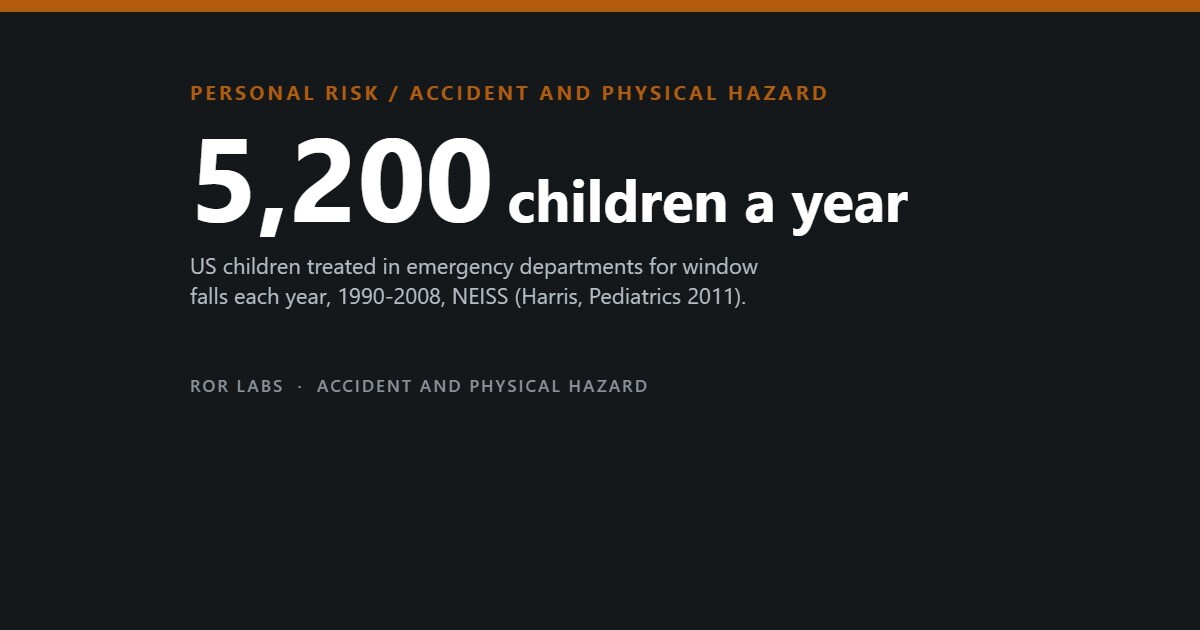
- About 5,200 children a year were treated in US emergency departments after falling from a window between 1990 and 2008. Two in three were aged four or under, and one in four was admitted to hospital.
- Window screens keep insects out, not children in. Furniture under a window, a hard landing surface and a fall of three storeys or more all raise the risk of serious injury.
- New York City’s window guard rule of 1976 was followed by a fall of more than half in child window falls within three years. The comparison is before and after, without a control city.
- Balcony falls among young holidaymakers are strongly tied to alcohol, but the consular figures behind most warnings are raw counts with no denominator.
A fall from a window is one of the few serious childhood injuries that a cheap piece of hardware can prevent. It keeps happening anyway, mostly to toddlers at home and mostly from the first few floors. Among young adults the risk moves to hotel balconies on holiday, and now and then a balcony gives way under a crowd.
We draw on US emergency department studies, hospital series from Europe, New York City’s fifty-year window guard rule, a Spanish study of holiday balcony falls, and official findings on several real deaths. Earlier pieces here covered falls at home among older adults and ladder falls.
The causes are well understood and the fixes simple, yet most numbers come from hospital samples or official tallies without a proper comparison group, so we know far more about who gets hurt than about how much each fix helps.
How often children fall from windows
The best national picture comes from a 2011 study in Pediatrics by Vaughn Harris, Lynne Rochette and Gary Smith at Nationwide Children’s Hospital in Ohio. Using the National Electronic Injury Surveillance System, a sample of US emergency departments, they estimated that 98,415 children were treated for window-fall injuries from 1990 to 2008, an average of about 5,200 a year, or roughly 14 a day.
Children aged four and under made up 65% of injuries and were more than three times as likely as older children to hurt their heads. One in four was admitted. The annual rate did fall over the period, driven by a drop among the youngest.
Who is treated after a window fall
Children aged 0–17 treated in US emergency departments for window-fall injuries, 1990–2008 (national estimate from a sample of hospitals).
Source: Harris, Rochette and Smith, Pediatrics (2011), and Nationwide Children’s Hospital release on the study (22 August 2011). NEISS records emergency visits only, not deaths at the scene.
Screens, furniture and the landing
‘Window screens will not prevent a child from falling out of a window,’ Gary Smith said when the US study was published, adding that many children in the data had pushed a screen out and then fallen. Screens exist to keep insects out and cannot hold a leaning toddler.
In the US data more than 190 children a year fell after climbing on furniture placed near a window, and at a Zurich children’s intensive care unit Mayer and colleagues found that 15 of 31 children who fell from buildings, 49%, had climbed on furniture first, and 87% fell from the third floor or lower.
A small Seattle pilot study led by Brian Johnston measured 18 windows children had fallen from and found that, compared with windows in other homes, they were more often horizontal sliders and had deeper sills, 6.28 inches against 4.31: a ledge a small child can kneel on.
What the falls have in common
Shares of children in three hospital and community studies. Each study had its own sample and definitions.
Sources: Mayer et al., Pediatric Surgery International (2006); Apostolopoulou et al., Child’s Nervous System (2023); Istre et al., Injury Prevention (2003). Small, single-centre samples.
In the US study, landing on a hard surface roughly doubled the chance of a head injury, and falls of three storeys or more raised the risk of serious harm. At a children’s neurosurgery unit in north-west England, 21 of 25 children seen after window falls had landed on concrete, and three of the 25 died.
What New York did
In 1972 New York City’s Health Department launched ‘Children Can’t Fly’. Emergency rooms and police reported falls, nurses visited families, a media campaign ran and free window guards went to families with young children in high-risk areas, as Charlotte Spiegel and F. C. Lindaman described in 1977.
The results persuaded the Board of Health to amend the Health Code in 1976. Landlords had to fit window guards in apartments where children aged ten and under lived, the first such rule in the country. Today it covers buildings with three or more flats, and guards or limiting devices must stop a window opening more than 4.5 inches.
New York, before and after the rule
Child window falls in New York City, and the city’s housing compared with the US as a whole.
Sources: NYC Health Department (15 April 2026); Pressley and Barlow, Injury Prevention (2005). The city’s figures are before-and-after counts without a control group.
The city says 24 children died in window falls in 1976, and that falls dropped by more than half within three years. In 2025 it recorded four non-fatal falls among children aged ten and under. Enforcement is still needed: inspectors issued more than 7,045 violations for missing or defective guards in the year to June 2025.
Joyce Pressley and Barbara Barlow offer a cross-check. New Yorkers are far more likely than other Americans to live in big blocks, yet the city’s rate of child injury from falls from buildings was nearly half the national rate. That compares places rather than testing the rule, but it points the same way.
Restrictors and the 100 mm gap
Outside New York the main tool is the window restrictor, a catch or cable that limits how far a window opens. The UK Health and Safety Executive notes that restrictors typically limit openings to no more than 100 mm. Its 2012 alert, which referred to a fatal incident, warned that some side-stay restrictors with plastic spacers could fail.
For homes, England’s National Child Mortality Database repeated the Royal Society for the Prevention of Accidents’ advice: fit restrictors on windows above the ground floor, ideally with a child-safe catch that needs no key in an emergency. It also quoted the Child Accident Prevention Trust’s estimate that one child under five is admitted to hospital each day in the UK after a fall from a building.
A restrictor only helps while it is engaged, and in July 2022 a boy of 22 months died after falling from a seventh-floor flat in a Leeds tower block. The window had a key lock and hinge restrictors, but the inquest heard these had been disengaged. The senior coroner recorded accidental death in December 2023 and did not issue a prevention of future deaths report.
His mother said she had asked the council several times for a cable lock. His sister called the council’s plan for safety leaflets the bare minimum and asked for permanent restrictors in high-rise blocks that house children or disabled people. The council said it would keep working on window safety advice.
Balcony falls on holiday
Among young adults the risk moves to hotels, and doctors in Spain call the result ‘balconing’: jumping from a balcony into a pool, or falling while climbing between balconies. Juan José Segura-Sampedro and colleagues reviewed five years of cases at the main trauma centre in the Balearic Islands and found 46 patients, almost all young men, most of them British.
Holiday balcony falls in the Balearics
46 patients treated after falls from hotel balconies at a Balearic Islands trauma centre over five years. Mean age 24.
Source: Segura-Sampedro et al., Injury (2017). One hospital; no count of how many guests stayed on balconies without falling.
The average fall was about three floors. Only six patients had jumped on purpose; the other 40 fell while trying to reach another balcony. The authors argue balconing is best treated as a consequence of binge drinking rather than a stunt.
The British government has issued warnings for years. In 2013 the embassy in Madrid said there had been 18 balcony falls and four deaths of Britons across Spain in 2012, that many involved alcohol, and that drinking could invalidate travel insurance. Those figures come from consular cases, so they count Britons who sought help and say nothing about how many Britons stayed in hotels that year.
In June 2019 Freddie Pring, a 20-year-old recruitment consultant who played rugby for Minehead Barbarians, died after falling from a second-floor hotel balcony in Magaluf on a work trip. At his inquest that November the coroner recorded accidental death. He said Freddie had most likely tripped, over-balanced or stumbled, and rejected suggestions that he had been balconing.
Toxicology showed alcohol but no drugs. His mother, Heather Pring, said it was important that his death be reported as a tragic accident, and has set up a memorial fund in his name.
When the balcony itself fails
Using the same US emergency department sample, Brenda Shields and colleagues estimated 86,500 balcony-fall injuries from 1990 to 2006, mostly among adults and at home, and structural failure of the balcony was involved in an estimated 5,600 cases.
Balcony falls in the United States
Estimated 86,500 balcony-fall injuries treated in US emergency departments, 1990–2006, all ages.
Source: Shields, Burkett and Smith, American Journal of Emergency Medicine (2010). Structural-failure share calculated here from the published estimates.
The best-known collapse happened in Berkeley, California, shortly after 1 a.m. on 16 June 2015. A fifth-floor balcony at an apartment complex gave way during a 21st birthday party. Six young people died, five of them students visiting from Ireland for the summer, and seven more were injured.
In March 2016 the Alameda County district attorney said there would be no criminal charges. After months of investigation, her office concluded that the main cause was water trapped in the balcony deck during construction, which led to dry rot in the timber. Survivors and families filed a dozen civil lawsuits. The people on the balcony had done nothing to cause it.
The deaths changed California law. In September 2018 Governor Jerry Brown signed SB 721, which requires buildings with three or more units to have a sample of their wood-supported balconies, decks and walkways inspected every six years: 15% of elements that stand six feet or more above the ground. Lawmakers cited Berkeley as the reason for the bill.
Older adults and the summer peak
Older people are less studied here, but they come off worst when they fall. In a US trauma centre series of 356 fall admissions, Anne Mosenthal and colleagues found that patients over 64 made up 14% of falls but more than half of deaths, even though most fell from low heights. The HSE alert on window restrictors was aimed at hospitals, care homes and others who look after people at risk of falling from windows.
At Barts Health in London, 61% of 93 children seen after falls from windows, roofs or balconies in 2010–2015 fell in the summer months, according to a conference abstract. In the north-west England series August was the peak month.
In the months after COVID-19 shelter-in-place orders began in 2020, a study at three US children’s trauma centres led by Christina Theodorou found that window falls made up 3.6% of child trauma patients, against 2.1% a year earlier, an odds ratio of 1.7. Rates went back to normal once the early shelter-in-place period ended.
Where the evidence is weak
Most injury data come from emergency department samples or single hospitals. NEISS counts people who reach an emergency department, so deaths at the scene are missed. Hospital series are small and record who was hurt badly enough to come in, not how many near misses there were.
The New York result is a before-and-after comparison with no control city, so other changes over the same years cannot be ruled out. The holiday balcony numbers are consular counts or one hospital’s patients, with no denominator of guests, nights or balconies, so they cannot give a rate.
Even so, the direction is consistent across countries and decades. Young children fall from windows they can open and climb to, and guards or restrictors that stop at about 10 cm prevent that, as long as they are fitted and kept working.
What to do
Steps sorted by when they matter. Each one says how strong the evidence is: Measured Official advice Untested
Before
- Fit window guards or restrictors that stop windows above the ground floor opening more than about 10 cm, ideally with a child-safe catch that adults can release in an emergency. Official advice see Sources
- Move beds, sofas and other furniture away from windows so young children cannot climb up to the sill. Measured see Sources
- Do not count on window screens: many children in the US study pushed a screen out and then fell. Measured see Sources
- If you rent, ask your landlord in writing to fit or repair guards; in New York City, tenants with a child aged 10 or under can call 311 if they refuse. Official advice see Sources
If it happens
- If someone falls from a height, call emergency services straight away and do not move them unless they are in immediate danger. Untested see Sources
- On holiday, do not climb between balconies or jump from them, especially after drinking. Official advice see Sources
- Check that restrictors are engaged each time a window is opened, and keep keys for locked restrictors where adults can reach them quickly. Untested see Sources
Afterwards
- Report a broken, loose or disengaged restrictor or guard to your landlord or council and keep a record of the request. Untested see Sources
- Take extra care in spring and summer, when windows are open more often and child falls peak. Measured see Sources
What not to do
- Do not assume a low floor is safe: most children in hospital series fell from no higher than the second or third floor. Measured see Sources
- Do not disable restrictors to get more air; in the Leeds death the restrictors had been disengaged, and New York’s 2025 falls happened where devices were missing or fitted wrongly. Measured see Sources
- Do not rely on travel insurance after drinking: the Foreign Office warns that alcohol can invalidate cover. Official advice see Sources
Not professional advice. Follow your landlord’s or building’s safety guidance and local rules.
Questions people ask
Will a window screen stop my child falling?
No. In the large US study many children pushed a screen out and then fell. A window guard, or a restrictor that stops the window opening more than about 10 cm, is what prevents falls.
Which floors are dangerous?
Any floor above the ground. Most children in hospital series fell from no higher than the second or third floor, which can feel low to adults. Falls of three storeys or more and landings on concrete carried the highest risk of serious injury in the US data.
How wide should a restricted window open?
UK practice usually works to no more than 100 mm. New York requires devices that stop a window opening more than 4.5 inches, and the US study suggested window stops at 4 inches. A restrictor with a child-safe catch lets adults open the window fully in an emergency.
I rent. Who is responsible for fitting guards?
It depends where you live. In New York City landlords of buildings with three or more units must fit them where a child aged ten or under lives. Elsewhere rules vary, so ask your landlord or council in writing.
Is balconing really common?
Nobody knows the rate, because the figures count injuries, not guests. In one Balearic trauma centre almost every patient had been drinking, and most fell while climbing between balconies rather than jumping.
The short version
- About 5,200 children a year were treated in US emergency departments after falling from a window between 1990 and 2008. Two in three were aged four or under, and one in four was admitted to hospital.
- Window screens keep insects out, not children in. Furniture under a window, a hard landing surface and a fall of three storeys or more all raise the risk of serious injury.
- New York City’s window guard rule of 1976 was followed by a fall of more than half in child window falls within three years. The comparison is before and after, without a control city.
- Balcony falls among young holidaymakers are strongly tied to alcohol, but the consular figures behind most warnings are raw counts with no denominator.
- Restrictors and guards only work when they are fitted and engaged. New York’s four falls in 2025 happened where devices were missing or fitted wrongly.
- Balconies can fail without anyone doing anything risky. The 2015 Berkeley collapse led California to require regular inspections of wooden balconies.
This article summarises research, official records and news reports for general information. It is not safety, legal or medical advice. Ask your landlord, council or a qualified installer about guards and restrictors; if someone has fallen, call emergency services.
Further reading: Harris, Rochette and Smith, Pediatrics (2011), for the national US picture of child window falls. Toprani et al., Injury Prevention (2018), for the history of New York’s window guard rule. Segura-Sampedro et al., Injury (2017), for the clinical profile of holiday balcony falls.
Sources
- NYC Health Department. New York City marks 50 years of window safety, celebrating hundreds of children’s lives saved. Press release (15 April 2026).
- Harris VA, Rochette LM, Smith GA. Pediatric injuries attributable to falls from windows in the United States in 1990–2008. Pediatrics (2011), doi:10.1542/peds.2010-2687.
- Nationwide Children’s Hospital. New study examines window fall-related injuries among youth. News release (22 August 2011).
- Mayer L, Meuli M, Lips U, Frey B. The silent epidemic of falls from buildings: analysis of risk factors. Pediatr Surg Int (2006), doi:10.1007/s00383-006-1731-7.
- Johnston BD, Quistberg DA, Shandro JR, et al. Pilot case–control study of paediatric falls from windows. Inj Prev (2011), doi:10.1136/ip.2010.030395.
- Apostolopoulou K, Setia V, Pettorini B, et al. Secure windows for child safety: a retrospective study of window falls in children, aiming to raise prevention awareness. Childs Nerv Syst 39(11):3195–3205 (2023).
- Istre GR, McCoy MA, Stowe M, et al. Childhood injuries due to falls from apartment balconies and windows. Inj Prev 9(4):349 (2003).
- Spiegel CN, Lindaman FC. Children can’t fly: a program to prevent childhood morbidity and mortality from window falls. Am J Public Health 67(12):1143 (1977), doi:10.2105/ajph.67.12.1143.
- Toprani A, Robinson M, Middleton JK, et al. New York City’s window guard policy: four decades of success. Inj Prev (2018), doi:10.1136/injuryprev-2017-042649.
- Pressley JC, Barlow B. Child and adolescent injury as a result of falls from buildings and structures. Inj Prev 11(5):267 (2005).
- Health and Safety Executive. Risks to vulnerable members of the public from falling from height from windows. Safety alert OPSTD 1-2012 (19 March 2012).
- National Child Mortality Database. Open windows. Safety notice (27 January 2021).
- ITV News Calendar. Death of toddler who plummeted from seventh-floor window ruled accidental (6 December 2023).
- Segura-Sampedro JJ, Pineño-Flores C, García-Pérez JM, et al. Balconing: an alcohol-induced craze that injures tourists. Characterization of the phenomenon. Injury (2017), doi:10.1016/j.injury.2017.03.037.
- British Embassy Madrid. Foreign Office urges British nationals to take care on balconies in popular holiday hotspots in Spain. GOV.UK (1 July 2013).
- Evening Standard. Freddie Pring: British rugby player died after ‘accidental’ balcony fall, inquest hears (21 November 2019).
- Shields BJ, Burkett E, Smith GA. Epidemiology of balcony fall-related injuries, United States, 1990–2006. Am J Emerg Med (2010), doi:10.1016/j.ajem.2009.08.023.
- CBS San Francisco. DA won’t file criminal charges in Berkeley balcony collapse (29 March 2016).
- KTVU. Gov. Brown signs balcony inspection law following deadly Berkeley collapse (17 September 2018).
- Mosenthal AC, Livingston DH, Elcavage J, et al. Falls: epidemiology and strategies for prevention. J Trauma (1995), doi:10.1097/00005373-199505000-00013.
- Haq HA, Fanous RN, Clark M, Parikh A. Falls from buildings in the paediatric population. Emerg Med J (2016), conference abstract, doi:10.1136/emermed-2016-206402.61.
- Theodorou CM, Brown E, Jackson JE, et al. Unintended consequences of COVID-19 on pediatric falls from windows: a multicenter study. J Surg Res 279:187–192 (2022).