Early Peanut Introduction and Food Allergy: What the Evidence Shows
Key takeaways · 13 min read
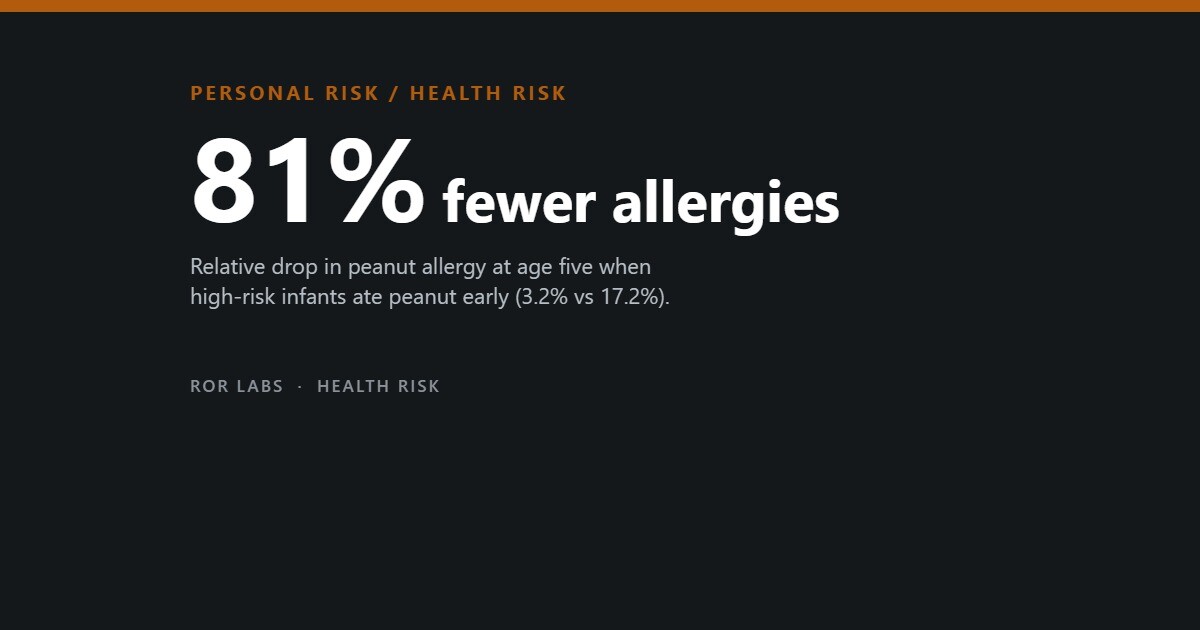
- In the LEAP trial, 17.2% of high-risk infants who avoided peanut were allergic at age five, against 3.2% of those who ate it regularly.
- The protection lasted: at age 12, 15.4% of the original avoidance group were allergic, against 4.4% of the early eaters.
- Feeding is the hard part. In the EAT trial of ordinary babies, only 42.8% of early-introduction families kept to the plan, and the main analysis found no significant benefit.
- After Australia changed its advice, infants eating peanut in their first year rose from 28% to 88%, but peanut allergy fell only from 3.1% to 2.6%, not a significant difference.
For most of the 2000s, parents of babies at risk of allergy in the United States were told to keep peanut away until the age of three. In 2015 a single randomised trial in London turned that advice upside down. Among high-risk infants who avoided peanut until their fifth birthday, 17.2% ended up allergic to it. Among those who ate it regularly from infancy, 3.2% did.
That result, from the LEAP trial, changed infant feeding guidance on several continents within two years. It has also been stretched. The trial studied a carefully screened group of babies with severe eczema or egg allergy, whose parents kept up a demanding feeding routine for years with close support from the study team. Most babies are not like that, and most families do not have that help.
This article sets out what the trials showed, how long the protection lasts, why a trial in ordinary babies struggled, and what happened to allergy rates where the advice changed. It is not feeding advice for any particular child.

A rule that ran backwards
The old advice was not careless. Peanut allergy is a leading cause of anaphylaxis and of deaths from food allergy, it usually lasts for life, and avoiding a feared food seemed the obvious way to prevent it. In 2000 the American Academy of Pediatrics recommended that high-risk children wait until three before eating peanut products. By 2008 the academy had withdrawn that advice, concluding that there was no convincing evidence that delaying foods prevented allergy. Withdrawal was not reversal, and most parents kept waiting.
Meanwhile, peanut allergy kept rising. The LEAP investigators wrote that its prevalence among children in Western countries had doubled in ten years. One observation in particular pointed the other way from the avoidance advice. In a 2008 study comparing Jewish schoolchildren in London and Israel, peanut allergy affected 1.85% of the London children and 0.17% of the Israeli children. Israeli infants aged 8 to 14 months were eating about 7.1 grams of peanut protein a month; British infants of the same age were eating essentially none.
The two groups differed in many ways besides diet, so the comparison proved nothing on its own. But it gave a hypothesis to test: that eating peanut early teaches tolerance, while avoiding it leaves allergy to develop, perhaps through exposure via inflamed skin.
The trial that changed the advice
The Learning Early About Peanut Allergy trial, led by George Du Toit and Gideon Lack at King’s College London, enrolled 640 infants aged 4 to under 11 months who had severe eczema, egg allergy, or both. Before randomisation, each baby had a skin-prick test. A further 76 infants with a strong reaction, a wheal of 5 mm or more, were excluded because they were likely to be allergic already. The rest, in two cohorts with no reaction or a small one, were randomly assigned to eat or avoid peanut until age five.
The eating group was asked to consume at least 6 grams of peanut protein a week, spread over three or more meals. That is roughly 24 grams of peanuts, or three heaped teaspoons of peanut butter, every week for four years or more. At age five, every child had an oral food challenge, the most reliable test of true allergy.
The LEAP trial at age five
Share of children with peanut allergy, confirmed by food challenge, by assigned group. Intention-to-treat analysis.
Sources: Du Toit G et al., New England Journal of Medicine 372(9):803–813 (2015); combined figures from Fleischer DM et al., Pediatrics 136(3):600 (2015).
The relative reduction was 81%. In absolute terms, 14 percentage points: about seven high-risk infants had to eat peanut regularly for one to be spared an allergy. There was no significant difference in serious adverse events between the groups. The trial was publicly funded, chiefly by the US National Institute of Allergy and Infectious Diseases, with support from the UK Medical Research Council and the National Institute for Health Research.
Even infants with a small skin reaction at entry benefited. And adherence was unusually high: 92% followed their assigned diet, helped by regular contact with the study team.
Does the protection last
Perhaps the children were merely kept desensitised by constant exposure, and allergy would surface once they stopped. The investigators tested this. In a follow-up called LEAP-On, published in 2016, they asked all participants to avoid peanut completely for 12 months from age five, regardless of their original group.
Of 628 eligible children, 556 took part. Avoidance was followed well in the original avoidance group (90.4%) and less strictly in the original eating group (69.3%). At age six, after a year without peanut, 18.6% of the original avoidance group were allergic against 4.8% of the original eating group. The gap had not closed.
In 2024 the team reported a third look, LEAP-Trio, at age 12. By then the children had eaten or avoided peanut as they and their families chose for six years. Of the original 640, 508 enrolled. Peanut allergy affected 15.4% of the original avoidance group and 4.4% of the original eating group.
Does the protection last?
Peanut allergy by original LEAP group at each follow-up.
| Study | Age | Original avoidance group | Original eating group |
|---|---|---|---|
| LEAP | 5 years | 17.2% | 3.2% |
| LEAP-On, after 12 months of avoidance | 6 years | 18.6% | 4.8% |
| LEAP-Trio, after free eating or avoidance | 12 years | 15.4% | 4.4% |
Sources: Du Toit G et al., NEJM 374(15):1435–1443 (2016); Du Toit G et al., NEJM Evidence 3(6):EVIDoa2300311 (2024). LEAP-Trio enrolled 508 of the original 640 participants.
That is strong evidence for lasting tolerance, with one caveat: about a fifth of the original children were missing at age 12, and those who return can differ from those who do not.
The adherence problem
LEAP answered the question for one group of high-risk babies. The Enquiring About Tolerance trial, run by the same London group and published in 2016, asked a broader one. It enrolled 1,303 exclusively breastfed infants from the general population at three months of age. Half were asked to start six allergenic foods, including peanut, cooked egg, cow’s milk, sesame, white fish and wheat, from three months, with about 2 grams of protein of each food twice a week. The other half followed the standard UK advice of exclusive breastfeeding to around six months.
Families found the early routine hard. Only 42.8% of the early-introduction group met the protocol, against 92.9% of the standard group. In the main intention-to-treat analysis, food allergy to any of the six foods affected 5.6% of the early group and 7.1% of the standard group, a difference that was not statistically significant. Among families who did stick to the protocol, peanut allergy was 0% against 2.5%.
That per-protocol figure needs caution: families who manage a demanding plan may differ in other ways. A later pooled analysis of the individual data from LEAP and EAT, using methods designed to handle poor adherence, still found a 75% reduction in peanut allergy in the intention-to-treat comparison, 1.9% against 7.6%.
Sticking to the plan
Share of participants who followed their assigned feeding protocol.
Sources: Du Toit G, Foong RX, Lack G, Allergology International (2016), doi:10.1016/j.alit.2016.08.001; Perkin MR et al., NEJM (2016), doi:10.1056/NEJMoa1514210.
The lesson most allergists drew was not that early introduction fails in ordinary babies, but that a single taste is not the intervention.
High-risk babies and everyone else
The 2017 US guidelines, issued as an addendum by an expert panel sponsored by the National Institute of Allergy and Infectious Diseases, split infants into three groups. For babies with severe eczema, egg allergy, or both, clinicians were advised to “strongly consider evaluation” with a blood or skin-prick test, and if needed a supervised food challenge, before introducing peanut at around four to six months. Babies with mild to moderate eczema could start at around six months at home. Babies with neither could have age-appropriate peanut foods introduced freely.
But most peanut allergy does not occur in the highest-risk group. In the Australian HealthNuts cohort of 5,276 infants, screening every baby with early eczema or egg allergy would have meant testing 16% of the population and would still have missed 23% of peanut allergy cases; 29% of those screened would have needed follow-up because their tests were positive. A 2022 modelling study using LEAP, EAT and a related observational cohort estimated how much of the total burden could be prevented under different strategies.
Who to target: modelled share of peanut allergy prevented
Estimated reduction in peanut allergy across a whole population, by strategy. Modelling, not observed results.
Source: Roberts G et al., Journal of Allergy and Clinical Immunology (online December 2022), using LEAP, EAT and PAS data. Estimates assume adherence similar to LEAP.
The model’s central assumption is that families feed peanut as consistently as LEAP families did, which, as EAT showed, is a large assumption. The same study estimated that if EAT’s families had kept to the plan as well as LEAP’s, peanut allergy in that ordinary population would have fallen from 2.5% to 0.29%. The gap between that number and what EAT actually achieved is the size of the adherence problem.
Australia’s updated guideline, published in January 2026, advises offering peanut and well-cooked egg at around six months, not before four, and at least once a week after that. The NHS says peanut can be introduced from around six months, finely ground or as a nut butter, and that parents of babies with eczema or a food allergy should talk to their GP or health visitor first.
Did allergy actually fall

The strongest population test comes from Melbourne. Australia has among the highest recorded rates of childhood food allergy in the world. Researchers recruited 12-month-old infants at immunisation clinics in 2007–2011 and again in 2018–2019, using the same sampling frame and methods, and gave every infant a skin-prick test followed by a food challenge if positive. Across 7,209 infants, the share who had eaten peanut in their first year rose from 28% to 88%.
Peanut allergy fell from 3.1% to 2.6%. The difference, −0.5 percentage points with a 95% confidence interval from −1.4 to 0.4, was not statistically significant. Earlier introduction was linked to lower risk in infants of Australian ancestry, but not East Asian ancestry. One possible factor, researchers have suggested, is how often peanut was eaten: in the later cohort, 5.5% of infants had eaten peanut only once and 18% only two to four times, and only around a quarter ate it more than once a week.
Two countries after the guidance changed
Infant feeding and allergy before and after early-introduction advice.
Ate peanut in first year: 28% → 88%
Peanut allergy at 1 year: 3.1% → 2.6%
Difference not statistically significant; 7,209 infants
Peanut allergy diagnosis by age 3: 0.79% → 0.45%
Any IgE food allergy: 1.46% → 0.93%
About 125,000 children; feeding not recorded
Sources: Soriano VX et al., JAMA 328(1):48–56 (2022); Koplin JJ, Soriano VX, Peters RL, Current Allergy and Asthma Reports (2022); Gabryszewski SJ et al., Pediatrics 156(5):e2024070516 (2025).
The United States offers a more encouraging but weaker signal. A study published in Pediatrics in October 2025 used electronic records from about 125,000 children in nearly 50 primary-care practices. The cumulative incidence of diagnosed peanut allergy by age three fell from 0.79% before the guidelines to 0.45% after the 2017 addendum, a 43% drop; diagnoses of any IgE-mediated food allergy fell from 1.46% to 0.93%. Egg allergy did not fall significantly.
Allergies were identified from diagnosis codes and adrenaline auto-injector prescriptions, not food challenges, and the records did not show what babies ate, so the study cannot prove cause and effect. The allergist Hugh Sampson noted that larger, more rigorous studies elsewhere had found no significant fall.
Uptake in the clinic has also been patchy. In a 2018 survey of 1,781 US paediatricians, 93.4% knew of the 2017 guidelines but only 28.9% reported following them fully, and 64.3% partly. Shown three clinical scenarios, 40.6% gave guideline-compatible answers for all of them. The commonest barriers were supervising feeds in the office and lack of time.
Knowing the guideline is not the same as using it
US paediatricians surveyed 18 months after the 2017 addendum.
Source: Gupta RS et al., JAMA Network Open 3(7):e2010511 (2020). Survey of 1,781 paediatricians, June–December 2018, funded by NIAID.
One more signal: at a Los Angeles hospital, the yearly odds of an emergency visit for a food reaction rose significantly among infants aged 0 to 1 between 2013 and 2024, but not among children aged two to five. It is one centre with 350 such visits, and more reactions at first tastes is an expected trade-off.
What early introduction cannot do
Early introduction is prevention, not treatment. An oral immunotherapy powder for peanut allergy was approved in the United States in 2020; daily doses raise the amount a child can tolerate, but carry their own risk of reactions. In 2024 the anti-IgE injection omalizumab became the first drug approved in the United States to reduce reactions to more than one food. In its trial, 67% of participants could eat at least 600 mg of peanut protein after 16 to 20 weeks of treatment, against 7% on placebo. Both are for diagnosed allergy and both need specialist care.
Nor does the evidence support changing a mother’s diet. Observational birth cohort studies had linked high peanut consumption in pregnancy with a 50 to 75% lower risk of allergy in the child. A randomised trial of 2,137 pregnant women in Australia, published in September 2026, tested that idea. Eating at least six eggs and 60 peanuts a week through pregnancy and the first four months of breastfeeding made no significant difference: 7.8% of infants in the high-intake group and 8.4% in the standard-diet group had egg or peanut allergy at one year.
And early introduction has a practical hazard of its own. Whole peanuts are a choking risk for young children. The researchers behind the population modelling stressed that education must specify peanut products such as peanut butter or peanut puffs, not the whole nut.
What the evidence suggests
For high-risk babies, the randomised evidence is about as strong as nutrition science gets: regular peanut from infancy cut peanut allergy by around four-fifths, and the protection was still there at age 12. For the general population, the case rests on smaller effects, poorer adherence and modelling, and the population data so far are mixed: a clear change in feeding in Australia with no significant fall in allergy, and a fall in diagnoses in the United States that cannot be tied directly to what babies ate. Across the trials, regular feeding mattered more than a first taste. For babies with severe eczema or egg allergy, the first step is a doctor, not the kitchen cupboard.
Questions people ask
When should peanut be introduced to a baby?
Most current guidelines say around six months, once the baby is eating solids, and not before four months. Babies with severe eczema or egg allergy may need a doctor’s assessment first.
How much peanut did the LEAP trial use?
At least 6 grams of peanut protein a week over three or more meals, roughly three heaped teaspoons of peanut butter, kept up until age five.
Does one taste of peanut prevent allergy?
There is no evidence that it does. The successful trials kept peanut in the diet regularly for years, and Australian guidance now says to offer it at least once a week.
Can I give my baby whole peanuts?
No. Whole nuts are a choking hazard for young children. Guidelines suggest smooth peanut butter or finely ground peanut instead.
Has early introduction reduced peanut allergy overall?
Not clearly yet. In Melbourne the fall from 3.1% to 2.6% was not statistically significant; US records show fewer diagnoses but cannot prove the cause.
The short version
- In the LEAP trial, 17.2% of high-risk infants who avoided peanut were allergic at age five, against 3.2% of those who ate it regularly.
- The protection lasted: at age 12, 15.4% of the original avoidance group were allergic, against 4.4% of the early eaters.
- Feeding is the hard part. In the EAT trial of ordinary babies, only 42.8% of early-introduction families kept to the plan, and the main analysis found no significant benefit.
- After Australia changed its advice, infants eating peanut in their first year rose from 28% to 88%, but peanut allergy fell only from 3.1% to 2.6%, not a significant difference.
- US records show diagnoses of peanut allergy in young children fell from 0.79% to 0.45%, but cannot show what babies ate. For babies with severe eczema or egg allergy, see a doctor first.
This article summarises published research and public-health guidance for general information. It is not medical advice. If your baby has severe eczema, a known food allergy, or has reacted to a food, speak to a doctor before introducing peanut, and seek emergency help for signs of a serious reaction such as difficulty breathing or swelling of the face or tongue.
Further reading: Du Toit et al., NEJM 372(9) (2015), for the original LEAP trial. Soriano et al., JAMA 328(1) (2022), for what happened to allergy rates when a whole country changed its advice. The NIAID clinician summary of the 2017 addendum guidelines, for the three risk groups in plain terms.
- Allergic, Theresa MacPhail (2023). A medical anthropologist on why allergies of every kind have become so common, with a long section on food allergy. Wide-ranging and well reported; it surveys competing theories rather than settling them.
- An Elegant Defense, Matt Richtel (2019). A journalist’s account of how the immune system decides what to attack and what to tolerate. Good background on the idea behind early introduction; it says little about allergy specifically.
- The End of Food Allergy, Kari Nadeau and Sloan Barnett (2020). A Stanford allergy researcher on prevention and treatment, including early feeding and immunotherapy. Clear on the science; its tone is more hopeful than some later population data justify.
Sources
Du Toit G et al. NEJM 372(9):803–813 (2015), doi:10.1056/NEJMoa1414850. — Fleischer DM et al. Consensus communication on early peanut introduction. Pediatrics 136(3):600 (2015). — Du Toit G et al. NEJM 374(15):1435–1443 (2016), doi:10.1056/NEJMoa1514209. — Du Toit G et al. NEJM Evidence 3(6):EVIDoa2300311 (2024). — Perkin MR et al. NEJM (2016), doi:10.1056/NEJMoa1514210. — Du Toit G, Foong RX, Lack G. Allergology International (2016), doi:10.1016/j.alit.2016.08.001. — Logan K et al. Allergy (2022), doi:10.1111/all.15597. — Roberts G et al. J Allergy Clin Immunol (2022), defining the window of opportunity and target populations to prevent peanut allergy. — Koplin JJ et al. J Allergy Clin Immunol (2016), feasibility of implementing early peanut introduction. — NIAID, Addendum Guidelines for the Prevention of Peanut Allergy in the United States, clinician summary (2017). — Gupta RS et al. JAMA Netw Open 3(7):e2010511 (2020). — Soriano VX et al. JAMA 328(1):48–56 (2022), doi:10.1001/jama.2022.9224. — Koplin JJ, Soriano VX, Peters RL. Curr Allergy Asthma Rep (2022), doi:10.1007/s11882-022-01032-3. — McWilliam V et al. Pediatr Allergy Immunol (2022), doi:10.1111/pai.13849. — Gabryszewski SJ et al. Pediatrics 156(5):e2024070516 (2025). — Healio, 27 October 2025; Allergic Living, 22 October 2025. — Chin AT et al. J Allergy Clin Immunol Glob (2025), doi:10.1016/j.jacig.2025.100637. — Young MC. Curr Opin Pediatr (2015), doi:10.1097/MOP.0000000000000291. — Wood RA et al. NEJM 390:889–899 (2024). — The Medical Letter, omalizumab for food allergy (2024). — PrEggNut trial, NEJM (2026), reported by News-Medical, 17 September 2026. — National Allergy Centre of Excellence, updated ASCIA guideline, 20 January 2026. — NHS, food allergies in babies and young children.