Thyroid Cancer Overdiagnosis: What the Evidence Shows
Key takeaways · 13 min read
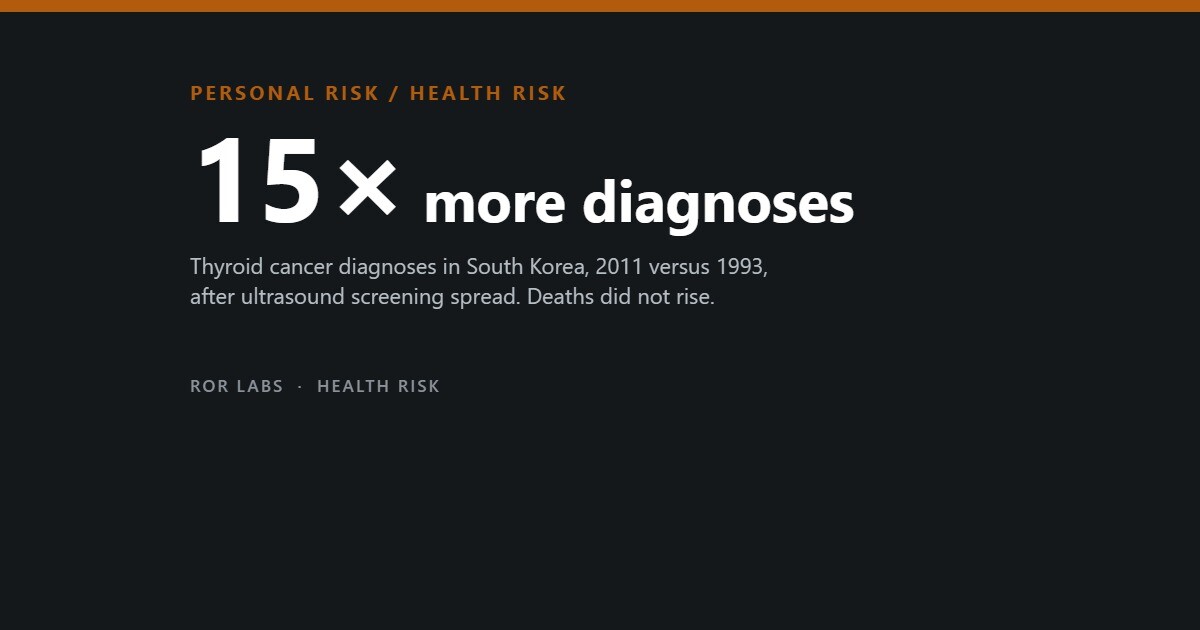
- South Korea diagnosed thyroid cancer 15 times as often in 2011 as in 1993, after ultrasound screening spread, while the death rate from thyroid cancer did not rise.
- After a group of doctors warned against screening in 2014, thyroid cancer operations in Korea fell by about 35% within a year. The population death rate kept falling.
- Models from the WHO’s cancer agency suggest about 90% of thyroid cancers in South Korean women in 2003–2007 were overdiagnosed, and more than 1.7 million people in 63 countries in 2013–2017.
- Autopsies find small papillary cancers in about 11% of thyroid glands examined in full, against a lifetime diagnosis risk of about 1% in the United States.
In 2011 doctors in South Korea diagnosed thyroid cancer 15 times as often as they had in 1993. Over the same years, the death rate from thyroid cancer did not rise. Writing in the New England Journal of Medicine in 2014, Hyeong Sik Ahn, Hyun Jung Kim and H. Gilbert Welch pointed to what had changed in between: thyroid ultrasound had become a common add-on to a national cancer screening programme that began in 1999. People were not getting more dangerous cancer. They were being looked at more closely.
The word for what the authors described is overdiagnosis. It does not mean a mistaken diagnosis. The cancer is real and is confirmed under the microscope. It means a cancer that would never have caused symptoms or death in that person’s lifetime if nobody had gone looking for it. No test can say which individual tumour is of that kind, so overdiagnosis can only be counted across populations.
Thyroid cancer has become the clearest example of the problem anywhere in medicine. This article covers what happened in South Korea, how overdiagnosis is estimated, what autopsies found, what treatment costs, Japan’s experience of watching small tumours, and the Fukushima screening dispute. It also covers the evidence that cuts the other way: some thyroid cancers do kill, and the estimates rest on models.
Fifteen times more cancer
A nationwide study published in The BMJ in 2016 reviewed the medical records of 5,796 patients sampled from the cancer registry. Between 1999 and 2008 the incidence of thyroid cancer rose 6.4-fold, from 6.4 to 40.7 per 100,000 people. Tumours smaller than 20 mm accounted for 94.4% of the increase. The share of cancers found by screening, rather than because a patient or doctor noticed something, rose from 15.0% to 56.1%.
The pattern followed the scanners. An analysis of 226,873 survey respondents found that regions where more people reported thyroid screening had higher thyroid cancer incidence, with a correlation of 0.77. That is an ecological comparison, not proof about individuals. Even tumours labelled as clinically detected had shrunk: their median size fell from 20 mm in 1999 to 9 mm in 2008, which the BMJ authors noted is too small for most people to notice.
Thyroid cancer diagnoses in South Korea
Age-standardised incidence per 100,000 people.
Source: Yoon YJ et al., Endocrinology and Metabolism (2026), doi:10.3803/EnM.2025.2807, using Statistics Korea data. Over the same period the age-standardised death rate fell from 0.75 per 100,000 in 2002 to 0.35 in 2023.
Deaths tell a different story. In the same 2026 analysis of national data, the standardised death rate from thyroid cancer peaked at 0.75 per 100,000 in 2002 and then declined steadily, to 0.35 by 2023.
When Korea stopped looking
In March 2014 eight Korean physicians formed the Physician Coalition for Prevention of Overdiagnosis of Thyroid Cancer and argued publicly that ultrasound screening of healthy people should be discouraged. The response was immediate. More than 43,000 operations for thyroid cancer were performed from the second quarter of 2013 to the first quarter of 2014. In the following twelve months there were about 28,000, a fall of 35%. Ahn and Welch wrote that “there are indications that the changes mainly reflect patients’ choices, not physicians’ recommendations.”
The story is a little less tidy than it is often told. A 2021 analysis of national registry data found that incidence had already peaked in 2012 and started to fall in 2013, before the public debate. The authors pointed to Korean guidelines issued in 2010 that advised against routine biopsy of nodules under 5 mm, and concluded that the controversy accelerated a decline that was already under way. Incidence among women then fell by about 16% a year from 2012 to 2016.
Before and after the 2014 warning
Thyroid cancer operations and deaths in South Korea.
Q2 2013 to Q1 2014: 43,000+
Q2 2014 to Q1 2015: about 28,000
A fall of 35% in one year
2002: 0.75 per 100,000
2023: 0.35 per 100,000
Age-standardised, whole population
Sources: Ahn HS, Welch HG, New England Journal of Medicine 373(24) (2015), doi:10.1056/NEJMc1507622; Yoon YJ et al., Endocrinology and Metabolism (2026), doi:10.3803/EnM.2025.2807.
Two newer findings complicate it further. Incidence did not keep falling: after reaching 42.50 per 100,000 in 2015 it rose again to 60.13 in 2021, with renewed increases in both localised and distant-stage cancers. And a 2024 study of 434,228 Korean patients found that the thyroid cancer death rate among people diagnosed in a given year fell from 1.94 per 1,000 person-years in 2005 to 0.76 in 2013, then rose to 2.70 in 2018. One possible reason is arithmetic: when fewer harmless tumours are diagnosed, the patients who remain are on average sicker. The authors, who lacked stage data, said some high-risk cancers may now be found later, and called for more research.
How much is overdiagnosis
Researchers at the International Agency for Research on Cancer (IARC), the World Health Organization’s cancer agency, have tried to put a number on the problem. Their method starts from an observation about the past. Before ultrasound, thyroid cancer incidence in the Nordic countries rose steadily with age, in the way most cancers do. Where incidence among young and middle-aged adults now rises far above that historical curve, the excess is attributed to diagnostic scrutiny.
Published in the New England Journal of Medicine in 2016, the first estimate covered 12 high-income countries and suggested that more than 470,000 women and 90,000 men may have been overdiagnosed over two decades. A 2020 update in The Lancet Diabetes & Endocrinology covered 26 countries and estimated more than 830,000 women and 220,000 men overdiagnosed in 2008–2012 alone, ranging from about 40% of cases in women in Thailand to more than 90% in South Korea. A 2024 study of 63 countries put the total for 2013–2017 at more than 1.7 million people.
Share of thyroid cancers estimated to be overdiagnosed, 2003–2007
Modelled estimates from cancer registry data, by country.
Sources: Vaccarella S et al., New England Journal of Medicine 375(7) (2016), doi:10.1056/NEJMp1604412; IARC press release 246 (18 August 2016). Estimates are model-based, not counts of individual patients.
These numbers are models, and their main assumption deserves to be stated plainly. They treat any rise above the historical age pattern as detection rather than disease. If something has truly increased the risk of thyroid cancer in younger adults, the models will count part of that real increase as overdiagnosis. A separate computer modelling study published in JAMA Network Open in 2026 estimated that 72% to 94% of papillary thyroid cancers diagnosed in the United States between 1991 and 2019 were overdiagnosed.
A reservoir found at autopsy
The strongest evidence that most of these cancers are harmless comes from people who died of something else. In 1985 pathologists in Finland cut the thyroid glands from 101 consecutive autopsies into slices 2 to 3 mm apart. They found occult papillary carcinoma in 36 of them, a prevalence of 35.6%, and titled their paper “A ‘normal’ finding in Finland”. Two thirds of the tumours were smaller than 1 mm.
A 2016 meta-analysis in the Journal of Clinical Oncology pooled 35 studies conducted between 1949 and 2007, covering 12,834 autopsies. When whole glands were examined, 11.2% contained a differentiated thyroid cancer; when only parts were examined, 4.1%. Crucially, the prevalence did not rise over the decades, even as diagnoses soared. A 2022 meta-analysis found almost the same rate at every age: 11.5% in people aged 40 or under and 13.4% in those over 80, which fits the idea that most of these tumours appear early in life and grow little afterwards.
How common hidden thyroid cancer is
Share of people with papillary or differentiated thyroid cancer found at autopsy, compared with the lifetime risk of a diagnosis.
Sources: Harach HR et al., Cancer 56(3):531 (1985); Furuya-Kanamori L et al., Journal of Clinical Oncology (2016), doi:10.1200/JCO.2016.67.7419.
The meta-analysis authors noted that tissue changes after death can make tiny lesions hard to read, which might inflate some counts. But living people show the same reservoir. A Japanese screening study using ultrasound and needle biopsy found small thyroid cancers in 3.5% of healthy adult women, more than 1,000 times the prevalence of clinically diagnosed thyroid cancer in Japanese women at the time.
What treatment costs the body
Overdiagnosis would matter less if treatment were harmless. The thyroid sits beside the four small parathyroid glands, which control calcium, and the recurrent laryngeal nerves, which move the vocal cords. In South Korea, an analysis of insurance claims for more than 15,000 people who had thyroid cancer surgery found that 11% had hypoparathyroidism and 2% vocal cord paralysis. About two thirds had the whole gland removed and need thyroid hormone tablets for life.
A US study of 27,912 patients in the SEER-Medicare database found that 12.3% developed a complication specific to thyroid surgery, such as low calcium or vocal cord paralysis, and that the risk rose with age and with more extensive operations. The US Preventive Services Task Force puts permanent hypoparathyroidism at 2 to 6 per 100 total thyroidectomies and nerve palsy at 1 to 2 per 100 operations. Radioactive iodine, often given after surgery, carries a small added risk of other cancers.
In May 2017 the Task Force gave thyroid cancer screening its lowest grade, recommending against screening adults without symptoms. It found no randomised trials of screening and inadequate evidence that finding cancers early improves health, while the harms of treatment were well documented. US incidence had risen from 4.9 to 15.3 cases per 100,000 people between 1975 and 2013.
Watching instead of operating
If most small papillary cancers never cause trouble, one option is to watch them. In 1993 the surgeon Akira Miyauchi proposed exactly that at Kuma Hospital in Kobe, Japan, for papillary microcarcinomas, tumours of 1 cm or less with no signs of spread. Patients chose between immediate surgery and regular ultrasound checks. Tokyo’s Cancer Institute Hospital began a similar programme in 1995.
Among 1,235 patients under surveillance at Kuma, 8% had tumours that grew by 3 mm or more within ten years, and 3.8% developed new lymph node metastases. Those patients then had surgery. None developed distant metastases or died of thyroid cancer. A later, larger series from the same hospital reported ten-year rates of 5.5% for growth and 1.1% for new node metastases. The programme’s weakness is that it was not randomised: patients chose their own path, and people who choose to wait may differ from those who do not.
Surgery now or watch first: unfavourable events at Kuma Hospital
Patients with low-risk papillary microcarcinoma seen in 2005–2013, by the management they chose.
| Event | Immediate surgery (974) | Active surveillance (1,179) |
|---|---|---|
| Temporary vocal cord paralysis | 4.1% | 0.6% |
| Temporary hypoparathyroidism | 16.7% | 2.8% |
| Permanent hypoparathyroidism | 1.6% | 0.08% |
Source: Miyauchi A, World Journal of Surgery (2016), doi:10.1007/s00268-015-3392-y, reporting data from Oda H et al. Patients chose their group; not randomised.
Cancer outcomes were excellent in both groups. The difference was in harm: complications were several times more common in those who had surgery at once. Two patients in the immediate surgery group were left with permanent vocal cord paralysis, despite experienced surgeons.
Age turned out to matter in an unexpected direction. Clinically detected thyroid cancer is generally more dangerous in older people, but the microcarcinomas of older patients grew least.
Who progressed under surveillance
Share of Kuma Hospital patients whose microcarcinoma progressed within ten years, by age at diagnosis.
Source: Miyauchi A, World Journal of Surgery (2016), doi:10.1007/s00268-015-3392-y, summarising Ito Y et al. (2014), 1,235 patients.
Fukushima and the screening effect
After the nuclear accident at Fukushima Daiichi in March 2011, Fukushima Prefecture began ultrasound thyroid examinations for everyone aged 18 or under at the time. In the first round, from October 2011 to March 2014, 300,476 children and young people were examined, 81.7% of those eligible. Of these, 113 were diagnosed with malignant or suspected malignant tumours, far more than the national cancer registry would predict for that age group.
A 2016 analysis in Epidemiology by Toshihide Tsuda and colleagues compared the screening results with Japan’s annual incidence and found, in one district, an incidence rate ratio of 50; compared with a less exposed district inside the prefecture, the prevalence odds ratio was 2.6, with a confidence interval from 0.99 to 7.0. The authors interpreted this as an excess. Critics answered that comparing a screened population with an unscreened one builds in the same effect seen in South Korea.
The United Nations Scientific Committee on the Effects of Atomic Radiation reviewed the evidence in its 2020/2021 report. It judged the large number of thyroid cancers diagnosed among about 300,000 young people to be the result of ultra-sensitive screening rather than radiation exposure, and considered discernible radiation-related increases unlikely. Some researchers continue to dispute that conclusion. The examinations were started because residents were anxious about radiation and are planned to continue for the long term. Both sides of that deserve respect: screening was offered to reassure, and it has also led to diagnoses and operations in young people.
Where the argument has limits
None of this means thyroid cancer is never dangerous. In the United States, a study of 77,276 patients diagnosed between 1974 and 2013 found that incidence of distant-stage papillary cancer rose 2.4% a year, and incidence-based mortality from advanced-stage papillary cancer rose 2.9% a year. Critics suggested changes in how deaths are attributed; the authors replied that the rise was confined to advanced papillary cancer. A 2019 review concluded that most of the increase is overdiagnosis but that there also appears to be a true increase in new cases.
Choice and anxiety matter too. In a Korean cohort of 927 patients with low-risk microcarcinoma, published in 2024, 453 chose surveillance and 474 chose surgery to remove half the gland. Older age, smaller tumours and higher income were linked to choosing to wait. In a multicentre cohort of 1,055 patients, quality of life after two years was best among those under surveillance, then those who had half the gland removed, then those who had the whole gland removed. A 2022 systematic review for the American Thyroid Association rated all but one of seven comparative studies as poor quality, so these differences rest on limited evidence.
Taken together, ultrasound screening of healthy adults finds many small cancers without reducing deaths. Small, low-risk papillary cancers can often be watched safely, especially in older adults. And estimates of overdiagnosis, however large, describe populations; they cannot tell any one person that their tumour is harmless.
Questions people ask
Should I have a thyroid ultrasound if I feel fine?
The US Preventive Services Task Force recommends against screening adults without symptoms. That does not apply to a neck lump, hoarseness or other symptoms, which a doctor should assess.
What does overdiagnosis mean?
A real cancer, confirmed under the microscope, that would never have caused symptoms or death in that person’s lifetime. It can be estimated across populations but not identified in one patient.
Is papillary thyroid cancer usually dangerous?
Usually not. In South Korea, five-year relative survival for localised and regional thyroid cancer was about 100%. A minority of tumours spread, which is why specialists assess risk.
What is active surveillance?
Regular ultrasound checks of a small, low-risk tumour instead of immediate surgery, with an operation if it grows or spreads. It began at Kuma Hospital in Japan in 1993.
Did the Fukushima accident cause thyroid cancer in children?
A UN scientific committee concluded the cancers found were mainly the result of sensitive screening, not radiation. Some researchers disagree, and monitoring continues.
The short version
- South Korea diagnosed thyroid cancer 15 times as often in 2011 as in 1993, after ultrasound screening spread, while the death rate from thyroid cancer did not rise.
- After a group of doctors warned against screening in 2014, thyroid cancer operations in Korea fell by about 35% within a year. The population death rate kept falling.
- Models from the WHO’s cancer agency suggest about 90% of thyroid cancers in South Korean women in 2003–2007 were overdiagnosed, and more than 1.7 million people in 63 countries in 2013–2017.
- Autopsies find small papillary cancers in about 11% of thyroid glands examined in full, against a lifetime diagnosis risk of about 1% in the United States.
- Watching tiny papillary cancers instead of operating led to fewer surgical complications in Japan, with no cancer deaths reported. But tumours in younger patients grew more often, and some thyroid cancers are genuinely aggressive.
This article summarises published research and public-health guidance for general information. It is not medical advice. If you have a lump in your neck, a thyroid nodule or a diagnosis of thyroid cancer, discuss the options, including surveillance where it applies, with a doctor.
Further reading: Ahn, Kim and Welch, NEJM (2014), for the South Korean story in two pages. Vaccarella et al., NEJM 375(7) (2016), for how overdiagnosis is estimated. The US Preventive Services Task Force recommendation of May 2017, for the evidence on screening and the harms of treatment.
- Malignant, Vinay Prasad (2020). An oncologist on how weak evidence and poor policy shape cancer care, including the costs of overtreatment. Sharp and well referenced; its tone is combative, and it ranges well beyond thyroid cancer.
- The Art of Statistics, David Spiegelhalter (2019). A statistician explains how to read risks, test results and claims about cause. Clear on why finding more cases is not the same as saving lives; it is not about thyroid disease specifically.
- How to Read Numbers, Tom Chivers and David Chivers (2021). A short guide to the statistical traps in news stories, from base rates to changing definitions. Quick and practical; necessarily brief on medical screening.
Sources
Ahn HS, Kim HJ, Welch HG. NEJM (2014), doi:10.1056/NEJMp1409841. — Ahn HS, Welch HG. NEJM 373(24) (2015), doi:10.1056/NEJMc1507622. — The ASCO Post, “South Korean study sparks warnings about the hazards of overscreening” (1 December 2014). — Park S et al. BMJ 355:i5745 (2016). — Ahn HS et al. Thyroid (2016), doi:10.1089/thy.2016.0075. — Oh CM et al. Cancer Medicine (2021), doi:10.1002/cam4.3926. — Yoon YJ et al. Endocrinology and Metabolism (2026), doi:10.3803/EnM.2025.2807. — Kim KJ et al. International Journal of Surgery (2024), doi:10.1097/JS9.0000000000001767. — Vaccarella S et al. NEJM 375(7) (2016), doi:10.1056/NEJMp1604412. — IARC press release 246 (18 August 2016). — Li M, Dal Maso L, Vaccarella S. Lancet Diabetes Endocrinol (2020), doi:10.1016/S2213-8587(20)30115-7. — IARC press release 284 (25 May 2020). — Li M et al. Lancet Diabetes Endocrinol (2024), doi:10.1016/S2213-8587(24)00223-7. — Francis DO et al. JAMA Network Open (2026), as reported by EMJ (1 March 2026). — Harach HR, Franssila KO, Wasenius VM. Cancer 56(3):531 (1985). — Furuya-Kanamori L et al. J Clin Oncol (2016), doi:10.1200/JCO.2016.67.7419. — Arroyo N et al. J Clin Endocrinol Metab 107(10):2945 (2022). — Papaleontiou M et al. J Clin Endocrinol Metab 102(7):2543 (2017). — US Preventive Services Task Force, thyroid cancer screening recommendation (9 May 2017); JAMA (2017), doi:10.1001/jama.2017.4011. — Miyauchi A. World J Surg (2016), doi:10.1007/s00268-015-3392-y. — Ito Y, Miyauchi A. J Endocr Soc 7(7):bvad063 (2023). — Suzuki S. Clinical Oncology (2016), doi:10.1016/j.clon.2015.12.027. — Tsuda T et al. Epidemiology (2016), doi:10.1097/EDE.0000000000000385. — UNSCEAR 2020/2021 Report, Annex B, launch presentation on health implications (March 2021). — Lim H et al. JAMA (2017), doi:10.1001/jama.2017.2719. — Seib CD, Sosa JA. Endocrinol Metab Clin North Am (2019), doi:10.1016/j.ecl.2018.10.002. — Kim MJ et al. Thyroid (2024), doi:10.1089/thy.2024.0264. — Moon JH et al. J Clin Endocrinol Metab (2021), doi:10.1210/clinem/dgaa889. — Chou R et al. Thyroid (2022), doi:10.1089/thy.2021.0539.