Horse riding injuries, helmets and the kick on the ground
Key takeaways · 10 min read
- About two thirds of US riding injuries happen while mounted, mostly falls; on the ground, kicks are the leading cause.
- The famous claim that riding is more dangerous than motorcycling rests on a 1985 book chapter.
- Emergency visits fell overall but rose by 140% among people over 60.
- Helmets are consistently linked to less brain injury; air vests have not shown protection.
In June 2024 Princess Anne, then 73, spent five nights in a Bristol hospital with concussion and minor injuries after an incident on her estate. She had not been riding at the time. Her doctors said the injuries were consistent with a blow from a horse’s head or legs. It was an unusually public example of a risk riders know well and outsiders rarely think about: a horse can hurt you when you are standing beside it.
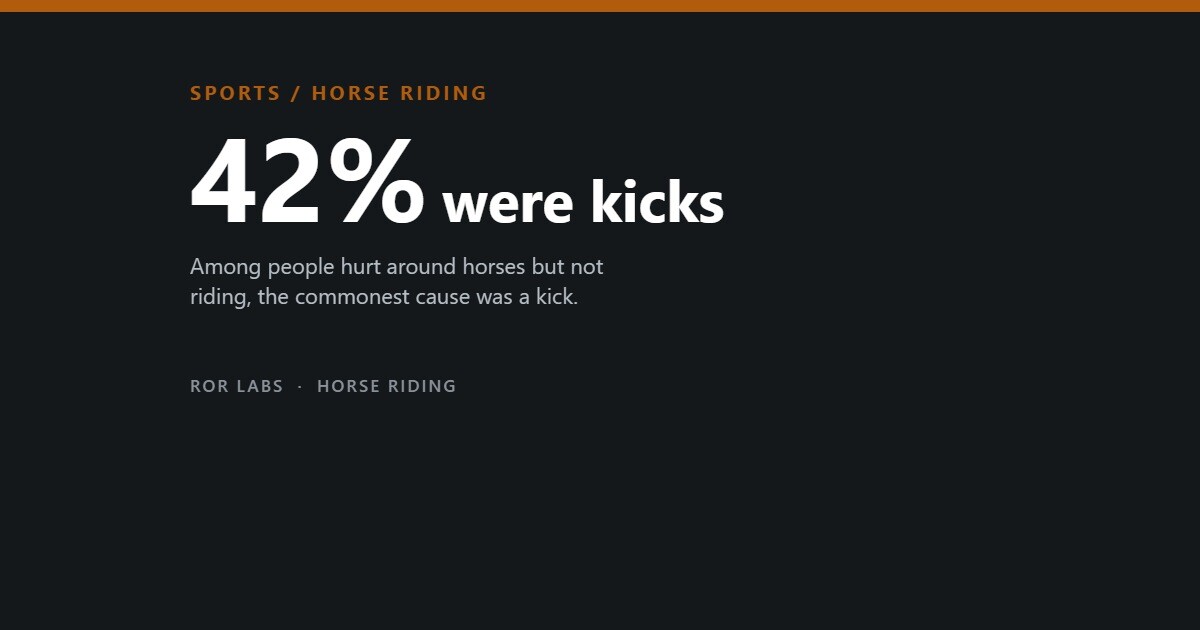
A study of US emergency departments from 1990 to 2017 found that among people hurt while not mounted, the commonest cause was being kicked, at 42.1%. Among those hurt while riding, it was falling or being thrown, at 73.9%. Those two mechanisms — the fall and the kick — explain most of equestrian injury. Both are shaped by habits riders can change, and one of the best-known claims about riding’s danger turns out to rest on very little.
This article follows the series format: what riders actually injure, where the risk concentrates, what has been measured to reduce it, and why the answer is not to stay out of the saddle.
What actually gets injured
The best national estimate comes from the US Consumer Product Safety Commission’s sample of hospitals. From 2001 to 2003, an estimated 102,904 people a year were treated in emergency departments for non-fatal horse-related injuries, 35.7 per 100,000 people. Two thirds, 66.1%, were hurt while mounted. The head and neck took 23.2% of injuries, the lower limb 22.2% and the upper limb 21.5%. More than 11% were admitted or transferred, and the authors estimated about 11,500 traumatic brain injuries a year.
How riders get hurt
Main mechanism of injury in US emergency departments, 1990–2017, by whether the person was riding.
Source: Acton et al., American Journal of Emergency Medicine 38(6):1062–1068 (2020); Thomas et al., British Journal of Sports Medicine 40(7) (2006).
Over a longer window the numbers have moved. From 1990 to 2017 US emergency departments saw an estimated 1.84 million horse-related visits, about 65,600 a year. Visits fell by 46% from 2000 to 2017, but among people over 60 the annual rate rose by 139.6%, and diagnoses of concussion and closed head injury rose by 337% from 1990 to 2009.
The injuries that end up in trauma centres are more serious and different in shape. In US national trauma data from 2007 to 2016, covering 24,791 patients, the chest was the commonest injured region, and head and neck injuries accounted for three quarters of the 320 deaths. A German trauma centre found falls caused 67.7% of injuries and kicks 16.5%; the head was the most often injured region, and a head injury multiplied the odds of admission about sixfold. In Australia, equestrian activities caused nearly 2,100 hospital admissions in 2024–25, more than half of them fractures, with the 15-to-19 age group the largest.
When the risk concentrates
Riding is often said to be more dangerous per hour than motorcycling. The claim is worth tracing. A CDC report in 1990 stated that the rate of serious injury per riding hour was estimated to be higher than for motorcyclists and car racers, citing a single book chapter from 1985. That chapter is the root of a figure repeated for forty years; the modern cohort studies that would test it do not exist. One of the few actual per-hour measurements, from young US riders in the 1990s, found 0.6 injuries per 1,000 riding hours. A 2016 analysis argued that for jumping sports, hours are the wrong denominator altogether: the risk sits in the jump.
Some risk factors are clearer. Young women are the group most often injured in almost every study, which partly reflects who rides: in a review of 71 epidemiological papers, 60 identified young females as the most affected group, and 97% of papers that examined mechanism found a fall from the horse the most common. Experience does not protect as much as people assume. In US Pony Club incident data from 2011 to 2017, less experienced members had more incidents, but the share that were serious was similar at every certification level, from 9.3% to 14.3%. A rider who has ridden for years falls less often, but lands just as hard.
In competition, the jump is where the danger lies. In international eventing from 2008 to 2018, 5.2% of the 190,429 horses that started a cross-country round had a fall, and 89% of falls happened at a fence. Corners carried 2.44 times the odds of a fall of a plain square spread, and brush fences with a ditch 2.02 times. The most feared fall is rotational, when the horse somersaults over the fence and can land on the rider. In British Eventing’s 2023 season, rotational falls were 2% of falls; 89% of riders who fell were unhurt and there were no deaths.
Where eventing falls happen
Odds of a fall at different fence types in international cross-country, compared with a square spread, 2008–2018.
Source: Bennet, Cameron-Whytock and Parkin, Equine Veterinary Journal 55(3):463–473 (2023).
What has been measured to work
Helmets have the most consistent evidence, although almost none of it comes from trials. At a US children’s trauma centre, only 19.7% of injured child riders had a documented helmet. Those who wore one had lower injury severity, less traumatic brain injury — 32.4% against 55.3% — and fewer intensive-care admissions, and going without a helmet independently predicted brain injury, with an odds ratio of 2.5. At a Canadian trauma centre, only 9% of seriously injured riders had worn a helmet. Not every study agrees: in 53 severe cases among Western-style riders at a rural centre, helmets were linked only to fewer superficial injuries. The weight of evidence still points one way.
Helmets: who wears them, and what they did
Observational studies; none of these is a randomised trial.
Helmet documented: only 19.7%
Brain injury: 32.4% with vs 55.3% without
No helmet, adjusted odds of brain injury: 2.5x
Short et al., 2017
Always wear a helmet, English style: 92.5%
Western style: 23.3%
Western riders reported more repeat head injuries
Picken et al., 2025
Source: Short et al., Journal of Pediatric Surgery (2017); Picken et al., Clinical Journal of Sport Medicine (2025).
Helmet habits differ sharply by riding style. Among 357 college riders, 92.5% of English-style riders always wore a helmet, against 23.3% of Western-style riders, and Western riders reported more repeat head injuries. Standards are tightening too: under the international federation’s rules, from 2028 competition helmets will have to meet at least two of four recognised standards. Beyond helmets the evidence becomes uncertain. In Pony Club data, foam body protectors were linked to lower injury risk in cross-country, a relative risk of 0.64, but not on the flat or in showjumping. Air vests, which inflate when the rider leaves the saddle, were linked to higher injury rates in studies of real falls, and in international eventing riders wearing them had 1.7 times the odds of serious injury — possibly because riders choose them for riskier courses, but in any case not evidence that they protect. Frangible fences, designed to collapse when hit, show a similar confusion: they are fitted to the riskiest fences, so their fall rates are higher, and the data cannot yet say how much they help.
Protective gear beyond the helmet
Observational estimates from Pony Club and international eventing. Above 1.00 means more risk.
Source: Andres et al., BMJ Open Sport & Exercise Medicine (2018); Nylund, PhD thesis, University of Sydney (2026); Bennet et al., Equine Veterinary Journal (2023); TRL report CPR4141 (2024). All subject to selection effects.
The kick on the ground has had far less research than the fall from the saddle. No study has tested a way to reduce it, and the evidence is limited to its scale: kicks are the leading cause of injuries to people who are not riding, and kicked patients in the German series were more likely to need surgery. Time spent around horses in the yard is not free of risk, and the older riders and handlers whose emergency visit rates rose while everyone else’s fell are the obvious group to think about it.
Why the answer is not to stop
Riding is real exercise. In laboratory measurements for a British Horse Society report, general riding required about 3.7 METs, trotting about 5.0 and grooming and saddling about 3.5 — moderate activity by the usual definition. In the same report’s survey of 1,248 riders, 68% rode or did yard work for at least half an hour three times a week, 37% of the women were over 45, and more than 80% said riding made them feel cheerful, relaxed or happy. The report was commissioned by the society and relied on self-report, so treat it as a description rather than proof.
Riding as exercise
Energy cost of horse-related activities measured in the laboratory. 3 METs or more counts as moderate activity.
Source: Church et al., The Health Benefits of Horse Riding in the UK, University of Brighton for the British Horse Society (2010).
There is also a therapeutic literature. Two meta-analyses of therapeutic riding and hippotherapy in children with cerebral palsy reached partly different conclusions: one found improvements in posture and balance, the other found short-term benefits on muscle asymmetry but no significant effect on overall motor function with longer programmes. The evidence is moderate for balance and weaker for broader function, which is a fair description of most exercise therapies.
None of this makes riding safe in the sense that swimming is safe. It means the risk is concentrated in places riders can influence. Wear a certified helmet every time, including on short hacks and Western-style rides, where the habit is weakest. Treat ground work with the same respect as riding, especially with age. In competition, understand that the risk sits at particular fences, and that equipment like air vests has not yet shown the protection its buyers expect. The famous comparison with motorcycling is not supported by modern data; the fall and the kick are, and both can be made less likely or less damaging.
Questions people ask
Is horse riding more dangerous than motorcycling?
The claim traces to a 1985 book chapter cited by the CDC in 1990. No modern study has confirmed it, and hours may be the wrong way to compare.
What is the most common horse riding injury?
Falls cause most injuries while riding; kicks cause the largest share of injuries on the ground. Head, limb and chest injuries are all common.
Do riding helmets work?
Observational studies consistently link helmets to less brain injury and lower severity, although there are no randomised trials.
Do air vests prevent riding injuries?
Not on current evidence. Studies of real falls link them to higher injury rates, probably partly because riders choose them for riskier courses.
Is horse riding good exercise?
Yes. Riding and yard work reach moderate-intensity levels, and trotting is higher.
The short version
- About two thirds of US riding injuries happen while mounted, mostly falls; on the ground, kicks are the leading cause.
- The famous claim that riding is more dangerous than motorcycling rests on a 1985 book chapter.
- Emergency visits fell overall but rose by 140% among people over 60.
- Helmets are consistently linked to less brain injury; air vests have not shown protection.
- Riding and yard work are moderate exercise; wear a certified helmet every time, and respect the ground as much as the saddle.
This is a summary of published research, not medical advice. Any head injury with confusion, vomiting or worsening headache needs urgent medical assessment, and a suspected concussion should be cleared by a doctor before riding again.
Further reading: Acton et al., American Journal of Emergency Medicine 38(6):1062–1068 (2020), for the US emergency data. Bennet et al., Equine Veterinary Journal 55(3):463–473 (2023), for eventing falls. Our article on skiing and helmets covers what a helmet can and cannot do in another fall sport.
- Horse Brain, Human Brain, Janet Jones (2020). A cognitive scientist and rider on how horses perceive the world, and how that knowledge changes safe handling on the ground.
- Horse Girls, Edited by Halimah Marcus (2021). Essays by riders on the pull of horses, including the falls, the costs and the reasons they keep going back.
- Horse, Geraldine Brooks (2022). A novel built around a real nineteenth-century racehorse, for readers who want the history of the sport rather than its statistics.
Sources
CBC News, 24 and 28 June 2024, on Princess Anne’s injury. — Acton AS, Gaw CE, Chounthirath T, Smith GA. American Journal of Emergency Medicine 38(6):1062–1068 (2020). — Thomas KE, Annest JL, Gilchrist J, Bixby-Hammett DM. British Journal of Sports Medicine 40(7) (2006). — Mutore K, et al. Trauma Surgery & Acute Care Open 6(1):e000728 (2021). — Krüger L, Hohberg M, Lehmann W, Dresing K. BMJ Open Sport & Exercise Medicine 4(1):e000408 (2018). — Australian Institute of Health and Welfare. Sports Injury in Australia: Equestrian activities (2026). — Centers for Disease Control and Prevention. MMWR 39(20) (1990), citing Firth JL, in Schneider RC et al., eds., Sports Injuries, Williams & Wilkins (1985). — Christey GL, et al. Pediatrics (1994). — O’Brien D. Animals 6(2):13 (2016), doi:10.3390/ani6020013. — Meredith L, Ekman R, Brolin K (2019), doi:10.46743/1540-580x/2019.1795. — Andres SA, et al. BMJ Open Sport & Exercise Medicine 4(1):e000426 (2018). — Bennet ED, Cameron-Whytock HA, Parkin TDH. Equine Veterinary Journal 55(3):463–473 (2023), doi:10.1111/evj.13863. — Bozorg S. British Eventing Falls Database: 2023 season. TRL report CPR4141 (2024). — Short SS, Fenton SJ, Scaife ER, Bucher BT. Journal of Pediatric Surgery (2017), doi:10.1016/j.jpedsurg.2017.03.043. — Ball CG, Ball JE, Kirkpatrick AW, Mulloy RH. American Journal of Surgery (2007), doi:10.1016/j.amjsurg.2007.01.016. — Carter BT, Richardson MD. Journal of Neurosciences in Rural Practice (2022), doi:10.25259/jnrp-2022-3-14. — Picken LK, et al. Clinical Journal of Sport Medicine (2025), doi:10.1097/JSM.0000000000001400. — Equestrian Australia. Progressive change to helmet standards, 4 February 2026. — Meyer C, et al. Annals of Biomedical Engineering (2024), doi:10.1007/s10439-024-03507-y. — Nylund LE. PhD thesis, University of Sydney (2026). — Church A, Taylor B, Maxwell N, Gibson O, Twomey R. The Health Benefits of Horse Riding in the UK. University of Brighton and Plumpton College for the British Horse Society (2010). — Zadnikar M, Kastrin A. Developmental Medicine & Child Neurology (2011), doi:10.1111/j.1469-8749.2011.03951.x. — Tseng SH, Chen HC, Tam KW. Disability and Rehabilitation (2013), doi:10.3109/09638288.2012.687033.