Golf swing injuries to the back and wrist, and the way back after surgery
Key takeaways · 10 min read
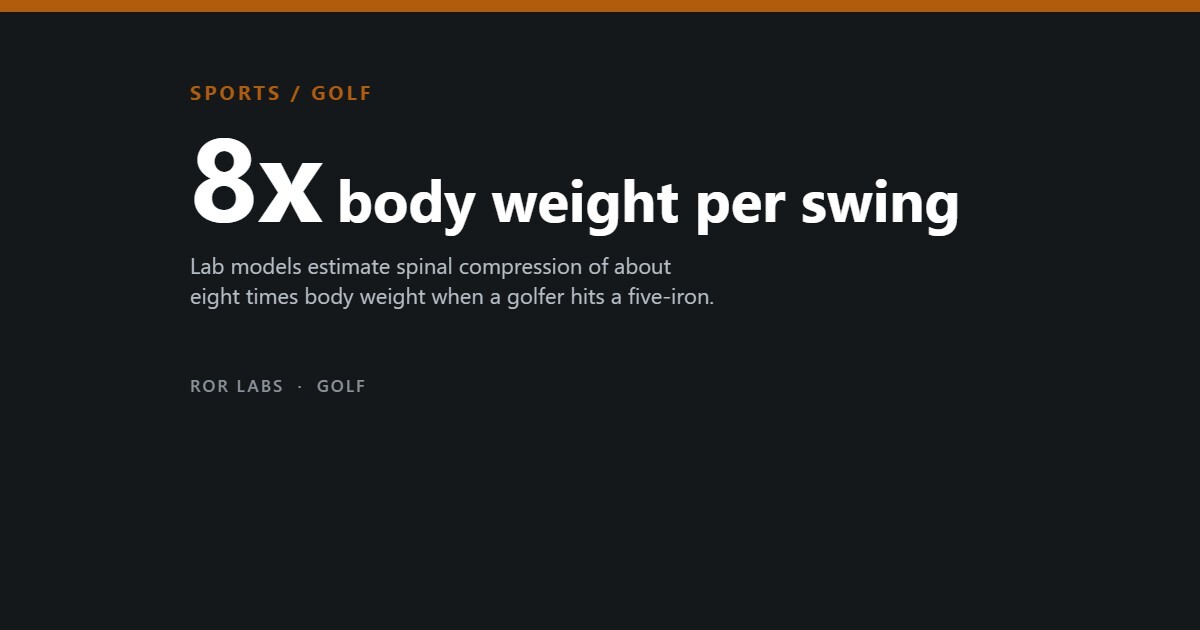
- Lab models estimate spinal compression of about eight times body weight in a five-iron swing; amateurs showed almost twice the shear of professionals.
- Most tour wrist problems are in the lead wrist, on the little-finger side; 30% of European Tour players examined at one event reported one.
- Golf accounts for 43% of published hook-of-hamate fractures in grip sports, and diagnosis took almost six months on average.
- A warm-up trial in 45 teenagers cut back pain episodes sharply, but not the number of players with pain, and one player drove the sham total.
On Friday 10 October 2025 Tiger Woods had a disc in his lower back replaced at the Hospital for Special Surgery in New York. Scans, he wrote the next day, had shown “a collapsed disc in L4/5, disc fragments and a compromised spinal canal.” Press counts put it as at least his seventh known back operation since 2014. He had not played a competitive event since the Open Championship in July 2024.
Woods is an extreme case, but his weak points are the game’s. A systematic review of professional golfers found the lumbar spine was the most commonly injured region in four of five studies, with the hand and wrist next. Ordinary players are not spared: in a 2023 survey of 1,170 male amateur golfers in the United States, 37.3% reported low back pain in the previous seven days.
This article covers what the swing does to the lower back and the lead wrist, as measured in laboratories; who gets hurt and how, from tour players to weekend golfers; what small trials of exercise have found and where they fall short; and what is known about getting back to golf after back surgery. The aim is to keep swinging, with fewer problems.
What the swing does to a back and a wrist
At the top of the backswing the shoulders turn much further than the hips. Coaches call that separation the X-factor, and good players stretch it further as the downswing starts. Just after impact the spine is still rotating towards the target while bending sideways, away from it. The product of the two, side bend multiplied by rotation speed, has been named the “crunch factor”.
The loads were first estimated in 1990, when Timothy Hosea’s group combined motion capture, force plates and muscle recordings in four professional and four amateur golfers hitting a five-iron. Modelled compression at the third and fourth lumbar vertebrae averaged 7,584 newtons in the professionals and 6,100 in the amateurs, about eight times body weight; running produces roughly three. The amateurs, though, had almost twice the shear: 596 newtons against 329.
Estimated loads on the lower back in one swing
Peak forces at the L3–L4 lumbar segment, modelled from motion, force-plate and muscle data in four professional and four amateur golfers, with two reference values. Small samples; one club.
Sources: Hosea et al. (1990) and Gatt et al., as summarised by Lindsay and Vandervoort, Asian Journal of Sports Medicine (2014).
A single swing rarely breaks anything; the damage is thought to come from repetition and from asymmetry. In a survey of 283 Japanese professionals, back pain fell mainly on the trail side, the right in a right-hander, and imaging showed more arthritic change in the right-sided facet joints and vertebrae than in men of the same age. A 2019 neurosurgical paper called the pattern “repetitive traumatic discopathy” and used Woods, fused at L5–S1 in 2017, as its example.
The lead wrist, the left in a right-hander, has its own problem. It starts the swing bent towards the little finger, swings to the thumb side at the top, then snaps back at impact, loading the ulnar side, where the extensor carpi ulnaris tendon runs in a sheath and the triangular fibrocartilage cushions the joint. The butt of the club sits over the hook of the hamate, a small bony spur in the palm. Hit a tree root or take too much turf, and that whole system is jolted at once.
Where the risk concentrates
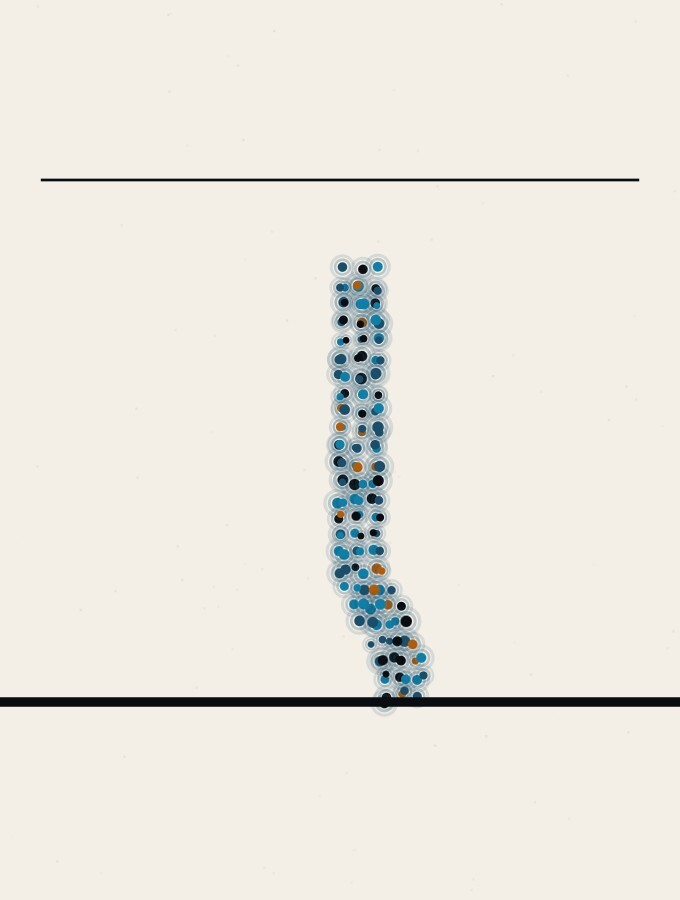
The best picture of tour wrists comes from the 2009 BMW PGA Championship at Wentworth, where doctors questioned and examined 128 of the 153 eligible European Tour players. Thirty-eight, 30%, reported 43 wrist problems. Most were in the leading wrist and on its little-finger side. Tenosynovitis of the extensor carpi ulnaris tendon was almost always in the lead wrist, and in half the cases players blamed hard ground or practice mats. More than a third were still competing with the problem.
The worst injuries were tears of the sheath that holds that tendon in its groove. Three of the four came from an unexpected strike on a tree root or other hidden object during a full shot, and the two repaired surgically faced 24 weeks of reduced practice. Jordan Spieth’s version was slower. He first noticed the tendon slipping in May 2023, called it “an ECU tendon issue” at the 2024 Masters, and in late August 2024 had surgery to recreate the sheath. It had not hurt when he swung, he said, but he doubted that was a coincidence.
Wrist problems on the European Tour
128 professionals examined at one tournament in 2009 (84% of the eligible field). Percentages of players, or of the problems reported.
Source: Hawkes, O’Connor and Campbell, British Journal of Sports Medicine 47(17):1075 (2013). One tournament; self-report plus examination.
The hamate is the injury golfers most often fail to recognise. A review of 120 patients with sport-related fractures of its hook found that 52, or 43%, broke it playing golf, slightly more than baseball, and every golfer whose side was recorded had broken the non-dominant, leading hand. On average diagnosis took almost six months, because ordinary wrist X-rays miss the fracture. In a 1977 series, 19 of 20 athletes had seen a doctor before, and only two had been diagnosed correctly.
Fractures of the hook of the hamate in grip sports
120 patients pooled from 21 case reports and series published 1972–2016, plus one early surgical series. Case reports favour unusual cases, so these are shares of published patients, not rates.
Sources: Kim et al., Medicine 97(46):e13275 (2018); Stark et al., Journal of Bone and Joint Surgery (1977).
Back risk is spread more evenly than the professional data suggest. In the survey of 1,170 American amateurs, players with handicaps of five or under were younger and practised more than those above ten, yet the share with back pain did not differ between them, and golfers with and without back pain were alike in age and training volume. The authors noted that the prevalence was similar to that in the general population and concluded that golf was probably not its main cause.
What has been measured to work
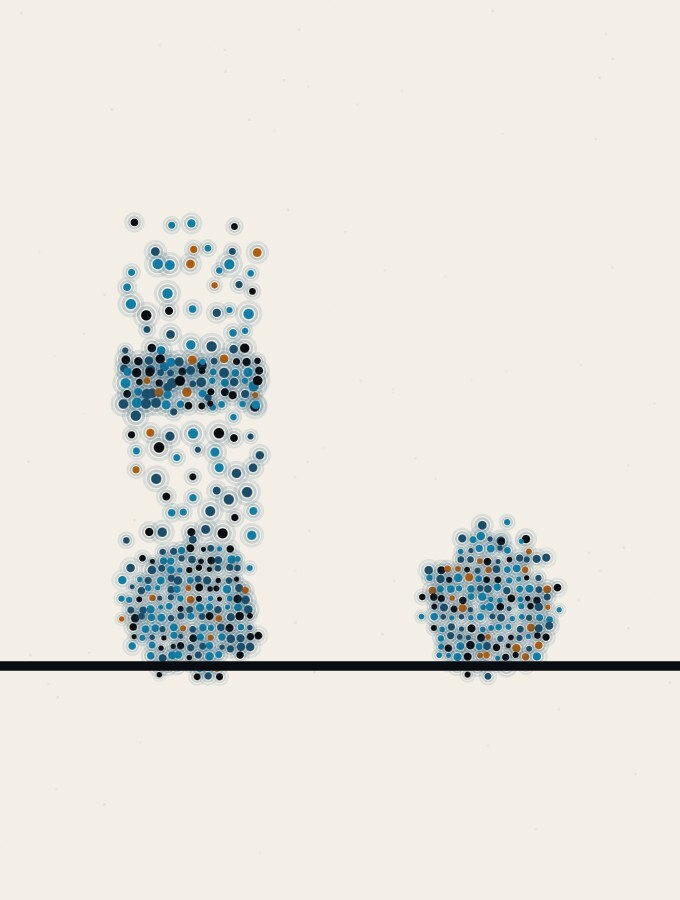
The best trial so far is small. In Japan, 45 high-school golfers were randomised to do one of two warm-ups before every session for 12 weeks: a programme aimed at lead-hip rotation and trunk movement, or a sham routine of shoulder and trail-hip stretches that looked similar. Neither players nor assessors knew which was meant to work. The programme group logged 16 episodes of low back pain against 100 in the sham group, a reduction the authors put at 84%.
The headline needs a second look. The number of players who had any back pain did not differ significantly: five in the programme group and eight in the sham group, with an odds ratio of 0.49 and a confidence interval running from 0.13 to 1.82. One sham player alone reported 39 of the 100 episodes. Pain was self-reported, even scores of one or two out of ten counted, and the journal issued a correction notice in 2026. The authors declared no funding and no conflicts.
A warm-up trial in adolescent golfers
45 high-school golfers, double-blind randomised trial against a sham warm-up, 12 weeks. Exposures are practice sessions or rounds.
Source: Hamada et al., Translational Sports Medicine (2025), doi:10.1155/tsm2/6993582; correction doi:10.1155/tsm2/9763731.
For golfers who already have back pain, the trials are smaller still. A Korean trial in 2026 randomised 30 amateurs with non-specific back pain to six weeks of trunk stabilisation and leg strengthening, or swing practice and stretching; pain and disability fell further in the exercise group. An earlier Korean study of 28 men with stiff lead hips found pain fell after hip exercises. Observational work fits: among 42 professionals at a 2001 PGA Tour event, the 14 with back pain had less lead-hip rotation.
Changing the swing itself rests on thinner evidence. Golfers with back pain in one study of 12 professionals slouched more at address and twisted beyond their measured range, but a 2022 review found no study demonstrating a link between the crunch factor and back pain. Shortening the backswing by almost a fifth did not cost clubhead speed or accuracy in one experiment. Warm-up studies are covered in our earlier article on golf injuries, carts and lightning.
Two popular numbers deserve caution. Back injuries are often said to affect 55% of professionals and 35% of amateurs, but the same pair is reported both as a share of golfers and as a share of injuries, and we could not trace it to a primary study. And in the American survey, golfers who did injury-prevention exercises had more complaints, not fewer: 85% had a previous injury against 60%. People start exercises after they get hurt, which a snapshot cannot untangle.
Why the answer is to swing smarter, not to stop
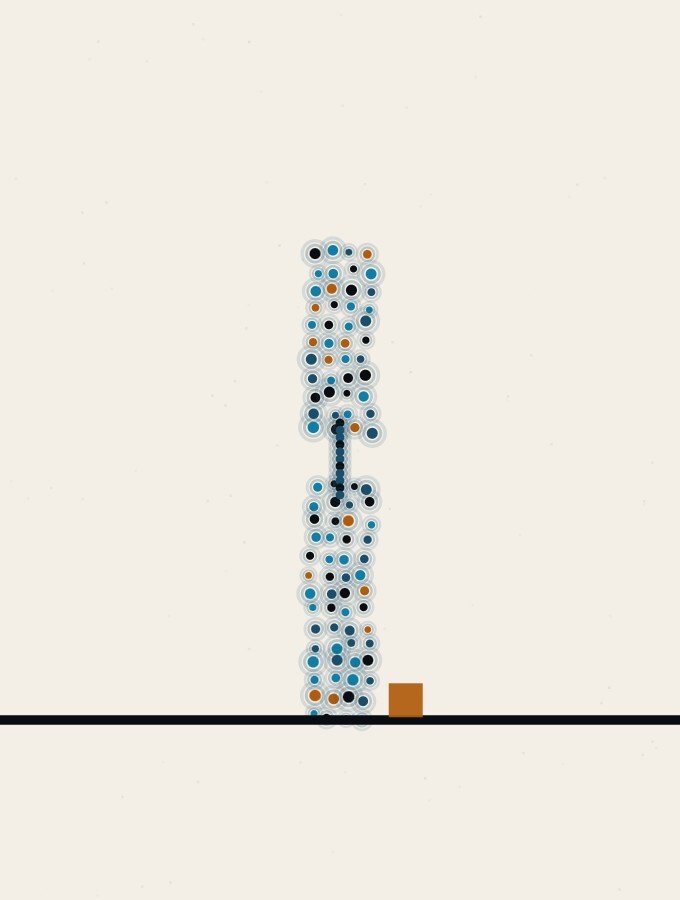
Even surgery is not usually the end of golf. When 523 North American spine surgeons were asked, most said golfers could return four to eight weeks after a microdiscectomy and six months after a lumbar fusion. In a series of 34 golfers fused at one or two levels, 65% were practising within a year and 52% were back on the course. Only 29% said leftover pain limited them.
A 2026 study of 41 keen golfers followed for an average of six and a half years after surgery for degenerative spine disease found that 82.9% returned, with similar rates after fusion and decompression. For disc replacement, the operation Woods chose, we found no golf-specific outcome series, so any timetable is a surgeon’s judgement. Woods himself returned seven months after his 2017 fusion and won the Tour Championship the following year.
Getting back to golf after back surgery
Small observational series and one pooled review. Percentages of golfers.
Sources: Shifflett et al., Sports Health (2016); Luxenburg et al., World Neurosurgery (2021); Jain et al., Neurosurgery abstract (2026).
For everyone else, the practical steps follow the measurements. Stand tall at address rather than slouching, let the lead heel lift if the hips will not turn, and keep the trunk and lead hip mobile and enduring. Limit long sessions off mats and hard ground. Ulnar wrist pain after a fat shot or a root deserves a proper look, including a carpal-tunnel view or CT if it lingers. Pushing a trolley spares the back more than carrying a bag.
Questions people ask
Is the modern swing bad for your back?
It produces large rotation and side bend, and lab studies estimate high spinal loads. But no study has compared injury rates between modern and classic swings, and the crunch factor has not been shown to predict back pain.
Can I play golf after a spinal fusion?
Most golfers in published series do, usually after about six months, and around half are on the course within a year. Follow your own surgeon’s timetable.
Why does the outside of my lead wrist hurt?
Common causes include extensor carpi ulnaris tendon irritation or instability, and a fracture of the hook of the hamate, which ordinary X-rays often miss. Persistent pain after a heavy strike is worth seeing a doctor about.
Does a warm-up prevent back pain?
One small double-blind trial in teenagers found far fewer episodes after a hip and trunk warm-up, though not fewer players with pain. It is cheap and low-risk; the evidence is still thin.
The short version
- Lab models estimate spinal compression of about eight times body weight in a five-iron swing; amateurs showed almost twice the shear of professionals.
- Most tour wrist problems are in the lead wrist, on the little-finger side; 30% of European Tour players examined at one event reported one.
- Golf accounts for 43% of published hook-of-hamate fractures in grip sports, and diagnosis took almost six months on average.
- A warm-up trial in 45 teenagers cut back pain episodes sharply, but not the number of players with pain, and one player drove the sham total.
- Most golfers return after back surgery: over half are on the course within a year of fusion, and 82.9% in a long-term series returned.
This is a summary of published research, not medical advice. If you have back pain that spreads down a leg, numbness, weakness or wrist pain that does not settle, see a doctor or physiotherapist, and talk to your surgeon before returning to golf after an operation.
Further reading: Lindsay and Vandervoort, Asian Journal of Sports Medicine (2014), for a clear review of why golfers’ backs hurt. Hawkes et al., British Journal of Sports Medicine (2013), for wrist problems on tour. Hamada et al., Translational Sports Medicine (2025), for the warm-up trial.
- Golf’s Holy War, Brett Cyrgalis (2021). A journalist follows the split between feel-based teaching and biomechanics-driven coaching, from amateurs to tour players. Context for the modern swing; not a medical book.
- The Way Out, Alan Gordon with Alon Ziv (2021). A psychotherapist’s account of pain reprocessing for chronic pain, including back pain. One perspective among several; read alongside medical advice, not instead of it.
- Exercised, Daniel E. Lieberman (2021). A Harvard biologist tests common beliefs about exercise, stretching and back pain against evolution and evidence. Good on why staying active matters.
Sources
- Doehring J. Tiger Woods undergoes another back surgery. WRDW/WAGT, 11 October 2025; Golf Digest, 11 October 2025 (Woods’s statement on X).
- Robinson PG, Murray IR, Duckworth AD, et al. Systematic review of musculoskeletal injuries in professional golfers. British Journal of Sports Medicine (2018), doi:10.1136/bjsports-2018-099572.
- Murray AD, Junge A, Robinson PG, et al. Cross-sectional study of characteristics and prevalence of musculoskeletal complaints in 1170 male golfers. BMJ Open Sport & Exercise Medicine 9(1):e001504 (2023).
- Lindsay DM, Vandervoort AA. Golf-related low back pain: a review of causative factors and prevention strategies. Asian Journal of Sports Medicine (2014), doi:10.5812/asjsm.24289 (source for Hosea et al. 1990, Gatt et al., Sugaya et al., Vad et al. and Bulbulian et al.).
- Bourgain M, Rouch P, Rouillon O, et al. Golf swing biomechanics: a systematic review and methodological recommendations for kinematics. Sports 10(6):91 (2022).
- McHardy A, Pollard H, Bayley G. A comparison of the modern and classic golf swing: a clinician’s perspective. South African Journal of Sports Medicine (2006).
- Walker CT, Uribe JS, Porter RW. Golf: a contact sport. Repetitive traumatic discopathy may be the driver of early lumbar degeneration in modern-era golfers. Journal of Neurosurgery: Spine 31(6):914 (2019).
- Hawkes R, O’Connor P, Campbell D. The prevalence, variety and impact of wrist problems in elite professional golfers on the European Tour. British Journal of Sports Medicine 47(17):1075 (2013).
- Golf Digest, 18 August 2024, and CBS Sports, 31 August 2024, on Jordan Spieth’s left wrist surgery.
- Kim H, Kwon BS, Kim JH, Nam K. Isolated hook of hamate fracture in sports that require a strong grip: comprehensive literature review. Medicine 97(46):e13275 (2018).
- Stark HH, Jobe FW, Boyes JH, Ashworth CR. Fracture of the hook of the hamate in athletes. Journal of Bone and Joint Surgery (1977), doi:10.2106/00004623-197759050-00001.
- Hamada Y, Akasaka K, Okubo Y, et al. Warm-up program for adolescent golfers reduces low back pain: a double-blind, randomized controlled trial. Translational Sports Medicine (2025), doi:10.1155/tsm2/6993582; correction doi:10.1155/tsm2/9763731 (2026).
- Kang NY, Im SC, Seo SW, et al. Effects of trunk stabilization and lower extremity strength training in amateur golfers with nonspecific low back pain. Journal of Back and Musculoskeletal Rehabilitation (2026), doi:10.1177/10538127251412593.
- Jang SH, Kim SY. Immediate effect of hip joint exercise program on low back pain and performance level in amateur golfers with chronic low back pain. Journal of the Korean Society of Physical Medicine 13(1):49 (2018).
- Lindsay D, Horton J. Comparison of spine motion in elite golfers with and without low back pain. Journal of Sports Sciences (2002), doi:10.1080/026404102320183158.
- Marksbury J. New spine lab in Arizona aims to eliminate golfers’ back pain. GOLF.com, 13 March 2025.
- Abla AA, Maroon JC, Lochhead RA, et al. Return to golf after spine surgery. Journal of Neurosurgery: Spine (2010), doi:10.3171/2010.9.spine10160.
- Shifflett GD, Hellman MD, Louie PK, et al. Return to golf after lumbar fusion. Sports Health (2016), doi:10.1177/1941738116680200.
- Luxenburg D, Bondar K, Cohen LL, et al. Return to golf following cervical and lumbar spinal fusion: a systematic review. World Neurosurgery (2021), doi:10.1016/j.wneu.2021.08.076.
- Jain HV, Chanbour H, Sundrani S, et al. Return to golf after degenerative spine surgery: how does type of surgery impact sports participation? Neurosurgery (2026), abstract 1016, doi:10.1227/neu.0000000000003964_1016.