Volleyball jumper’s knee, and the load that builds a tendon
Key takeaways · 9 min read
- In a 2005 survey of 613 elite athletes, 44.6% of volleyball players had jumper’s knee, the highest of nine sports; non-elite rates are lower.
- Prevalence depends on the method: questionnaire studies found about twice the rate of studies using a clinical examination.
- Risk rises with training hours, sets played and jumps landed, and is higher in men and on hard surfaces.
- Staged tendon loading beat eccentric squats in the largest trial; steroid injections helped briefly but did worse at six months.
In October 2024 a Norwegian team reported what had become of 138 young elite volleyball players it had first examined at about 18, more than a decade earlier. Of the 37 who had developed jumper’s knee, seven, or 19%, said the knee had directly caused them to retire from competitive volleyball. Eleven years on, their affected knees still scored lower for function than healthy ones. The researchers’ conclusion was blunt: jumper’s knee is not a self-limiting condition.
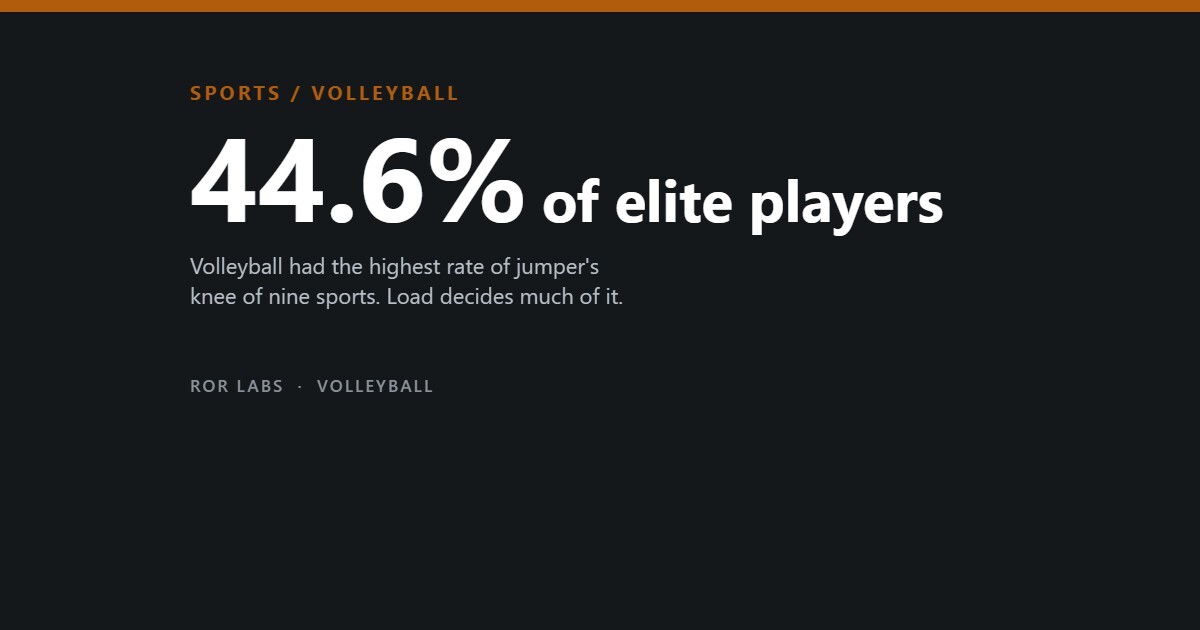
Volleyball is where the condition is most at home. In a 2005 survey of 613 Norwegian national-level athletes from nine sports, 14.2% had jumper’s knee when examined. In volleyball the figure was 44.6%, the highest of any sport, followed by basketball at 31.9%; cyclists and orienteers had none. Affected athletes had lived with symptoms for 32 months on average. Recreational players are less exposed, but volleyball also led a Dutch survey of non-elite athletes.
This article covers what jumper’s knee does, where the risk concentrates, what has been measured to work, why much of that evidence is thinner than it looks, and why the answer is to play carefully rather than to stop. In January 2026 a Swiss laboratory added a new piece to the puzzle of why tendons fail under repeated overload.
What jumper’s knee does to a volleyball player
Jumper’s knee, or patellar tendinopathy, is pain in the tendon that joins the kneecap to the shin, usually just below the kneecap. The tendon stores and releases energy each time a player loads for a jump and absorbs a landing, and the pain is load-dependent: worst with jumps and changes of direction, easing with rest. Imaging can show changes in the tendon, but a scan cannot show pain, so the diagnosis is made by examination.
It is also stubborn. In the Norwegian elite survey the mean score on the VISA questionnaire, which rates pain and function from 0 to 100, was 64 among those affected. The authors noted that symptoms were often serious enough to impair performance for long periods. In a Dutch survey of 891 non-elite athletes from seven sports, 8.5% had current jumper’s knee; volleyball players had the highest rate at 14.4% and soccer players the lowest at 2.5%.
Jumper’s knee by sport and level
Share of athletes with current jumper’s knee in two cross-sectional surveys, one of Norwegian national-level athletes, one of Dutch non-elite athletes.
Sources: Lian et al., American Journal of Sports Medicine 33(4):561 (2005), 613 athletes; Zwerver et al., British Journal of Sports Medicine 45(4):324 (2011), 891 athletes.
How common it is depends heavily on how it is counted. A 2023 meta-analysis of 28 studies put jumper’s knee at 18.3% of athletes and 24.8% of volleyball players, against 0.1% of the general population. But studies that relied on questionnaires alone found 25.4%, while those using a clinician’s examination found 12.1%, and the authors warned of overdiagnosis. The famous 45% comes from one elite sample of about 50 volleyball players.
The answer depends on how you ask
Pooled prevalence of patellar tendinopathy in athletes by diagnostic method, with 95% confidence intervals in brackets, from a 2023 meta-analysis.
Source: Nutarelli et al., Orthopaedic Journal of Sports Medicine (2023), doi:10.1177/23259671231173659. Most included studies were rated medium quality.
Where the risk concentrates
The clearest driver is load. A four-year Norwegian study followed 141 healthy elite players aged 16 to 18, recording every training session and match. Twenty-eight developed jumper’s knee, 22 boys and six girls. Each extra hour of volleyball training a week raised the odds 1.72 times, and each extra set of matches played a week 3.88 times, the strongest sports-related predictor. Boys carried three to four times the risk of girls. Body composition made no difference.
Counting jumps sharpened the picture. When researchers filmed a week of training and ten matches among 44 players at the same level, they logged 11,943 jumps. Boys jumped 35.7 times per training hour and girls 13.7, and weekly training totals among boys ranged from 50 to 666. Differences between individuals were far larger than differences between playing positions, and the authors suggested that total jumps may matter more than hours on court.
How often young elite players jump
Jumps per hour counted from video of one training week and ten matches at a Norwegian elite volleyball school, players aged 16 to 18.
Source: Bahr and Bahr, British Journal of Sports Medicine 48(17):1322 (2014), 11,943 jumps by 26 boys and 18 girls.
Other studies point the same way. An Italian survey of 407 players in 1984 found symptoms most often in those playing five or more times a week and on hard surfaces such as cement. A 2026 Portuguese study of 78 first-division players, using ultrasound to confirm the diagnosis, found the odds rising 1.37 times per weekly training hour and 4.41 times higher in men. The FIVB’s medical guidance adds an irony: the players who jump highest are at greatest risk.
What has been measured to work
For years the standard treatment was the eccentric decline squat: slow single-leg squats on a board tilted at 25 degrees, done into some pain, twice a day for 12 weeks. In a 2005 Australian trial of 17 elite volleyball players treated in the preseason, squats on the decline board and on a flat step both helped, but the decline group was more likely to reach a clinically meaningful 20-point gain on the VISA scale after 12 months.
Heavy, slow lifting does at least as well. A Danish trial randomised 39 men with jumper’s knee to 12 weeks of corticosteroid injections, decline squats or heavy slow resistance training. All three groups improved at 12 weeks. By the half-year follow-up the injection group had deteriorated, while both exercise groups held their gains; the heavy-lifting group was the most satisfied. The authors concluded that steroid injections have good short-term but poor long-term effects.
The largest trial so far, in the Netherlands, compared eccentric training with a four-stage programme that starts with pain-relieving isometric holds, moves to heavy lifting, then jumps, and finally sport. Among 76 athletes with ultrasound-confirmed jumper’s knee, mostly of two years’ standing, VISA scores improved by 28 points with the staged programme against 18 with eccentric training after 24 weeks. Return to sport was 43% against 27%, a gap that could be chance.
Staged loading against eccentric squats
Results after 24 weeks in a Dutch trial of 76 athletes randomised to a four-stage progressive tendon-loading programme or eccentric decline squats.
Source: Breda et al., British Journal of Sports Medicine 55(9):501 (2021). The VISA-P difference was significant (adjusted 9 points, 95% CI 1 to 16); the return-to-sport difference was not.
What does not work is trying to fix the knee while playing a full season. In a 2005 Norwegian trial, 29 elite volleyball players with jumper’s knee either added decline squats twice a day for 12 weeks in the second half of the season or trained as usual. VISA scores barely moved: 71.1 to 70.2 with squats, 76.4 to 75.4 without. Players managed about 59% of the prescribed sessions. A Danish prevention trial in 209 professional footballers found eccentric training did not reduce tendon injuries either.
Most of this evidence comes from small trials. A 2021 network meta-analysis found 37 randomised trials testing 33 treatments, most represented by a single study. The striking pain relief from isometric holds was first shown in six volleyball players; a later crossover trial of 21 people found a reduction of 0.9 points on a ten-point scale that had faded within 45 minutes. Reviewers have argued that the approach spread faster than the evidence for it.
Why the answer is not to stop playing
Rest from sport is neither a feasible nor an effective treatment for elite athletes, a 2011 review of 32 treatment studies concluded, and the long-term Norwegian follow-up held good news alongside the bad. About 70% of tendons that looked abnormal on ultrasound at the start appeared structurally normal on MRI 11 years later, and imaging changes did not track with how the knee felt. Most former players who had jumper’s knee did not retire because of it.
The risk is also a distribution that coaches and players can move. It rises with weekly hours, sets played and jumps landed, which are all things a schedule decides. The FIVB’s medical guidance calls limiting jumping volume in training perhaps the most effective preventive measure, alongside stronger thigh and hip muscles and attention to landing technique. The Norwegian researchers argued that coaches, not young players, decide how many teams and matches a talented teenager takes on.
Eleven years after jumper’s knee
Former young elite volleyball players followed up a mean of 11.4 years after baseline. Function scores run from 0 to 100, higher is better.
Source: Visnes et al., American Journal of Sports Medicine 52(13) (2024), doi:10.1177/03635465241284648; 138 of 143 former players.
For an amateur player the list is short. Count jumps, not just hours, and increase them gradually, especially for teenagers who play for several teams. Treat pain below the kneecap that lingers into the next day as a load signal rather than a nuisance. If it persists, a physiotherapist-led programme of progressive loading has the best trial support, and a steroid injection trades short-term relief for a worse outcome later. Our article on ankle sprains at the net covers volleyball’s other common injury.
Questions people ask
Can I keep playing with jumper’s knee?
Many players do, but adding eccentric squats on top of a full season did not help in a Norwegian trial. The programmes that worked reduced pain-provoking activity for a few weeks, then rebuilt load in stages, keeping pain at a tolerable level.
Does a steroid injection help?
In the short term, yes. In a Danish trial the injection group had deteriorated by six months, while exercise groups held their gains, and a review recommended against injections.
Why do men get it more often?
Male players were at higher risk in several studies, and in one filmed sample boys jumped more than twice as often per training hour as girls. Load explains part of the gap, but probably not all.
Does an abnormal scan mean I have jumper’s knee?
No. Tendons without pain can look abnormal, and many abnormal tendons later normalise. In junior basketball players, though, abnormal tendons were 4.2 times as likely to become painful, so a scan is a warning, not a diagnosis.
The short version
- In a 2005 survey of 613 elite athletes, 44.6% of volleyball players had jumper’s knee, the highest of nine sports; non-elite rates are lower.
- Prevalence depends on the method: questionnaire studies found about twice the rate of studies using a clinical examination.
- Risk rises with training hours, sets played and jumps landed, and is higher in men and on hard surfaces.
- Staged tendon loading beat eccentric squats in the largest trial; steroid injections helped briefly but did worse at six months.
- Play carefully: manage jump volume, especially for teenagers, and treat lingering tendon pain early, since one affected player in five later retired because of it.
This is a summary of published research, not medical advice. If you have pain below the kneecap that worsens with jumping or lingers after training, see a doctor or physiotherapist before increasing your training or playing through it.
Further reading: Lian et al., American Journal of Sports Medicine (2005), for prevalence across sports. Breda et al., British Journal of Sports Medicine (2021), for the progressive tendon-loading trial. Visnes et al., American Journal of Sports Medicine (2024), for the 11-year follow-up.
- Built to Move, Kelly Starrett and Juliet Starrett (2023). Ten simple physical habits for keeping joints and tissues durable; general rather than volleyball-specific.
- Exercised, Daniel E. Lieberman (2021). A Harvard biologist tests common beliefs about exercise and rest against evolution and evidence.
- The Data Detective, Tim Harford (2021). Ten rules for judging statistics, useful when a prevalence figure depends on how a condition is counted.
Sources
- Visnes H, Bache-Mathiesen LK, Yamaguchi T, Gilhuus HP, Algaard KRH, Hisdal E, et al. Long-term prognosis of patellar tendinopathy (jumper’s knee) in young, elite volleyball players: tendon changes 11 years after baseline. American Journal of Sports Medicine 52(13) (2024), doi:10.1177/03635465241284648.
- Lian ØB, Engebretsen L, Bahr R. Prevalence of jumper’s knee among elite athletes from different sports: a cross-sectional study. American Journal of Sports Medicine 33(4):561–567 (2005), doi:10.1177/0363546504270454.
- Zwerver J, Bredeweg SW, van den Akker-Scheek I. Prevalence of jumper’s knee among non-elite athletes from different sports: a cross-sectional survey. British Journal of Sports Medicine 45(4):324 (2011), conference abstract.
- Nutarelli S, da Lodi CMT, Cook JL, Deabate L, Filardo G. Epidemiology of patellar tendinopathy in athletes and the general population: a systematic review and meta-analysis. Orthopaedic Journal of Sports Medicine (2023), doi:10.1177/23259671231173659.
- Visnes H, Bahr R. Training volume and body composition as risk factors for developing jumper’s knee among young elite volleyball players. Scandinavian Journal of Medicine & Science in Sports (2013), doi:10.1111/j.1600-0838.2011.01430.x.
- Bahr MA, Bahr R. Jump frequency may contribute to risk of jumper’s knee: a study of interindividual and sex differences in a total of 11 943 jumps video recorded during training and matches in young elite volleyball players. British Journal of Sports Medicine 48(17):1322 (2014).
- Ferretti A, Puddu G, Mariani PP, Neri M. Jumper’s knee: an epidemiological study of volleyball players. The Physician and Sportsmedicine (1984), doi:10.1080/00913847.1984.11701970.
- Reis AM, Barros AS, Poças PS, Gutierres MAP. Jumper’s knee risk in elite volleyball: impact of training volume, sex, and position. Journal of Sports Medicine and Physical Fitness 66(7):847 (2026), doi:10.23736/S0022-4707.26.17195-3.
- Reeser JC, Bahr R. Principles of prevention and treatment of common volleyball injuries. FIVB Medical Commission, undated PDF hosted on fivb.com (2024).
- Young MA, Cook JL, Purdam CR, Kiss ZS, Alfredson H. Eccentric decline squat protocol offers superior results at 12 months compared with traditional eccentric protocol for patellar tendinopathy in volleyball players. British Journal of Sports Medicine 39(2):102 (2005).
- Kongsgaard M, Kovanen V, Aagaard P, et al. Corticosteroid injections, eccentric decline squat training and heavy slow resistance training in patellar tendinopathy. Scandinavian Journal of Medicine & Science in Sports 19(6):790–802 (2009), doi:10.1111/j.1600-0838.2009.00949.x.
- Breda SJ, Oei EHG, Zwerver J, et al. Effectiveness of progressive tendon-loading exercise therapy in patients with patellar tendinopathy: a randomised clinical trial. British Journal of Sports Medicine 55(9):501 (2021).
- Visnes H, Hoksrud A, Cook J, Bahr R. No effect of eccentric training on jumper’s knee in volleyball players during the competitive season: a randomized clinical trial. Clinical Journal of Sport Medicine 15(4):227–234 (2005).
- Fredberg U, Bolvig L, Andersen NT. Prophylactic training in asymptomatic soccer players with ultrasonographic abnormalities in Achilles and patellar tendons: the Danish Super League Study. American Journal of Sports Medicine 36(3):451 (2008), doi:10.1177/0363546507310073.
- Challoumas D, Pedret C, Biddle M, et al. Management of patellar tendinopathy: a systematic review and network meta-analysis of randomised studies. BMJ Open Sport & Exercise Medicine 7(4):e001110 (2021).
- Rio E, Kidgell D, Purdam C, et al. Isometric exercise induces analgesia and reduces inhibition in patellar tendinopathy. British Journal of Sports Medicine 49(19):1277 (2015).
- Holden S, Lyng K, Graven-Nielsen T, et al. Isometric exercise and pain in patellar tendinopathy: a randomized crossover trial. Journal of Science and Medicine in Sport (2019), doi:10.1016/j.jsams.2019.09.015.
- Silbernagel KG, Vicenzino B, Rathleff MS, Thorborg K. Isometric exercise for acute pain relief: is it relevant in tendinopathy management? British Journal of Sports Medicine 53(21):1330 (2019).
- Gaida JE, Cook J. Treatment options for patellar tendinopathy: critical review. Current Sports Medicine Reports (2011), doi:10.1249/JSR.0b013e31822d4016.
- Cook JL, Khan KM, Kiss ZS, Purdam CR, Griffiths L. Prospective imaging study of asymptomatic patellar tendinopathy in elite junior basketball players. Journal of Ultrasound in Medicine 19(7):473 (2000).
- ETH Zurich. Researchers discover trigger of tendon disease. EurekAlert!, 14 January 2026; Moschini G, et al. Science Translational Medicine (2026), doi:10.1126/scitranslmed.adt1228.