Volleyball shoulder injuries, and the spike count that matters
Key takeaways · 10 min read
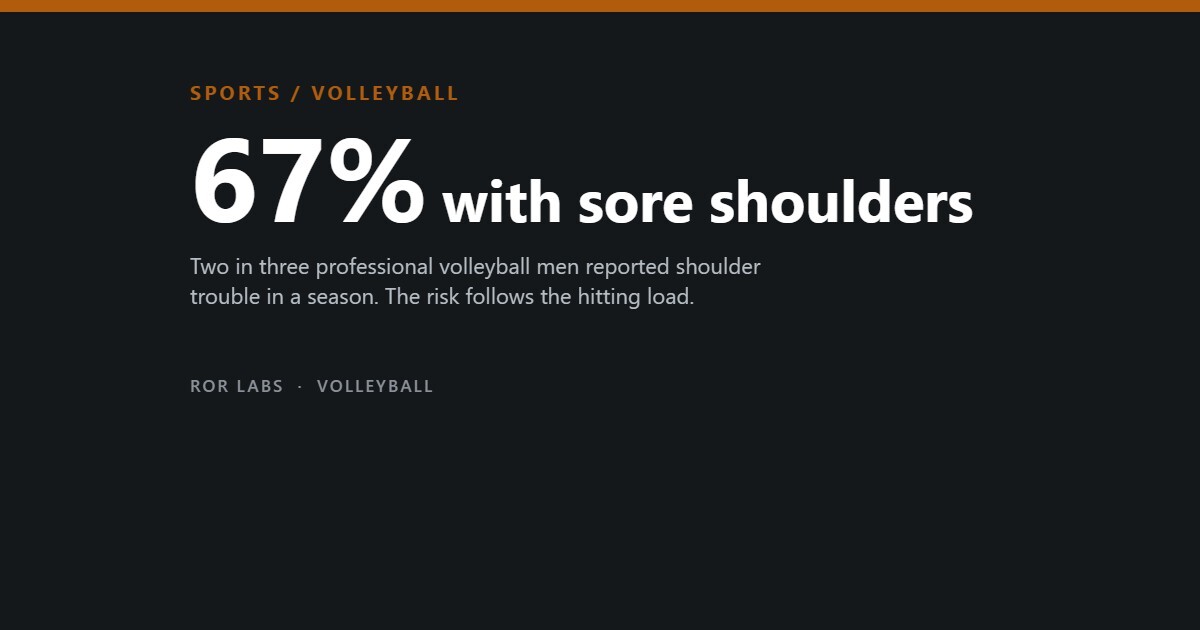
- Across three seasons, 67% of professional and university men reported a shoulder problem and 19% had one in an average week.
- Outside hitters and opposites carry most of the risk; a previous shoulder problem is the strongest single predictor.
- Suprascapular nerve damage with infraspinatus wasting has been found in up to a third of elite players, often without pain.
- A shoulder warm-up programme cut problems by 28% in elite handball; no volleyball trial has yet shown the same.
On 8 July 2026 the Philippine club Nxled confirmed that its captain, Brooke Van Sickle, a three-time Most Valuable Player of the Premier Volleyball League, would sit out the whole PVL on Tour tournament with a minor tear in her right shoulder. “She’s dealing with a minor tear on her shoulder but will return for the next conference,” her coach, Ettore Guidetti, told SPIN.ph. She had first taken the pain for tendinitis, according to the league.
Her case is unusual only because it made the news. A study that followed 75 professional and university men in Japan, Qatar, Turkey and the United States over three seasons found that 67% reported a shoulder problem at some point in a season, and 27% had one that substantially cut their training or performance. In an average week, 19% were playing with a complaining shoulder. Most of it is overuse.
This article covers what spiking and serving do to the shoulder, including a nerve injury that is common in volleyball and often painless, where the risk concentrates, what has been measured to reduce it, and why the answer is to play carefully rather than to stop. Ankle sprains, the sport’s other big injury, have their own article.
What spiking and serving do to the shoulder
A spike is a throw with a jump attached. The arm cocks back into extreme outward rotation, whips through the ball, and must then be braked by the small muscles at the back of the shoulder. A laboratory study of 14 Division I players found that spiking and serving put the shoulder in more abduction and horizontal adduction at ball contact than baseball pitching does, which the authors suggested might explain why one nerve injury is so much more common in volleyball.
The usual diagnoses are rotator cuff tendinopathy, impingement, labral tears and instability. In a cohort of 95 professional and masters players followed for eight months, 52.6% reported shoulder pain and 38.9% missed at least a day. Among those injured, MRI most often showed subacromial bursitis (94%), lesions of the upper labrum (73%) and acromioclavicular arthritis (62%).
How often volleyball shoulders complain
Share of players reporting shoulder problems in four studies, using each study’s own definition. Self-reported questionnaires capture problems that never cost a match.
Sources: Skazalski et al., Journal of Athletic Training 59(1):81 (2024); Forthomme et al., Medicine & Science in Sports & Exercise (2013); Frisch et al., Orthopaedic Journal of Sports Medicine (2017).
The injury most specific to volleyball is suprascapular neuropathy. The suprascapular nerve crosses the back of the shoulder blade to the infraspinatus, the muscle that turns the arm outwards and helps brake the follow-through. Stretched or compressed at a notch near the joint, the nerve stops feeding the muscle, which wastes until the hollow is visible. In 1994 neurologists examined 30 high-level male players and found the lesion in 12, eight of them latent. Adding 36 international players, the prevalence was 33%, always on the hitting side.
Later estimates are lower. A 2020 study of 82 professional players, by which time the jump topspin serve had become the most common serve, found infraspinatus wasting in 9% of men and 12% of women. Every case had weaker outward rotation, and none complained of pain or reduced performance. The authors had expected the change in serving to lower the frequency, but a single cross-sectional study cannot show why it fell.
Nerve damage and wasting in the hitting shoulder
Share of elite players with suprascapular nerve findings or infraspinatus wasting, by study. Methods differ: some used nerve tests, others examination or MRI.
Sources: Eggert and Holzgraefe (1993); Holzgraefe et al., British Journal of Sports Medicine 28(3):177 (1994); Witvrouw et al., BJSM 34(3):174 (2000); Miura et al. (2019); Mazza et al. (2020).
Where the risk concentrates
Position is the clearest marker. In a men’s national-team squad followed with ultrasound and questionnaires over several seasons, 11 of 19 outside hitters and 2 of 4 opposites developed shoulder complaints within 12 weeks, against 2 of 19 middle blockers, none of 12 setters and 1 of 5 liberos. Together, outside hitters and opposites were 12.2 times more likely to develop complaints. Middles jump as often as anyone; the authors pointed to lighter attack loads and different hitting mechanics.
The same pattern appears far from the professional game. Among 175 high-school girls in the American Midwest, 43.8% of hitters reported recurring shoulder pain not caused by a fall or collision, against 29.8% of setters and defensive specialists. Girls who also played a club season reported it more often than those who played only for their school, 43.3% against 32.6%.
Who develops shoulder complaints, by position
Players without complaints at the start who developed them during a 12-week follow-up, in a men’s national-team squad. Small groups: counts given in brackets.
Source: Skazalski, Bahr and Whiteley, Scandinavian Journal of Medicine & Science in Sports (2020), doi:10.1111/sms.13831.
The strongest individual predictor is a shoulder that has complained before. In a study of 66 first- and second-division players from nine teams, those with a history of dominant-shoulder pain had nine times the risk of further pain during the season, and stronger eccentric rotator strength was protective. In the professional men’s study, players who started the season with a complaint reported problems in 38% of weeks, against 8% for teammates who started clean.
Load is the factor a coach can change. The Midwest survey asked players how often they hit or served in a week. Each extra 100 contacts raised the odds of recurring pain about 1.3 times, an association that became borderline after adjustment, and the share in pain rose noticeably above 250 contacts a week. Out-of-season weight training of an unspecified kind carried 3.2 times the odds; the authors suspected the wrong exercises or too little rest. It was a one-off, self-reported survey, so it shows association, not cause.
Shoulder pain rises with load and history
Two studies. Top: share of US high-school girls reporting recurring shoulder pain by number of risk factors (over 250 hits and serves a week, more than 5 years of school play, out-of-season lifting). Bottom: share of weeks with a shoulder complaint in professional men.
Sources: Frisch et al., Orthopaedic Journal of Sports Medicine (2017); Skazalski et al., Journal of Athletic Training 59(1):81 (2024).
Other markers are less consistent. In the 95-player cohort, scapular dyskinesis, a shoulder blade that moves out of rhythm, carried 4.2 times the odds of pain and 3.5 times the odds of injury, and being a starter 2.7 times the odds of injury, while sex, age, position and training overload showed no significant link. Small cohorts often disagree like this.
What has been measured to work
No volleyball-specific programme has yet been shown to prevent shoulder problems. The best evidence comes from handball, another sport built on a repeated overhead throw. In a trial, 45 elite teams with 660 players were randomised by team. Half added a shoulder programme from the Oslo Sports Trauma Research Center to their warm-up three times a week, aimed at the risk factors handball research had found: reduced rotation range, weak outward rotation and a poorly controlled shoulder blade.
Over a seven-month season the average prevalence of shoulder problems was 17% in the programme teams and 23% in the controls, an odds ratio of 0.72, or 28% lower. Substantial problems fell from 8% to 5%, but that difference could have been chance. The trial was run by the centre that designed the programme, and it was in handball, not volleyball.
Warm-up programmes and overuse problems in randomised trials
Average prevalence during the season. Handball: shoulder problems in 660 elite players. Volleyball: overuse problems of any kind in 672 recreational adults.
Sources: Andersson et al., British Journal of Sports Medicine 51(14):1073 (2017); Gouttebarge et al., Journal of Sports Sciences (2020).
The one large volleyball trial is less encouraging for shoulders. In the Netherlands, 672 recreational adults were randomised by region either to VolleyVeilig, a 15-minute warm-up that included four to five minutes of shoulder exercises such as outward rotation against an elastic band, or to usual practice. Acute injuries were 21% lower in the crude analysis, a difference that lost significance after adjustment, and overuse problems did not differ. Three authors had helped develop the programme with the Dutch federation.
That leaves managing load, which is plausible rather than proven. Laboratory studies have compared spiking techniques and found they change shoulder angles, but none has tested whether a technique prevents injury. In the national-team study, players whose dominant shoulder showed a thickened bursa or new blood vessels in the tendon on ultrasound were 10.2 and 6.5 times more likely to develop complaints; the authors advised monitoring those players’ load.
Why the answer is not to stop playing
Several of the most quoted volleyball shoulder facts are weaker than they sound. The claim that an elite player spikes 40,000 times a season traces to an estimate in a small clinical study of elite attackers, repeated in reviews since; nobody has counted. A loss of inward rotation in the hitting arm, treated as a warning sign in baseball, appears in volleyball to be an anatomical adaptation, according to a systematic review, and a 2025 prospective cohort found no link with pain or injury. And infraspinatus wasting is often painless: in a series of 38 players with isolated wasting, 35 had no pain, and 13 of 16 reviewed after five and a half years were still playing.
None of this means volleyball shoulders are fine. It means that a finding on a scan is not a disability, and that the risk sits mainly in things that can be moved: how many hard swings a week, how sharply volume jumps after a break, whether a shoulder that already hurts gets rest and rehabilitation, and whether the muscles that brake the arm are strong.
In practice that starts with counting. Coaches can log serves and attacks the way baseball counts pitches, spread hitting volume across the week, build up after an off-season, and treat a recurring ache in an outside hitter as a reason to adjust rather than push through. A shoulder strength routine like the one tested in handball costs little and targets the same muscles. A shoulder that keeps hurting, or visible wasting or weakness, deserves an assessment by a sports physician or physiotherapist.
Volleyball’s overall injury rate is relatively low compared with other team sports, and its shoulder problems are mostly the kind that respond to rest, strength and adjusted load. The answer is to play carefully, with the hitting arm’s workload treated as something to manage.
Questions people ask
Why do volleyball players get shoulder pain?
Mostly from repetition. Spiking and serving rotate the arm to extremes and then brake it hard, thousands of times a season. Tendons, the bursa, the labrum and the suprascapular nerve can all be irritated.
Is a wasted infraspinatus muscle dangerous?
It is a sign of suprascapular nerve injury and deserves assessment, but it is often painless. In one series most players with isolated wasting had no pain and many were still playing years later, usually with strengthening of the outward rotators.
Does a warm-up programme prevent shoulder injuries in volleyball?
Not yet proven. A shoulder programme cut shoulder problems by 28% in elite handball, but a Dutch volleyball warm-up with shoulder exercises did not reduce overuse problems in recreational adults.
How many spikes a week is too many?
There is no validated limit. In one survey of high-school girls, pain became noticeably more common above about 250 hits and serves a week, but that was self-reported and observational. Sudden jumps in volume are the safer thing to avoid.
The short version
- Across three seasons, 67% of professional and university men reported a shoulder problem and 19% had one in an average week.
- Outside hitters and opposites carry most of the risk; a previous shoulder problem is the strongest single predictor.
- Suprascapular nerve damage with infraspinatus wasting has been found in up to a third of elite players, often without pain.
- A shoulder warm-up programme cut problems by 28% in elite handball; no volleyball trial has yet shown the same.
- Play carefully: count serves and attacks, raise volume gradually and treat a recurring ache as a reason to adjust.
This is a summary of published research, not medical advice. If your shoulder hurts when you hit or serve, keeps coming back, or you notice wasting or weakness at the back of the shoulder, see a doctor or physiotherapist before increasing your training.
Further reading: Skazalski et al., Journal of Athletic Training (2024), for weekly shoulder problems in professional men. Holzgraefe et al., British Journal of Sports Medicine (1994), for suprascapular neuropathy. Andersson et al., British Journal of Sports Medicine (2017), for the handball shoulder trial.
- Outlive, Peter Attia (2023). A physician’s case for strength and stability training across a lifetime; read the training chapters for the shoulder.
- The Art of Uncertainty, David Spiegelhalter (2024). A Cambridge statistician on acting sensibly when the evidence, like volleyball shoulder prevention, is promising but unsettled.
- Proof, Adam Kucharski (2025). An epidemiologist on how we decide something is true; useful when the best prevention trial comes from a different sport.
Sources
- Skazalski C, Whiteley RJ, Sattler T, Kozamernik T, Bahr R. Knee, low back, and shoulder problems among university and professional volleyball players: playing with pain. Journal of Athletic Training 59(1):81–89 (2024), doi:10.4085/1062-6050-0476.22.
- Skazalski C, Bahr R, Whiteley R. Shoulder complaints more likely in volleyball players with a thickened bursa or supraspinatus tendon neovessels. Scandinavian Journal of Medicine & Science in Sports (2020), doi:10.1111/sms.13831.
- Forthomme B, Wieczorek V, Frisch A, Crielaard JM, Croisier JL. Shoulder pain among high-level volleyball players and preseason features. Medicine & Science in Sports & Exercise (2013), doi:10.1249/MSS.0b013e318296128d.
- Frisch KE, Clark J, Hanson C, Fagerness C, Conway A, Hoogendoorn L. High prevalence of nontraumatic shoulder pain in a regional sample of female high school volleyball athletes. Orthopaedic Journal of Sports Medicine (2017), doi:10.1177/2325967117712236.
- Carvalho de Toledo D, Crema Duarte PH, de Lima Malta N, et al. Risk factors for shoulder pain, injury, and dysfunction in volleyball athletes: a prospective cohort study. Orthopaedic Journal of Sports Medicine 13(11):23259671251389119 (2025).
- Reeser JC, Fleisig GS, Cools AMJ, Yount D, Magnes SA. Biomechanical insights into the aetiology of infraspinatus syndrome. British Journal of Sports Medicine (2012), doi:10.1136/bjsports-2011-090918.
- Holzgraefe M, Kukowski B, Eggert S. Prevalence of latent and manifest suprascapular neuropathy in high-performance volleyball players. British Journal of Sports Medicine 28(3):177 (1994).
- Eggert S, Holzgraefe M. Compression neuropathy of the suprascapular nerve in high performance volleyball players (in German). (1993), doi:10.1055/s-2007-993497.
- Witvrouw E, Cools A, Lysens R, et al. Suprascapular neuropathy in volleyball players. British Journal of Sports Medicine 34(3):174 (2000).
- Miura K, Tsuda E, Ishibashi Y. Glenohumeral rotational deficit and suprascapular neuropathy in the hitting shoulder in male collegiate volleyball players. Progress in Rehabilitation Medicine 4 (2019).
- Mazza D, Iorio R, Drogo P, et al. Did the prevalence of suprascapular neuropathy in professional volleyball players decrease with the changes occurred in serving technique? The Physician and Sportsmedicine (2020), doi:10.1080/00913847.2020.1766344.
- Ferretti A, De Carli A, Fontana M. Injury of the suprascapular nerve at the spinoglenoid notch: the natural history of infraspinatus atrophy in volleyball players. American Journal of Sports Medicine 26(6):759–763 (1998).
- Challoumas D, Stavrou A, Dimitrakakis G. The volleyball athlete’s shoulder: biomechanical adaptations and injury associations. Sports Biomechanics (2017), doi:10.1080/14763141.2016.1222629.
- Reeser JC, Verhagen E, Briner WW, Askeland TI, Bahr R. Strategies for the prevention of volleyball related injuries. British Journal of Sports Medicine (2006), doi:10.1136/bjsm.2005.018234.
- Andersson SH, Bahr R, Clarsen B, Myklebust G. Preventing overuse shoulder injuries among throwing athletes: a cluster-randomised controlled trial in 660 elite handball players. British Journal of Sports Medicine 51(14):1073 (2017), doi:10.1136/bjsports-2016-096226.
- Gouttebarge V, Barboza SD, Zwerver J, Verhagen E. Preventing injuries among recreational adult volleyball players: results of a prospective randomised controlled trial. Journal of Sports Sciences (2020), doi:10.1080/02640414.2020.1721255.
- Garcia JM. BVS to miss PVL on Tour as she recovers from minor shoulder tear. SPIN.ph, 8 July 2026; Brooke Van Sickle shifts focus on leading Nxled from sidelines. PVL.ph (2026).