The Widowhood Effect: What the Evidence Shows
Key takeaways · 11 min read
- Widowed people have a higher risk of death than married people, about 41% higher in the first six months.
- Heart attacks and strokes are about twice as common in the first 30 days after a partner dies.
- The effect is usually larger in men, but not in every country or group.
- Studies comparing wives and ex-wives suggest the loss itself causes harm, at least in men.
Most people have heard a version of the story. A couple are married for sixty years, one of them dies, and within months the other follows. Families often say the survivor died of a broken heart.
Epidemiologists call this the widowhood effect: the higher risk of death among people whose spouse has recently died. It is one of the most consistently documented findings in social epidemiology, observed across countries, decades and data sets covering millions of people.
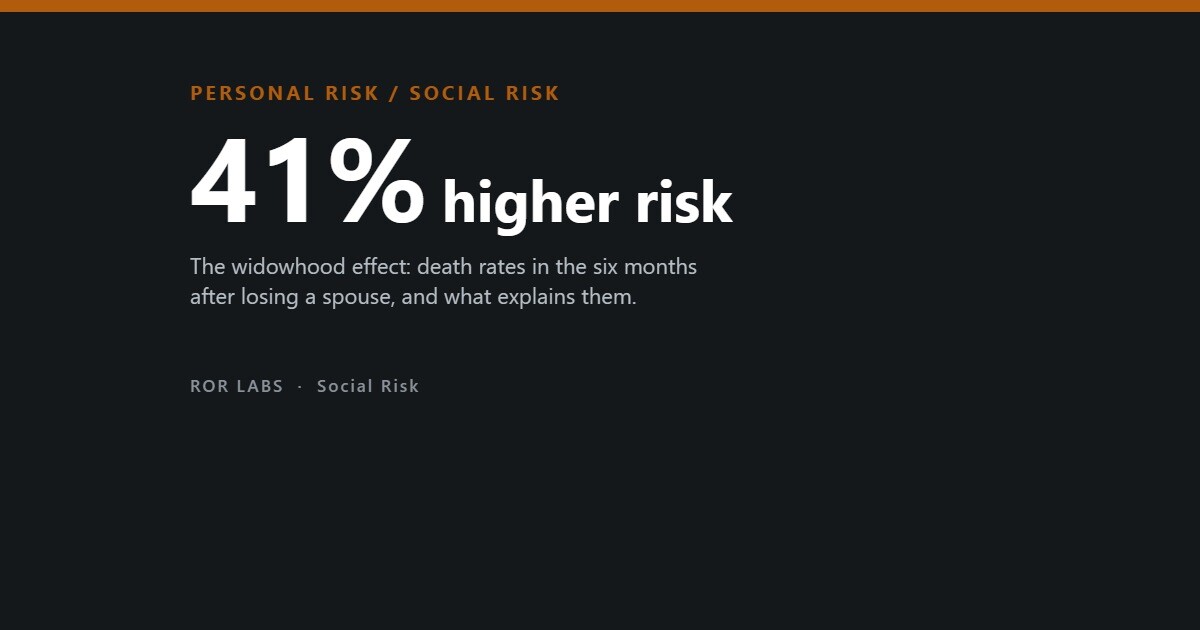
What is less settled is how large the effect is, who it affects most, and how much of it is really caused by the loss rather than by things married couples share. This article looks at what the research shows. The headline figure comes from a meta-analysis of 15 cohorts and more than two million people: in the first six months after a spouse dies, the survivor’s risk of death is about 41% higher.
An old observation
The idea is not new. In 1963 Michael Young, Bernard Benjamin and Chris Wallis reported in The Lancet that among 4,486 widowers aged 55 and over in England and Wales, death rates in the first six months after bereavement were about 40% higher than among married men of the same age. After that, the excess faded.
Six years later, Colin Murray Parkes and colleagues followed the same kind of group and titled their paper in the British Medical Journal ‘Broken heart’. Most of the extra deaths were from heart disease. The phrase stuck, and so did the question of whether grief itself was doing the damage.
Since then, the finding has been repeated with far larger data sets and better methods, in Finland, Norway, Scotland, England, Israel, the United States and elsewhere. The early estimate of about 40% in the first six months has turned out to be remarkably close to modern pooled figures.
How big is the effect?
Two meta-analyses give the best overall estimates. Jen Ruey Moon and colleagues, writing in PLoS ONE in 2011, pooled 15 cohort studies covering 2,263,888 people. They found that widowed people had a higher risk of death than married people, and that the excess was concentrated early. In the first six months after bereavement, the relative risk was 1.41. After that it fell to 1.14.
Eran Shor and colleagues, in Demography in 2012, took a wider sweep: 123 publications. Their pooled hazard ratio for widowed compared with married people was 1.23, meaning a 23% higher risk of death over the follow-up period, after adjustment for age and other factors.
These are relative risks. For an 80-year-old, whose baseline risk of dying in any given year is already substantial, a 20 to 40% increase is a meaningful number of extra deaths. For a 50-year-old, it is a much smaller absolute change, although the relative effect in some studies is larger at younger ages.
The risk is highest soon after the loss
Relative risk of death, widowed compared with married people.
Moon JR and colleagues, PLoS ONE, 2011. Meta-analysis of 15 cohorts, 2,263,888 people. Bars show the excess above 1.0.
When the risk is highest
The timing matters because it helps distinguish between explanations. If widowhood simply marked people who were already at risk, the excess would be spread evenly over time. Instead, almost every large study finds it clustered in the first weeks and months.
In Norway, Tone Brenn and Elinor Ytterstad followed the whole population and found that excess mortality was highest in the very first week after a spouse’s death, falling quickly after that.
In England, Iain Carey and colleagues used primary care records to compare 30,447 people whose partner had died with 83,588 people whose partner had not. Within 30 days of bereavement, 50 of the bereaved (0.16%) had a heart attack or stroke, compared with 67 (0.08%) of the controls. After adjustment, the rate was 2.2 times higher. The excess faded after the first month. The study was published in JAMA Internal Medicine in 2014.
These are small absolute numbers, but the pattern is striking. Acute grief is a physiological event as well as an emotional one, and a sudden rise in heart attacks and strokes is consistent with what is known about stress, blood pressure and blood clotting.
Heart attack or stroke in the 30 days after bereavement
Matched cohort study, UK primary care records.
Carey IM and colleagues, JAMA Internal Medicine, 2014. Adjusted incidence rate ratio 2.20 (95% CI 1.52 to 3.15).

Men and women
The widowhood effect is usually larger for men. In Moon’s meta-analysis, the pooled relative risk was 1.23 for widowers and 1.04 for widows, with the estimate for women not statistically significant. In Shor’s larger review, the figures were 1.27 for men and 1.15 for women.
Several explanations have been offered. Men in older generations were more likely to rely on their wives for social contact, for managing health appointments and medicines, and for daily routines such as cooking. Women are more likely to have wider social networks outside the marriage.
But the gap is not universal. In a study of Scotland, Paul Boyle, Zhiqiang Feng and Gillian Raab found adjusted hazard ratios of 1.40 for men and 1.36 for women, almost the same. They also found that the raised risk lasted for at least ten years, much longer than in some other studies. The Scottish data covered a representative sample of the population linked to census and death records, which allowed them to control for household and individual characteristics that many earlier studies could not measure.
Race also matters in the United States. Felix Elwert and Nicholas Christakis, using data on 410,272 elderly married couples, found a large and enduring widowhood effect among white couples, but no detectable effect among Black couples. Their explanation was that differences in marital and social context, rather than biology, shape how much a spouse’s death affects the survivor.
The widowhood effect differs by race in the United States
Nationally representative study of 410,272 elderly married couples.
Elwert F, Christakis NA, American Sociological Review, 2006. For intermarried men, the wife’s race largely determined the effect.
Widowers are usually at higher risk than widows
Pooled relative risk of death, widowed compared with married.
| Study | Men | Women |
|---|---|---|
| Moon and colleagues, 2011 | 1.23 | 1.04 (not significant) |
| Shor and colleagues, 2012 | 1.27 | 1.15 |
| Boyle and colleagues, 2011 (Scotland) | 1.40 | 1.36 |
PLoS ONE, 2011; Demography, 2012; Epidemiology, 2011.
Is it really the loss?
The obvious objection is that couples are not random. People tend to marry people like themselves in education, income, habits and health. They share a home, a diet and often the same exposures. If one partner dies of lung disease, the other may have been breathing the same smoke for forty years.
Researchers have tried several ways to separate cause from shared circumstance.
Pekka Martikainen and Tapani Valkonen, in a study of 1.58 million Finns, found that excess mortality after widowhood was 17% for men and 6% for women after adjustment. Deaths from accidents, violence and alcohol rose by 50 to 150%. These causes are closely tied to behaviour and stress after a loss, rather than to long shared exposure.
Elwert and Christakis found a more ingenious test. If the widowhood effect only reflected similarities between spouses, then the death of an ex-wife should raise a man’s risk too, because he chose her for the same reasons. Using data on more than a million elderly Americans, they found a clear effect of a current wife’s death on a husband’s mortality, but no significant effect of an ex-wife’s death. That supports a causal interpretation.
They also found, in a study of 373,189 couples, that the effect appeared after almost every cause of a spouse’s death, including cancers, infections and heart disease. That suggests the effect does not depend mainly on a shared illness.
The case for caution
Not every study agrees that the effect is fully causal. Javier Espinosa and William Evans, in the Journal of Health Economics in 2008, used causes of death that were unlikely to be linked to the survivor’s own characteristics. They concluded that the widowhood effect in men was causal, but that for women it largely reflected omitted variables, factors that affect both partners and are not measured in the data.
Boyle and colleagues’ Scottish study found little difference in the effect by the cause of the spouse’s death, which argues against a simple shared-exposure explanation. But it also found smaller effects among people who already had a long-term illness, suggesting that the effect interacts with the survivor’s own health in ways that are not yet well understood.
The overall picture is that part of the widowhood effect is real harm from the loss, especially in men and especially in the first weeks, while part reflects what couples share. The balance varies across countries and groups.
Is the widowhood effect causal? Four approaches
Studies designed to separate the loss itself from what couples share.
| Study | Approach | Conclusion |
|---|---|---|
| Martikainen and Valkonen, 1996 | 1.58m Finns, causes of death | Violent and alcohol deaths up 50–150% |
| Elwert and Christakis, 2008 | Wives versus ex-wives | Causal effect in men |
| Espinosa and Evans, 2008 | Random-seeming causes of death | Causal in men, mostly selection in women |
| Boyle and colleagues, 2011 | Cause of spouse’s death | Little difference by cause |
American Journal of Public Health; Demography; Journal of Health Economics; Epidemiology.
Why the first weeks are dangerous
Several mechanisms have been proposed, and they are not mutually exclusive.
The first is physiological. Acute grief is a severe stressor. It is associated with raised heart rate and blood pressure, disturbed sleep, and changes in blood clotting and inflammation. Those are the same changes that can trigger a heart attack or stroke in someone whose arteries are already narrowed, which is consistent with Carey’s finding that the excess was sharpest in the first month.
The second is behavioural. People who are grieving may eat and sleep poorly, drink more, stop exercising and stop taking medicines. Martikainen and Valkonen’s finding that deaths from accidents, violence and alcohol rose most steeply fits this explanation, and so does the larger effect among men who relied on a spouse for daily routines.
The third is the loss of care. In older couples, one partner is often the other’s informal carer, noticing symptoms, making appointments and managing medication. When that person dies, some of that care disappears overnight.
The fourth is shared circumstance, discussed above. Some of the excess reflects exposures and habits that both partners had for decades, which would have raised the survivor’s risk whether or not the spouse had died.
What might help
Very few trials have tested interventions to reduce mortality after bereavement, so any advice here is inference rather than proven effect.
The timing evidence suggests that the first weeks and months are when support matters most, and that some of the risk is practical. A widower who stops taking his medicines, eats poorly and sees no one may be at risk for reasons that friends, family and a primary care doctor can notice.
Carey’s study found the sharpest rise in heart attacks and strokes in the first 30 days, which is also when many bereaved people see a doctor for other reasons: death certificates, sleep problems, or support. Some researchers have suggested this is an opportunity to check blood pressure and medication, although that has not been tested in a trial.
Elwert and Christakis’s finding that social context shapes the effect points in the same direction. Relationships outside the marriage may be one of the things that protect people when the marriage ends.
What the evidence does not show
It does not show that most widowed people die soon after their spouse. The relative risk rises, but in absolute terms most bereaved people survive the first year.
It does not show that grief alone causes death. Some of the effect is linked to accidents, alcohol and missed care, and some reflects what couples share.
It does not show a single size for the effect. Estimates range from almost nothing in some groups to more than 40% in others, depending on sex, race, time since loss and country.
And there is little trial evidence on what reduces the risk. Suggestions about support and medical check-ups are reasonable but largely untested.
Questions people ask
Is the widowhood effect real?
Yes. Large meta-analyses consistently find higher mortality after a spouse’s death, with a relative risk of about 1.41 in the first six months.
Can you die of a broken heart?
The risk of heart attack and stroke roughly doubles in the first 30 days after losing a partner, according to a UK study of more than 30,000 bereaved people. Absolute risk remains low.
Are men more affected than women?
Usually. Meta-analyses find a larger effect in widowers, although a Scottish study found almost equal effects in men and women.
How long does the increased risk last?
It is highest in the first weeks and months, but some studies find a smaller excess lasting years.
Is it caused by grief or by shared lifestyle?
Both. Studies comparing wives and ex-wives support a real causal effect, especially in men, but part of the association reflects what spouses share.
The short version
- Widowed people have a higher risk of death than married people, about 41% higher in the first six months.
- Heart attacks and strokes are about twice as common in the first 30 days after a partner dies.
- The effect is usually larger in men, but not in every country or group.
- Studies comparing wives and ex-wives suggest the loss itself causes harm, at least in men.
- There is little trial evidence on what reduces the risk, though practical and social support are plausible.
This article summarises published research on mortality after bereavement. It is not medical advice. If you or someone close to you is struggling after a death, a family doctor, a bereavement support service or a local grief counselling organisation can help.
Further reading. Elwert and Christakis, ‘Wives and Ex-Wives: A New Test for Homogamy Bias in the Widowhood Effect’, Demography, 2008, is the most elegant attempt to separate cause from selection. Moon and colleagues, ‘Widowhood and Mortality: A Meta-Analysis’, PLoS ONE, 2011, is open access.
- The Grieving Brain, Mary-Frances O’Connor (2022). A neuroscientist on what grief does to the brain and body, and why it takes time.
- Together, Vivek H. Murthy (2020). The former US Surgeon General on loneliness and social connection as health risks.
- The Good Life, Robert Waldinger and Marc Schulz (2023). Lessons from the Harvard Study of Adult Development on relationships and long-term health.
Sources
- Young M, Benjamin B, Wallis C. The mortality of widowers. The Lancet, 1963;282(7305):454–457. doi:10.1016/S0140-6736(63)92193-7.
- Parkes CM, Benjamin B, Fitzgerald RG. Broken heart: a statistical study of increased mortality among widowers. British Medical Journal, 1969;1(5646):740–743. doi:10.1136/bmj.1.5646.740.
- Moon JR, Kondo N, Glymour MM, Subramanian SV. Widowhood and mortality: a meta-analysis. PLoS ONE, 2011;6(8):e23465. doi:10.1371/journal.pone.0023465.
- Shor E, Roelfs DJ, Curreli M, Clemow L, Burg MM, Schwartz JE. Widowhood and mortality: a meta-analysis and meta-regression. Demography, 2012;49(2):575–606. doi:10.1007/s13524-012-0096-x.
- Carey IM, Shah SM, DeWilde S, Harris T, Victor CR, Cook DG. Increased risk of acute cardiovascular events after partner bereavement: a matched cohort study. JAMA Internal Medicine, 2014;174(4):598–605. doi:10.1001/jamainternmed.2013.14558.
- Brenn T, Ytterstad E. Increased risk of death immediately after losing a spouse: cause-specific mortality following widowhood in Norway. Preventive Medicine, 2016;89:251–256. doi:10.1016/j.ypmed.2016.06.019.
- Boyle PJ, Feng Z, Raab GM. Does widowhood increase mortality risk? Testing for selection effects by comparing causes of spousal death. Epidemiology, 2011;22(1):1–5. doi:10.1097/EDE.0b013e3181fdcc0b.
- Martikainen P, Valkonen T. Mortality after the death of a spouse: rates and causes of death in a large Finnish cohort. American Journal of Public Health, 1996;86(8):1087–1093. doi:10.2105/AJPH.86.8_Pt_1.1087.
- Elwert F, Christakis NA. Widowhood and race. American Sociological Review, 2006;71(1):16–41. doi:10.1177/000312240607100102.
- Elwert F, Christakis NA. The effect of widowhood on mortality by the causes of death of both spouses. American Journal of Public Health, 2008;98(11):2092–2098. doi:10.2105/AJPH.2007.114348.
- Elwert F, Christakis NA. Wives and ex-wives: a new test for homogamy bias in the widowhood effect. Demography, 2008;45(4):851–873. doi:10.1353/dem.0.0029.
- Espinosa J, Evans WN. Heightened mortality after the death of a spouse: marriage protection or marriage selection? Journal of Health Economics, 2008;27(5):1326–1342. doi:10.1016/j.jhealeco.2008.04.001.
- American College of Cardiology. Journal scan: increased risk of acute cardiovascular events after partner bereavement. February 2014.