Surfer’s ear, and the bone that grew in 87.7% of freedivers’ ears too
Key takeaways · 9 min read
- Surfer’s ear is benign bone growth deep in the ear canal, caused by repeated cold water and wind. It traps water and wax, leading to infections and muffled hearing.
- It is not just surfers: 87.7% of freedivers’ ears and 69.5% of white-water kayakers’ ears had exostoses, and pond swimmers get them too.
- Exposure acts like a dose: 92% of wind- and kitesurfers with ten years or more on the water had exostoses, and cold water raised the odds 5.8-fold in US surfers.
- Surgery works but carries risks: pooled eardrum perforation rates were 3.8% to 5.3%, and a quarter of operated Cornish ears were severely narrowed again a decade later.
In June 2026 the comedian Harry Enfield told the Off Menu podcast that he is partially deaf. He blamed his regular swims in the Highgate Ponds in north London: when he was fitted for hearing aids, he was told bone had grown inside his ears. He called them stalactites. The Press Association reported that he had decided against surgery, which he described as very painful and slow to recover from.
His diagnosis was exostoses, better known as surfer’s ear, and he is far from the only swimmer to have it. When doctors in Ireland examined cold-water athletes, including swimmers, triathletes and kayakers as well as surfers, 23.7% had the bony growths, and only 3.6% of those knew. Of the athletes in the same study who already had a diagnosis, nearly half did not surf at all.
This article covers what the growths are and what they do to hearing, who gets them and how much exposure it takes, what prevention and surgery have been measured to achieve, and why the answer is to surf carefully rather than to stay on the beach.
What actually happens in the ear canal
Exostoses are smooth, benign lumps of dense bone that grow from the deep, bony part of the ear canal, close to the eardrum, usually in both ears. The leading explanation is that cold water and wind repeatedly trigger blood vessels in the thin canal lining to dilate, which stimulates bone-forming cells. Wind matters because it chills wet skin by evaporation. Once formed, the bone does not shrink.
A narrowed canal holds on to water, wax and sand. That brings the symptoms: water that will not drain, muffled hearing, blockages and repeated outer-ear infections. The hearing loss is conductive, meaning sound is physically blocked rather than the inner ear being damaged, so it often comes and goes with a blockage. Some surgeons consider growths clinically relevant only once they close about 80% of the canal.
Symptoms rise with the size of the growths
Share of 130 German wind- and kitesurfers reporting ear complaints in the previous 12 months, by the severity of exostoses on video otoscopy.
Source: Wegener, Wegner and Weiss, European Archives of Oto-Rhino-Laryngology (2021). Severe means more than two thirds of the canal closed.
The same study shows the other side. Almost a quarter of people with severe growths had no complaints at all in the previous year. A surgical team made the point decades earlier: most canal exostoses cause no symptoms, and even symptomatic ear infections usually settle with ordinary medical treatment.
Where the risk concentrates
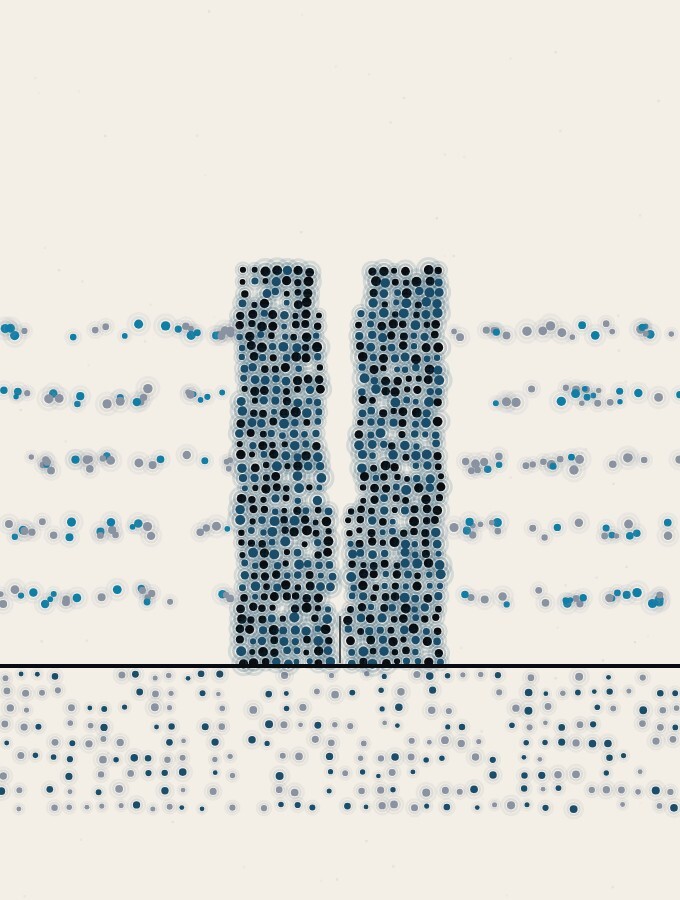
Surfers are the classic group, but the pattern follows cold water and wind, not the board. The earlier article cited surveys of surfers from New Zealand, California and England. Newer work adds other water users. At an international freediving competition, 87.7% of the 204 ears examined had exostoses, and sea temperature where people trained was the strongest predictor of how severe they were.
White-water kayakers showed growths in 69.5% of ears, against 1.7% of ears in volunteers who did no cold-water sport. Windsurfers and kitesurfers on the North Sea and Baltic coasts, where the water falls to about 4°C in winter, appear to need less time than surfers to reach the same degree of narrowing; the authors linked this to the wind. Freshwater counts too, which is how a London pond can do it.
How common exostoses are in water users
Share with exostoses on examination. Some studies counted people and some counted ears, as marked; groups were mostly volunteers, so these are not population rates.
Sources: Lambert et al. (2021); Sheard and Doherty (2008); Wegener et al. (2021); Simas et al. (2021); Cooper et al. (2008); Nakanishi et al. (2011); Boyle et al. (2022); Fabiani et al.
Exposure works like a dose. Among the German wind- and kitesurfers, 92% of those with ten or more years on the water had exostoses, against 61% with less. In a US study of 202 surfers, those who surfed mostly in cold water had 5.8 times the odds of exostoses. In Victoria, Australia, a man who had surfed regularly for 20 years had about a one-in-two chance of serious narrowing.
What raises the odds of exostoses
Odds ratios from two observational studies. The German figures describe the odds of a more severe grade for each additional unit of exposure.
Sources: Kroon et al., Otolaryngology–Head and Neck Surgery (2002); Wegener, Wegner and Weiss (2021).
The cold-water story is strong but not tidy. On Australia’s Gold Coast, where the sea stays above 19°C, 71.8% of 85 long-time surfers had exostoses, a figure the authors noted matches cold-water studies. Their surfers averaged 35 years in the water, which may matter more than temperature. Skulls tell the same story over a longer time: 56.5% of Neandertal remains examined had ear-canal exostoses, a rate matched by few modern populations. One caution applies to all of these numbers: most come from volunteers examined at contests, clubs and beaches, so they describe keen water users rather than everyone who swims.
What has been measured to work
No trial has randomised surfers to earplugs. The evidence is observational, but it points one way. In a prospective study of 242 ears on the Brittany coast, the severity of narrowing tracked the hours surfers had spent in the water without earplugs or a hood; hours spent wearing earplugs showed no such link. That is the pattern you would expect if protection works, though people who protect their ears may differ in other ways.
Knowing is not the same as doing. In a survey of 334 Californian surfers published in 2024, 96.06% knew that earplugs could prevent exostoses, and 64.85% never wore them. The commonest reasons were that earplugs blunt hearing in the water, are uncomfortable and make it hard to talk in the line-up. Most who never wore them said they would be more willing if they knew more about the condition.
When growths do cause trouble, the only cure is to remove the bone, usually through the ear canal with a fine chisel, called an osteotome, or with a drill, sometimes through a cut behind the ear. A 2023 meta-analysis pooled 15 studies covering 1,788 operated ears and compared the two instruments.
Complications of surgery: chisel or drill
Pooled complication rates after removal of ear-canal exostoses, by bone-removal method. Meta-analysis of 15 observational studies (530 osteotome ears, 1,258 drill ears).
Source: Swisher, Singh, Debbaneh and Rivero, Annals of Otology, Rhinology & Laryngology (2023).
Single centres show what the numbers mean in practice. In an American series of 401 ears operated on with a drill through a cut behind the ear, one eardrum was perforated, 4.5% healed slowly and 4.8% lost more than 15 decibels of high-pitched hearing. In another American series using only micro-chisels through the canal, 80% of patients had healed by three weeks and all but one by six.
Bone that grows back
Ear-canal narrowing found years after surgery for exostoses, in two surgical follow-ups that used different measures.
Sources: Timofeev, Notkina and Smith, Clinical Otolaryngology (2004), 46 ears; House and Wilkinson, Otolaryngology–Head and Neck Surgery (2008).
In the Cornish follow-up, earplug use after surgery was the clearest factor linked to slower regrowth, and older patients regrew faster. Those figures come from small, selected groups. They are a reason to keep protecting an operated ear, not a forecast for any one surfer. Surgical reports also name rarer risks, including injury to the facial nerve, which runs close to the canal.
Why the answer is not to stop surfing
Exostoses are a slow, mostly silent condition. Many people carry them for life without trouble, and Cornish surgeons found that 12% of surfers with very heavy cold-water exposure had none at all, which suggests individual susceptibility. Surgery is effective, and patients are usually glad they had it: in a series of 67 patients, 14.9% had a complication, yet satisfaction was high and was not reduced by those complications.
The practical message is to protect the ear early. Wear well-fitting earplugs or a neoprene hood in cold water and wind, including on lakes and ponds, and shake or tilt water out afterwards. Never poke the canal with cotton buds or fingers. A University of Bristol physiologist advises staying out of the water for two to three months after canalplasty, so prevention also saves surfing time. Falls, fins and reef cuts are a separate matter, covered in our earlier article on surfing injuries.
What to do
Steps sorted by when they matter. Each one says how strong the evidence is: Measured Official advice Untested
Before
- Use well-fitting earplugs or a neoprene hood in cold water and wind, including lakes and ponds. Measured see Sources
If it happens
- Keep protection on for every session; in a French study, narrowing tracked hours in the water without earplugs or a hood. Measured see Sources
Afterwards
- Tilt your head to let water drain after surfing or swimming. Official advice see Sources
- See a GP or ear, nose and throat specialist if your ears feel blocked, hurt, discharge or hear less. Official advice see Sources
- After ear canal surgery, keep wearing earplugs; it was the factor most linked to slower regrowth. Measured see Sources
What not to do
- Do not poke the ear canal with cotton buds or fingers to clear water or wax. Official advice see Sources
Not medical advice. See a doctor for blocked, painful or discharging ears.
Questions people ask
Is surfer’s ear the same as swimmer’s ear?
No. Swimmer’s ear is an infection of the outer ear canal. Surfer’s ear is bone growth in the canal. The two are linked, because a narrowed canal traps water and makes infections more likely.
Can you get it in warm water or fresh water?
Yes. A study of long-time surfers in water above 19°C found exostoses in 71.8%, and cold-water swimmers in lakes and ponds are affected too. Cold and wind make it more likely and faster.
Do earplugs really prevent it?
No randomised trial exists. Observational studies consistently link earplugs or hoods with less severe growths and with slower regrowth after surgery, so they are the best available protection.
Will the bone go away if I stop surfing?
No. Exostoses do not shrink. Stopping or protecting your ears can slow further growth, but only surgery removes bone that is already there.
How long is recovery after surgery?
It depends on the technique. In one series of canal-only chisel operations, 80% of patients had healed within three weeks and all but one within six. Expect weeks to a few months out of the water.
The short version
- Surfer’s ear is benign bone growth deep in the ear canal, caused by repeated cold water and wind. It traps water and wax, leading to infections and muffled hearing.
- It is not just surfers: 87.7% of freedivers’ ears and 69.5% of white-water kayakers’ ears had exostoses, and pond swimmers get them too.
- Exposure acts like a dose: 92% of wind- and kitesurfers with ten years or more on the water had exostoses, and cold water raised the odds 5.8-fold in US surfers.
- Surgery works but carries risks: pooled eardrum perforation rates were 3.8% to 5.3%, and a quarter of operated Cornish ears were severely narrowed again a decade later.
- Surf carefully: wear earplugs or a hood in cold water and wind, keep wearing them after surgery, and see a doctor about blocked or painful ears.
This is a summary of published research, not medical advice. If your ears feel blocked, ache, discharge or hear less than before, see a GP or an ear, nose and throat specialist. Do not poke the ear canal with cotton buds, fingers or other objects to clear water or wax.
Further reading: Wegener, Wegner and Weiss, European Archives of Oto-Rhino-Laryngology (2021), for exposure and symptoms in wind- and kitesurfers. Swisher et al., Annals of Otology, Rhinology & Laryngology (2023), for surgical complications by technique. Trinkaus, Samsel and Villotte, PLOS ONE (2019), for exostoses in Pleistocene skulls.
Sources
- Willix P. Harry Enfield has been left partially deaf after freshwater swimming. Press Association, via The Irish News, 4 June 2026.
- Foster C. Can freshwater swimming lead to hearing loss? Press Association, via The Irish News, 4 June 2026.
- Boyle S, Keane R, Jinih M, McCarthy Deering E, Patil N, Choo M. An awareness and prevalence study of Irish cold-water athletes and external auditory canal exostoses. Journal of Laryngology & Otology (2022), doi:10.1017/S0022215121004369.
- Wegener F, Wegner M, Weiss NM. External auditory exostoses in wind-dependent water sports participants: German wind- and kitesurfers. European Archives of Oto-Rhino-Laryngology (2021), doi:10.1007/s00405-021-06939-7.
- Whitaker SR, Cordier A, Kosjakov S, Charbonneau R. Treatment of external auditory canal exostoses. Laryngoscope (1998), doi:10.1097/00005537-199802000-00007.
- Sheard PW, Doherty M. Prevalence and severity of external auditory exostoses in breath-hold divers. Journal of Laryngology & Otology 122(11):1162–1167 (2008), doi:10.1017/S0022215108001850.
- Cooper A, Tong R, Neil R, Owens D, Tomkinson A. External auditory canal exostoses in white water kayakers. British Journal of Sports Medicine (2008), doi:10.1136/bjsm.2008.048157.
- Lambert C, Marin S, Esvan M, Godey B. Impact of ear protection on occurrence of exostosis in surfers: an observational prospective study of 242 ears. European Archives of Oto-Rhino-Laryngology (2021), doi:10.1007/s00405-021-06609-8.
- Simas V, Hing W, Rathbone E, Pope R, Climstein M. Auditory exostosis in Australian warm water surfers: a cross-sectional study. BMC Sports Science, Medicine and Rehabilitation (2021), doi:10.1186/s13102-021-00281-5.
- Nakanishi H, Tono T, Kawano H. Incidence of external auditory canal exostoses in competitive surfers in Japan. Otolaryngology–Head and Neck Surgery (2011), doi:10.1177/0194599811402041.
- Fabiani M, Barbara M, Filipo R. External ear canal exostosis and aquatic sports. Karger, doi:10.1159/000275702.
- Kroon DF, Lawson ML, Derkay CS, Hoffmann K, McCook J. Surfer’s ear: external auditory exostoses are more prevalent in cold water surfers. Otolaryngology–Head and Neck Surgery (2002), doi:10.1067/mhn.2002.124474.
- Hurst W, Bailey M, Hurst B. Prevalence of external auditory canal exostoses in Australian surfboard riders. Journal of Laryngology & Otology (2004), doi:10.1258/002221504323086525.
- Trinkaus E, Samsel M, Villotte S. External auditory exostoses among western Eurasian late Middle and Late Pleistocene humans. PLOS ONE (2019), doi:10.1371/journal.pone.0220464.
- Davis RJ, Ayo-Ajibola O, Lin ME, Doherty JK. External auditory canal exostosis and the California surfer population: a cross-sectional study. Laryngoscope 135 (2025), doi:10.1002/lary.31672.
- Swisher AR, Singh P, Debbaneh PM, Rivero A. Complication rates in osteotome and drill techniques in external auditory canal exostoses: a systematic review and meta-analysis. Annals of Otology, Rhinology & Laryngology (2023), doi:10.1177/00034894221147804.
- House JW, Wilkinson EP. External auditory exostoses: evaluation and treatment. Otolaryngology–Head and Neck Surgery (2008), doi:10.1016/j.otohns.2008.01.023.
- Ghavami Y, Bhatt JM, Ziai K, Maducdoc MM, Djalilian HR. Transcanal micro-osteotome only technique for excision of exostoses. Otology & Neurotology (2016), doi:10.1097/MAO.0000000000000934.
- Timofeev I, Notkina N, Smith IM. Exostoses of the external auditory canal: a long-term follow-up study of surgical treatment. Clinical Otolaryngology (2004), doi:10.1111/j.1365-2273.2004.00865.x.
- Attlmayr B, Smith IM. Prevalence of ‘surfer’s ear’ in Cornish surfers. Journal of Laryngology & Otology (2015), doi:10.1017/S0022215115000316.
- Carvalho da Costa J, Castro A, Lino J, Soares TC, Almeida e Sousa C. External auditory canal exostoses: long-term surgical satisfaction and its relationship with surgical complications. Journal of Laryngology & Otology (2021), doi:10.1017/S0022215121001547.
- Baumgardt D. Surfer’s ear: the condition that might leave wild swimmers and surfers with hearing loss. The Conversation, republished by The New Daily, 21 February 2025.