Surfer’s myelopathy, and the backache in a first lesson that can end in paralysis
Key takeaways · 10 min read
- Surfer’s myelopathy is a rare, non-traumatic stroke of the lower spinal cord in beginners: back pain, then numbness, leg weakness and urinary retention, sometimes within half an hour.
- In a 23-patient Hawaiian review, every MRI showed a pencil-like bright line in the centre of the cord down to its tip; early scans can be normal.
- In a prospective study, all 11 patients fell ill at a first lesson, seven of ten had lain prone for over 45 minutes, and none had been warned.
- No treatment is proven. Blood pressure support is favoured over steroids; patients who arrive with some leg movement recover far more often.
In August 2026 doctors in Lisbon described a man in his late thirties who felt a sharp pain at the top of his lower back during his third surfing lesson, as he arched up from lying on the board to stand. He finished the lesson. Within an hour he could not move his legs, could not feel them and could not pass urine. After eight weeks of rehabilitation he could move his feet and bend his legs, but he still could not walk.
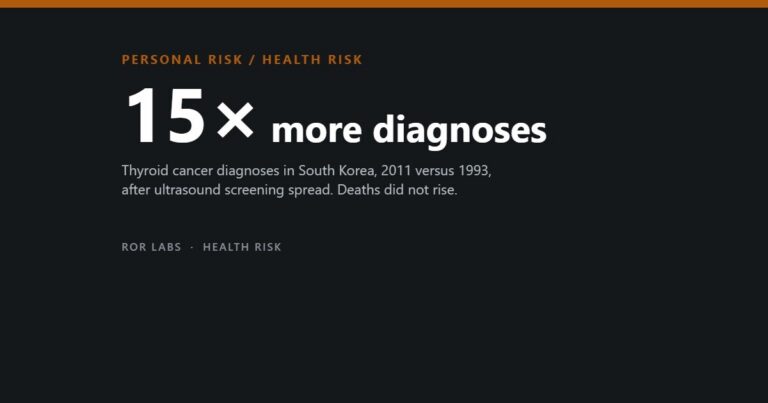
Nothing had hit him. Doctors call this surfer’s myelopathy: a stroke of the lower spinal cord in a healthy beginner, first described in 2004 in a series of nine patients with an average age of 25. Fewer than 100 cases have been published since. A 2017 review of 66 found that people on their first day on a board made up between 89.5% and 100% of the novices in the various reports.
This article covers what happens in the body and on the scan, the moments where the risk gathers, what treatment has and has not shown, and why the sensible answer for beginners is to surf carefully rather than stay on the beach.
What actually happens in surfer’s myelopathy
The story is strikingly uniform. A beginner spends a long time lying face down on the board with the back arched and the head up, paddling and practising the push-up to standing. A dull ache or a sudden cramp starts in the lower back. Tingling and numbness follow in the legs, then weakness, and the bladder stops emptying. In two of three Korean men, the weakness set in within minutes to half an hour of the first pain.
The leading explanation is a shortage of blood. The lower spinal cord depends heavily on one feeding vessel, the artery of Adamkiewicz, and its route is narrow and variable. Holding the spine in extension for a long time may stretch, kink or spasm that supply, or that of the small segmental arteries that feed it. Where the artery arises differs between people, which may help explain why only a few beginners are affected.
Where the artery of Adamkiewicz arises
Share of people in whom the main artery to the lower spinal cord branches off at each level of the spine, as summarised in a 2026 review of surfer’s myelopathy.
Source: Yuniarti, Harisusanti, Tanudjaja and Octavius, Chinese Neurosurgical Journal 12:30 (2026), citing anatomical studies.
The arterial theory has some direct support. In the Lisbon case, CT angiography showed narrowed and blocked segmental arteries at the levels of T11 to L2. In a prospective Hawaiian study, angiography in one patient showed flow through a vertebral artery feeding the spinal cord’s main front artery disappearing when the back was extended. Other explanations remain on the table: congested veins, a tiny fragment of disc lodging in a cord artery, or straining against a closed throat during the pop-up.
The scan usually tells the story. A radiology review of 23 Hawaiian patients, all scanned within 24 hours, found the same picture in every one: a thin, “pencil-like” bright line in the centre of the cord on T2-weighted MRI, running from the mid-thoracic spine down to the conus at the cord’s tip, with the cord swollen. The abnormal stretch averaged 13.8 centimetres. Contrast dye added little.
What 23 Hawaiian patients showed on arrival
Clinical and MRI findings in a retrospective review of surfer’s myelopathy at three Hawaiian hospitals, 2003 to 2012. All MRI was done within 24 hours of the first symptoms.
Source: Nakamoto, Siu, Hashiba, et al., American Journal of Neuroradiology 34(12):2393 (2013).
Early scans can mislead in both directions. A 43-year-old American first-timer, completely paralysed below the waist, had a normal T2 scan 11 to 12 hours after onset. A 23-year-old Japanese man showed the typical bright line but no sign of restricted diffusion, the usual marker of a fresh arterial stroke, and his doctors suggested his cord had been injured by blocked veins rather than arteries.
Where the risk concentrates
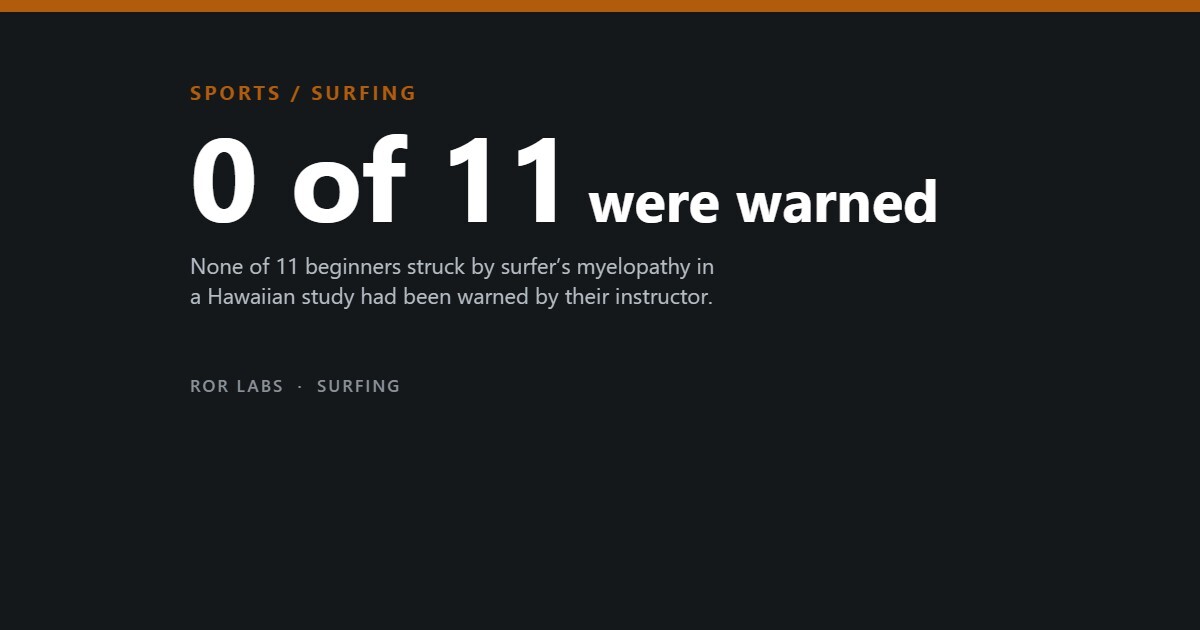
The setting is almost always a beginner’s lesson. Neurologists at the Queen’s Medical Center in Honolulu enrolled 11 patients aged 16 to 39, ten of them men, between 2021 and 2024 and asked them in detail what they had done. Every one had become ill during or shortly after a first surfing lesson. Seven of the ten who answered had lain prone for more than 45 minutes at a stretch, the posture beginners adopt while waiting for waves.
Experienced surfers mostly sit up on the board between waves, which unloads the lower back. None of the 11 patients had heard of the condition, and none had been warned by an instructor. Low back pain was the first symptom in seven of ten. Among nine who could say, six lost the ability to walk within 30 to 60 minutes of the first symptom and three within 30 minutes. That speed is why the first ache matters: it is the only warning many patients get, and it arrives while they are still in the water and keen to carry on.
What 11 patients were doing when it started
Prospective study of people diagnosed with surfer’s myelopathy in Hawaii, 2021 to 2024; denominators vary because not every patient answered every question. Conference abstract, not yet a full paper.
Source: Bellatti, Choi, Snyder, et al., American Academy of Neurology annual meeting abstract (2025), The Queen’s Medical Center, Honolulu.
Patients are young and fit, and often travellers. In the 23-patient radiology review, 19 were men, the average age was 26, and most were visitors who flew home after a few days. Yet the 2026 Bali series was three women, aged 20 to 25, from Korea, China and elsewhere, and one published American case was a first-timer of 43.
Severity on arrival varies widely. In the Hawaiian review, about a third of patients arrived with complete or near-complete loss of movement, grades A or B on the American Spinal Injury Association scale, and roughly two in five arrived at grade D, able to move their legs against gravity.
How badly 23 patients were affected on arrival
American Spinal Injury Association Impairment Scale on admission. Grade A is complete loss of movement and feeling below the injury; grade E is normal.
Source: Nakamoto, Siu, Hashiba, et al., American Journal of Neuroradiology 34(12):2393 (2013).
The sport’s spread matters too. Doctors in Korea and Japan have written that surfing has become a mass leisure activity in both countries, and a Kamakura emergency team estimated about two million surfers in Japan. They found awareness of the condition among emergency physicians very poor, even in one of the country’s best-known surfing areas.
What has been measured to work
Nothing has been proven, because the condition is too rare for a trial. Doctors borrow from spinal stroke and traumatic spinal cord injury, and the reported treatments vary from hospital to hospital: high-dose steroids, raising blood pressure to push blood through the cord, draining spinal fluid with a lumbar drain to lower pressure around it, blood thinners, and in Japan the antioxidant edaravone and hyperbaric oxygen. Each rests on reasoning and single cases.
Steroids are the most common choice and the least supported. In the Hawaiian radiology series, seven patients received the full high-dose methylprednisolone protocol once used for spinal trauma, and their recovery was no better than others’, although the group was too small to be sure. Among the three Korean men, the one treated only by keeping his mean blood pressure above 85 millimetres of mercury recovered almost fully within a month; the two given steroids stayed paralysed. Three patients prove nothing, but the pattern has led many specialists to favour blood pressure support, which is what guidelines for traumatic spinal cord injury recommend in the first week. In Honolulu, doctors reported a man who arrived completely paralysed, had angiography within ten hours and pressure support with spinal fluid drainage within a day, and was walking with forearm crutches at six months.
Who improved in the first days
Change of at least one grade on the American Spinal Injury Association scale between admission and last follow-up, among 20 patients with follow-up. Median follow-up was only six days.
Source: Nakamoto, Siu, Hashiba, et al., American Journal of Neuroradiology 34(12):2393 (2013). The grade C to E figure is derived from the paper’s counts.
The strongest predictor of recovery is simply how bad things are on arrival. In the Hawaiian review, none of the seven patients who came in at grade A or B had improved by follow-up, while about half of the rest had. Recovery can continue for months, though: a Japanese man admitted at grade A was walking with long leg braces when followed up more than a year later, and a Japanese woman of 19 walked unaided by day nine.
Why the answer is not to stop surfing
There is no incidence figure at all: nobody counts how many surf lessons are given each year, so the risk per lesson is unknown. Yet fewer than 100 cases have reached the medical literature in two decades, while one Japanese team put the country’s surfers alone at about two million. Case series also tilt towards the worst outcomes. Several authors point out that mild cases that settle within days may never be diagnosed or published, so the true outlook is probably better than the reports suggest.
The commoner harms of learning, from fins, boards and drowning, are in our earlier article on surfing injuries. Surfer’s myelopathy is different because the advice is so cheap. Neurologists at the Queen’s Medical Center in Honolulu sum it up as SPINE: sit up on your board; treat pain in the back and legs, imbalance or not being able to walk, and numbness in the legs as warning signs; and educate new surfers.
Instructors can teach sitting up in the first lesson and keep early sessions short. Beginners should rest when the back aches. If back pain comes with numbness, weakness or trouble passing urine, get out of the water, lie down and call emergency services. Do not try to walk it off. Tell the hospital it began while surfing; it is easily mistaken for a slipped disc or an infection.
What to do
Steps sorted by when they matter. Each one says how strong the evidence is: Measured Official advice Untested
Before
- Keep a first surf session short, and choose an instructor who talks about back pain and sitting up. Official advice see Sources
If it happens
- Sit up on the board while waiting for waves instead of lying arched for long stretches. Seven of ten patients in a Hawaiian study had lain prone for over 45 minutes. Measured see Sources
- Stop and rest at the first unusual ache in the lower back. Official advice see Sources
What not to do
- Do not carry on surfing or walk around to ease a new backache that comes with tingling or weakness in the legs. Official advice see Sources
Not medical advice. Sudden back pain with leg weakness, numbness or trouble passing urine is an emergency: call emergency services.
Questions people ask
Is surfer’s myelopathy a stroke?
It behaves like one. Most specialists think the lower spinal cord loses its blood supply while the back is held arched, but the exact mechanism has not been proven, and a few cases point to blocked veins rather than arteries.
Can experienced surfers get it?
Almost all reported cases are beginners, most on their first day. Experienced surfers tend to sit up between waves and have stronger back muscles, which may be why, but this has not been studied directly.
Can it happen without surfing?
Yes. Similar injuries have been reported after gymnastics such as handstands and back flips, stand-up paddleboarding and heavy lifting, all involving an arched spine.
Do people recover?
Some recover fully within days, others remain paralysed. People who arrive with some movement in their legs do much better than those who arrive with none. Rehabilitation can bring gains over many months.
The short version
- Surfer’s myelopathy is a rare, non-traumatic stroke of the lower spinal cord in beginners: back pain, then numbness, leg weakness and urinary retention, sometimes within half an hour.
- In a 23-patient Hawaiian review, every MRI showed a pencil-like bright line in the centre of the cord down to its tip; early scans can be normal.
- In a prospective study, all 11 patients fell ill at a first lesson, seven of ten had lain prone for over 45 minutes, and none had been warned.
- No treatment is proven. Blood pressure support is favoured over steroids; patients who arrive with some leg movement recover far more often.
- Surf carefully: sit up between waves, keep first sessions short, and treat back pain with leg symptoms as an emergency, not something to walk off.
This is a summary of published research, not medical advice. Sudden back pain with leg weakness, numbness or trouble passing urine is a medical emergency: get out of the water, lie down and call emergency services. For back pain while learning to surf, or recovery after a spinal injury, see a doctor or physiotherapist.
Further reading: Nakamoto et al., American Journal of Neuroradiology (2013), for MRI findings in 23 patients. Choi et al., Journal of Korean Neurosurgical Society (2018), for three Korean cases and a review of treatment options. Yuniarti et al., Chinese Neurosurgical Journal (2026), for the Bali series and proposed diagnostic criteria.
Sources
- Ferreira NR, Lourenço A, Delgado S, Grenho F, Ventura L. Non-traumatic spinal cord ischaemia – surfer’s myelopathy. BMJ Case Reports (2026), doi:10.1136/bcr-2026-273715.
- Sparke C. Man develops paraplegia 60 minutes after surf lesson: case report. AusDoc, 14 August 2026.
- Thompson TP, Pearce J, Chang G, Madamba J. Surfer’s myelopathy. (2004), doi:10.1097/01.brs.0000134689.84162.e7.
- Swinney CC, Flick D, Cheng M. Atraumatic spinal cord injury in the novice surfer: a comprehensive review and update (2017), PMID 28210528.
- Choi JH, Ha JK, Kim CH, Park JH. Surfer’s myelopathy: case series and literature review. Journal of Korean Neurosurgical Society 61(6) (2018).
- Yuniarti M, Harisusanti L, Tanudjaja J, Octavius GS. Surfer’s myelopathy in Bali: a case series of three patients and review of the pathophysiology, proposed diagnostic criteria, and treatment. Chinese Neurosurgical Journal 12:30 (2026), doi:10.1186/s41016-026-00450-w.
- Bellatti S, Choi JW, Snyder E, Rooks L, Nakagawa K, Hui F, Wilson J, Brown S. Prolonged back hyperextension in surfer’s myelopathy patients supports positional spinal ischemia as a mechanism of injury. American Academy of Neurology Annual Meeting abstract (2025).
- Nakamoto BK, Siu A, Hashiba KA, et al. Surfer’s myelopathy: a radiologic study of 23 cases. American Journal of Neuroradiology 34(12):2393 (2013).
- Gilbert C, Kirshblum S, Miller A, Nieves J. Surfer’s myelopathy: an atypical case presentation. (2020), doi:10.1038/s41394-020-0297-2.
- Noguchi S, Ohtonari T, Sakai K, Yamamoto J. Surfer’s myelopathy with magnetic resonance imaging evidence suggestive of venous congestion: a case report. NMC Case Report Journal (2026).
- Bradshaw JC, Kenet AL, Ritter S, et al. Acute management of surfers’ myelopathy: a case report. (2024), doi:10.5339/jemtac.2024.37.
- Nakano H, Yamamoto D, Yamagami H, Sekine I, Ofuchi H. Paraplegia after surfing in a young female novice surfer: a case report on surfer’s myelopathy. Acute Medicine & Surgery 6:312–315 (2019), doi:10.1002/ams2.416.
- Bellatti SE, Choi JW, Brown SC. A case of surfer’s myelopathy: insights into early management leading to radiographic and neurologic improvement. American Academy of Neurology Annual Meeting abstract, The Queen’s Medical Center (accessed October 2026).
- Aoki M, Moriizumi S, Toki M, Murakami T, Ishiai S. Rehabilitation and long-term course of nontraumatic myelopathy associated with surfing. (2013), doi:10.1097/phm.0b013e318238a1d0.
- Igasaki S, Suzuki Y, Sakai N, et al. A case of surfer’s myelopathy with serial imaging examination from early stage after onset [in Japanese]. Rinsho Shinkeigaku 60(11) (2020).
- Wilson J. Surfer’s myelopathy. The Queen’s Medical Center Neuroscience Institute, presentation to the Hawaii Neurotrauma Advisory Board, 24 October 2024.