Pickleball injuries, older beginners and the fall that breaks a wrist
Key takeaways · 9 min read
- US emergency visits for pickleball rose from an estimated 8,894 in 2020 to 16,997 in 2022; admissions more than tripled.
- Falls cause about two thirds of injuries; wrist fractures are especially common in older women.
- Newer players and those who treat prevention as unimportant are hurt more often.
- No pickleball-specific trial exists, but balance training cuts falls in older adults by about a quarter.
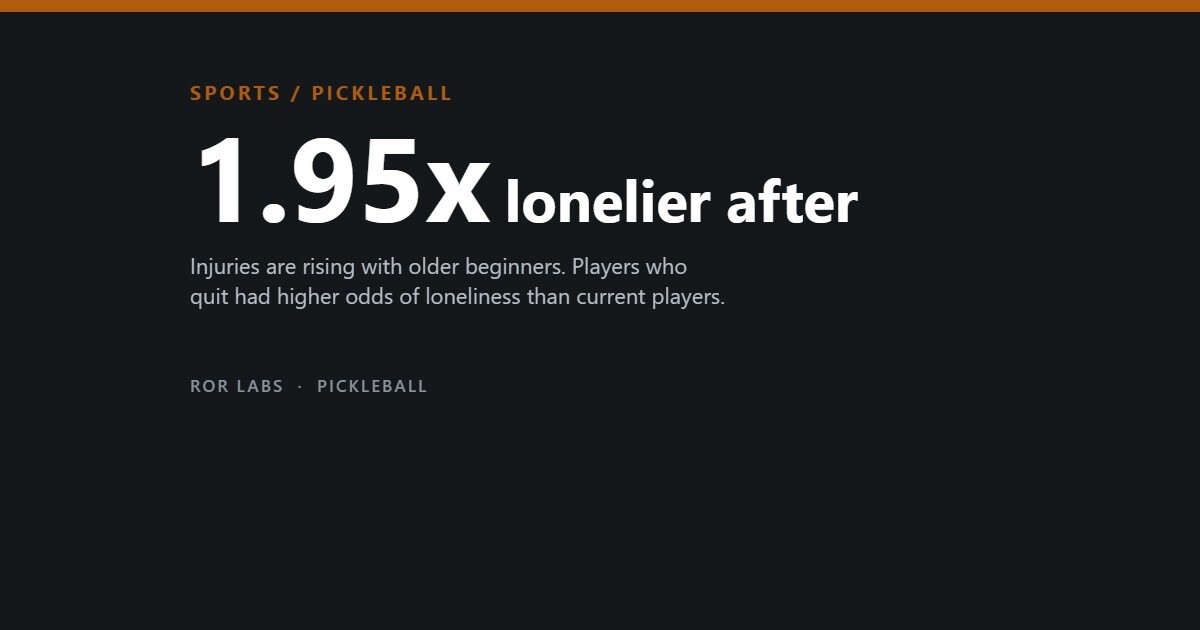
In a 2025 survey of 825 Americans over 50, people who had never played pickleball had 1.53 times the odds of feeling lonely compared with people who were playing it. People who had played and then stopped had 1.95 times the odds. The highest odds were not among those who never started. They were among those who quit.
Many of those who quit did so because they got hurt, and the injuries are real. US emergency department visits for pickleball roughly doubled in two years, and most of the patients were in their sixties and seventies. But the injuries follow a pattern — a fall on an outstretched hand, a lunge that snaps an Achilles tendon, a ball in an unprotected eye — and a pattern can be worked on.
This article follows the series format: what pickleball players actually injure, where the risk concentrates, what has been measured to reduce it, and why the answer is not to put the paddle away.
What actually gets injured
Pickleball has been the fastest-growing sport in America for five years running. The Sports and Fitness Industry Association counted 24.3 million US players in 2025, up from 4.2 million in 2020, with 7.5 million playing at least eight times a year. The injury counts have followed the players. Using the national emergency department sample run by the Consumer Product Safety Commission, one study estimated 40,698 pickleball injuries from 2020 to 2022: 8,894 in 2020, 14,808 in 2021 and 16,997 in 2022. Hospital admissions rose faster than visits, from 992 to 3,541.
Pickleball injuries in US emergency departments
Estimated national totals from the NEISS hospital sample.
Source: Cheng et al., Arthroscopy, Sports Medicine, and Rehabilitation (2024).
The same study found fractures were the largest single category, 29% of visits, most of them in the arm and wrist. The mean patient age was 63.9, and 73% were aged 60 to 79. Across twenty years of the same data, from 2004 to 2023, another team estimated 99,816 emergency visits, with fractures at 28.7% and sprains and strains at 24.7%.
Emergency data only catches the injuries bad enough for a hospital. A survey of 1,758 US players, mean age 62.7, asked about everything. Over twelve months, 68.5% reported some physical complaint and 40.8% had an injury that stopped them playing for at least a day. The knee was the commonest site, at 29.1%, followed by the thigh, leg and foot, the shoulder, the back and the elbow. Most of the worst injuries were overuse problems rather than sudden ones.
Where players hurt themselves
Share of 1,758 US players reporting a complaint at each site in the past year.
Source: Owoeye et al., Sports Medicine – Open 11:100 (2025).
When the risk concentrates
Falls are the heart of it. In every large emergency study of the sport, slips, trips and falls cause close to two thirds of injuries: 63.3% among players over 60 in one analysis, 64.3% in another, 65.5% in a third. A ten-year study of wrist, hand and finger injuries found 90.5% came from falls and 60.3% were fractures. Over that decade those injuries rose by 765.6%, a significant climb that tennis did not share.
Sex changes what the fall does. Among players over 60, women had 3.7 times the fractures of men and 9.3 times the wrist fractures, while men had 3.5 times the strains and sprains. A separate emergency analysis found women had about three times the odds of a fracture. The same study recorded five deaths from cardiac arrest on court, a reminder that for older beginners some of the risk is the heart rather than the ankle. A clinic series of 198 foot and ankle patients adds another pattern: Achilles tendon ruptures made up 39.4% of diagnoses, most often while running or lunging forward.
Experience and habits matter too. In the survey of 1,758 players, those with fewer than five years in the game had 1.50 times the odds of injury, and those playing three or more times a week 1.45 times. The strongest factor was attitude: players who rated injury prevention as of low or moderate importance had about twice the odds. Body weight made no difference.
Who gets hurt more often
Adjusted odds of injury in a survey of 1,758 US players. 1.00 means no difference.
Source: Owoeye et al., Sports Medicine – Open 11:100 (2025).
Eyes are a smaller but rising problem. A study published in JAMA Ophthalmology in 2025, as reported in the ophthalmology trade press, estimated 3,112 pickleball eye injuries in US emergency departments from 2005 to 2024, 1,262 of them in 2024 alone. The ball caused 43%, falls 28% and the paddle 12%. A second study in the journal Eye counted 2,573 from 2014 to 2023, with corneal abrasions and orbital fractures the commonest findings.
What has been measured to work
Here the honest answer is short. There is no randomised trial of any injury-prevention measure in pickleball. Three reviews of the sport’s injury literature, published from 2023 to 2026, all rest on emergency surveillance and surveys. Every recommendation specific to pickleball is therefore sensible advice rather than tested fact. What we do have is strong evidence from next door.
Borrowed evidence
The two measures with the strongest trials, from outside pickleball itself.
Cochrane review, community-dwelling people
All exercise: 23% fewer falls
Balance and functional training: 24% fewer
39 studies, 7,920 people, high certainty
Systematic review of 29 studies
Median share of eye injuries with no eyewear: 93%
Ordinary glasses did not protect
Squash, racquetball, tennis, badminton
Source: Sherrington et al., Cochrane Database of Systematic Reviews (2019); Mazarelo, Winter and Fong, The Physician and Sportsmedicine (2023).
The first is fall prevention. A Cochrane review of exercise for older people living at home found it cut the rate of falls by 23%, with high-certainty evidence, and balance and functional training alone cut it by 24%. Those programmes were not designed for pickleball, but the injury they prevent — an older adult losing balance and landing on a hand or hip — is exactly the one that dominates the sport’s emergency data. Balance work off the court is likely to be the best-supported way to make time on the court safer, although no study has tested it directly on players.
The second is eyewear. In a systematic review of racket sports, a median 93% of eye injuries happened when no eye protection was worn, and ordinary prescription glasses, contact lenses and industrial safety glasses did not protect adequately. Eyewear rated for racket sports is the relevant kind. USA Pickleball does not require it, according to trade press reporting, while the American Academy of Ophthalmology recommends it. Warm-ups and footwear appear in every review’s list of advice but have not been tested in the sport; one small preprint of 253 players found stretching made no difference to arm injuries, while long sessions and playing on consecutive days raised the risk by about half.
Why the answer is not to stop
The benefits are what make the injury numbers worth managing. In a pilot study of 33 players over 65 wearing activity trackers, a session delivered more than 68 minutes of moderate-to-vigorous activity on average; three sessions a week would meet the national guideline, which only about a third of Americans reach. In a six-week study of inactive rural adults aged 50 to 75, attendance was 74%, jump height improved by 11% and pain scores fell. That study had no control group, so it shows the game is feasible for beginners more than it proves an effect.
Staying in the game
Adjusted odds of feeling lonely among 825 US adults over 50, compared with current players.
Source: Kurth et al., Journal of Primary Care & Community Health (2025).
The social side may matter even more. Besides the loneliness study, a survey of 1,667 players found wellbeing scores rose with how often and how long people played, most clearly among those aged 63 to 77, and that a history of injury weakened the link. A 2025 systematic review of 14 studies of padel and pickleball found associations with happiness, lower depression and better social integration, especially in older adults. All of this is observational: people who are healthier and more sociable may simply be more likely to play. But it lines up with the loneliness finding in an important way. The harm is not only the fracture. It is also the months of isolation afterwards, and sometimes never coming back.
That is the case for playing carefully rather than not at all. The risk is concentrated in a small number of situations — the first years of play, falls on an outstretched hand, long sessions on consecutive days, older bones in a fall, bare eyes at the kitchen line — and each of those can be changed. Build up playing time slowly, work on balance off the court, avoid long sessions on back-to-back days, and wear racket-sport eyewear. The research does not say the courts are dangerous. It says that millions of people took up a new sport late in life, quickly, and that the ones who got hurt were mostly doing the same few things.
Questions people ask
How common are pickleball injuries?
About 41% of players in one large survey had an injury that stopped them playing for at least a day in a year. US emergency visits reached an estimated 16,997 in 2022.
What is the most common pickleball injury?
By body site the knee; by emergency diagnosis, fractures, mostly of the wrist and arm after falls.
Is pickleball safe for seniors?
Most injured players are over 60, but the game offers substantial activity and social contact. Balance training, gradual build-up and a medical check for anyone with heart disease reduce the main risks.
Should I wear eye protection for pickleball?
Eye injuries are rising, and in other racket sports most happened without eyewear. Racket-sport-rated eyewear is the sensible choice.
Is pickleball more dangerous than tennis?
Not clearly. Older pickleball players now visit emergency rooms about as often as older tennis players, largely because so many more of them play.
The short version
- US emergency visits for pickleball rose from an estimated 8,894 in 2020 to 16,997 in 2022; admissions more than tripled.
- Falls cause about two thirds of injuries; wrist fractures are especially common in older women.
- Newer players and those who treat prevention as unimportant are hurt more often.
- No pickleball-specific trial exists, but balance training cuts falls in older adults by about a quarter.
- People who stopped playing were lonelier than current players — the goal is to stay in the game, not to leave it.
This is a summary of published research, not medical advice. If you have heart disease, osteoporosis or a previous fracture, or are returning to activity after a long break, talk to your doctor before starting, and have any persistent injury assessed by a doctor or physiotherapist.
Further reading: Owoeye et al., Sports Medicine – Open 11:100 (2025), for injury predictors. Sherrington et al., Cochrane Database of Systematic Reviews (2019), for exercise to prevent falls. Our earlier article on tennis injuries and tennis elbow covers racket sports and long life.
- Together, Vivek Murthy (2020). The former US Surgeon General on loneliness and its effects on health. Written before much of the research on social sport, but the argument fits it closely.
- Super Agers, Eric Topol (2025). A cardiologist’s evidence-based look at what predicts healthy ageing, with appropriate scepticism about quick fixes.
- Keep Sharp, Sanjay Gupta (2021). A neurosurgeon’s practical guide to brain health with age, including movement and social connection.
Sources
Kurth JD, Casper JM, Sciamanna C, et al. Association of pickleball participation with decreased perceived loneliness and social isolation. doi:10.1177/21501319251385855 (2025). — Sports and Fitness Industry Association. 2026 Pickleball Single Sport Report, press release, 4 June 2026. — Cheng R, Moran J, Kim BI, et al. Arthroscopy, Sports Medicine, and Rehabilitation (2024). — Lee PM, Nishi R, Obana KK, et al. Arthroscopy, Sports Medicine, and Rehabilitation (2025). — Owoeye OBA, Yemm T, Blechle R, et al. Sports Medicine – Open 11:100 (2025), doi:10.1186/s40798-025-00900-2. — Weiss HB, Dougherty J, DiMaggio CJ. Injury Epidemiology 8:34 (2021), doi:10.1186/s40621-021-00327-9. — Kulkarni R, et al. The Physician and Sportsmedicine (2025), doi:10.1080/00913847.2025.2539062. — Yu J, et al. Orthopaedic Journal of Sports Medicine 13(1) (2025). — Firouzbakht PK, et al. Hand (2024), doi:10.1177/15589447241238371. — McMillan PJ, et al. Sports Health (2025), doi:10.1177/19417381251350671. — Kingston KA, et al. Foot & Ankle International (2024), doi:10.1177/10711007241271215. — Lacher CR, et al. JAMA Ophthalmology (2025), doi:10.1001/jamaophthalmol.2025.3577, as reported by Healio, 21 October 2025. — Shah et al. Eye 40:646–653 (2026). — Casals M, et al. Apunts Sports Medicine (2023). — Azar FM, et al. Journal of the American Academy of Orthopaedic Surgeons (2024). — Squali B, Caplan BE, Cole BJ. Orthopaedic Nursing (2026). — Sherrington C, et al. Cochrane Database of Systematic Reviews (2019), doi:10.1002/14651858.CD012424.pub2. — Mazarelo JFD, Winter SL, Fong DTP. The Physician and Sportsmedicine (2023), doi:10.1080/00913847.2023.2196934. — Hanks JE, Myers B. Preprints.org (2025), not peer reviewed. — Casper JM, Bocarro JN, Drake NR (2023), doi:10.1177/15588661231156139. — Wray P, et al. International Journal of Environmental Research and Public Health 18(16):8374 (2021). — Owoeye OBA, et al. Frontiers in Psychology 16:1676695 (2025). — Lauxtermann L, Stubbs B. Frontiers in Psychology (2025), doi:10.3389/fpsyg.2025.1614448. — Sports and Fitness Industry Association. 2026 Topline Participation Report, press release, 12 March 2026.