The Bystander Effect: What the Evidence Shows
Key takeaways · 14 min read
- In the classic 1968 experiment, 85% of students who thought they alone could hear a seizure went for help before it ended, against 31% of those who thought four others could hear.
- The story that inspired the research, 38 neighbours watching Kitty Genovese die, was largely wrong; the newspaper that told it later said it had grossly exaggerated.
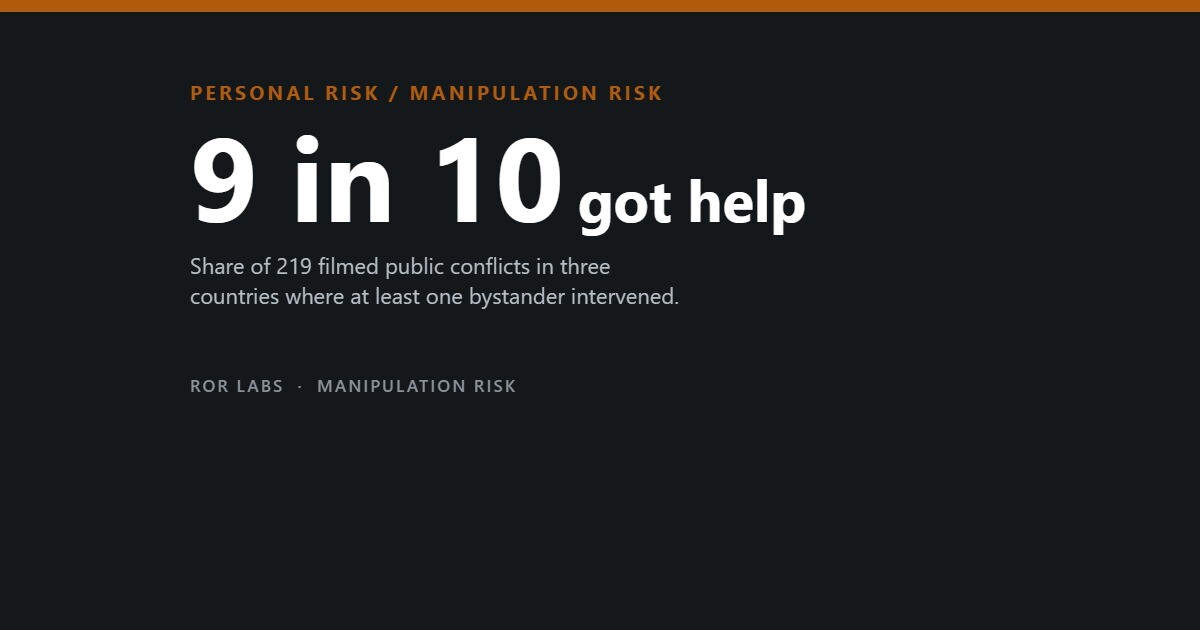
- In 219 filmed public conflicts in three countries, at least one bystander intervened in 90.9%, and each extra bystander raised the odds that someone did.
- The help rate is not universal: in 43 filmed shop and business robberies, bystanders helped in 35%.
The bystander effect is one of the best-known findings in psychology. Put more people around an emergency, the textbooks say, and each of them becomes less likely to help. It is usually introduced with a murder in New York in 1964, in which 38 neighbours supposedly watched from their windows and did nothing.
Both halves of that story deserve a second look. The murder was misreported. The laboratory effect is real, but it measures something narrower than most people assume: the chance that one particular person steps in. For someone being attacked in the street, the question that matters is different. Will anyone help me? Surveillance footage from three countries suggests the answer is usually yes.
This article goes through the original experiment, the meta-analysis that found the effect shrinks when danger is obvious, the camera studies, the places where help is rarer, and the programmes that have been tested for making people act.
Thirty-eight witnesses
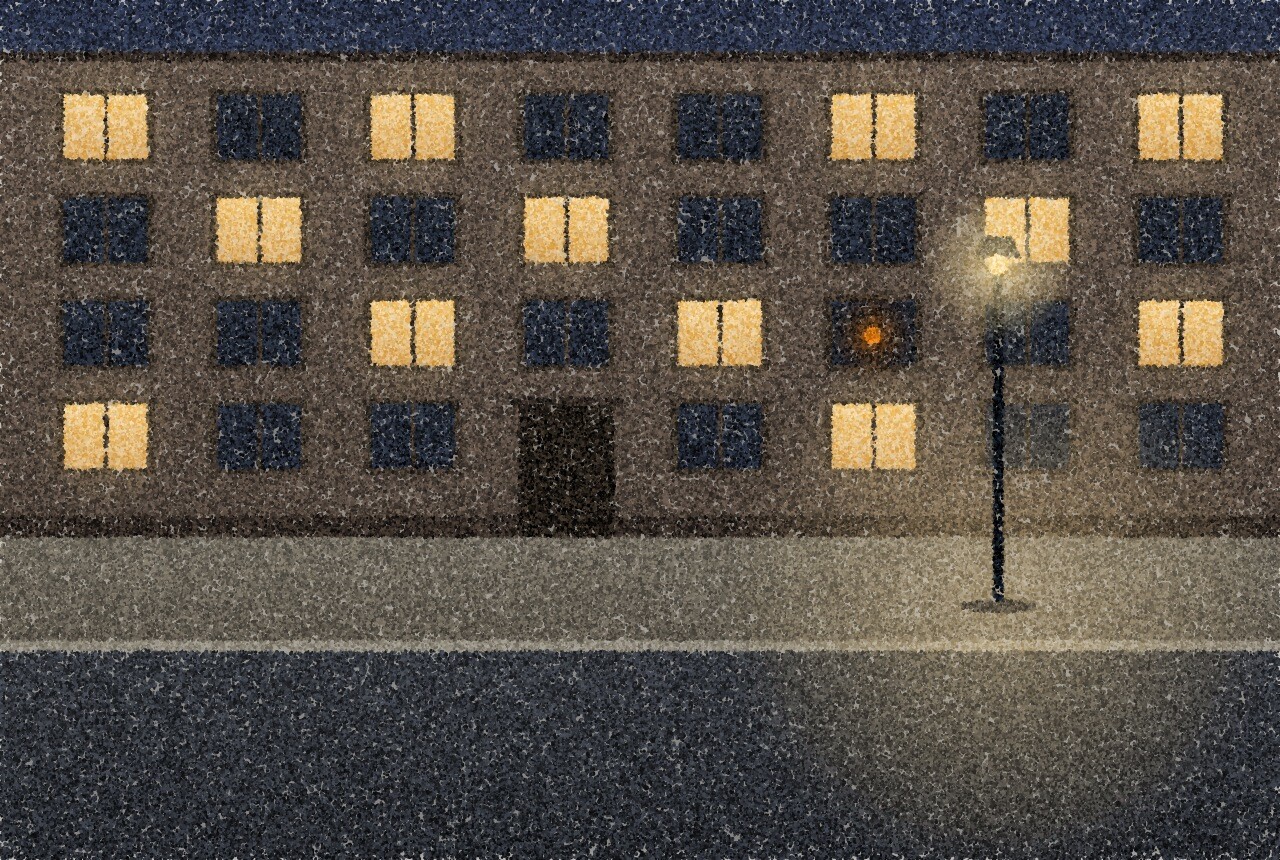
Catherine “Kitty” Genovese was stabbed outside her home in Kew Gardens, Queens, in the early hours of 13 March 1964. Two weeks later the New York Times reported that 38 respectable citizens had watched a killer stalk and stab her over half an hour without calling the police. The story became a national symbol of urban indifference, and it is still the opening anecdote of many psychology chapters.
In 2007 the psychologists Rachel Manning, Mark Levine and Alan Collins went back to the archive. Writing in American Psychologist, they found no evidence that there were 38 witnesses, that the witnesses saw the murder, or that they all stayed inactive. There were two attacks, not three. At least two people called the police, and a neighbour, Sophia Farrar, went out and held Genovese as she was dying.
When the killer died in 2016, the Times itself said its 1964 article had “grossly exaggerated the number of witnesses and what they had perceived.” Manning and colleagues were careful to separate the parable from the research it inspired. The story was wrong; the experiments still had to be judged on their own.
The experiment
John Darley and Bibb Latané designed their best-known study at New York University. Students sat alone in booths and talked over an intercom about university life. They were told the others could hear them, but the number varied: some believed only one other student was on the line, others two or five. Partway through, a recorded voice began to stammer, choke and describe a seizure, and asked for help.
The measure was simple: did the student leave the booth to find the experimenter before the fit ended? Of those who thought they were the only listener, 85% did. Of those who thought two others could hear, 62% did. Of those who thought four other bystanders were listening, 31% did. Eventually every lone listener went for help, against about six in ten of those in the largest groups.
The 1968 intercom experiment
Share of students who reported the seizure before it ended, by how many others they believed could hear it.
Source: Darley JM, Latané B, Journal of Personality and Social Psychology (1968), doi:10.1037/h0025589. The “victim” was a recording; groups were imagined, not present.
Darley and Latané called the mechanism diffusion of responsibility: when others might act, each person feels less obliged to. The idea was that inaction in a group need not mean indifference. Each listener could assume that someone else had already gone for help, and nobody could check.
Note what the design held fixed. Nobody could see anyone else, the danger was to a stranger rather than to the participant, and the “others” never existed. It was a clean test of one idea, and it worked.
When danger changes the answer
Four decades of follow-up studies were pooled in 2011 by Peter Fischer and colleagues in Psychological Bulletin. Across 105 effect sizes from more than 7,700 participants, the presence of others reduced helping, with an overall effect of g = −0.35, a modest effect in psychology’s usual terms. The bystander effect replicates. But it was not the same size everywhere.
It was weaker when the emergency was perceived as dangerous, when a perpetrator was present, and when helping carried a physical cost. The authors suggested two reasons. A clear, dangerous emergency is recognised faster, so there is less room for the uncertainty that lets everyone wait. And other people can be a source of physical support: intervening against an attacker is more feasible with company.
Laboratory and street, side by side
What different kinds of study measure, and what they found.
| Study | Setting | Finding |
|---|---|---|
| Darley and Latané (1968) | Staged seizure, imagined group | Reporting fell from 85% to 31% |
| Fischer et al. (2011) | 105 effect sizes, 7,700+ people | Overall g = −0.35; weaker in dangerous emergencies |
| Lindegaard et al. (2021) | 80 filmed conflicts | Help 19 times more likely when danger present |
| Philpot et al. (2020) | 219 filmed conflicts, 3 countries | Someone helped in 90.9% |
Sources: doi:10.1037/h0025589; doi:10.1037/a0023304; doi:10.1177/19485506211042683; doi:10.1037/amp0000469.
That finding was awkward, because dangerous emergencies are the ones the field was founded to explain, and they are the hardest to stage ethically. Researchers cannot put volunteers in a real fight. So a group in Copenhagen, Amsterdam and Lancaster started watching ones that had already happened.
What the cameras saw
Richard Philpot, Lasse Liebst, Mark Levine and colleagues obtained police and city CCTV recordings of real public disputes: 95 from Lancaster in England, 63 from Amsterdam and 61 from Cape Town, 219 in all. Coders watched each one and noted every time a bystander did something to help, such as stepping between the parties, pulling an aggressor away, calming someone with a gesture or a touch, or comforting the victim. The results, published in American Psychologist in 2020, contradicted the popular picture.
In 90.9% of conflicts at least one bystander intervened, and usually several did: the average was 3.76 interveners. The rate did not differ significantly between the three cities, even though they differ greatly in violent crime and in how safe people feel in public. And the more bystanders there were, the more likely it was that someone helped. Each additional person present raised the odds by about 10%. The study had limits that its authors listed: there was no sound, so verbal help was missed; most incidents were in night-time entertainment districts, where drinking is common; and the definition of helping was broad. Still, it was the largest systematic look at real conflicts and their aftermath.
Will anyone help? Filmed public conflicts
Share of incidents in which at least one bystander intervened, compared with how often interveners were hurt.
Sources: Philpot R et al., American Psychologist (2020), 219 incidents; Lindegaard MR et al., Journal of Social Psychology (2026), 43 robberies; Liebst LS et al., Psychology of Violence (2021), 417 interveners.
You, or someone
Do the camera studies prove Darley and Latané wrong? Not exactly, and this is the most useful point in the whole literature. The laboratory measured individual probability: how likely is this one person to act? The CCTV study measured group probability: how likely is it that at least one person acts? The two can move in opposite directions at the same time.
A companion study of 81 violent incidents in Copenhagen, which followed 764 individual bystanders, found exactly that. Each bystander was less likely to intervene when more people were present, the classic effect. But with more people there, the chance that somebody stepped in still rose. Bystanders who knew one of the people involved, even slightly, were much more likely to act than strangers.
Two questions, two answers
The same crowd can lower each person’s chance of helping and raise the chance that someone does.
Copenhagen, 764 bystanders in 81 fights
More people present: each person less likely to step in
Standardised odds ratio 0.28
UK, Netherlands, South Africa, 219 conflicts
Each extra bystander: odds that someone helps up about 10%
Odds ratio 1.10 per person
Sources: Liebst LS et al., Aggressive Behavior (2019), doi:10.1002/ab.21853; Philpot R et al., American Psychologist (2020), doi:10.1037/amp0000469.
The arithmetic is not mysterious. If each of ten people has a modest chance of acting, the chance that none of them does can be small, even if each would have been more likely to act alone. For a victim, a crowd is usually good news. For any one member of that crowd, the pull to wait for someone else is real, and the lab captured it accurately.
Where help is rarer
The nine-in-ten figure is not a law of nature. In September 2026 the same research group published an analysis of 43 commercial robberies caught on CCTV, using the same coding method. Bystanders helped the victim in 35% of them, far less often than in street disputes. Robberies involved fewer bystanders and more weapons, and in that setting the number of people present was not linked to helping at all.
That makes sense. Stepping between two drunk friends outside a bar is very different from confronting an armed stranger behind a counter. The authors warned against carrying a helping rate from one kind of emergency to another. The sample is small, and the paper is new, so the 35% should be treated as a first estimate rather than a settled figure.
What about the risk to the person who helps? In a further analysis of 93 recorded disputes covering 417 interveners, 3.6% of those who stepped in were physically harmed, and people who did not intervene were almost never hurt. Being connected to one side of the conflict was associated with a higher risk. How severe the fight was when someone stepped in was not. These were mostly unarmed disputes; the figure says nothing about knives or guns.
What makes people act
The clearest evidence that bystanders can be made more useful comes from cardiac arrest, where minutes matter and the bystander is often the only person who can act in time. In the 2000s Denmark made CPR training mandatory in elementary schools and for anyone taking a driving licence, alongside other measures. Between 2001 and 2010 the share of out-of-hospital cardiac arrests in which a bystander gave CPR rose from 21.1% to 44.9%, and 30-day survival rose from 3.5% to 10.8%.
That study was observational, and Danish hospital care also improved over the decade, so not all of the survival gain can be credited to bystanders. A randomised trial in Stockholm tested one part directly. When a dispatch system texted nearby trained volunteers about a cardiac arrest, bystander CPR was given in 62% of cases, against 48% in the control group. Survival at 30 days did not differ significantly; the trial was not large enough to show it.
Bystander CPR when systems change
Out-of-hospital cardiac arrests in Denmark before and after national initiatives, and a Swedish trial of volunteer alerts.
| Measure | Before | After |
|---|---|---|
| Denmark, bystander CPR given (2001 vs 2010) | 21.1% | 44.9% |
| Denmark, alive at 30 days (2001 vs 2010) | 3.5% | 10.8% |
| Stockholm trial, bystander CPR (control vs text alert) | 48% | 62% |
Sources: Wissenberg M et al., JAMA 310(13):1377–1384 (2013); Ringh M et al., NEJM (2015), doi:10.1056/NEJMoa1406038. The Danish data are observational.
For violence, the most studied tools are campus and school bystander programmes. A Campbell systematic review of 27 studies, 21 of them randomised trials, found that participants reported more bystander intervention one to four months later, by about a quarter of a standard deviation. By six months the effect was no longer significant, and there was no evidence that the programmes changed participants’ own rates of sexual assault perpetration.
The strongest single result came from Kentucky. In a cluster randomised trial of Green Dot across 26 high schools, schools receiving the programme reported lower rates of sexual violence perpetration once it was fully running: prevalence rate ratios of 0.83 in the third year and 0.79 in the fourth. The outcomes were anonymous student self-reports, and the trial was a single programme in one state.
Do bystander programmes work?
Randomised evidence on programmes that train young people to intervene in sexual violence.
| Evidence | Outcome | Result |
|---|---|---|
| Campbell review, 27 studies (21 RCTs) | Self-reported intervening, 1–4 months | Up about 0.25 SD |
| Same review | Intervening at 6 months | Not significant |
| Same review | Participants’ own perpetration | No evidence of effect |
| Green Dot, 26 Kentucky high schools | Sexual violence perpetration, years 3 and 4 | Rate ratio 0.83, then 0.79 |
Sources: Kettrey HH, Marx RA, Tanner-Smith EE, Campbell Systematic Reviews (2019), doi:10.4073/csr.2019.1; Coker AL et al., American Journal of Preventive Medicine (2017), doi:10.1016/j.amepre.2017.01.020.
Levine and colleagues have argued that such programmes may undersell themselves by teaching the classic bystander effect as a warning. The camera data suggest a different message: intervention is normal, groups can act together, and knowing people on the scene helps. That argument is plausible but has not itself been tested in a trial.
What the evidence suggests
The bystander effect is real but narrower than its reputation. In controlled studies, each person is less likely to act when others are around, and that holds most strongly when the situation is ambiguous and harmless to the helper. In real public conflicts, people usually do intervene, and a larger crowd raises the chance that someone will. The reassuring figure has limits: it comes mainly from night-time disputes in three cities, it fell to about a third in robberies, and it does not tell any one person that someone else will act. Training can raise bystander CPR and self-reported intervening, though campus effects fade within months.
What to do
Steps sorted by when they matter. Each one says how strong the evidence is: Measured Official advice Untested
Before
- Take a CPR or bystander training course. Training can raise bystander CPR and intervening, though effects fade within months, so refresh it. Measured see Sources
If it happens
- Act as if nobody else will. Larger crowds raise the chance that someone intervenes, but that does not tell any one person that someone else will. Measured see Sources
- Weigh your own safety. In recorded unarmed disputes, 3.6% of people who stepped in were physically harmed; the figure says nothing about knives or guns. Measured see Sources
Questions people ask
Is the bystander effect real?
Yes, as a statement about individuals: a 2011 meta-analysis of 105 effect sizes found that people help less when others are present. It is weaker in obvious, dangerous emergencies.
Did 38 people really watch Kitty Genovese die?
No. Archive research found no evidence for 38 witnesses who saw the attack and did nothing. At least two people called the police and a neighbour held her as she died.
If I am attacked in public, will someone help?
In filmed street conflicts in the UK, the Netherlands and South Africa, someone intervened in about nine out of ten. In filmed robberies, it was about one in three.
How dangerous is it to intervene?
In recorded public disputes, 3.6% of interveners were physically harmed. That comes mainly from unarmed conflicts and does not apply to situations involving weapons.
Does bystander training make a difference?
For CPR, national training was followed by a large rise in bystander CPR in Denmark. Campus programmes raised self-reported intervening for a few months; effects faded by six months.
The short version
- In the classic 1968 experiment, 85% of students who thought they alone could hear a seizure went for help before it ended, against 31% of those who thought four others could hear.
- The story that inspired the research, 38 neighbours watching Kitty Genovese die, was largely wrong; the newspaper that told it later said it had grossly exaggerated.
- In 219 filmed public conflicts in three countries, at least one bystander intervened in 90.9%, and each extra bystander raised the odds that someone did.
- The help rate is not universal: in 43 filmed shop and business robberies, bystanders helped in 35%.
- Training helps at the margins: bystander CPR in Denmark roughly doubled after national programmes, while campus programmes raised self-reported intervening only for a few months.
This article summarises published research for general information. It is not safety training or legal advice. In an emergency, call your local emergency number first; where there are weapons or your own safety is at risk, reporting to the police is usually safer than stepping in. Recognised first-aid and CPR courses teach what to do in a medical emergency.
Further reading: Manning, Levine and Collins, American Psychologist 62(6) (2007), for how the Genovese story was built. Philpot et al., American Psychologist (2020), for the camera study of 219 public conflicts. Fischer et al., Psychological Bulletin (2011), for when the classic effect holds and when it weakens.
- Humankind, Rutger Bregman (2020). A historian argues that people are more decent than their reputation, and retells the Genovese case along the way. Lively and persuasive; it is an argument for one side, and it picks its examples to fit.
- The Social Instinct, Nichola Raihani (2021). An evolutionary biologist on why humans cooperate, from families to strangers. Strong on the science of helping in general; emergencies and bystanders are a small part of it.
- Hope for Cynics, Jamil Zaki (2024). A Stanford psychologist on how people underestimate others’ goodwill and what that costs. Useful for the gap between belief and behaviour; parts lean on survey findings that are less solid than field data.
Sources
- Darley JM, Latané B. Bystander intervention in emergencies: diffusion of responsibility. J Pers Soc Psychol (1968), doi:10.1037/h0025589.
- Hortensius R, de Gelder B. From empathy to apathy: the bystander effect revisited. Curr Dir Psychol Sci (2018).
- Manning R, Levine M, Collins A. American Psychologist 62(6):555–562 (2007), doi:10.1037/0003-066X.62.6.555.
- McFadden RD. Winston Moseley obituary, New York Times, 4 April 2016, as reported by Poynter (2016).
- Fischer P et al. Psychol Bull 137(4):517–537 (2011), doi:10.1037/a0023304.
- Philpot R et al. American Psychologist (2020), doi:10.1037/amp0000469.
- Liebst LS et al. Aggressive Behavior (2019), doi:10.1002/ab.21853.
- Lindegaard MR et al. Soc Psychol Personal Sci (2021), doi:10.1177/19485506211042683.
- Liebst LS et al. Psychology of Violence 11 (2021), doi:10.1037/vio0000299.
- Lindegaard MR et al. J Soc Psychol (2026), doi:10.1080/00224545.2026.2729059.
- Levine M, Philpot R, Kovalenko AG. Soc Issues Policy Rev (2020), doi:10.1111/sipr.12063.
- Wissenberg M et al. JAMA 310(13):1377–1384 (2013), doi:10.1001/jama.2013.278483.
- Ringh M et al. NEJM (2015), doi:10.1056/NEJMoa1406038.
- Kettrey HH, Marx RA, Tanner-Smith EE. Campbell Syst Rev (2019), doi:10.4073/csr.2019.1.
- Coker AL et al. Am J Prev Med (2017), doi:10.1016/j.amepre.2017.01.020.
- The Freeman (Philstar), 13 September 2026.