Hospital Delirium in Older Adults: What the Evidence Shows
Key takeaways · 10 min read
- About 29% of older medical inpatients develop delirium, and many cases are missed; nurses in one study identified only 31%.
- Delirium is associated with about three times the odds of dying and, in a large Australian study, about three times the risk of a new dementia diagnosis over five years.
- Multicomponent prevention programmes reduced delirium from 18.4% to 10.5% of patients, but did not reduce deaths in hospital.
- No trial has yet shown that preventing delirium prevents dementia.
An older person goes into hospital for a broken hip or a chest infection and, two days later, does not know where they are. They pull at a drip, see things that are not there, or simply go quiet and stop following conversation. Families are often told it is the medication, or old age, or that it will pass.
It has a name: delirium. It is an acute, fluctuating disturbance of attention and awareness, and a pooled analysis of older medical inpatients put the cumulative incidence at about 29%. It is associated with a higher risk of dying, of losing independence and, in several large cohorts, of developing dementia. It is also missed in a large share of the patients who have it.
This is what the evidence shows about how common delirium is, what prevents it, what does not work once it starts, and how strong the link to dementia really is. The most useful finding is also the least dramatic: about two in five cases can be prevented with things that involve no drug at all.
How often it happens, and how often it is missed
Delirium is common enough that most families with an older relative in hospital will meet it. A 2025 meta-analysis of older inpatients on medical wards by Pilar Pérez-Ros and colleagues estimated a pooled cumulative incidence of 28.8%. Rates are higher after major surgery and in intensive care, where it has been reported in 60 to 80% of patients.
After surgery the range is enormous. A review in Brain by Raj Kalaria and Elizabeta Mukaetova-Ladinska put postoperative delirium anywhere from 9% to 87%, averaging around 40%, depending on age, the type of operation and existing vascular disease. Hip fracture repair, heart surgery and organ transplantation are at the high end. The risk factors most often studied, including in a meta-analysis of acute medical wards by Sellal Ahmed and colleagues, are older age, existing dementia, severity of illness, poor vision, urinary catheters and medicines such as sedatives.
As populations age, this becomes a larger share of hospital work. More patients arrive already frail, with some cognitive impairment and several medicines, which is exactly the combination that makes delirium likely.
How often delirium occurs
By setting, older adults in hospital.
Pérez-Ros and colleagues, 2025; Kalaria and Mukaetova-Ladinska, Brain, 2012; Pandharipande and colleagues, 2005. Rates depend on how carefully delirium is looked for.
It is also easy to miss. In a study by Sharon Inouye and colleagues, nurses identified delirium in only 31% of the patients who had it. Reviews put the share of cases not identified in older hospital patients at somewhere between 32% and 66%. The patients most likely to be missed were those with the quiet, hypoactive form, those with poor vision, those who already had dementia and those over 80.
The quiet form is the important one. A confused patient who shouts is noticed. A confused patient who lies still and says little is often taken to be tired, depressed or simply old. Delirium can look like all of those.
How often delirium is identified
Share of cases recognised or missed in older hospital patients.
Inouye and colleagues, as summarised by Flaherty and Morley, Journals of Gerontology Series A, 2004. Figures come from different studies and settings and should be read as a range.

What delirium is linked to afterwards
The association with death is consistent. A meta-analysis of 71 studies and more than 49,000 older inpatients by May Zin Aung Thein and colleagues found that those who had delirium had about three times the odds of dying as those who did not, with an odds ratio of 3.18. The authors also found signs of publication bias, and the studies were very different from each other, so the precise figure matters less than its direction.
The link to dementia is the finding that has changed how researchers think about delirium. In a population-based cohort of people aged 85 and over in Vantaa, Finland, Daniel Davis and colleagues found that among people without dementia, a history of delirium was associated with an odds ratio of 8.7 for new dementia at the next assessment. The DECIDE study in England found almost the same figure, 8.8, independent of illness severity and baseline cognition, and a higher risk with more than one episode.

Those numbers deserve their confidence intervals. The Vantaa estimate ran from 2.1 to 35; the DECIDE estimate from 1.9 to 41.4. Both studies were small in the number of people who developed delirium and then dementia, which is why the intervals are so wide. The direction is clear; the size is not.
A much larger 2024 study in The BMJ by Emily Gordon and colleagues used hospital records from New South Wales, Australia, and found that among patients without dementia, one episode of delirium was associated with roughly three times the risk of a new dementia diagnosis over five years, and each additional episode with a further 20% increase. It is a more modest figure than the cohort studies, from a much bigger sample, and it is the one worth remembering.
Delirium and later dementia
Association between an episode of delirium and a new dementia diagnosis in three studies.
Davis and colleagues, Brain, 2012 (95% CI 2.1 to 35); Richardson and colleagues, Age and Ageing, 2021 (95% CI 1.9 to 41.4); Gordon and colleagues, BMJ, 2024. Associations, not proof of cause.
What prevents it
The best-known prevention programme is the Hospital Elder Life Program, first tested by Inouye and colleagues in 852 patients aged 70 and over at Yale–New Haven Hospital and published in 1999. It targets six risk factors: disorientation, sleep deprivation, immobility, poor vision, poor hearing and dehydration. The interventions are ordinary: orienting people to the day and place, making sure they have their glasses and hearing aids, getting them out of bed, helping them sleep without sedatives, and keeping them drinking. It reduced the number of patients who developed delirium, but did not change its severity or the chance of it recurring once it had happened.
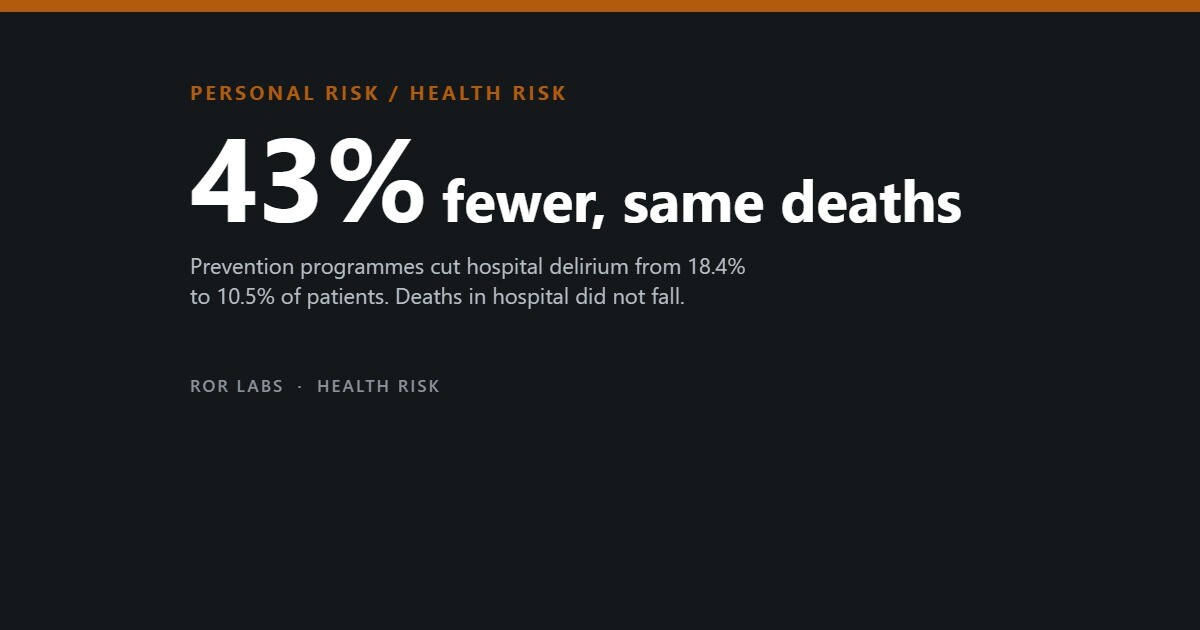
The Cochrane review by Jennifer Burton and colleagues pooled 14 trials of such multicomponent programmes in 3,693 hospital patients outside intensive care. Delirium developed in 10.5% of patients who received the programmes and 18.4% of those who received usual care, a risk ratio of 0.57. That is the source of the claim that about two in five cases can be prevented. The certainty was rated moderate. The programmes also reduced falls by a similar proportion and may have shortened hospital stays by about a day.
Its component analysis pointed to three elements as most clearly associated with fewer cases: re-orientation with familiar objects, cognitive stimulation and sleep hygiene. The review was careful about the others; some estimates were too uncertain to say whether they helped or not.
Multicomponent prevention, pooled trials
Hospital patients outside intensive care, 14 trials, 3,693 people.
Burton and colleagues, Cochrane Database of Systematic Reviews, 2021. Risk ratio 0.57 (95% CI 0.46 to 0.71), moderate certainty.
The part that did not move
Here is the finding that should temper the enthusiasm. In the same Cochrane review, the programmes that reduced delirium by 43% made little or no difference to deaths in hospital: 5.2% in the intervention groups against 4.5% with usual care, a risk ratio of 1.17 with a wide interval. Mortality at one to three months showed no difference either.
And not one of the trials measured whether preventing delirium prevented dementia. The link between delirium and dementia comes from observational cohorts. The trials that could test whether breaking that link matters have not yet reported it.
There are plausible explanations. The trials may be too small to detect an effect on death, or delirium may partly be a marker of how sick and frail someone already is, rather than a cause of what follows. The trials also could not be blinded: staff knew who was receiving the programme, and in several trials so did the people assessing delirium. That is a real source of bias, and the reviewers downgraded the evidence for it.
None of this makes prevention pointless. Fewer episodes of confusion and fewer falls are worth having for their own sake. But the honest statement is that prevention reduces delirium, not that it has been shown to prevent the deaths or dementia that delirium predicts.
What the prevention trials changed
Cochrane review of multicomponent programmes versus usual care.
Burton and colleagues, Cochrane, 2021. Below 1 means fewer events with the programme. The mortality estimate is low certainty (95% CI 0.79 to 1.74). No trial reported new dementia.
What does not work
Antipsychotic drugs such as haloperidol have long been given to agitated, delirious patients. A 2016 systematic review for the American Geriatrics Society by Karin Neufeld and colleagues looked at 19 studies. In seven that tested antipsychotics to prevent delirium after surgery, there was no significant effect on how many patients developed it. Across all 19, antipsychotics were not associated with shorter or less severe delirium, shorter hospital or intensive care stays, or lower mortality.
A 2020 network meta-analysis of 108 trials by Min Seo Kim and colleagues found some drugs that reduced delirium in intensive care patients, notably dexmedetomidine, a sedative used in ventilated patients. Outside intensive care, none of the agents showed benefit. Guidelines now reserve antipsychotics for patients who are dangerously agitated or severely distressed, not as a treatment for delirium itself.
Sedatives, particularly benzodiazepines, are among the medicines most associated with triggering delirium in the first place, and avoiding them is part of every prevention guideline. One of the most useful things a family member can do is ask what new medicines have been started.
What the evidence does not show
It does not show that delirium causes dementia. The associations are strong and consistent, and the Australian data show a dose response with more episodes. But delirium strikes people who are already frail and ill, and no trial has yet shown that preventing it lowers dementia risk.
It does not show that prevention saves lives. The trials that reduced delirium did not reduce deaths in hospital, though they may have been too small to see a modest effect.
It does not give a single incidence figure. Rates vary widely with the ward, the patients and how carefully delirium is looked for, which is itself part of the story: where nobody screens, delirium looks rarer than it is.
And the dementia estimates from Vantaa and DECIDE have very wide intervals. The larger Australian estimate of about three times the risk is the more stable guide.
Questions people ask
How common is delirium in older people in hospital?
A 2025 meta-analysis of older patients on medical wards estimated about 29%. It is more common after major surgery and in intensive care.
Can hospital delirium be prevented?
Partly. A Cochrane review found that multicomponent programmes reduced it from 18.4% to 10.5% of patients, about two in five cases prevented. They combine orientation, sleep, mobility, hydration, and making sure people have their glasses and hearing aids.
Does delirium cause dementia?
It is strongly associated with later dementia, with about three times the risk over five years in a large Australian study. Whether it causes dementia or reveals vulnerability that was already there has not been settled.
Do antipsychotics help delirium?
A review of 19 studies found they did not shorten delirium, reduce its severity or lower mortality, and did not prevent it after surgery. They are generally kept for dangerous agitation.
What can families do?
Tell staff what the person is normally like, bring glasses and hearing aids, help with orientation to the day and place, and mention any sudden change in attention or alertness, especially if the person has gone unusually quiet.
The short version
- About 29% of older medical inpatients develop delirium, and many cases are missed; nurses in one study identified only 31%.
- Delirium is associated with about three times the odds of dying and, in a large Australian study, about three times the risk of a new dementia diagnosis over five years.
- Multicomponent prevention programmes reduced delirium from 18.4% to 10.5% of patients, but did not reduce deaths in hospital.
- No trial has yet shown that preventing delirium prevents dementia.
- Antipsychotics did not shorten delirium or reduce mortality in a review of 19 studies.
This article summarises published research on delirium in older people. It is not medical advice and not a diagnostic tool. A sudden change in someone’s attention, alertness or confusion is a medical matter; tell the doctors or nurses caring for them straight away, and ask your own doctor about any concerns about memory or thinking.
Further reading. Burton and colleagues, ‘Non-pharmacological interventions for preventing delirium in hospitalised non-ICU patients’, Cochrane Database of Systematic Reviews, 2021, is the pooled evidence on prevention. Gordon and colleagues, ‘Delirium and incident dementia in hospital patients in New South Wales, Australia’, BMJ, 2024, is the largest recent study of the dementia link and is open access.
- The Age of Diagnosis, Suzanne O’Sullivan (2025). A neurologist on what naming a condition does and does not achieve. A contested argument, useful here because delirium is so often not named at all.
- Extra Life, Steven Johnson (2021). A history of how human life expectancy doubled, largely through unglamorous public health measures, which is roughly what delirium prevention is.
- How to Read Numbers, Tom Chivers and David Chivers (2021). A short guide to odds ratios, confidence intervals and why an 8.7 with an interval from 2 to 35 means less than it seems.
Sources
- Pérez-Ros P, Plaza-Ortega N, Martínez-Arnau FM. Mortality risk following delirium in older inpatients: a systematic review and meta-analysis. Worldviews on Evidence-Based Nursing, 2025. doi:10.1111/wvn.70027.
- Flaherty JH, Morley JE. Delirium: a call to improve current standards of care. Journals of Gerontology Series A, 2004. doi:10.1093/gerona/59.4.m341.
- Pandharipande PP, Jackson JC, Ely EW. Delirium: acute cognitive dysfunction in the critically ill. Current Opinion in Critical Care, 2005.
- Aung Thein MZ, Pereira JV, Nitchingham A, Caplan GA. A call to action for delirium research: meta-analysis and regression of delirium associated mortality. BMC Geriatrics, 2020.
- Davis DHJ, Muñiz Terrera G, Keage H, and colleagues. Delirium is a strong risk factor for dementia in the oldest-old: a population-based cohort study. Brain, 2012.
- Richardson SJ, Davis DHJ, Stephan BCM, and colleagues. Recurrent delirium over 12 months predicts dementia: results of the Delirium and Cognitive Impact in Dementia (DECIDE) study. Age and Ageing, 2021.
- Gordon EH, Ward DD, Xiong H, Berkovsky S, Hubbard RE. Delirium and incident dementia in hospital patients in New South Wales, Australia: retrospective cohort study. BMJ, 2024.
- Inouye SK, Bogardus ST, Charpentier PA, and colleagues. A multicomponent intervention to prevent delirium in hospitalized older patients. New England Journal of Medicine, 1999.
- Burton JK, Craig L, Yong SQ, and colleagues. Non-pharmacological interventions for preventing delirium in hospitalised non-ICU patients. Cochrane Database of Systematic Reviews, 2021. doi:10.1002/14651858.CD013307.pub2.
- León-Salas B, Trujillo-Martín MM, and colleagues. Multicomponent interventions for the prevention of delirium in hospitalized older people: a meta-analysis. Journal of the American Geriatrics Society, 2020. doi:10.1111/jgs.16768.
- Neufeld KJ, Yue J, Robinson TN, Inouye SK, Needham DM. Antipsychotic medication for prevention and treatment of delirium in hospitalized adults: a systematic review and meta-analysis. Journal of the American Geriatrics Society, 2016. doi:10.1111/jgs.14076.
- Kim MS, Rhim HC, Park A, and colleagues. Comparative efficacy and acceptability of pharmacological interventions for the treatment and prevention of delirium: a systematic review and network meta-analysis. Journal of Psychiatric Research, 2020. doi:10.1016/j.jpsychires.2020.03.012.
- Kalaria RN, Mukaetova-Ladinska EB. Delirium, dementia and senility. Brain, 2012.
- Ahmed S, Leurent B, Sampson EL. Risk factors for incident delirium among older people in acute hospital medical units: a systematic review and meta-analysis. Age and Ageing, 2014.
- Kluger C, Shah P, Maiti S, and colleagues. Therapeutic advances in the prevention and treatment of delirium in the hospital setting. American Journal of Therapeutics, 2018.