Vitamin A: Food Sources, Deficiency, and Safe Limits
In This Series: Nutrients
- Which Nutrients Are You Actually Short Of?
- How Nutrients Are Classified — and What the Reference Numbers Mean
- Vitamin C: Food Sources, Scurvy, and the Ceiling the Body Sets
- Vitamin D: Food Sources, Sunlight, and What the Trials Found
- Vitamin D2 vs D3: What the Head-to-Head Trials Found
- Riboflavin: Food Sources, Deficiency, and the Migraine Trials
- Thiamin: Food Sources, Beriberi, and Why There Is No Upper Limit
- Calcium: Food Sources, Bone Density, and What the Trials Found
Key takeaways · 10 min read
- Vitamin A is a group: retinol in animal foods, provitamin A carotenoids in plants.
- Per tablespoon: cod liver oil 4,080 µg, braised beef liver 1,416, sweet potato 144, carrot 125. Per plate the order reverses, because nobody eats liver by the spoonful.
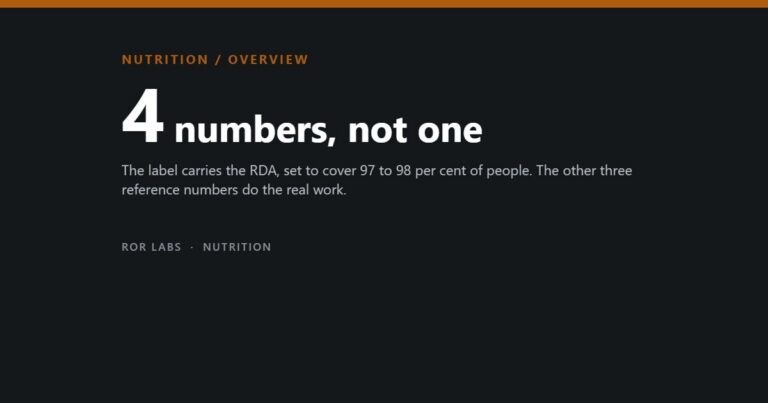
- In 2001 the conversion for dietary beta-carotene moved from 6:1 to 12:1. The range measured in people is 3.6:1 to 28:1.
- Deficiency runs night blindness, Bitot’s spots, then corneal scarring. The last stage does not reverse.
Vitamin A is not a compound. It is a job description, filled by retinol and its relatives in animal foods and by plant pigments that the gut wall converts into them — at a rate that is one of the more contested numbers in nutrition.
What it does is unusually well established. The eye’s low-light pigment cannot be rebuilt without it, and running short produces eye damage specific enough to have its own clinical ladder. The public health story attached to it — that capsules cut child deaths by a quarter — is far less settled, and the trial that unsettled it was the largest ever run.
This is the first vitamin entry in this appendix. Four parts each time: what the nutrient does, which foods carry it per measured spoonful, what running short does, and what the reference numbers are. For vitamin A the upper number matters more than for most.
What it does
In the retina, 11-cis retinal binds to a protein called opsin to make rhodopsin, the pigment that lets the eye respond in low light. Rhodopsin is bleached by light and rebuilt continuously; when supply falls, rebuilding slows, and the first thing anybody notices is that they cannot see in the dark.
The second job is larger and less visible. Retinoic acid switches genes on and off, governing how epithelial tissue differentiates — the surfaces of the eye, gut, airway and skin — along with parts of the immune response. EFSA’s 2024 review notes the same compound is involved in many critical processes in organ development during pregnancy, which is exactly why excess is dangerous.
The three foods that carry the most per spoonful
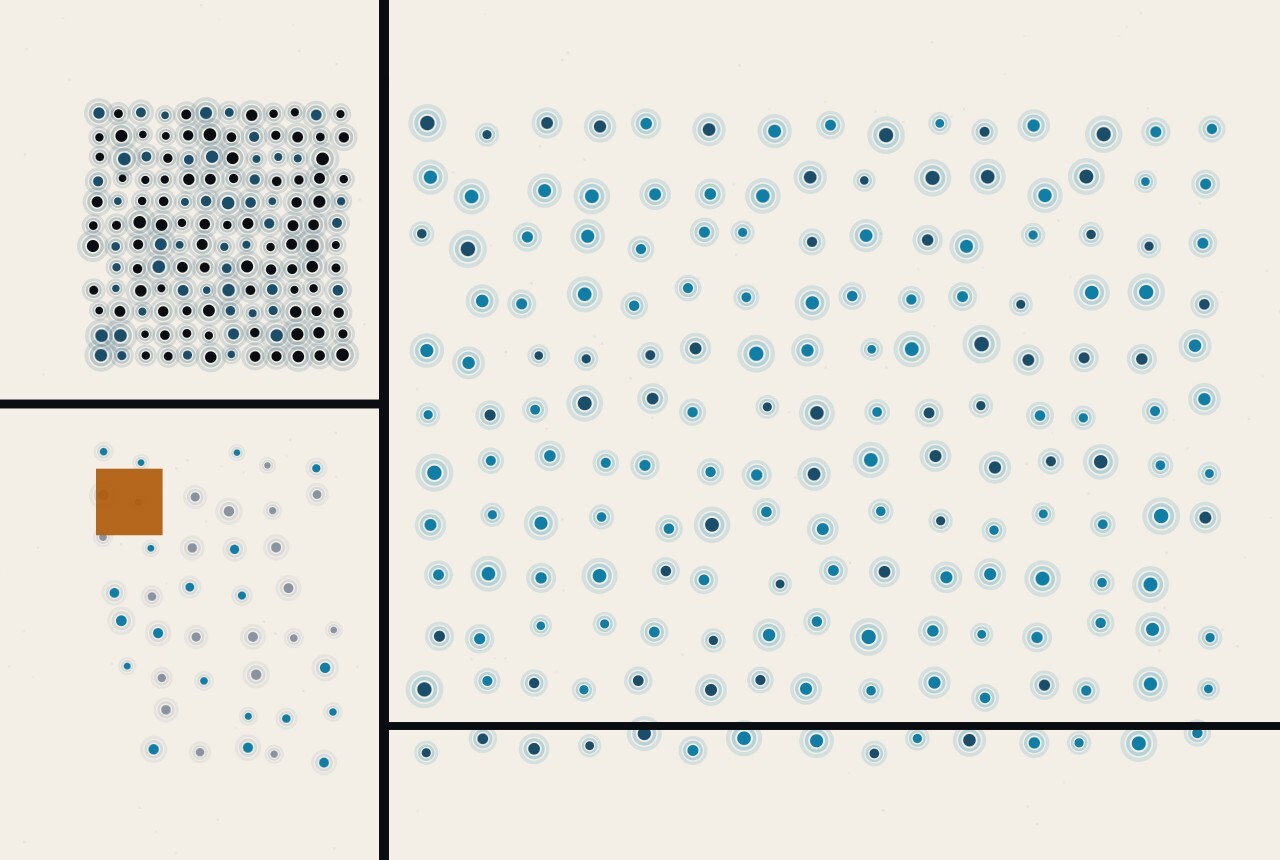
Ranked strictly by what fits on a tablespoon, using the US Department of Agriculture’s composition values, the order is not the one the health pages give.
Vitamin A per level tablespoon
USDA SR Legacy values per 100 g, converted to one level tablespoon: 15 g for solids, 13.6 g for oil, 14.2 g for butter. Share is of the 900 µg RAE adult male RDA.
| Food (USDA FDC ID) | Per 100 g | Per tablespoon | Share of RDA |
|---|---|---|---|
| Cod liver oil (173577) | 30,000 µg | 4,080 µg | 453% |
| Beef liver, braised (168626) | 9,440 µg | 1,416 µg | 157% |
| Sweet potato, baked in skin (168483) | 961 µg | 144 µg | 16% |
| Carrots, raw (170393) | 835 µg | 125 µg | 14% |
| Butter, salted (173410) | 684 µg | 97 µg | 11% |
| Spinach, frozen, boiled (169288) | 603 µg | 90 µg | 10% |
| Egg yolk, raw (172184) | 381 µg | 57 µg | 6% |
Source: USDA FoodData Central, SR Legacy. Tablespoon figures are conversions at the stated weights.
The spoon is an unforgiving unit, and it produces an honest oddity. The top of the list is cod liver oil and liver — one that almost nobody eats by the spoonful, and one that takes an adult past the daily upper limit in a single tablespoon. The foods that actually deliver most of the vitamin A in ordinary diets sit in the bottom half and get there by volume: a whole baked sweet potato is 1,403 µg, half a cup of raw carrots 459. Per spoon they look weak. Per plate they are the reason most people are not deficient.
The conversion factor that halved the carrot
Plant foods contain no retinol at all. Their vitamin A is beta-carotene and related pigments, which have to be absorbed and then converted. Until 2001 the FAO and WHO figure was that 6 micrograms of dietary beta-carotene were worth 1 microgram of retinol. The US Institute of Medicine then rebuilt it in two steps — beta-carotene in oil converts at about 2 to 1, and beta-carotene locked in a whole food is about one-sixth as available as in oil. Nothing about the carrot changed; the number attached to it halved.
What one microgram of retinol is worth
Retinol activity equivalents, and the spread measured in humans.
Sources: Institute of Medicine, 2001; West et al., J Nutr 132, 2002; Tang, AJCN 91(5), 2010.
The consequence was not academic. Under the old rates, national food supply data said every population could meet its requirement from the food already available; under the new rates, populations across the developing world could not. One committee decision moved millions of people across a line without anybody changing what they ate. And the spread underneath is wider still: stable-isotope work puts the real conversion anywhere between about 3.6 and 28 to 1, differing between individuals within the same study.
What running short does
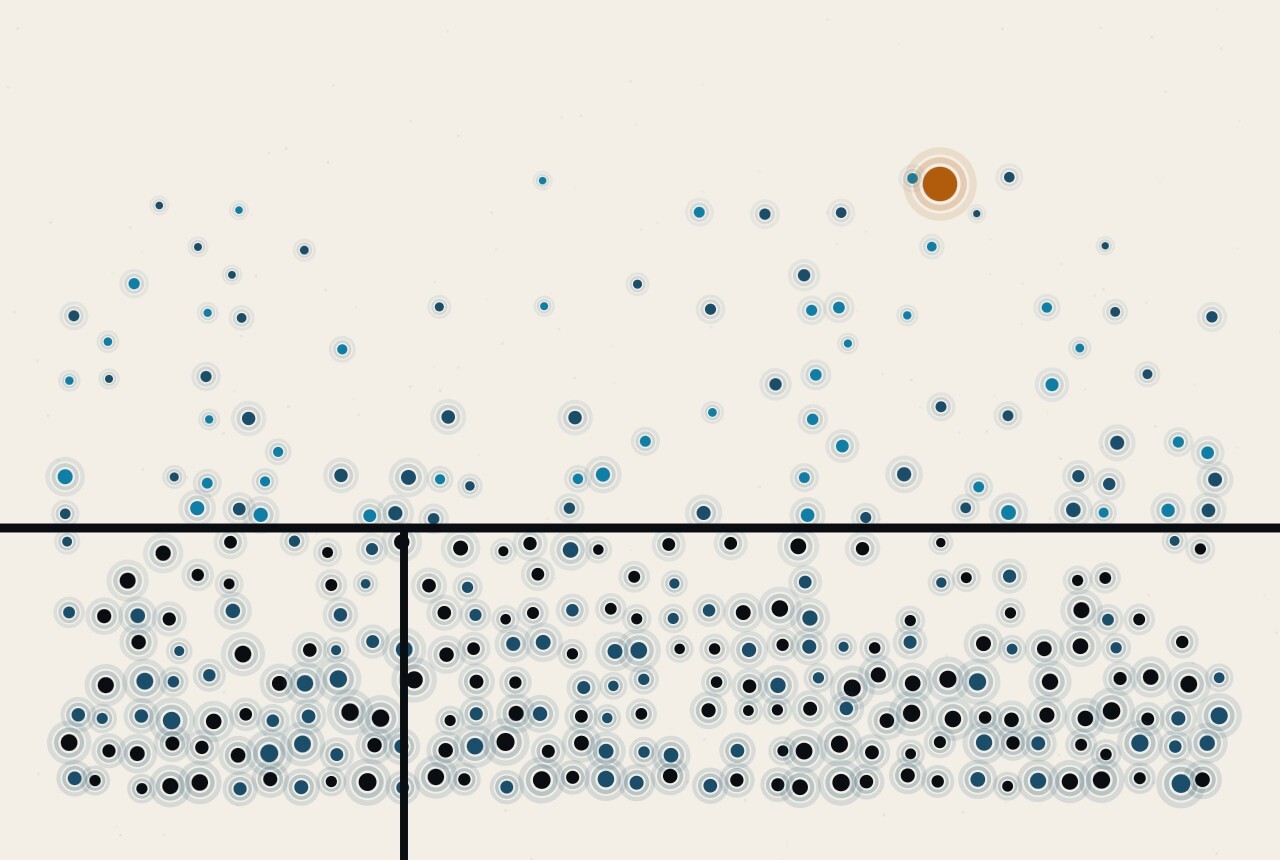
Deficiency follows a ladder, one of the few in nutrition that is genuinely stepwise.
The clinical sequence
Progression in the eye. NIH Office of Dietary Supplements.
Who is at risk is well mapped: preterm infants, born with low liver stores; pregnant and lactating women and young children in low-income countries; and anyone who cannot absorb fat, since the whole vitamin travels with dietary fat. Up to 90 per cent of people with cystic fibrosis have pancreatic insufficiency, and Crohn’s disease, ulcerative colitis and coeliac disease all interfere.
The trial that made the capsule story smaller
From the 1980s, community trials in Nepal, Indonesia, India and elsewhere found that periodic high-dose vitamin A cut child deaths substantially. Pooled, the eight large trials give a weighted average risk ratio of 0.77, and the Cochrane review built on them reported a 24 per cent reduction in all-cause mortality across 17 trials and 194,483 children. That figure became global policy.
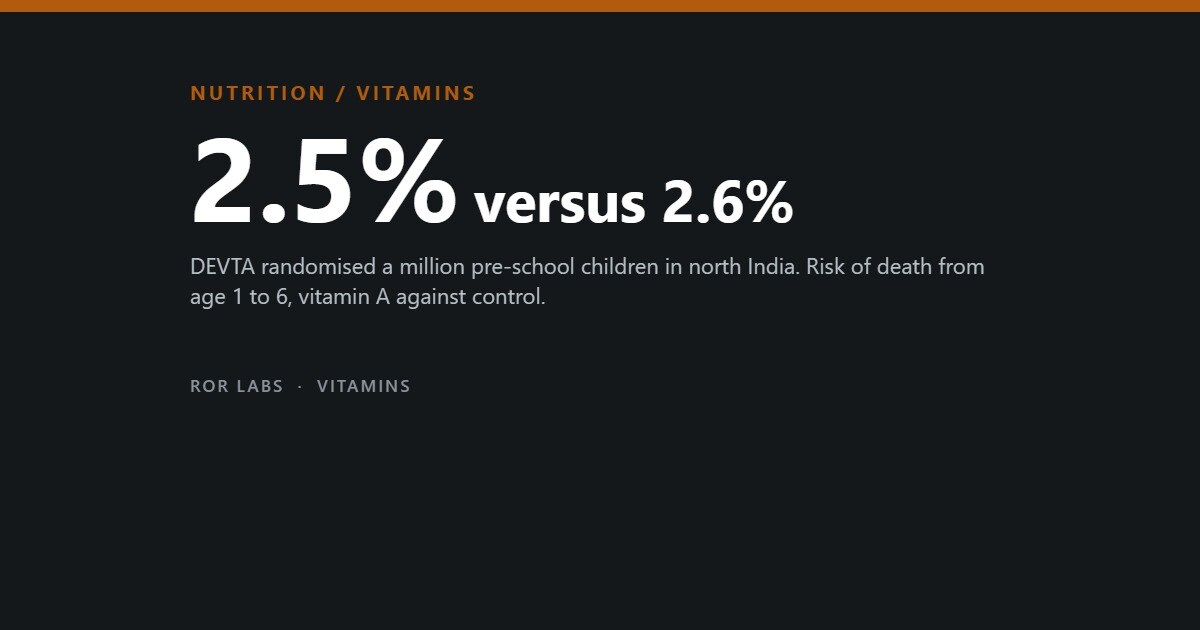
Then DEVTA reported. Cluster-randomised across 8,338 state child-care centres in north India, it covered a million pre-school children at any one time, giving 200,000 IU of retinol every six months for five years — larger than all the previous trials put together. It found a risk ratio of 0.96, with a 99 per cent confidence interval from 0.87 to 1.05, and an absolute risk of dying between one and six of 2.5 per cent against 2.6.
Mortality risk ratio, vitamin A against control
Below 1.00 favours supplementation. Bars show distance below 1.00; full bar = 30 per cent.
Source: Awasthi, S. et al., DEVTA, The Lancet 381, 2013, pp.1469–1477.
This was not a trial where the supplement failed to arrive. The control group’s mean plasma retinol was 0.62 µmol/L, low enough to qualify the population for supplementation, and both severe biochemical deficiency and Bitot’s spots were halved in the children who received it. The biology worked; the mortality did not move as the earlier trials predicted, and the authors say plainly that the discrepancy is itself statistically significant.
Their own conclusion is the fair summary. Combining all nine trials gives a risk ratio of 0.89 — real, not zero — but, in their words, only about a quarter to a half as large as the previous trials suggested: perhaps 5 to 15 per cent rather than 20 to 30. A separate pooled analysis of individual data from 11 trials of dosing in the first days of life, 163,567 children, found no effect on infant survival at all.
How much is too much
The adult RDA is 900 µg RAE for men and 700 for women, 770 in pregnancy and 1,300 during lactation. The upper level for adults is 3,000 µg — a narrower gap than most vitamins have — and it applies only to preformed vitamin A. Carotenoids from food do not count towards it.
The ceiling is set by what excess does to a developing fetus. EFSA reviewed the evidence again in 2024 and retained 3,000 µg RE per day with teratogenicity as the critical effect. The study underneath it found women taking more than 4,500 µg RE a day had 3.5 times the risk of a baby with cranial-neural-crest defects compared with women under 1,500; for supplemental intake above 3,000 µg RE the figure was 4.8. Liver damage sits higher, at a lowest observed adverse effect level of 14,000 µg a day.
The band, in micrograms of retinol activity equivalents a day
US Dietary Reference Intakes and the EFSA 2024 upper level, for preformed vitamin A only.
Sources: NIH Office of Dietary Supplements; EFSA NDA Panel, EFSA Journal 22(6), 2024; UK SACN, 2005.
Bone is the unsettled part. EFSA judged the evidence linking retinol to fracture inconsistent and would not set the upper level on it, but the UK guidance level of 1,500 µg a day still stands, and meta-analyses split by form: higher retinol is associated with more hip fractures, while dietary beta-carotene goes the other way.
The clearest harm comes from supplements rather than food. In ATBC, 20 mg a day of beta-carotene given to smokers raised lung cancer incidence by 18 per cent; in CARET, 30 mg plus 25,000 IU of retinol in smokers and asbestos-exposed workers raised lung cancer by 28 per cent and death from it by 46. Both stopped early. Beta-carotene in food has never been shown to do this — the harm attaches to the pill.
Questions people ask
How much vitamin A is in a tablespoon?
Entirely on which tablespoon. Cod liver oil carries about 4,080 µg RAE, braised beef liver about 1,416, mashed baked sweet potato about 144 and raw grated carrot about 125 — the first two above an adult’s whole daily requirement, the last two around a seventh of it.
Is beta-carotene as good as retinol?
Not per microgram, and not reliably per person: twelve micrograms in food count as one of retinol, and the conversion measured in individuals ranges from about 3.6 to 28 to one. The compensation is safety: the upper level applies only to preformed vitamin A, carotenoid conversion is self-limiting, and excess carotene from food does not cause the toxicity retinol does — at most it turns the skin orange, harmlessly and reversibly.
Why is my supplement label in IU?
Because the older unit has not fully gone. The conversions are fixed: 1 IU of retinol is 0.3 µg RAE, 1 IU of supplemental beta-carotene also 0.3, but 1 IU of dietary beta-carotene only 0.05.
Do vitamin A capsules improve eyesight?
They reverse the vision loss caused by deficiency, which is specific and dramatic. There is no evidence they improve vision in someone who is not deficient, and once the cornea has scarred the damage does not reverse. A blood retinol test is also a poor guide near the top of the range: the body holds serum retinol steady by design.
The short version
- Vitamin A is a group: retinol in animal foods, provitamin A carotenoids in plants.
- Per tablespoon: cod liver oil 4,080 µg, braised beef liver 1,416, sweet potato 144, carrot 125. Per plate the order reverses, because nobody eats liver by the spoonful.
- In 2001 the conversion for dietary beta-carotene moved from 6:1 to 12:1. The range measured in people is 3.6:1 to 28:1.
- Deficiency runs night blindness, Bitot’s spots, then corneal scarring. The last stage does not reverse.
- The largest trial ever run, a million children, found 0.96 where the earlier eight averaged 0.77. All nine give 0.89 — real, but perhaps 5 to 15 per cent rather than 20 to 30.
- RDA 900 µg men, 700 women; upper level 3,000 µg of preformed vitamin A, set on teratogenicity. Beta-carotene supplements raised lung cancer in smokers by 18 and 28 per cent; beta-carotene in food has not.
This is a reference page, not clinical guidance. Vitamin A is one of the nutrients where the gap between the recommended and the harmful amount is narrow, and the risk in pregnancy is specific — decisions about supplements or high-dose products belong with a doctor or pharmacist.
Further reading: The DEVTA paper is worth reading for its discussion alone — an unusually fair piece of writing about a result its authors did not expect and decline to overclaim. EFSA’s 2024 opinion is explicit about which harms it treats as established.
- Ultra-Processed People, Chris van Tulleken (2023). A physician’s self-experimenting look at the evidence behind supplementation.
- The Age of Diagnosis, Suzanne O’Sullivan (2025). On overdiagnosis and medicalization.
- Noise, Daniel Kahneman, Olivier Sibony & Cass Sunstein (2021). On unwanted variability in expert judgment.
Sources
- NIH Office of Dietary Supplements, “Vitamin A and Carotenoids”, fact sheet for health professionals. (RDA 900/700 µg RAE; UL 3,000 adults down to 600 under 4. 12 µg dietary and 2 µg supplemental beta-carotene per 1 µg RAE; 1 IU retinol 0.3, dietary beta-carotene 0.05. Sweet potato 1,403 µg; carrots ½ cup 459. ATBC +18%; CARET +28% and +46%.)
- USDA FoodData Central, SR Legacy, vitamin A RAE per 100 g. (Cod liver oil 30,000; beef liver braised 9,440; sweet potato 961; carrots 835; butter 684; spinach 603; egg yolk 381.)
- Awasthi, S. et al., “DEVTA”, The Lancet 381(9876), 2013, pp.1469–1477. (RR 0.96, 99% CI 0.87–1.05; 2.5% vs 2.6%; control retinol 0.62 µmol/L; Bitot’s spots halved; eight earlier trials 0.77; all nine 0.89, 95% CI 0.84–0.95.)
- Mayo-Wilson, E. et al., BMJ 343, 2011, d5094, and Imdad, A. et al., Cochrane Database of Systematic Reviews, 2017. (24% mortality reduction across 17 trials, 194,483 children.)
- Neonatal Vitamin A Supplementation Evidence group, Arch Dis Child 104(3), 2019. (11 trials, 163,567 children; RR 0.97 at six months, 1.00 at twelve.)
- EFSA NDA Panel, “Upper intake level for preformed vitamin A and beta-carotene”, EFSA Journal 22(6), 2024, 8814. (UL 3,000 µg RE/day on teratogenicity; RR 3.5 above 4,500 and 4.8 for supplements above 3,000; hepatotoxicity LOAEL 14,000; bone evidence inconsistent.)
- West, C.E., Eilander, A. and van Lieshout, M., J Nutr 132(9S), 2002. (6:1 replaced by 12:1; adequacy achievable under the old rates, not the new.)
- Tang, G., AJCN 91(5), 2010. (Conversion 3.6:1 to 28:1, varying between and within studies.)
- Penniston, K.L. and Tanumihardjo, S.A., AJCN 83(2), 2006. (Serum retinol is a non-sensitive indicator of liver reserves in the subtoxic range.)
- Knapik, J.J. and Hoedebecke, S.S., “Vitamin A and bone fractures”, J Spec Oper Med 21(1), 2021. (Retinol associated with more hip fractures; dietary beta-carotene with fewer.)