Daylight Saving Time: What the Evidence Shows
Key takeaways · 11 min read
- In the spring change, people sleep less: about 40 minutes less on the following Monday in US time-use data, and 65 minutes less on the changeover Sunday in UK Biobank wearable data.
- Pooled studies find heart attacks about 4–5% more common in the days after the spring change, with no clear effect in autumn and no difference in weekly totals in some datasets.
- A US study estimated a 6% rise in fatal crashes in the week after the spring change, about 28 deaths a year; studies in Finland, Australia and Britain found no rise.
- Effects are real but small and partly a reshuffling in time. Sleep scientists favour permanent standard time; the US House voted in July 2026 for permanent daylight saving time instead.
On the Monday after clocks go forward in spring, a Michigan hospital network recorded 24% more heart attacks needing an emergency procedure than expected. On the Tuesday after clocks went back in autumn, it recorded 21% fewer. Over each week as a whole, there was no difference at all.
Those three findings, from a 2014 study, capture most of what is known about the risks of changing the clocks. The spring shift takes an hour of sleep from a large population on one night, and some measurable harm follows in the next few days. The effects are real in many datasets, absent in others, and small in absolute terms. Some of what looks like extra harm may simply be harm that would have happened a few days later.
This article sets out what studies have found about sleep, heart attacks, road deaths, injuries at work and medical errors around the clock change, why the findings disagree from country to country, and why the long argument about abolishing the change is really an argument about which hour to keep.
The hour you actually lose
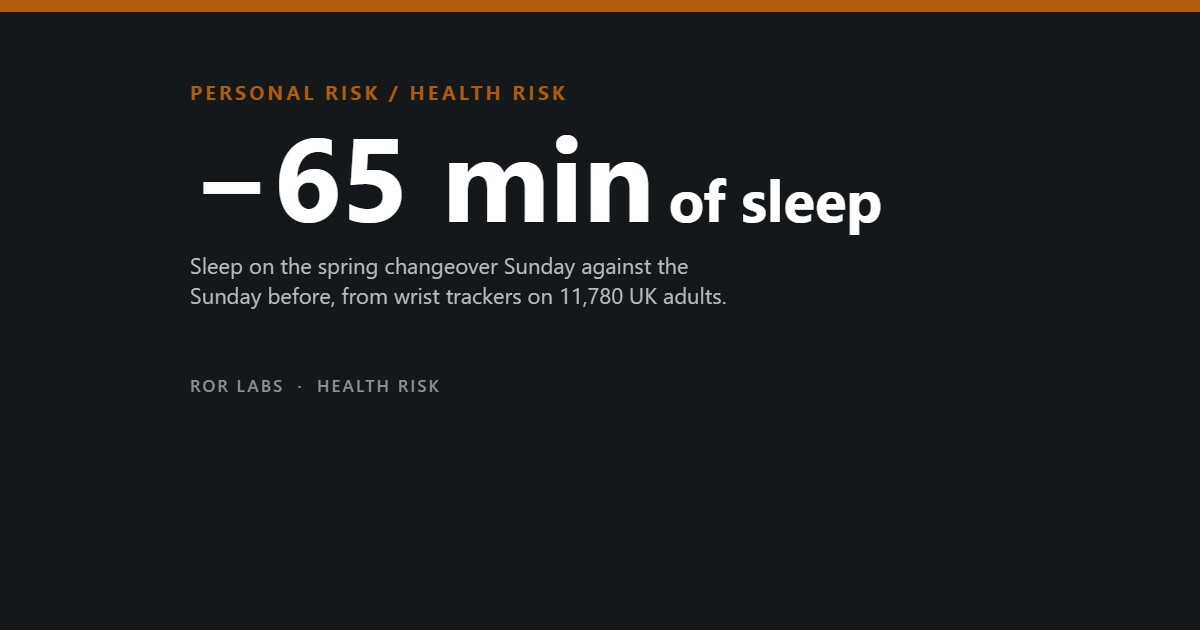
The spring change does not simply remove an hour from one night. The body clock, set by morning light, takes days to adjust, so people go to bed at the old time and wake at the new one. In 2009, Christopher Barnes and David Wagner used US time-use survey data to show that Americans slept about 40 minutes less on the Monday after the spring change. Wrist-worn trackers tell the same story. A UK Biobank analysis of 11,780 people found sleep on the changeover Sunday was 65 minutes shorter than the Sunday before, while the autumn change added 33 minutes, with some catch-up afterwards.
Sleep lost to the spring change
Measured reductions in sleep after clocks go forward, from three kinds of data.
Sources: de Lange et al., Journal of Sleep Research (2025), doi:10.1111/jsr.14335; Barnes CM, Wagner DT, Journal of Applied Psychology (2009), doi:10.1037/a0015320; Medina D et al., Journal of Clinical Sleep Medicine 11(8):879–884 (2015).
Teenagers lose the most, because their body clocks already run late. A study that fitted 35 American high-school students with trackers found they slept 32 minutes less per night on school nights after the change, a cumulative loss of 2 hours 42 minutes over the week, and their reaction times and attention lapses worsened measurably.
Hearts in the first week
The best-known health effect is on the heart. A Swedish national study published in 2008 found heart attacks rose in the first three weekdays after the spring change, with an incidence ratio of 1.051, and found no significant change after the autumn change. Since then the question has been pooled twice. A 2019 meta-analysis of seven studies covering more than 115,000 people found an odds ratio of 1.05 after the spring change and no significant effect in autumn. A 2024 meta-analysis of 12 studies from 10 countries reached nearly the same figures: 1.04 in spring and 1.02, not significant, in autumn.
Heart attacks after the clock change
Pooled relative risk in the days after each transition. 1.00 means no change.
Bars start from 0.95 to show the differences. Sources: Manfredini R et al., Journal of Clinical Medicine 8(3):404 (2019); Hurst A et al., Deutsches Ärzteblatt International (2024).
A 4 or 5% rise on a few days is a small effect on a common event, and it is not universal. A 2025 American study of 168,870 heart-attack patients found no significant difference in rates or outcomes during the weeks of the clock change. Finnish data found no change in weekly totals, and neither did the Michigan study that produced the 24% Monday figure. That pattern suggests a shift in timing for some heart attacks that were already on their way, rather than many extra ones.
Strokes show a similar shape. A Finnish study of hospital admissions from 2004 to 2013 found ischaemic strokes 8% higher in the first two days after a transition, but no significant increase over the week as a whole.
Roads: a contested 6%
Road deaths are where the evidence divides most sharply. In 2020, Josef Fritz and colleagues analysed 732,835 fatal US crashes between 1996 and 2017 and found a 6% rise in risk in the week after the spring change, which they estimated at about 28 extra deaths a year. The rise was mostly in the morning and larger in the western part of each time zone, where mornings are darkest. When the US moved the change from April to March in 2007, the spike moved with it, which points to the clock itself.
An economist, Austin Smith, reached a similar conclusion with different methods in 2016: more than 30 deaths a year from 2002 to 2011, driven by lost sleep rather than by the shift in light, which mainly moved crashes to a different time of day. But a critic has argued that much of the Fritz effect comes from the dates chosen after 2007 rather than from the clock change itself.
Road crashes after the spring change, country by country
Selected studies of crashes or casualties around the spring transition.
| Study | Country | Finding |
|---|---|---|
| Fritz et al. 2020 | United States | 6% more fatal crashes in the following week |
| Smith 2016 | United States | Over 30 extra deaths a year, 2002–2011 |
| Lahti et al. 2010 | Finland | No increase in road accidents |
| James 2022 | Australia | No effect on road deaths; crashes shift within the day |
| Singh et al. 2022 | Great Britain | Where significant, casualties fell rather than rose |
| Gillmore 2025 | Chile | 6% more crashes in week one; 2.7% fewer overall |
Sources: Fritz J et al., Current Biology (2020), doi:10.1016/j.cub.2019.12.045; Smith AC, AEJ: Applied Economics (2016), doi:10.1257/app.20140100; Lahti T et al. (2010), doi:10.1155/2010/657167; James J, Economic Inquiry (2022), doi:10.1111/ecin.13130; Singh R et al., BMJ Open 12(4):e054678 (2022); Gillmore C, Health Economics (2025), doi:10.1002/hec.4936.
Elsewhere the effect often disappears. Finland, from 1981 to 2006, found no increase. Australia found no effect on road deaths at either transition. In Great Britain, 54 of 287 statistical models found a significant change, and every one of them showed fewer casualties, not more. Chile captured both sides: 6% more crashes in the first week of daylight saving time, but 2.7% fewer over the whole period, because lighter evenings help. Light matters as much as sleep. A 1995 study estimated that year-round daylight saving time from 1987 to 1991 might have prevented 901 fatal crashes, 727 of them involving pedestrians, who are especially vulnerable after dark.
Mines, hospitals and mistakes
The clearest workplace evidence comes from mining. Barnes and Wagner matched their sleep data with US mine-injury records from 1983 to 2006. On the Monday after the spring change, injuries were 5.7% more frequent and the workdays lost to those injuries 67.6% higher, a sign that the injuries were more severe. The autumn change had no effect. Studies in Finland and Ontario, however, found no rise in workplace injuries, so this result too depends on setting.
Hospitals are a natural place to look for the effects of a tired workforce. A study at a multi-state US health system, covering 2010 to 2017, found that patient-safety incidents attributed to human error rose 18.7% in the week after the spring change (95% CI 5.6% to 33.6%). All safety incidents combined rose 4.2%, which was not statistically significant, and the autumn change showed no significant effect.
Errors and injuries after the spring change
Increase in the days after clocks go forward, relative to comparable days.
Sources: Barnes CM, Wagner DT, Journal of Applied Psychology (2009), US mines 1983–2006; Kolla BP et al., Journal of General Internal Medicine 36:51–54 (2021).
Why the studies disagree
Several reasons explain why one country finds harm and another does not. The size of the effect depends on how far east or west people live within their time zone, on the date of the change, on what time work and school start, and on how dark the mornings already are. Smaller studies are also more likely to report large effects by chance. A 2022 review of 13 studies concluded that a spring increase of roughly 5% is enough to explain the published findings, that bigger figures tend to come from smaller studies, and that there is no consistent autumn effect.
There is also the question of what is being lost. If a heart attack or crash happens on Monday instead of Thursday, the clock change has moved it, not caused it. Weekly totals that do not change, as in the Michigan and Finnish heart data, point in that direction. Fatal crash data are harder to explain that way, since a death in a crash that would not otherwise have happened is not displaced from later in the week.
None of this means the change is harmless. It means the harm is modest, concentrated in the first few days after the spring transition, and larger for people who are already short of sleep.
Permanent time, but which one
Most people say they would like to stop changing the clocks. The disagreement is about which time to keep. The American Academy of Sleep Medicine, backed by European and British sleep and circadian societies, has called since 2020 for “a fixed, national, year-round standard time,” on the grounds that morning light anchors the body clock and permanent daylight saving time would leave many winter mornings dark. Supporters of permanent daylight saving time point to lighter evenings and to the pedestrian findings.
History offers two cautionary tales. The United States tried year-round daylight saving time from January 1974; public support fell from 79% to 42% over the dark winter months, and Congress restored standard time that October. Russia moved to permanent summer time in 2011 and switched to permanent winter time in 2014. The European Parliament voted 410 to 192 in March 2019 to end seasonal changes, but member states have never agreed which time each should keep.
Attempts to stop changing the clocks
Selected decisions on permanent time.
| When | Where | What happened |
|---|---|---|
| January 1974 | United States | Year-round daylight saving time; reversed that October |
| 2011–2014 | Russia | Permanent summer time, then permanent winter time |
| March 2019 | European Parliament | Votes 410–192 to end changes; member states never agree |
| 2020 | American Academy of Sleep Medicine | Calls for permanent standard time |
| March 2022 | US Senate | Passes permanent daylight saving time; House does not act |
| July 2026 | US House | Passes H.R. 139, 308–117; awaiting the Senate |
Sources: AASM position statement, Journal of Clinical Sleep Medicine 16(10):1781–1784 (2020); European Parliament (2019); CBS News, 15 July 2026.
In July 2026 the US House of Representatives passed the Sunshine Protection Act by 308 votes to 117. It would make daylight saving time permanent nationwide, while allowing states to stay on standard time all year if they act before the law takes effect. Its future in the Senate is unclear, and US clocks are due to go back an hour on 1 November 2026.
What the evidence supports
The evidence supports a few modest conclusions. The spring change costs most people some sleep for several days, and a small rise in heart attacks, and in some countries crashes and injuries, follows. The autumn change does little measurable harm. For individuals, the sleep studies suggest treating the first days after the spring change like a short bout of jet lag: protecting sleep, expecting slower reactions in the morning, and taking care on dark roads. For policy, the choice is between darker mornings and darker evenings, and the sleep science and the road-safety evidence do not point in quite the same direction.
Questions people ask
Does daylight saving time cause heart attacks?
Pooled studies find about 4–5% more heart attacks in the days after the spring change, but several studies find no difference across the whole week, which suggests some are brought forward rather than caused.
Are there more car crashes after the clocks change?
A large US study found 6% more fatal crashes in the week after the spring change. Studies in Finland, Australia and Britain did not find an increase.
Is the autumn change harmful too?
Much less so. Most studies find no significant effect, and some find slightly fewer heart attacks.
Why do sleep experts prefer permanent standard time?
Because morning light sets the body clock. Permanent daylight saving time would make winter mornings darker for months.
When do US clocks change in 2026?
They go back one hour at 2 a.m. on Sunday 1 November 2026, unless the law changes before then.
The short version
- In the spring change, people sleep less: about 40 minutes less on the following Monday in US time-use data, and 65 minutes less on the changeover Sunday in UK Biobank wearable data.
- Pooled studies find heart attacks about 4–5% more common in the days after the spring change, with no clear effect in autumn and no difference in weekly totals in some datasets.
- A US study estimated a 6% rise in fatal crashes in the week after the spring change, about 28 deaths a year; studies in Finland, Australia and Britain found no rise.
- Effects are real but small and partly a reshuffling in time. Sleep scientists favour permanent standard time; the US House voted in July 2026 for permanent daylight saving time instead.
- Workplace injuries rose 5.7% in US mines after the spring change, and patient-safety incidents caused by human error rose 18.7% in one hospital system.
This article summarises published research for general information. It is not medical advice. If you have a heart condition, a sleep disorder or work long or safety-critical shifts, ask your doctor or occupational health service how to manage the days after a clock change.
Further reading: Manfredini et al., Journal of Clinical Medicine 8(3):404 (2019), for the pooled heart-attack evidence. Fritz et al., Current Biology (2020), and Singh et al., BMJ Open (2022), for two opposite answers on road safety. The American Academy of Sleep Medicine’s 2020 position statement for the case for permanent standard time.
- Life Time, Russell Foster (2022). A leading circadian scientist explains the body clock and what disrupts it. The best background on why morning light matters; it argues for its own conclusions.
- The Nocturnal Brain, Guy Leschziner (2019). A sleep neurologist’s case studies of what happens when sleep goes wrong. Vivid on sleep loss; about disorders rather than clock changes.
- Saving Time, Jenny Odell (2023). An essay on how clocks and schedules came to rule daily life. A cultural history rather than science, useful for why changing the clocks provokes such strong feeling.
Sources
Sandhu A, Seth M, Gurm HS. Open Heart 1:e000019 (2014). — Janszky I, Ljung R. NEJM (2008), doi:10.1056/NEJMc0807104. — Manfredini R et al. Journal of Clinical Medicine 8(3):404 (2019). — Hurst A et al. Deutsches Ärzteblatt International (2024), PMC11526362. — Rymer J et al. JAMA Network Open (2025). — Sipilä JOT et al. Sleep Medicine (2016), doi:10.1016/j.sleep.2016.10.009. — Barnes CM, Wagner DT. Journal of Applied Psychology (2009), doi:10.1037/a0015320. — Medina D et al. JCSM 11(8):879–884 (2015). — de Lange MA et al. Journal of Sleep Research (2025), doi:10.1111/jsr.14335. — Kolla BP et al. J Gen Intern Med 36:51–54 (2021). — Fritz J et al. Current Biology (2020), doi:10.1016/j.cub.2019.12.045. — Smith AC. AEJ: Applied Economics (2016), doi:10.1257/app.20140100. — Martín-Olalla JM, arXiv (2020), doi:10.48550/arxiv.2004.04156. — Lahti T et al. (2010), doi:10.1155/2010/657167. — James J. Economic Inquiry (2022), doi:10.1111/ecin.13130. — Singh R, Sood R, Graham DJ. BMJ Open 12(4):e054678 (2022). — Gillmore C. Health Economics (2025), doi:10.1002/hec.4936. — Ferguson SA et al. AJPH (1995), doi:10.2105/AJPH.85.1.92. — Martín-Olalla JM, Mira J. Chronobiology International (2022), doi:10.1080/07420528.2022.2157738. — Rishi MA et al. JCSM 16(10):1781–1784 (2020). — CBS News, House passes Sunshine Protection Act, 15 July 2026.