Shingles Vaccine and Dementia: What the Evidence Shows
Key takeaways · 10 min read
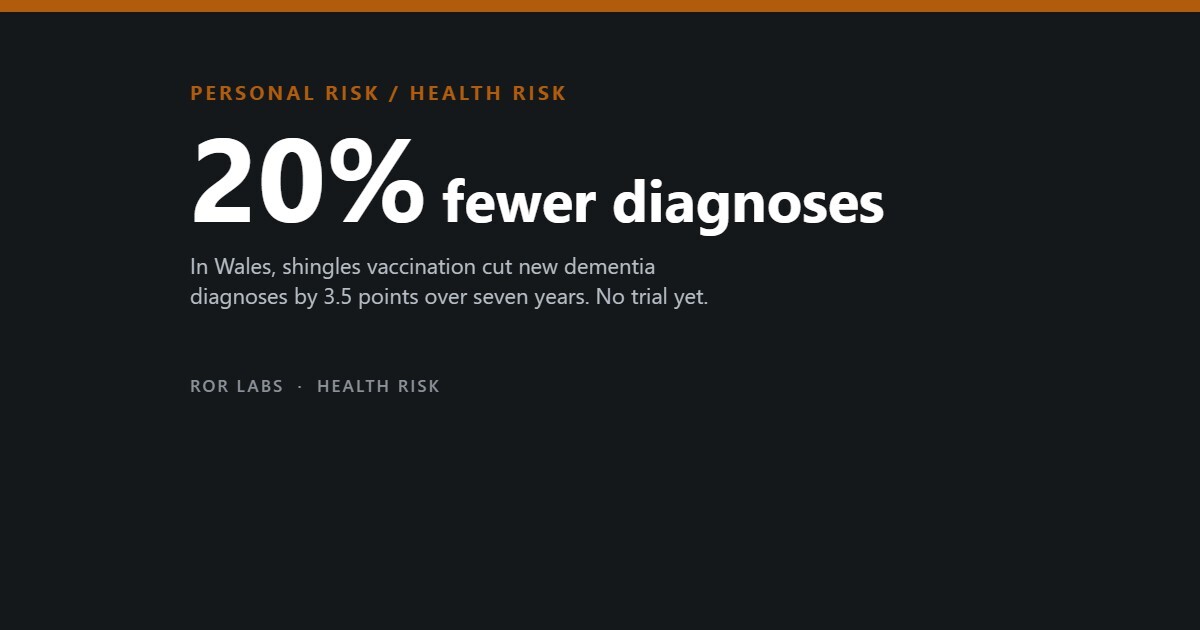
- In Wales, people born just after a 1933 cutoff could get the shingles vaccine and those born just before could not. Over seven years, vaccination cut new dementia diagnoses by 3.5 percentage points, a 20% relative reduction.
- Similar natural experiments in Australia and Canada found smaller effects of eligibility, about 2 percentage points; the Welsh effect was concentrated in women.
- Studies of the newer Shingrix vaccine are observational. One found a hazard ratio of 0.49 against the unvaccinated but 0.73 against people who had a different vaccine, a sign of how much healthy-vaccinee bias can inflate results.
- A 2026 critique argued the natural experiments imply effects that are internally inconsistent, two of them above 100%. No randomised trial has yet tested dementia as an outcome.
On 1 September 2013, Wales started offering the shingles vaccine to people aged 79. Anyone born on or after 2 September 1933 became eligible at some point; anyone born before that date never did. One week either side of the line, the difference was stark. Among people one week too old, 0.01% were vaccinated. Among those one week younger, 47.2% were.
That arbitrary date turned a public-health programme into something close to a randomised trial. People born a few days apart are alike in almost every way that matters for dementia, except that one group could get the vaccine and the other could not. In April 2025, a team led by Pascal Geldsetzer at Stanford reported in Nature that the eligible group went on to have fewer dementia diagnoses.
The finding has since been repeated in other countries, extended to deaths and challenged in print. This article sets out what the Welsh study and its successors found, what the larger observational studies of the newer vaccine add, why some researchers think the numbers do not hang together, and what the vaccine is proven to do regardless.
What shingles does on its own
Shingles is the varicella zoster virus, the chickenpox virus, waking up decades after a childhood infection. The CDC estimates that about one in three people in the United States will get it during their lifetime, around a million cases a year, and that the risk rises sharply after the age of 50. Between 10% and 18% of people with shingles go on to have postherpetic neuralgia, nerve pain that can last for months after the rash heals.
Two vaccines have been used. Zostavax, a live weakened virus, cut shingles by 51.3% in a trial of 38,546 older adults published in 2005, but its protection waned: one large analysis estimated effectiveness at 68% in the first year and 47% in the second. Shingrix, a non-live recombinant vaccine with an adjuvant called AS01, did far better in its trials and has replaced Zostavax in the United States since 2020 and in the UK since 2023.
How well the vaccines prevent shingles itself
Efficacy against shingles in the main randomised trials.
Sources: Lal H et al., NEJM (2015), doi:10.1056/NEJMoa1501184; Cunningham AL et al., NEJM (2016), doi:10.1056/NEJMoa1603800; Oxman MN et al., NEJM (2005), doi:10.1056/NEJMoa051016.
Everything else in this article is about a possible extra benefit. The protection against shingles is not in doubt.
The birthday that split Wales
The Welsh study used primary-care records for 282,541 older adults. Because uptake jumped at the cutoff but nothing else should, the authors could estimate the effect of the vaccine by comparing people on either side of the line, a design called regression discontinuity. Over seven years, eligibility for the live vaccine was followed by fewer new diagnoses of dementia. Translated into the effect of actually being vaccinated, new dementia diagnoses fell by 3.5 percentage points (95% CI 0.6 to 7.1), a relative reduction of 20.0%.
The cutoff in Wales
Vaccine uptake one week either side of the eligibility date, and the estimated effect of vaccination over seven years.
Vaccinated: 0.01%
Never eligible
Vaccinated: 47.2%
Effect of vaccination on new dementia diagnoses: −3.5 points (−20%)
Source: Eyting M, Xie M, Michalik F et al., Nature 641:438–446 (2025), doi:10.1038/s41586-025-08800-x. Natural experiment using routine records; the outcome is a recorded diagnosis.
The authors anticipated the obvious objection, that something else might change at the same birth date. They checked the ten leading causes of illness and death in Wales and found no jump at the cutoff in any of them. Shingles diagnoses did fall, by 37.2% in relative terms, as they should if the vaccine was doing its known job. The effect on dementia was stronger in women. In an earlier version of the paper, estimates for men were close to zero, although the confidence interval did not rule out a meaningful benefit.
The study’s own limits are worth stating plainly. The outcome is a dementia diagnosis in a GP record, and much dementia goes undiagnosed. The people studied were about 79 or 80 when the programme began, and follow-up lasted at most about eight years. And the vaccine was Zostavax, which is no longer used in most programmes.
Australia, Canada and the deaths
Australia began its own programme in November 2016 for people aged 70 to 79, with a birth-date cutoff of 2 November 1936. A study of records from 65 general practices, published in JAMA in April 2025, found that eligibility reduced new dementia diagnoses by 1.8 percentage points (95% CI 0.4 to 3.3) over 7.4 years. Uptake was 30.2% among the eligible and 6.5% among the ineligible. The authors did not convert this into an effect per vaccinated person, because vaccination is under-recorded in Australian GP data, and they noted that dementia was heavily under-diagnosed: 1.4% of over-65s in their data had a diagnosis, against an estimated true prevalence of 8.4%.
A Canadian study in The Lancet Neurology in 2026 used Ontario’s birth-date cutoffs and reported about 2 percentage points fewer dementia diagnoses over 5.5 years. A further Welsh analysis in Cell, in December 2025, looked further along the disease course. Vaccination was associated with fewer diagnoses of mild cognitive impairment, and among people already diagnosed with dementia, with fewer deaths from dementia. Deaths from other causes did not change, which is what would be expected if the effect were real rather than a general marker of health; the reduction in dementia deaths was again clear in women and not in men.
Three natural experiments
Change in new dementia diagnoses associated with a birth-date cutoff for the live shingles vaccine. Wales reports the effect of vaccination; Australia and Canada report the effect of eligibility, which is smaller because not everyone eligible was vaccinated.
| Country | Follow-up | Measure | Change in diagnoses |
|---|---|---|---|
| Wales | 7 years | Effect of vaccination | −3.5 points (−20%) |
| Australia | 7.4 years | Effect of eligibility | −1.8 points |
| Canada (Ontario) | 5.5 years | Effect of eligibility | about −2.0 points |
Sources: Eyting et al., Nature (2025); Pomirchy M et al., JAMA (2025), doi:10.1001/jama.2025.5013; Pomirchy M et al., Lancet Neurology (2026), doi:10.1016/S1474-4422(25)00455-7.
Newer vaccine, bigger databases
For Shingrix, the vaccine people are actually offered now, there are no birth-date experiments, only observational studies. They are large. Maxime Taquet and colleagues at Oxford used the switch in US practice from Zostavax to Shingrix in October 2017 and compared 103,837 people who received each. Those given the newer vaccine lived 17% longer without a dementia diagnosis over six years, an average of 164 extra diagnosis-free days among those who developed dementia. The difference was larger in women (22%) than in men (13%). In June 2026, a study of 509,926 Medicare patients aged 66 and over who had stayed in a skilled nursing facility, funded by Shingrix’s maker GSK, reported that 18.8% of those vaccinated and 24.6% of those not vaccinated developed dementia within four years.
Here is the problem with such comparisons. People who choose to be vaccinated tend to be healthier, better off and more engaged with their doctors than people who do not. A Kaiser Permanente study published in February 2026 shows the size of that bias neatly. Two doses of Shingrix, compared with no shingles vaccine, came with a hazard ratio for dementia of 0.49 — roughly half the risk. Compared with people who had received a tetanus-diphtheria-pertussis booster instead, another marker of a person who gets vaccinated, the hazard ratio was 0.73.
An Oxford follow-up added another twist: both the shingles vaccine and an RSV vaccine that uses the same AS01 adjuvant were associated with lower dementia risk over 18 months, with no difference between them. That is consistent with the idea that the immune boost from the adjuvant, rather than protection against shingles, might matter. It is also consistent with both groups simply being healthier than average.
The same vaccine, two comparison groups
Hazard ratio for dementia after two doses of Shingrix, depending on whom the vaccinated are compared with. Lower means less dementia.
Source: Rayens EA et al., Nature Communications (2026), doi:10.1038/s41467-026-69289-0. Observational; the gap between the two figures reflects differences between people who do and do not get vaccinated.
Why the numbers may not hold
In September 2026, Mika Kivimäki and colleagues, including Gill Livingston of the Lancet dementia commission, published a pointed critique. They took each natural experiment and worked back to the effect it implied for a person who was actually vaccinated. Wales implied an 18% reduction. Australia implied 177%. Canada’s two cutoffs implied 84% and 111%. A vaccine cannot prevent more than 100% of cases, so at least two of these figures are impossible, and they cannot all be estimates of the same thing. The authors also pointed out that national dementia rates in the three countries have not fallen in the way such large effects would suggest.
Implied effect per vaccinated person
The reduction in dementia diagnoses implied by each natural experiment, worked back to people who were actually vaccinated, according to a 2026 critique.
Source: Kivimäki M, Frank P, Livingston G, Sipilä PN, Brain, Behavior, and Immunity (2026), doi:10.1016/j.bbi.2026.107021. Figures above 100% are not biologically possible, which is the critique’s point.
There are partial answers. Under-recording of vaccination in Australian records would inflate the implied effect, and small denominators make such back-calculations unstable. But the critique lands on real weaknesses. The outcome in every study is a recorded diagnosis, which can be delayed or missed without the disease changing. The Oxford team saw hints that the advantage narrowed by year six, which fits a delay as well as a prevention. Effects concentrated in women are biologically possible but also a warning sign when they appear in some studies and not others. And the natural-experiment evidence concerns a vaccine that is being phased out.
The researchers behind the original work agree on the remedy. Writing in Nature Medicine in June 2026, Geldsetzer called for large randomised trials, and in May 2026 he told a neurology conference that one is “really needed.” No trial with dementia as its outcome has yet reported.
Who is offered the vaccine
Vaccination policy rests on preventing shingles, not dementia. In the United States, the CDC recommends two doses of Shingrix, two to six months apart, for adults aged 50 and over and for adults aged 19 and over with weakened immune systems. In the UK, Shingrix replaced Zostavax for the whole programme in September 2023. Until August 2028 it is offered to people turning 65 or 70; from September 2028 to people turning 60 or 65; and from September 2033 routinely at 60. People who are severely immunosuppressed are eligible from 18.
The vaccine’s common side effects are a sore arm, tiredness and aches for a day or two, which the trial participants reported more often than those on placebo. Those are the trade-offs the eligibility rules are based on.
What the evidence supports
The natural experiments are among the cleverest pieces of evidence in dementia research, and their direction is consistent across three countries. But consistency in direction is not the same as a reliable size, and the critique shows the sizes do not fit together. The Shingrix studies are large but cannot escape the fact that vaccinated people differ from unvaccinated ones. The fair summary is that a protective effect is plausible and worth a trial, not that it is established. The reason to be vaccinated remains the one the trials proved: fewer cases of shingles and of the nerve pain that can follow it.
Questions people ask
Does the shingles vaccine prevent dementia?
It might reduce or delay dementia diagnoses, according to natural experiments and observational studies, but no randomised trial has tested it and the effect sizes are disputed.
Which vaccine was studied in Wales?
The live vaccine, Zostavax. Current programmes in the UK and US use the recombinant vaccine, Shingrix, for which the evidence on dementia is observational.
Why did the effect appear mainly in women?
Nobody knows. Differences in immune response are one proposed explanation, but the sex difference was not seen in the Australian study, which weakens confidence in it.
Who can get the shingles vaccine?
In the US, adults aged 50 and over, and younger adults with weakened immune systems. In the UK, eligibility depends on age and is moving towards 60.
How does shingles relate to dementia biologically?
That is still a hypothesis. Proposals include fewer viral reactivations, broader effects on the immune system and less inflammation in blood vessels of the brain.
The short version
- In Wales, people born just after a 1933 cutoff could get the shingles vaccine and those born just before could not. Over seven years, vaccination cut new dementia diagnoses by 3.5 percentage points, a 20% relative reduction.
- Similar natural experiments in Australia and Canada found smaller effects of eligibility, about 2 percentage points; the Welsh effect was concentrated in women.
- Studies of the newer Shingrix vaccine are observational. One found a hazard ratio of 0.49 against the unvaccinated but 0.73 against people who had a different vaccine, a sign of how much healthy-vaccinee bias can inflate results.
- A 2026 critique argued the natural experiments imply effects that are internally inconsistent, two of them above 100%. No randomised trial has yet tested dementia as an outcome.
- The vaccine’s proven benefit is against shingles itself: Shingrix was 97.2% effective in adults aged 50 and over and 89.8% in those aged 70 and over.
This article summarises published research and public-health guidance for general information. It is not medical advice. Whether and when to be vaccinated depends on your age, health and local programme; ask your doctor, nurse or pharmacist.
Further reading: Eyting et al., Nature 641 (2025), for the Welsh natural experiment and its checks. Kivimäki et al., Brain, Behavior, and Immunity (2026), for the case that the results do not fit together. The CDC’s clinical overview of shingles for the baseline risks.
- Immune, Philipp Dettmer (2021). An illustrated tour of the immune system for general readers. Helpful background on how vaccines and adjuvants work; it predates the dementia studies.
- Remember, Lisa Genova (2021). A neuroscientist on how memory works and which kinds of forgetting are normal. A calm counterweight to headlines about dementia; light on epidemiology.
- Keep Sharp, Sanjay Gupta (2021). A neurosurgeon’s overview of brain ageing and risk factors. Broad and readable; some advice goes beyond what trials have shown.
Sources
Eyting M, Xie M, Michalik F, Heß S, Chung S, Geldsetzer P. Nature 641:438–446 (2025), doi:10.1038/s41586-025-08800-x. — Pomirchy M et al. JAMA (2025), doi:10.1001/jama.2025.5013. — Pomirchy M et al. Lancet Neurology (2026), doi:10.1016/S1474-4422(25)00455-7. — Xie M, Eyting M, Bommer C, Ahmed H, Geldsetzer P. Cell (2025), doi:10.1016/j.cell.2025.11.007. — Taquet M, Dercon Q, Todd JA, Harrison PJ. Nature Medicine (2024), doi:10.1038/s41591-024-03201-5. — Taquet M, Todd JA, Harrison PJ. npj Vaccines (2025), doi:10.1038/s41541-025-01172-3. — Rayens EA et al. Nature Communications (2026), doi:10.1038/s41467-026-69289-0. — Annals of Internal Medicine (2026), doi:10.7326/ANNALS-25-04689. — Kivimäki M, Frank P, Livingston G, Sipilä PN. Brain, Behavior, and Immunity (2026), doi:10.1016/j.bbi.2026.107021. — Geldsetzer P. Nature Medicine (2026), doi:10.1038/s41591-026-04474-8. — Lal H et al. NEJM (2015), doi:10.1056/NEJMoa1501184. — Cunningham AL et al. NEJM (2016), doi:10.1056/NEJMoa1603800. — Oxman MN et al. NEJM (2005), doi:10.1056/NEJMoa051016. — Baxter R et al. American Journal of Epidemiology 187(1):161 (2018). — CDC, Shingles clinical overview and vaccine recommendations (2024). — UK Health Security Agency, Shingrix programme letter (4 July 2023); NHS, Shingles vaccine (2026).