Golf injuries, golf carts and the lightning myth
Key takeaways · 9 min read
- Golf injures about 2.5 people per 1,000 rounds, mostly backs, elbows and shoulders through overuse.
- Over a career, most golfers are injured at some point; practice volume and swing faults drive it.
- The most severe golf injuries often happen to children struck by clubs, frequently at home.
- Golf carts caused an estimated 147,696 emergency visits from 1990 to 2006; ejection is the big danger.
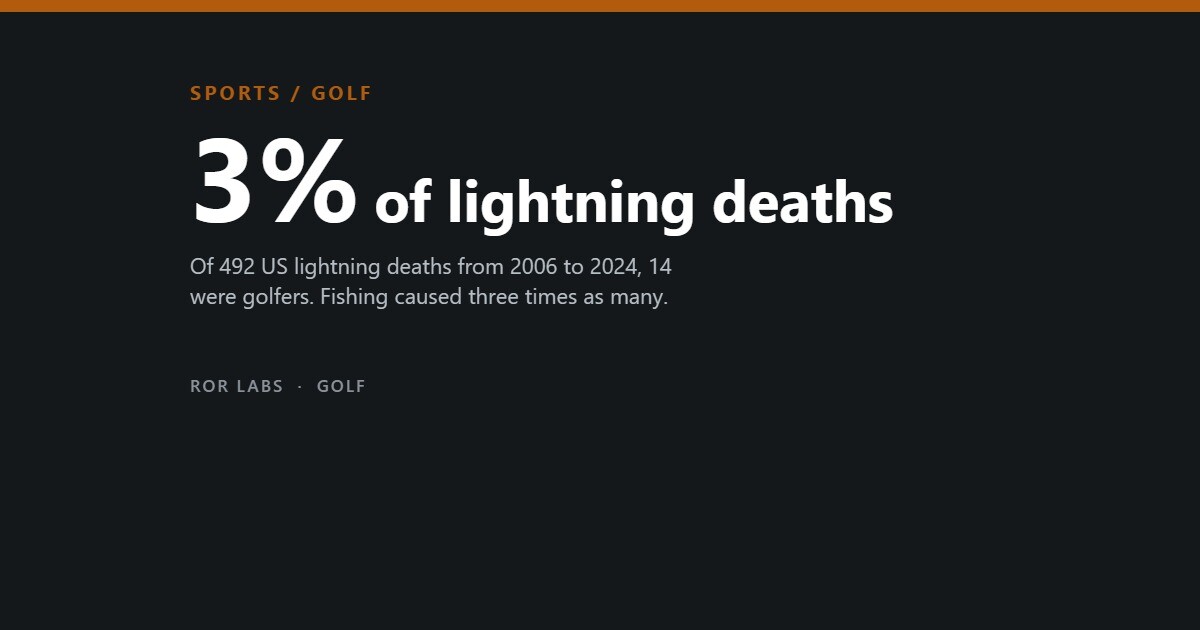
Golfers are supposed to be the people lightning kills. In the United States from 2006 to 2024, the National Lightning Safety Council counted 492 lightning deaths. Fourteen of them, 3%, happened on golf courses. Fishing accounted for three times as many. The council’s own words: the belief that golfers suffer the most lightning deaths “was shown to be a myth”.
Golf’s real hazards are duller and closer to home. The commonest injuries are backs and elbows worn down by thousands of practice swings. The most severe ones often happen to children, frequently in their own back gardens, from a club swung by someone else. And the vehicle that makes a round easier, the golf cart, both removes much of the exercise and sends thousands of people to emergency departments each year.
This article follows the series format: what golfers actually injure, where the risk concentrates, what has been measured to reduce it, and why the answer is not to give the game up.
What actually gets injured
By the standards of this series, golf is gentle. A 2024 meta-analysis of seven studies covering 269,754 rounds put the pooled injury rate at 2.5 per 1,000 rounds, with amateurs at 1.3 and professionals at 8.5. Prospective studies of amateurs, reviewed in 2017, found 0.28 to 0.60 injuries per 1,000 hours of play.
Golf injury rates
Injuries per 1,000 rounds of 18 holes, pooled across seven studies.
Source: Kuitunen and Ponkilainen, Irish Journal of Medical Science, doi:10.1007/s11845-024-03759-6 (2024). Pooled rate 95% CI 0.9–7.5.
The sites are consistent. In a prospective study of 588 Australian golfers, 15.8 injuries occurred per 100 golfers a year: the lower back accounted for 18.3%, the elbow and forearm 17.2%, the foot and ankle 12.9% and the shoulder 11.8%. In a German study of 703 golfers, 82.6% of injuries were overuse rather than a single trauma. Professionals mostly hurt their backs, wrists and shoulders; amateurs their elbows, backs and shoulders.
Where golfers are injured
Share of injuries by body site, prospective study of 588 Australian golfers.
Source: McHardy, Pollard and Luo, American Journal of Sports Medicine (2007). 15.8 injuries per 100 golfers per year.
The low rate per hour hides a high toll over a career. A 2024 review of 17 studies found that 73.5% of professionals and 54.2% of amateurs had been injured at some point. In a UK study of 303 golfers, a low-back injury meant an average of 54 days before full recovery. Even the names mislead: in a Korean survey of 208 golfers, damage on the outer side of the elbow, the tennis-elbow side, was three times as common as on the inner side, which is the one named after golf.
When the risk concentrates
For the golfer, risk concentrates in the swing and in its volume. In the Australian study, a faulty swing was blamed for 46.2% of injuries, and most happened at impact or in the follow-through. The 2017 review identified repetitive practice volume as the main cause in professionals and poor mechanics as a frequent, possibly leading, cause in amateurs. Carrying a bag was hazardous to the lower back, shoulder and ankle in the German study.
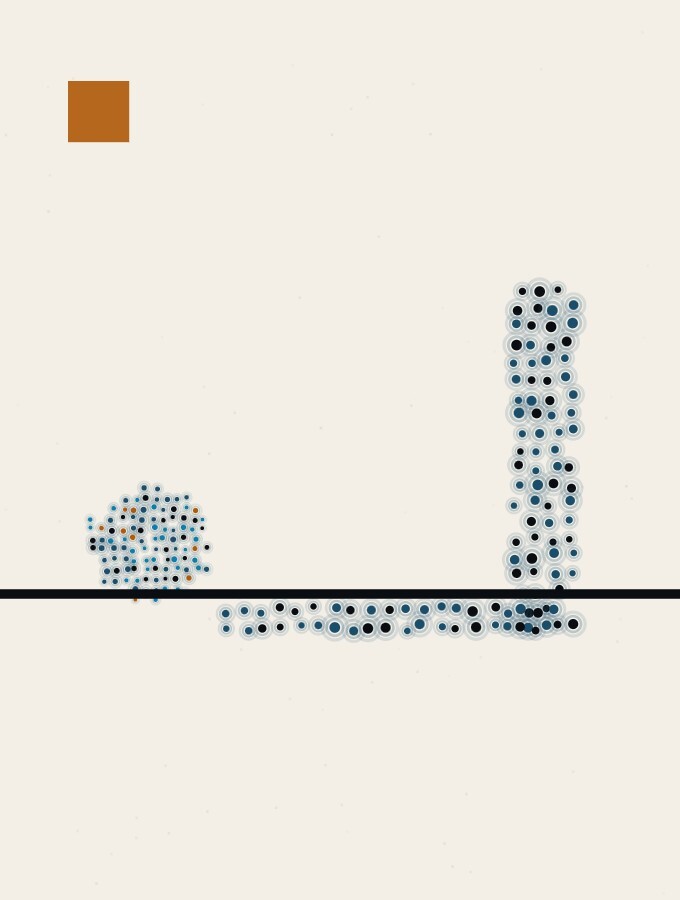
For everyone else nearby, the risk concentrates in the club and the ball. US emergency departments treated an estimated 663,471 golf-related injuries from 1990 to 2011, about 30,000 a year. Being hit by a club caused 23.4% and being hit by a ball 16.0%; the head and neck were the commonest injury site at 36.2%. Rates per 10,000 golfers were highest among children aged 7 to 17 (22.1) and adults over 55 (21.8), against 7.6 for ages 18 to 54, and older patients were admitted five times as often.
Children are the group where golf injuries are most severe. At one trauma centre, golf caused 6% of sports admissions but carried a higher injury severity score. Eighty per cent of those children were under 12, 48% were injured at home, 57% were struck by a club and 68% were hurt in the head or neck. In a paediatric neurosurgery series, golf was the second commonest cause of sports-related cases, and a third of those needed surgery. A survey of junior golfers found 47.6% had been hit by a golf ball at least once.
Who gets hurt, per 10,000 golfers
US emergency department golf injuries, 1990–2011.
Source: Walsh et al., American Journal of Emergency Medicine, doi:10.1016/j.ajem.2017.05.035 (2017).
The golf cart
Golf carts are the hazard least associated with golf. US emergency departments treated an estimated 147,696 cart-related injuries from 1990 to 2006, rising 132% over the period. Children under 16 made up almost a third. Falling or jumping from the cart was the leading cause, and 7.8% of patients were admitted. Seventy per cent happened at sports facilities, and 15% on streets.
Studies from children’s trauma centres show what those falls can do. In Pennsylvania, 108 children hurt in golf carts between 2004 and 2014 had skull fractures in 43.5% of cases and bleeding in the brain in 29.6%; 58.3% had been thrown from the cart. In another series only one child in forty was wearing a seat belt, drivers were as young as nine, and child drivers were linked to rollovers. A 2025 conference study estimated 53,855 cart injuries among people aged 22 or under from 2010 to 2023, about 3,800 a year, half from falls or ejections and 44% involving the head, face or neck. As carts spread into retirement communities and holiday towns, many of these injuries happen nowhere near a golf course.
Alcohol adds to the risk on the course generally. In a 2025 analysis of golf injuries from 2011 to 2021, the share that were fractures rose from about 12% to 18% when alcohol was involved.
What has been measured to work
There are no randomised trials of golf injury prevention. A 2019 systematic review of 23 studies found that many golfers do not warm up, or do so only briefly, and that the evidence linking warm-up to fewer injuries was mixed and inconclusive, although warm-ups did improve performance. The German study found warm-ups associated with fewer injuries only when they lasted at least ten minutes.
What the evidence does support is practical. Because practice volume and swing faults drive most overuse injuries, lessons and a gradual build-up in range time address the known causes. For children, the risk is mostly the club: keeping them well away from anyone swinging, at home as much as on the course, matches where the injuries actually occur. For carts, the trauma-centre data point to seat belts where fitted, adult drivers, and keeping children seated. For lightning, the standard advice to leave the course when thunder is heard is sound, even if golf’s share of deaths is smaller than its reputation.
On lightning, the council’s breakdown is worth seeing in full. Of the 492 deaths from 2006 to 2024, fishing accounted for 42, beach activities for 32, boating for 25 and camping for 23, all ahead of golf’s 14. The pattern reflects where people are in the open near water during summer storms, and how many of them there are, not anything peculiar to golf courses.
US lightning deaths by activity
Deaths from 2006 to 2024, 492 in total.
Source: Jensenius, National Lightning Safety Council (January 2025).
Why the answer is not to stop
Golf has one of the most striking longevity associations in sport. A Swedish study of 300,818 golfers found a standardised mortality ratio of 0.60, meaning 40% lower mortality than the general population, in every age group, both sexes and every socioeconomic group. Golfers with the lowest handicaps had the lowest mortality of all. The authors were careful to say the study was observational and that healthier lifestyles explain part of the difference.
Walking the course against riding
Steps and energy for a round, from a scoping review and a crossover study.
Source: Murray et al., British Journal of Sports Medicine 51(1):12–19 (2017); Lyerly et al., Journal of Sports Medicine and Physical Fitness (2022). Walking 18 holes: 11,245–16,667 steps.
The mechanism is mostly walking. A scoping review found that walking 18 holes takes 11,245 to 16,667 steps, four to eight miles, against about 6,280 when riding a cart, and burns roughly 531 to 2,467 calories a round. In a small crossover study, nine holes cost 624 calories on foot and 336 in a cart. The review’s recommendation was blunt: golfers should walk the course rather than ride. A 2018 international consensus statement of 25 experts added longer life, better cardiovascular risk factors and mental well-being to the benefits, and a moderate annual injury risk and possibly more skin cancer to the costs.
That leaves an unusual trade. The same machine that removes most of the exercise also causes most of the severe injuries not related to the swing. Walking the course keeps the benefit and removes a hazard at once. For the swing itself, the injuries are mostly overuse and mostly avoidable with coaching and a sensible practice load. The answer is to play differently, not to stop.
Questions people ask
What are the most common golf injuries?
Lower back, elbow and forearm, shoulder and wrist. Most are overuse injuries linked to practice volume and swing mechanics.
Is golfer’s elbow common in golfers?
Less than the name suggests. In one survey, pain on the outer, tennis-elbow side was three times as common as on the inner side.
Are golfers at high risk from lightning?
Less than their reputation: golf accounted for 3% of US lightning deaths from 2006 to 2024. Leaving the course when thunder is heard is still the right rule.
Are golf carts dangerous?
They cause thousands of emergency visits a year, many among children thrown or falling from the cart. Seat belts, adult drivers and seated passengers reduce the risk.
Is walking the course better than riding?
Yes: roughly twice the steps and calories, and no cart hazard.
The short version
- Golf injures about 2.5 people per 1,000 rounds, mostly backs, elbows and shoulders through overuse.
- Over a career, most golfers are injured at some point; practice volume and swing faults drive it.
- The most severe golf injuries often happen to children struck by clubs, frequently at home.
- Golf carts caused an estimated 147,696 emergency visits from 1990 to 2006; ejection is the big danger.
- Golf caused 3% of US lightning deaths, not the most.
- Swedish golfers had 40% lower mortality; walking the course doubles the steps.
This is a summary of published research, not medical advice. It does not replace assessment of a persistent injury by a doctor or physiotherapist. If you have heart disease or back problems, talk to your doctor about how much to play and whether to walk or ride.
Further reading: Murray et al., British Journal of Sports Medicine 52(22):1426 (2018), the international consensus statement on golf and health. Walsh et al., American Journal of Emergency Medicine (2017), for golf injuries in US emergency departments. The National Lightning Safety Council’s analysis of US lightning deaths, 2006–2024.
- LIV and Let Die, Alan Shipnuck (2023). A reporter’s account of the upheaval in professional golf. It is about money and power rather than health, and a readable window into the modern game.
- Move, Caroline Williams (2021). A science journalist on how movement changes the brain and mood. Useful background for why the walking half of golf may matter as much as the swing.
- Numbers Don’t Lie, Vaclav Smil (2020). Seventy-one short essays on putting numbers in proportion — a good habit for anyone who assumed golfers top the lightning statistics.
Sources
Jensenius JS. A detailed analysis of lightning deaths in the United States from 2006 through 2024. National Lightning Safety Council (January 2025). — Kuitunen I, Ponkilainen V. Irish Journal of Medical Science, doi:10.1007/s11845-024-03759-6 (2024). — Murray AD, Daines L, Archibald D, et al. British Journal of Sports Medicine 51(1):12–19 (2017). — McHardy A, Pollard H, Luo K. American Journal of Sports Medicine, doi:10.1177/0363546507300188 (2007). — Gosheger G, et al. American Journal of Sports Medicine 31(3) (2003). — Williamson et al. British Journal of Sports Medicine, doi:10.1136/bjsports-2024-ioc.115 (2024), conference abstract. — Williams, Murray, Sorbie. Physician and Sportsmedicine, doi:10.1080/00913847.2024.2432859 (2024). — Moon, Kim. Journal of Exercise Rehabilitation 19(2):134 (2023). — Walsh BA, Chounthirath T, Friedenberg L, Smith GA. American Journal of Emergency Medicine, doi:10.1016/j.ajem.2017.05.035 (2017). — Swisher et al. Clinical Journal of Sport Medicine, doi:10.1097/JSM.0000000000001299 (2025). — Vitale et al. Pediatric Emergency Care, doi:10.1097/PEC.0b013e3182037c9a (2011). — Rahimi et al. Journal of Neurosurgery: Pediatrics, doi:10.3171/ped.2005.102.2.0163 (2005). — Nicholas et al. Journal of Sport Rehabilitation, doi:10.1123/jsr.7.2.112 (1998). — Watson DS, Mehan TJ, Smith GA, McKenzie LB. American Journal of Preventive Medicine, doi:10.1016/j.amepre.2008.03.029 (2008). — Garay M, et al. Journal of Pediatric Orthopaedics B (2021). — Starnes et al. Pediatrics (2018), meeting abstract. — Ganley et al., Children’s Hospital of Philadelphia, AAP National Conference abstract (2025). — Ehlert A, Wilson PB. Journal of Strength and Conditioning Research 33(12):3444–3462 (2019). — Farahmand B, Broman G, de Faire U, et al. Scandinavian Journal of Medicine and Science in Sports, doi:10.1111/j.1600-0838.2008.00814.x (2009). — Murray AD, et al. British Journal of Sports Medicine 52(22):1426 (2018). — Lyerly et al. Journal of Sports Medicine and Physical Fitness, doi:10.23736/S0393-3660.20.04377-6 (2022).