Protein food sources and the new target above the RDA
Key takeaways · 9 min read
- The recommended amount is 0.8 grams per kilogram a day. There is no upper limit.
- The 2025 to 2030 US guidelines raised the goal to 1.2 to 1.6 grams per kilogram. Many Americans already eat that much.
- Per tablespoon, soy isolate and gelatin lead — and gelatin contains no tryptophan.
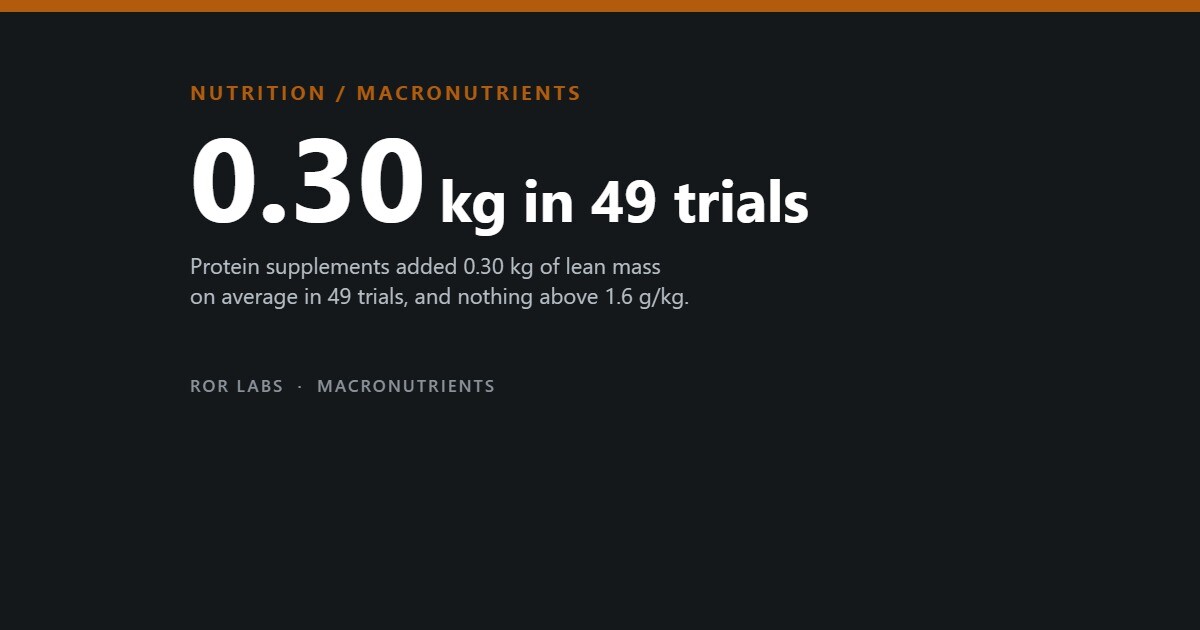
- With resistance training, extra protein added about 0.3 kilograms of lean mass, with no further gain above about 1.6 grams per kilogram.
Rank foods by how much protein one level tablespoon holds and the first two places go to powders. Soy protein isolate comes first at 13.2 grams. Second is plain gelatin at 12.8 grams, which on paper is 86% protein.
Look one column further in the same USDA record and gelatin’s tryptophan is listed at zero. Tryptophan is one of the nine amino acids the body cannot make, and a protein that lacks one of them cannot, on its own, be used to build the body’s proteins. The tablespoon counts grams. It cannot count what the grams are made of, and that is where most arguments about protein actually live.
This article covers what protein does and how much the reference numbers say you need, which foods carry it, the new US guideline that raised the target, what the trials found about extra protein and muscle, and whether high intakes are safe.
What protein does, and the numbers behind it
Protein supplies amino acids, which the body uses to build and repair muscle, make enzymes and hormones, and run the immune system. Of the twenty amino acids in food, nine are essential and must come from the diet. The rest the body can make for itself if it has enough nitrogen and energy.
The reference numbers for protein
US dietary reference values for adults, with average intakes.
Source: National Academies, DRI macronutrient tables; UC Davis nutrition information sheet on protein requirements; USDA ARS, WWEIA Data Brief 29 (2021).
The 0.8 gram figure comes from nitrogen balance studies, which measure whether the body is taking in as much nitrogen as it loses. Those studies put the average requirement at about 0.66 grams per kilogram, and the recommended amount is set above it so that it covers nearly everyone. It is a floor for healthy adults, not a target for building muscle. The National Academies found no intake level with clear adverse effects, which is why no upper limit exists.
Most Americans are well above the floor. In national survey data from 2015 to 2016, men averaged 97 grams a day and women 69, about 16% of their energy. Intake falls with age: men over 60 averaged 71 grams and women 63. About two thirds came from animal foods.
Three foods by the spoonful
The series ranks foods by what one level tablespoon, 15 grams, delivers, using USDA values per 100 grams.
Protein in one level tablespoon (15 g)
USDA FoodData Central, SR Legacy, nutrient 203. FDC identifiers given so the figures can be checked.
Source: USDA FoodData Central. Gelatin’s tryptophan (nutrient 501) is recorded as 0 g per 100 g.
Soy isolate, gelatin and dried egg white are the three, and the pattern from earlier articles holds: the top of the table is ingredients, not meals. Gelatin is the lesson. It is made from collagen, and collagen is built mostly from a few non-essential amino acids. Protein quality is measured by how well a food supplies all nine essential amino acids in digestible form. In 2013 the Food and Agriculture Organization recommended a newer score for this, the digestible indispensable amino acid score, to replace the older one.
Real servings are where most protein comes from. Eggs, dairy, meat, fish, beans, lentils, tofu and nuts all supply it, and in a mixed diet the amino acids one food lacks another tends to supply. For most people eating enough food, the question is not quality but quantity, and that is the question the new guidelines changed.
The new target
In January 2026 the US Dietary Guidelines for 2025 to 2030 set a protein goal for the first time in grams per kilogram: “1.2–1.6 grams of protein per kilogram of body weight per day, adjusting as needed based on your individual caloric requirements.” It also told readers to prioritise high-quality, nutrient-dense protein foods, naming both animal and plant sources.
Harvard’s Nutrition Source described that as 50% to 100% more than the previous minimum, while pointing out that many Americans already eat enough. For a 70-kilogram adult, the new range works out to 84 to 112 grams a day, against 56 grams at the old floor. A perspective published in the Journal of Nutrition in 2026 questioned the change, arguing that what is optimal for one segment of the population should not be considered optimal for all without sufficient evidence.
Both sides agree on the floor. The argument is about who benefits from going well above it, and that is a question the trials have tested directly.
What the trials found about muscle
The most cited analysis pooled 49 randomised trials with 1,863 participants who did resistance training, with or without extra protein.
Extra protein during resistance training
Pooled results from 49 randomised trials, 1,863 people. Added gain from protein supplements over training alone.
Source: Morton et al., British Journal of Sports Medicine 52(6):376–384 (2018). Fat-free mass 95% CI 0.09–0.52; strength 0.64–4.33.
Extra protein helped, and by a small amount: 0.30 kilograms of fat-free mass and about 2.5 kilograms on a one-repetition lift, over months of training. Gains stopped rising at about 1.6 grams per kilogram a day, though the interval around that estimate ran up to 2.2. The effect was larger in people already trained and smaller with age — about 0.01 kilograms less for every year older.
That number is the source of the new guideline’s range. It came from people lifting weights. What the trials say about everyone else is less encouraging.
Older adults, and protein without exercise
Muscle loss with age, called sarcopenia, is the strongest argument for eating more protein later in life. Two expert groups, PROT-AGE in 2013 and the European society ESPEN in 2022, recommend at least 1.0 to 1.2 grams per kilogram for people over 65.
Protein trials in older adults
Added effect of protein supplements, or higher protein intake, on muscle.
Source: Bauer et al., JAMDA 16:740–747 (2015); ten Haaf et al., Am J Clin Nutr 108(5):1043 (2018), 95% CI −0.06 to 0.28; Campbell et al., J Gerontol A (2023).
The PROVIDE trial gave 380 older adults with sarcopenia a whey, leucine and vitamin D drink twice a day for 13 weeks. Muscle mass rose by 0.17 kilograms and a chair-stand test improved by about a second, but grip strength and the overall physical performance score did not change. A pooled analysis of 36 studies in healthy older adults found no significant effect on lean mass at all. A 2023 review of controlled feeding trials reached the same conclusion: intakes above about 1.3 grams per kilogram made no difference to lean mass or function unless people were also training or cutting calories.
The pattern is consistent. Protein is a building material. Without a stimulus to build, more material mostly gets burned.
How much at one meal
A common rule says the body can use only 20 to 30 grams of protein at a sitting. It came from short studies of muscle protein synthesis. One found the response levelled off at about 0.24 grams per kilogram in younger men and 0.40 in older men.
A 2023 study challenged it. Thirty-six young men did whole-body resistance exercise and then took 25 or 100 grams of protein. The larger dose produced a greater and longer anabolic response, lasting more than twelve hours, with little extra oxidation. It did not test four 25-gram meals against one 100-gram meal, so it cannot say whether spreading protein across the day matters. It does suggest the per-meal ceiling is softer than the rule implies, and that total daily intake is what counts most.
Is a high intake safe?
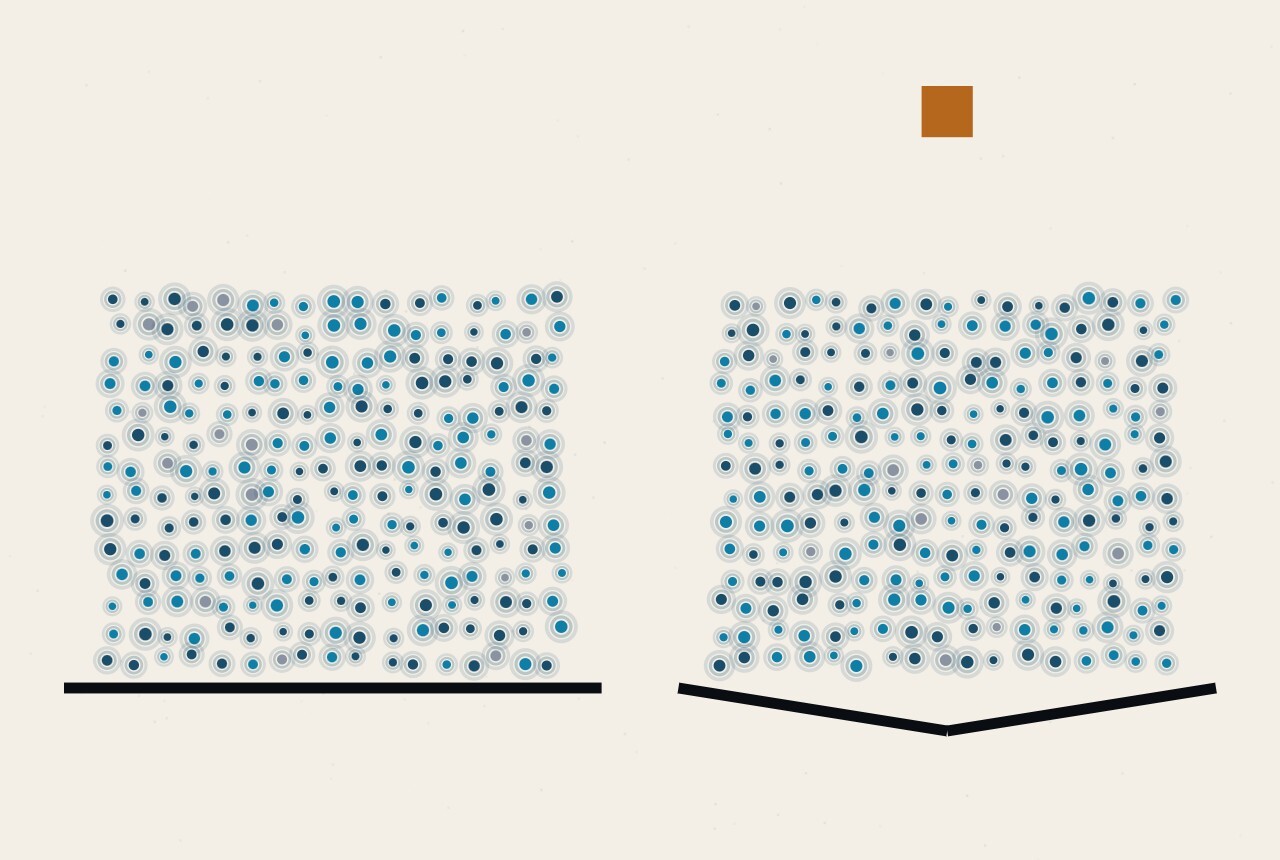
For healthy kidneys, the trials are reassuring. A 2018 meta-analysis of 28 randomised trials with 1,358 participants defined high protein as at least 1.5 grams per kilogram, 20% of energy or 100 grams a day. The change in kidney filtration rate was not significant, and neither dose, trial length, age nor diabetes explained any difference between trials.
Kidney disease is different. In people with chronic kidney disease, a pooled analysis of 19 randomised trials found that low-protein diets reduced progression to kidney failure (odds ratio 0.59). Anyone with reduced kidney function should set their protein target with a doctor, not from a population guideline.
Keeping intake where it should be
For most adults the floor is easy to reach, and many are already above the new range. The people most likely to fall short are older adults eating less overall, people cutting calories hard, and people recovering from illness. For them, spreading protein across meals from eggs, dairy, fish, meat, beans and soy is a reasonable way to reach 1.0 to 1.2 grams per kilogram.
For anyone wanting more muscle, the evidence points to training first and protein second. Going beyond about 1.6 grams per kilogram showed no further benefit in the pooled trials, and the powder at the top of the tablespoon table is a convenience, not a requirement.
Questions people ask
How much protein do I need a day?
The US recommended amount is 0.8 grams per kilogram of body weight. The 2025 to 2030 guidelines set a goal of 1.2 to 1.6 grams per kilogram, and older-adult groups recommend at least 1.0 to 1.2.
Is collagen or gelatin a good protein source?
It is high in protein by weight but lacks tryptophan, an essential amino acid, so it is a poor sole source.
Do protein supplements build muscle?
With resistance training, a little: about 0.3 kilograms of extra fat-free mass on average. Without training, trials in older adults found little or no effect.
Is a high-protein diet bad for the kidneys?
Not in healthy people, according to 28 randomised trials. People with existing kidney disease are the exception and should follow medical advice.
Is there a limit to how much protein I can absorb at once?
The old 20 to 30 gram rule is weaker than thought. A 2023 study found 100 grams produced a longer response than 25, though it did not compare spreading intake across meals.
The short version
- The recommended amount is 0.8 grams per kilogram a day. There is no upper limit.
- The 2025 to 2030 US guidelines raised the goal to 1.2 to 1.6 grams per kilogram. Many Americans already eat that much.
- Per tablespoon, soy isolate and gelatin lead — and gelatin contains no tryptophan.
- With resistance training, extra protein added about 0.3 kilograms of lean mass, with no further gain above about 1.6 grams per kilogram.
- In older adults who were not training, extra protein changed little.
- High intakes were safe for healthy kidneys; kidney disease is the exception.
This is a summary of published research, not medical advice. If you have kidney disease, diabetes, or another chronic condition, are pregnant, or are older and losing weight or strength, talk to your doctor or a registered dietitian before changing your protein intake or starting a supplement.
Further reading: Morton et al., British Journal of Sports Medicine 52(6):376–384 (2018), for the trial evidence on protein and training. Devries et al., Journal of Nutrition 148(11):1760–1775 (2018), on high protein and kidney function. The FAO’s 2013 report on dietary protein quality evaluation, for how protein quality is scored.
- Built to Move, Kelly and Juliet Starrett (2023). Ten physical habits for keeping mobility and strength with age, including a chapter on protein. Practical rather than academic, and it assumes the reader will actually train.
- How Not to Age, Michael Greger (2023). A long, heavily referenced survey of ageing research from a plant-based advocate. Read it for the sources, and weigh its conclusions against the trials above.
- Think Again, Adam Grant (2021). On revising what we thought we knew — relevant when a guideline changes in one direction and its critics push in the other.
Sources
National Academies of Sciences, Engineering, and Medicine, Dietary Reference Intakes, macronutrients summary table. — UC Davis Department of Nutrition, protein requirements information sheet. — Hoy MK, Clemens JC, Moshfegh AJ. Protein intake of adults. USDA ARS, WWEIA Data Brief 29 (2021). — Pedersen AN, Cederholm T. Food and Nutrition Research 58 (2014). — USDA FoodData Central, SR Legacy, nutrients 203 and 501; FDC identifiers are printed in the figure. — FAO. Dietary protein quality evaluation in human nutrition. Food and Nutrition Paper 92 (2013). — US Departments of Agriculture and Health and Human Services, Dietary Guidelines for Americans 2025–2030 (January 2026). — Harvard T.H. Chan School of Public Health, The Nutrition Source (9 January 2026). — Pasiakos SM, et al. Journal of Nutrition (2026), via American Society for Nutrition release. — Morton RW, Murphy KT, McKellar SR, et al. British Journal of Sports Medicine 52(6):376–384 (2018). — Bauer J, Biolo G, Cederholm T, et al. JAMDA 14(8):542–559 (2013). — Volkert D, et al. ESPEN practical guideline, Clinical Nutrition 41:958–989 (2022). — Bauer JM, Verlaan S, Bautmans I, et al. JAMDA 16:740–747 (2015). — ten Haaf DSM, Nuijten MAH, Maessen MFH, et al. American Journal of Clinical Nutrition 108(5):1043 (2018). — Campbell WW, et al. Journals of Gerontology A 78(S1):67 (2023). — Moore DR, Churchward-Venne TA, Witard O, et al. Journals of Gerontology A 70(1):57–62 (2015). — Trommelen J, van Lieshout GAA, Nyakayiru J, et al. Cell Reports Medicine 4(12):101324 (2023). — Devries MC, Sithamparapillai A, Brimble KS, et al. Journal of Nutrition 148(11):1760–1775 (2018). — Yan B, Su X, Xu B, et al. PLoS One (2018).