Swimming injuries, shoulders, and the lesson that changes the odds
Key takeaways · 9 min read
- Collegiate swimming and diving injure about 1.6 athletes per 1,000 exposures, the lowest rate of any NCAA sport; the shoulder is the usual site.
- Only four of twelve studies found training volume linked to shoulder pain. Volume matters, but it is not the whole answer.
- The serious risks are drowning and shallow-water diving, not the pool workout.
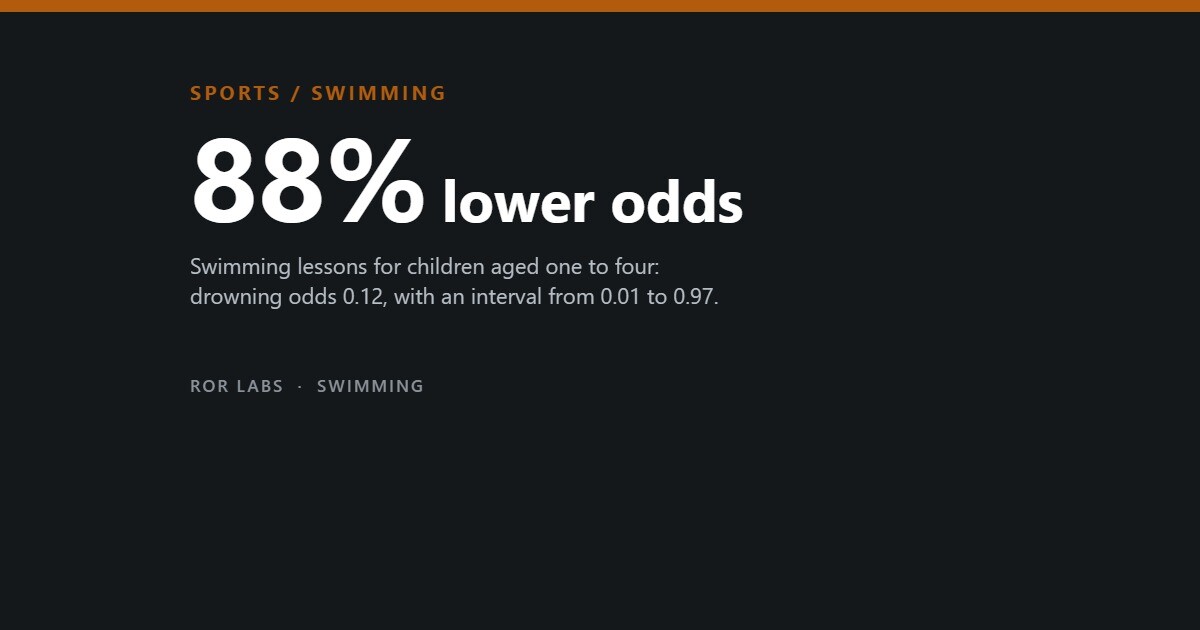
- Lessons for children aged one to four were associated with 88% lower drowning odds, with a very wide interval.
Swimming has the lowest injury rate of any sport the NCAA tracks. Collegiate swimmers and divers are hurt at about 1.6 injuries per 1,000 athlete-exposures, against a 25-sport average of 6.0 and a wrestling rate of 13.1. Most of what does happen is a sore shoulder.
The serious risk around water is a different one, and it mostly falls on people who are not training at all. About 4,000 Americans drown every year. Children aged one to four drown at a higher rate than any other age group, and more than half of American adults say they have never taken a swimming lesson.
This article follows the series format: what swimmers actually injure, where the risk concentrates, what has been measured to reduce it, and why the answer is not to stay out of the pool.
What actually gets injured
The best numbers come from the NCAA Injury Surveillance Program. Over five seasons from 2009-10 it recorded 149 injuries in men’s swimming and diving and 208 in women’s, rates of 1.54 and 1.71 per 1,000 athlete-exposures. The shoulder was the most common site, strains were the most common diagnosis, and most injuries were classed as overuse or non-contact. Nothing about that looks like the injury tables for football or basketball, where the cause is usually another body.
Injury rates across collegiate sports
NCAA injuries per 1,000 athlete-exposures, 2009-10 to 2013-14.
Source: CDC, MMWR 64(48) (2015); Kerr et al., British Journal of Sports Medicine (2015).
Two details inside those totals matter. Divers are hurt more often than swimmers: among women, 2.49 per 1,000 against 1.63, a rate ratio of 1.53. And women swimmers had more overuse injuries than men, 1.04 against 0.66 per 1,000. A later five-season update found the same shape again, with the shoulder accounting for a third of women’s swimming injuries and head or face injuries leading among women divers.
Divers, swimmers and overuse
NCAA injuries per 1,000 athlete-exposures, 2009-10 to 2013-14.
Source: Kerr et al., British Journal of Sports Medicine (2015). Women divers against swimmers, rate ratio 1.53 (1.07–2.19); men 1.33 (0.85–2.31), not significant.
High school figures are lower still. A national surveillance system counted 563 swimming and diving injuries across 2.17 million athlete-exposures between 2008 and 2019, a rate of 0.26 per 1,000. Girls were injured about one and a half times as often as boys.
When the risk concentrates
For competitive swimmers the obvious suspect is volume. A distance swimmer can make tens of thousands of arm strokes a week, and “swimmer’s shoulder” is part of the vocabulary of the sport. The expectation is that more yards mean more pain.
The evidence is less tidy than the expectation. A 2020 systematic review looked for studies that measured both training volume and shoulder pain in competitive swimmers. It found twelve, and only four reported a significant relationship. Among the youngest competitive swimmers, none did. One imaging study of adolescents did find that hours in the water and weekly distance tracked supraspinatus tendinopathy closely. Volume is part of the story. It is not the whole of it, and nobody has shown a training ceiling that reliably prevents the problem.
Outside competition, the risk concentrates somewhere else entirely. Diving into shallow water is the leading cause of spinal cord injury among aquatic activities. A classic Californian series found that those injured were mostly men aged 15 to 19, that 45% of cases involved rivers or streams, 27% pools and 28% lakes or the sea, and that 60% were tetraplegic on arrival at hospital. The most common X-ray finding was a wedge fracture of the neck, which the authors read as violent forward bending of the neck; most of the injured showed no sign of having struck the bottom at all. The injuries cluster in summer and at weekends. Later reviews add a strong association with alcohol.
Drowning concentrates by age and by who had the chance to learn. The CDC counted about 4,000 unintentional drownings a year, and the rate rose after 2019, by 10 to 14% in 2020 and 2021. Among children aged one to four, deaths in 2021 and 2022 ran about 28% above the 2019 level, reaching 3.1 per 100,000. Rates were highest among American Indian, Alaska Native and Black Americans, and about a third of Black adults said they could not swim, against 6.9% of white adults.
Unintentional drowning in the United States
Deaths per 100,000 people, before and after the pandemic.
Source: CDC, Vital Signs, MMWR 73(20) (2024).
What has been measured to work
There is no randomised trial showing that swimming lessons prevent drowning, and there probably never will be; nobody can ethically assign children to go without. The best evidence is a case-control study published in 2009.
Swimming lessons and childhood drowning
Case-control study of drownings in six US states, 2003 to 2005.
Drowned: 2 of 61 had had formal lessons (3%)
Controls: 35 of 134 (26%)
Adjusted odds ratio 0.12
95% interval 0.01 to 0.97
Drowned: 7 of 27 had had formal lessons
Too few cases for a firm estimate
No clear conclusion
The authors called for larger studies
Source: Brenner et al., Archives of Pediatrics and Adolescent Medicine 163(3):203–210 (2009).
The headline figure, 88% lower odds, is real and was widely reported. So is its weakness. The interval runs from 0.01 to 0.97, which means the data are consistent with almost total protection and with almost none. It rests on 61 drownings. The authors were explicit that lessons are one layer among several, alongside fencing, supervision and resuscitation training, and not a replacement for any of them.
Pool fencing has the most consistent evidence of any drowning measure. Reviews of case-control studies put the protection from a four-sided fence, one that separates the pool from the house as well as the street, at about 73%. Three-sided fences, where the house forms the fourth wall, carried almost twice the drowning risk of four-sided ones. The distinction is the whole point: most young children who drown in home pools got there from the house.
Which makes one negative study instructive. When researchers examined local pool-fencing ordinances in Los Angeles County between 1990 and 1995, they found no association with the childhood drowning rate. Their explanation was not that fences fail. They pointed to building codes that did not isolate pools from homes, weak enforcement, and fencing that was poorly maintained or left open. A rule that permits the wrong fence measures the rule, not the fence.
For the shoulder, the evidence is thinner. Programmes of rotator cuff strengthening and stroke correction are widely used, but there is no large randomised trial showing that they reduce injury in swimmers. It is honest to say so.
Why the answer is not to stop
Swimming may be one of the healthiest things an adult can do. In a British cohort of 80,306 adults followed for about nine years, people who swam had 28% lower mortality from all causes and 41% lower cardiovascular mortality than those who did not. A 2024 meta-analysis of longitudinal studies put the reduction in all-cause mortality at 24%, a hazard ratio of 0.76.
Swimming and mortality
Hazard ratios for death against people who did not take part. Below 1.00 means lower risk. Observational studies.
Source: Oja et al., British Journal of Sports Medicine 51(10):812–817 (2017); Oja et al., Sports Medicine – Open 10:46 (2024), 0.76 (0.63–0.92). n.s. = not statistically significant.
Both figures come from observational studies, and the authors of the British cohort said plainly that no firm conclusions about cause and effect could be drawn. People who swim may differ from those who do not in ways the analysis could not fully capture. Swimming is also one of the few vigorous forms of exercise that rarely triggers asthma, which is why it is often recommended for children who have it. But the injury side of the ledger is unusually light: a rate a quarter of the collegiate average, dominated by overuse rather than trauma, and almost never catastrophic in the pool itself.
The catastrophic risks sit at the edges of the sport, and they are the ones that are most changeable. A shallow-water dive is a decision. A pool with four-sided fencing is a design choice. And more than half of American adults, 54.7%, have never had a lesson, while 15.4% say they cannot swim. That is not a reason to keep people away from water. It is the gap the evidence says to close.
Questions people ask
Is swimming safe for my shoulders?
For recreational swimmers, overwhelmingly yes. Shoulder pain is common in competitive swimmers training large volumes, and even there the link to volume is inconsistent. Persistent pain deserves assessment by a physiotherapist or sports physician.
At what age should children learn to swim?
The strongest data are for children aged one to four, where lessons were associated with lower drowning risk. Lessons do not make a child drown-proof, and supervision and fencing still apply. For older children the study was too small to say either way.
Is diving into a pool dangerous?
Diving into the deep end of a properly designed pool is low risk. The spinal cord injuries come from diving into shallow or unknown water, often rivers and lakes, often after drinking.
Are divers at higher risk than swimmers?
Yes, somewhat. Collegiate women divers were injured about one and a half times as often as swimmers, with more head, face and trunk injuries.
Is it too late to learn as an adult?
No. The CDC’s own recommendation is basic swimming and water-safety skills training, particularly for groups who never had access to it.
The short version
- Collegiate swimming and diving injure about 1.6 athletes per 1,000 exposures, the lowest rate of any NCAA sport; the shoulder is the usual site.
- Only four of twelve studies found training volume linked to shoulder pain. Volume matters, but it is not the whole answer.
- The serious risks are drowning and shallow-water diving, not the pool workout.
- Lessons for children aged one to four were associated with 88% lower drowning odds, with a very wide interval.
- Four-sided pool fencing is the best-supported measure. Rules that allow three-sided fences did not work.
- Swimmers had 24 to 28% lower all-cause mortality in cohort studies. Learning to swim is the gap to close.
This is a summary of published research, not medical or water-safety advice. It does not replace supervision of children around water, qualified swimming instruction, or assessment of persistent pain by a doctor or physiotherapist. If someone is in difficulty in the water, call emergency services.
Further reading: Brenner et al., Archives of Pediatrics and Adolescent Medicine 163(3):203–210 (2009), for the lesson study and its caveats. Feijen et al., Journal of Athletic Training 55(1):32–41 (2020), for what is and is not known about training volume and shoulder pain. Kerr et al., British Journal of Sports Medicine (2015), for the collegiate injury data.
- Why We Swim, Bonnie Tsui (2020). A journalist’s account of why people take to the water, from survival to competition. Affectionate rather than analytical, which is the right counterweight to an injury article.
- How Minds Change, David McRaney (2022). On why people act on some safety evidence and ignore the rest — relevant to fences left open and lessons never taken.
- Radical Uncertainty, John Kay and Mervyn King (2020). On deciding well when the numbers are thin, as they are for most drowning-prevention measures.
Sources
Centers for Disease Control and Prevention, MMWR 64(48) (2015), NCAA injury rates by sport, 2009-10 to 2013-14. — Kerr ZY, Baugh CM, Hibberd EE, et al. Epidemiology of NCAA men’s and women’s swimming and diving injuries from 2009/10 to 2013/14. British Journal of Sports Medicine, doi:10.1136/bjsports-2014-094423 (2015). — Chandran A, Morris SN, D’Alonzo BA, et al. Journal of Athletic Training 56(7):711 (2021). — Belilos EA, Jow S, Maxwell MD. Descriptive epidemiology of high school swimming and diving injuries (2023). — Feijen S, Tate A, Kuppens K, Claes A, Struyf F. Journal of Athletic Training 55(1):32–41 (2020). — Kewalramani LS, Kraus JF. Acute spinal-cord lesions from diving. Western Journal of Medicine (1977). — Centers for Disease Control and Prevention. Vital signs: drowning death rates, self-reported swimming skill, swimming lesson participation. MMWR 73(20) (2024). — Brenner RA, Taneja GS, Haynie DL, et al. Archives of Pediatrics and Adolescent Medicine 163(3):203–210 (2009). — Thompson DC, Rivara FP. Pool fencing for preventing drowning in children. Cochrane Database of Systematic Reviews (2000). — Morgenstern H, Bingham T, Reza A. American Journal of Public Health 90(4):595–601 (2000). — Oja P, Kelly P, Pedisic Z, et al. British Journal of Sports Medicine 51(10):812–817 (2017). — Pollack KM, Kercher C, Frattaroli S, et al. Health and Place (2012), on swimming and asthma. — Oja P, et al. Health benefits of different sports. Sports Medicine – Open 10:46 (2024).