Climbing growth plate fractures, the teenage finger injury that passes for a sprain
Key takeaways · 10 min read
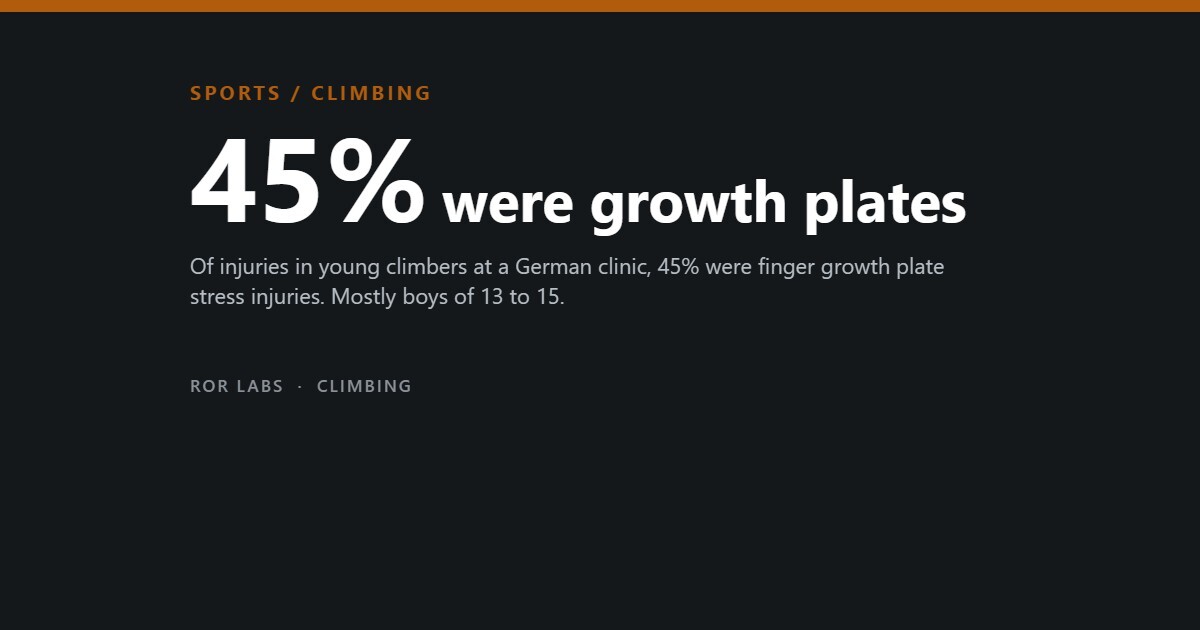
- In a German referral clinic, 45.3% of 137 climbing injuries in under-18s were stress injuries to a finger growth plate, usually at the base of the middle bone of the middle finger.
- Cases cluster in the growth spurt, around 13 to 15, and mostly in boys, who in one series waited more than twice as long as girls to see a doctor.
- Early injuries can be invisible on X-ray, and many young competitors mistake the injury for an adult-style pulley tear.
- With six to eight weeks off climbing, most heal; in one algorithm study all 37 injuries healed and nine needed surgery.
Between 2017 and 2020 a German sports medicine clinic that acts as a national and international referral centre for climbing injuries recorded every patient under 18 who came in with pain from climbing. Of 137 injuries, 62, or 45.3%, were the same thing: a stress injury to the growth plate of a finger. Ankle sprains, the classic gym accident, made up 5.1%. The results, published in 2025, show how differently teenagers get hurt.
Adults who overload their fingers tend to damage the pulleys that hold the tendons against the bone. In teenagers the weak point is the growth plate, the layer of cartilage near the end of a bone where it lengthens. The typical failure is at the base of the middle bone of the middle finger: a crack that runs from the growth plate into the joint surface, known as a Salter-Harris type III fracture. It builds up over weeks of loading, not in one fall.
This article covers what the injury is, who gets it and why it is so often missed, what treatment achieves, what climbing bodies advise and how little of that advice has been tested, and why the answer for a young climber with sore fingers is to climb carefully rather than to stop. It is written for parents and coaches as much as for climbers, now that climbing has been an Olympic sport since the Tokyo Games of 2021.
What actually happens in a young climber’s finger
The first larger series came from Germany in 2005. Doctors described 24 young climbers with fractures at the back of the base of the middle phalanx, the middle bone of the finger. Their average age was 14.5 and 23 were boys. Twenty had the Salter-Harris III pattern and four a slip of the growth plate. None could recall an acute injury, so the authors classed every case as a fatigue fracture caused by repetitive stress.
The grip seems to matter. In a 2016 questionnaire study of 18 injured adolescents with 22 affected fingers, 95% of the fingers were middle fingers and 64.3% of the injuries happened in a crimp, the grip in which the middle joint bends sharply while the fingertip joint is pushed straight. Half happened during bouldering competitions, and every climber was within the year of their fastest growth.
Who gets it, and in which finger
Shares from four clinical case series of adolescent climbers with finger growth plate stress injuries. Each series is small, and all come from specialist clinics.
Sources: Hochholzer & Schöffl, Wilderness & Environmental Medicine (2005); Schöffl & Schöffl, European Journal of Sports Medicine (2016); Bärtschi et al., Hand Surgery and Rehabilitation (2019); Schöffl et al., BMJ Open Sport & Exercise Medicine (2025).
Not every painful growth plate is broken. A Swiss clinic followed 28 young climbers treated between 2006 and 2018, with 67 painful fingers between them: 54% had a fracture visible on imaging and 46% a symptomatic “sprain” of the growth plate that could, the authors warned, progress to a fracture. In the 2025 German series, 15 of the 62 injuries were stress reactions with swelling on MRI but no fracture line.
Where the risk concentrates
The risk sits in a narrow window of growth. The UIAA Medical Commission, the medical body of the international mountaineering federation, places the adolescent growth spurt at around 13 to 15 and says the fingers stop growing at around 16 to 17. The American Orthopaedic Society for Sports Medicine gives a peak of about 11 to 14 for girls and 12 to 16 for boys, adding that the injury can occur up to 18. Every case series is dominated by boys: 23 of 24 in 2005, and 46 of the 62 growth plate injuries in the 2025 surveillance study, a significant difference.
Boys also waited longer. In the 2025 study they saw a doctor a mean of 26.5 days after their pain began, against 11.6 days for girls. Their breaks from climbing lasted 76.8 days against 38.4, and their pain lasted 174 days against 104. The authors could not explain the gap from their data. They suggested that boys may climb in a more strength-based style and may be more likely to ignore pain, a hypothesis they did not test.
What brought young climbers to a specialist clinic
Adolescent climbers seen at a German referral centre, 2017–2020: 137 injuries in 95 patients. The last two pairs compare the share of finger and shoulder injuries with an all-age series of 633 climbing injuries from the same centre in 2017–2018.
Source: Schöffl et al., BMJ Open Sport & Exercise Medicine 11(1):e002212 (2025), Box 1 and Table 4. A referral centre sees more chronic injuries than an emergency department.
The injury is easy to miss. Early stress fractures are often invisible on plain X-rays, and reading them on MRI needs thin, angled slices. Young climbers may not suspect it either: at the 2017 US youth national championships, 35.5% of 267 competitors named the pulley tear, an adult injury, as the commonest youth injury, and only 15.0% named the growth plate. Of those who reported a pulley injury, 82% said they were uninformed about growth plate injuries. As our earlier article on climbing injuries showed, pulley tears are the adult problem.
The numbers also have a denominator problem. Every series comes from specialist clinics, so nobody knows how many young climbers in a given gym are affected. A 2025 classification paper counted 107 published cases, 84 in boys; another 2025 paper said more than 200. A widely repeated claim of a 600% rise in a decade traces back to a climbing coach’s training blog, cited as 2017, quoting a clinician; no study is given. And in the 2025 surveillance study, neither weekly training hours nor campus board use was significantly linked to the injury.
What has been measured to work
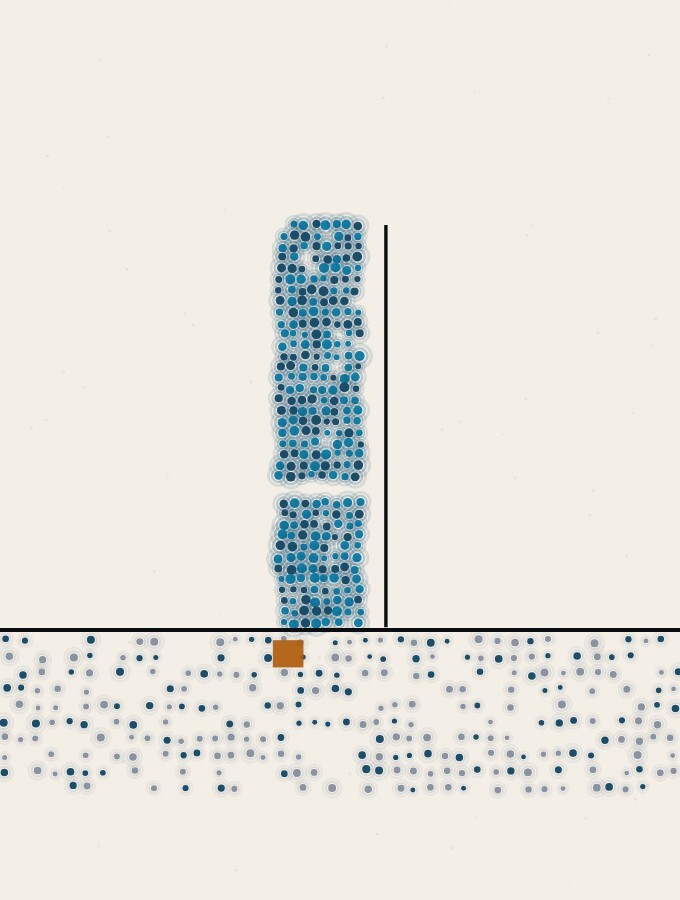
Treatment rests mainly on rest. A 2022 critical review by climbing medicine researchers advised stopping all climbing for about six to eight weeks while keeping up general fitness, with a resting splint for the first two to three weeks in more severe cases. Climbing-specific training should resume only after imaging shows healing, the finger moves fully without pain and a clinician has given clearance. In a small MRI study of seven climbers, follow-up scans after six or twelve weeks off showed healing in every finger.
The best outcome data come from a German treatment algorithm tested in 27 climbers with 37 injuries over four years. Twenty-eight injuries were treated without surgery and nine with surgery, used when CT showed hardened bone along the fracture line, a sign that it would not heal on its own. All healed and none recurred. The mean time from starting treatment to returning to the sport was 40 days, with wide variation. A Swiss series measured something else: radiological union took a mean of 35 weeks.
Results of a treatment algorithm
Thirty-seven finger growth plate stress injuries in 27 adolescent climbers (mean age 14.7), treated by a staged algorithm at German centres over four years. A case series without a comparison group.
Source: Schöffl et al., American Journal of Sports Medicine (2021), doi:10.1177/03635465211056956; percentages calculated from the counts in the abstract.
Prevention advice is consistent, if untested. The British Mountaineering Council, with approval from the UIAA Medical Commission, advises climbers under 18 not to campus, climbing a board of wooden rungs with the hands alone, either feet-off or dynamically. A UIAA factsheet says not to increase finger-strengthening exercises during the growth spurt. The American orthopaedic society advises no double-dyno campusing until 18 or until the growth plates close, no added weight on hangboards and checking height and weight every three months from 9 to 18.
What young competition climbers knew
Survey of 267 climbers aged 8 to 18 at the 2017 USA Climbing Sport and Speed Youth National Championships. Self-reported answers.
Source: Meyers et al., International Journal of Environmental Research and Public Health 17(3):812 (2020). Funded by a University of Colorado undergraduate research programme; no conflicts declared.
No trial has tested whether any of this advice prevents fractures. The guidance rests on case series, biomechanics and expert opinion, and the first structured return-to-climbing protocol for these injuries appeared only in 2020. A study registered in 2026 is using expert consensus to build a screening tool for coaches and parents; the registration notes that no validated tool exists yet. The simplest rule in current guidance concerns pain: finger pain that lasts more than a day, or keeps coming back for over a week, means stopping and seeing a professional.
Why the answer is not to stop climbing
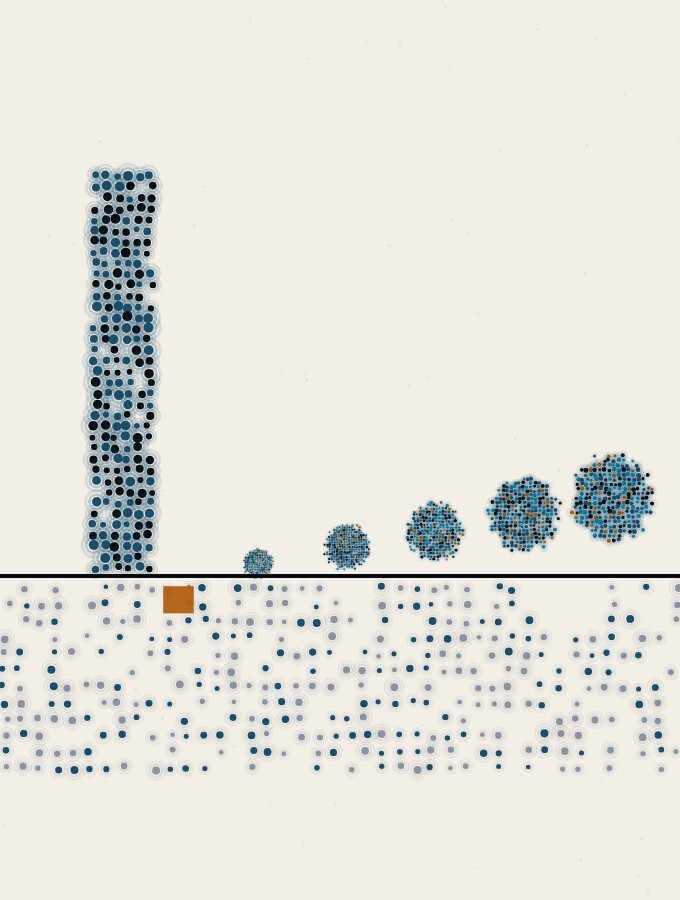
Caught early and rested, the injury usually heals well. In the 2016 German series, every injured adolescent regained full finger function with rest; the one who was left with lasting damage had kept climbing. In an 11-year follow-up of young German climbers, the two epiphyseal fractures found in 1999 had both healed completely, with no later abnormalities on X-ray. The pattern in all these series is that the harm comes from loading a damaged growth plate, not from climbing itself.
Hard training in the teenage years may still leave marks. The same follow-up re-examined 15 former members of the German junior national team and 13 recreational climbers at a mean age of about 27, after 11 years. Early osteoarthritis appeared in 27% of the former team climbers and 15% of the recreational group. Total years of training, climbing grade and campus board use in 1999 were linked to it. The groups were small, and most of these climbers, 79%, were still climbing.
Former junior climbers, 11 years later
Re-examination in 2011–2013 of climbers first X-rayed in 1999: 15 former German junior national team members and 13 recreational climbers, mean age about 27 at follow-up.
Source: Schöffl et al., Orthopaedic Journal of Sports Medicine (2018), doi:10.1177/2325967118792847. Observational; follow-up rate 76%.
Climbing carefully as a teenager means building volume slowly, favouring open-hand grips over hard crimps, leaving campus boards and weighted hangboarding until growth has finished, and treating swelling over the middle knuckle as a reason to see someone rather than to tape up. The 2022 review recommends routine monitoring of training load during the growth spurt. The authors of the US survey were explicit that they did not want to discourage young climbers, writing that the sport’s benefits largely outweigh the risks.
What to do
Steps sorted by when they matter. Each one says how strong the evidence is: Measured Official advice Untested
Before
- Leave campus boarding (feet-off or dynamic) and weighted hangboarding until growth has finished. British and US guidance both set 18 as the line. Measured see Sources
- Build climbing volume slowly during the growth spurt, around 13 to 15, and keep a simple log of training load. Official advice see Sources
If it happens
- Favour open-hand grips over hard crimps. In one series 64.3% of growth plate injuries began in a crimp. Measured see Sources
- Stop finger-intensive climbing if a finger hurts for more than a day or the pain keeps coming back for over a week. Official advice see Sources
Afterwards
- See a doctor or physiotherapist familiar with climbing about swelling or pain over the middle finger joint. Early stress injuries may not show on a plain X-ray. Measured see Sources
- Expect about six to eight weeks off climbing if a growth plate injury is confirmed, then a gradual return only after a clinician clears it. Measured see Sources
What not to do
- Do not tape up a sore teenage finger and keep climbing. In one series the only climber left with lasting damage had kept climbing. Official advice see Sources
Not medical advice. If a young climber has finger pain lasting more than a day or swelling over a finger joint, stop finger-intensive climbing and see a doctor or physiotherapist.
Questions people ask
Is a finger growth plate injury just a sprain?
It can look like one, with a swollen, sore middle knuckle and no memorable injury. In young climbers, pain on the back of the middle finger joint should be checked for a growth plate stress injury, because a fracture treated as a sprain can keep being loaded.
Does a normal X-ray rule it out?
Not always. Early stress injuries may not show on plain X-rays. Specialists use MRI, ultrasound or CT when the history and examination suggest the injury.
At what age is campus board training safe?
British guidance, approved by the UIAA Medical Commission, says no feet-off or dynamic campusing under 18. US orthopaedic guidance says no double-dyno campusing until 18 or until the growth plates have closed.
How long will it take to climb again?
It varies widely. A review advises six to eight weeks off climbing for most cases, then a gradual return; in one Swiss series, load reduction lasted three to twelve months. More severe or late-diagnosed cases may need surgery.
Will it cause arthritis later?
Most treated fractures heal without lasting change. Small follow-up studies link years of intensive finger training, including campus boarding, to early arthritis signs, but the numbers are small.
The short version
- In a German referral clinic, 45.3% of 137 climbing injuries in under-18s were stress injuries to a finger growth plate, usually at the base of the middle bone of the middle finger.
- Cases cluster in the growth spurt, around 13 to 15, and mostly in boys, who in one series waited more than twice as long as girls to see a doctor.
- Early injuries can be invisible on X-ray, and many young competitors mistake the injury for an adult-style pulley tear.
- With six to eight weeks off climbing, most heal; in one algorithm study all 37 injuries healed and nine needed surgery.
- Guidance says no dynamic campus boarding under 18 and to stop for finger pain lasting over a day. None of it has been tested in a trial.
This is a summary of published research, not medical advice. If a young climber has finger pain that lasts more than a day, keeps coming back, or comes with swelling over a finger joint, stop finger-intensive climbing and see a doctor or physiotherapist, ideally one familiar with climbing injuries.
Further reading: Schöffl et al., BMJ Open Sport & Exercise Medicine (2025), for the prospective clinic series. Jones et al., Current Sports Medicine Reports (2022), for diagnosis and management. Meyers et al., Current Sports Medicine Reports (2020), for a staged return-to-climbing protocol.
Sources
- Schöffl VR, Schöffl I, Jones G, Klinder A, Küpper T, Gunselmann L, et al. Prospective analysis of injury demographics, distribution, severity and risk factors in adolescent climbers. BMJ Open Sport & Exercise Medicine 11(1):e002212 (2025), doi:10.1136/bmjsem-2024-002212.
- Hochholzer T, Schöffl VR. Epiphyseal fractures of the finger middle joints in young sport climbers. Wilderness & Environmental Medicine (2005).
- Schöffl I, Schöffl V. Epiphyseal stress fractures in the fingers of adolescents: biomechanics, pathomechanism, and risk factors. European Journal of Sports Medicine (2016).
- Bärtschi N, Scheibler AG, Schweizer A. Symptomatic epiphyseal sprains and stress fractures of the finger phalanges in adolescent sport climbers. Hand Surgery and Rehabilitation (2019), doi:10.1016/j.hansur.2019.05.003.
- Schöffl V, Iruretagoiena X, Nelson T, Miro P. Proposal of a specific classification of primary periphyseal stress injuries in adolescent rock climbers. Frontiers in Sports and Active Living (2025), doi:10.3389/fspor.2025.1596624. One author declared employment by Camp4 Human Performance.
- UIAA Medical Commission. Factsheet on sport climbing. theuiaa.org (undated).
- American Orthopaedic Society for Sports Medicine, STOP Sports Injuries. Rock climbing tip sheet, reviewed September 2025.
- Meyers RN, Hobbs SL, Howell DR, Provance AJ. Are adolescent climbers aware of the most common youth climbing injury and safe training practices? International Journal of Environmental Research and Public Health 17(3):812 (2020).
- Hörst E. Reducing risk of growth plate fractures in youth climbers. Training for Climbing (first published December 2019, updated 2023); Meyers R. Perceptions regarding finger injuries and safe training practices in elite, adolescent rock climbers. University of Colorado thesis (2018).
- Jones G, Johnson R, Schöffl V, Schöffl I, Lutter C, Johnson MI. Primary periphyseal stress injuries of the fingers in adolescent climbers: a critical review. Current Sports Medicine Reports (2022), doi:10.1249/JSR.0000000000001016.
- Bayer T, Schöffl VR, Lenhart M, Herold T. Epiphyseal stress fractures of finger phalanges in adolescent climbing athletes: a 3.0-Tesla magnetic resonance imaging evaluation. Skeletal Radiology (2013), doi:10.1007/s00256-013-1694-4.
- Schöffl V, Schöffl I, Flohé S, El-Sheikh Y, Lutter C. Evaluation of a diagnostic-therapeutic algorithm for finger epiphyseal growth plate stress injuries in adolescent climbers. American Journal of Sports Medicine (2021), doi:10.1177/03635465211056956.
- British Mountaineering Council. Campus boards: guidance on use (approved by the UIAA Medical Commission). thebmc.co.uk.
- Meyers RN, Schöffl V, Mei-Dan O, Provance AJ. Returning to climb after epiphyseal finger stress fracture. Current Sports Medicine Reports (2020), doi:10.1249/JSR.0000000000000770.
- Liggett C. Development of a risk screening tool for finger epiphyseal stress injury in youth competitive climbers: a modified Delphi consensus study. Open Science Framework registration (2026), osf.io/2jd8w.
- Schöffl V, Hoffmann PM, Imhoff AB, Küpper T, Schöffl I, Hochholzer T. Long-term radiographic adaptations to stress of high-level and recreational rock climbing in former adolescent athletes: an 11-year prospective longitudinal study. Orthopaedic Journal of Sports Medicine (2018), doi:10.1177/2325967118792847.