Car Theft: What the Evidence Shows
Key takeaways · 13 min read
- Car theft fell by roughly two-thirds in England and Wales from 1995 to 2008 and by about 80% in the United States from 1990 to 2020. The best-supported explanation is better security, above all the electronic engine immobiliser.
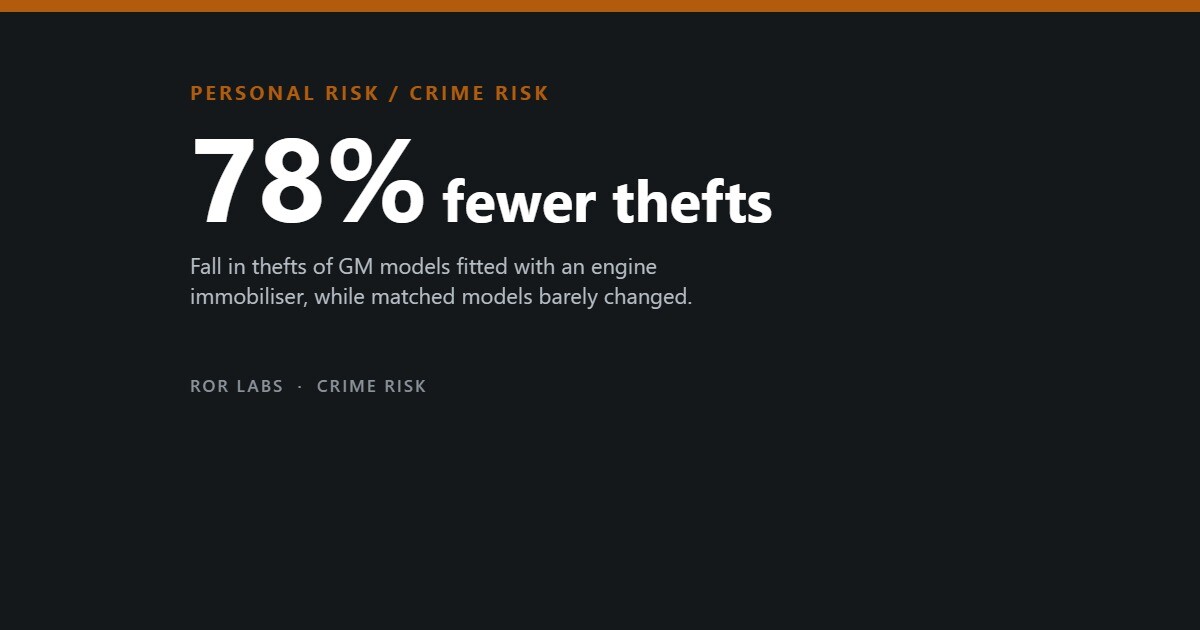
- When General Motors fitted an immobiliser to some models, their theft rate fell 78% while matched models without one barely moved.
- Hyundai and Kia models sold without immobilisers drove a US surge to 1,020,729 thefts in 2023. A software fix cut theft claims on upgraded cars by 53%, and national thefts fell to 659,880 in 2025.
- Keyless relay theft is real, but its share is uncertain: survey estimates in England and Wales range from 14% to 58% of thefts, the higher figure resting on 52 incidents.
In 2023 the National Insurance Crime Bureau counted 1,020,729 stolen vehicles in the United States, the second year running above a million. Two years later the figure was 659,880, a fall of more than a third. Much of that rise, and part of the fall, traces back to a small electronic part that some cars had and others did not.
That part is the engine immobiliser, a chip in the key that the car must recognise before the engine will run. Criminologists credit it with much of the long decline in car crime on both sides of the Atlantic. The same research shows that every lock eventually meets a thief who studies it, so the story is less a straight line than a series of moves and countermoves.
This article looks at why car theft fell, why it spiked in the United States, how keyless and electronic methods work, what relay-theft figures can and cannot tell us, what is known about signal-blocking pouches and recovery, and why Japan’s figures point two ways at once.

A thirty-year fall
From the 1990s car theft fell steadily for decades. In England and Wales vehicle-related theft fell by about two-thirds (65%) between 1995 and 2008, according to the British Crime Survey. In the United States both police records and the national victim survey show vehicle theft falling by about 70% from 1991 to 2008.
In 2011 Graham Farrell, Nick Tilley and colleagues set out what they called the security hypothesis: that crime fell largely because there were fewer easy opportunities, and that better vehicle security was the clearest case. In a companion paper, Farrell, Tseloni and Tilley compared the security fitted to victims’ cars with the security fitted to cars in general, using six years of British Crime Survey data covering more than 22,000 cases. The result was a “security protection factor”, how many times less likely a car was to be stolen than one with no security at all.
How much less likely a car was to be stolen, by security fitted
Security protection factor: times less likely to be stolen than a car with no security. England and Wales, 2001–2007.
Source: Farrell G, Tseloni A, Tilley N, Criminology & Criminal Justice (2011), doi:10.1177/1748895810392190. British Crime Survey data; the authors note the figures may slightly overstate protection.
The immobiliser was the strongest single device, and combinations did better than the sum of their parts. The effect was much larger against theft of a car than theft from a car, as expected if the immobiliser was doing the work: it stops a car being driven away, not a window being broken. The paper’s headline “SPF 25” came from two configurations the authors themselves flagged as uncertain, so the 15 to 19 range is the safer reading.
What the immobiliser did
Survey comparisons cannot rule out that owners of well-protected cars also park in safer places. Stronger evidence comes from natural experiments.
The clearest American case comes from General Motors. From 1986 it fitted its PASS-Key immobiliser to certain models, and federal records kept under a 1984 anti-theft law allowed a matched comparison group of similar cars without it. In a study published in Security Journal, Farrell analysed 141,385 thefts in those records from 1983 to 1995. Theft of the immobilised models fell 78% between the late 1980s and the early 1990s. Theft of the matched models fell 4%.
The PASS-Key experiment
Change in average theft rate between 1983–1988 and 1992–1995.
Source: Farrell G, Security Journal, doi:10.1057/s41284-024-00452-2, using NHTSA industry data from the Federal Register. The comparison group was matched, not identical.
European evidence points the same way. The European Union made immobilisers compulsory on new cars from the late 1990s; in the UK the rule applied from October 1998. Using that mandate as a natural experiment, the economists Jan van Ours and Ben Vollaard estimated in the Economic Journal that the device reduced car theft by about 40% overall, after allowing for thieves switching to cars without one. They calculated that 34 cars had to be fitted, at about 50 euros each, to prevent one theft. A review by Rick Brown of 16 studies from the UK, Germany, Australia and the United States found that 15 showed immobilisers had reduced theft.
The review also found limits. Reductions were largest for joyriding-type thefts, where the car is later found, and smaller for permanent thefts by professionals. Some theft moved to cars without immobilisers, though the overall fall outweighed it.
The cars left without one

Unlike the European Union, the United States never made immobilisers compulsory, but by the 2010s almost every new car sold there had one. Hyundai and Kia were the exception. According to the Highway Loss Data Institute, which analyses US insurance claims, only 17% of 2011 Hyundai and Kia models had an immobiliser as standard, against 92% of other brands. Even among 2022 models the figures were 84% and 96%.
Around 2022, videos showing how to steal these cars spread on TikTok and YouTube, and thefts rose fast. In the first half of 2023, the institute found theft claims for Hyundai and Kia vehicles running at 11.2 per 1,000 insured vehicle years, nearly seven times the rate for other makes. For 2015 to 2019 models the gap was more than threefold.
Immobiliser fitted as standard, by brand and model year
Share of vehicles in each group with an electronic immobiliser as standard equipment, United States.
Source: Highway Loss Data Institute, reported by Carrier Management, 12 August 2024. Immobilisers became standard on all 2023 Hyundai and Kia models.
The manufacturers released a software update from February 2023 that makes the car start only when the real key is in the ignition. By December 2023 the institute found theft claims 53% lower on upgraded cars than on those not yet updated, and whole-vehicle thefts 64% lower. That is a strong result, though it compares upgraded cars with those not yet upgraded, and owners who sought the update quickly may differ in other ways.
The national numbers followed. The National Insurance Crime Bureau counted 1,008,756 thefts in 2022 and 1,020,729 in 2023, then 850,708 in 2024, a 17% fall it called the largest annual drop in 40 years, and 659,880 in 2025, a further 23% fall. Even so, the Hyundai Elantra and Sonata were still among the three most stolen models in 2025.
US vehicle thefts, peak and decline
Vehicles reported stolen in the United States, in thousands.
Source: National Insurance Crime Bureau news releases, 9 April 2024, 18 March 2025, 18 March 2026 and 30 September 2026. The 2026 figure covers six months.
How much of the surge was caused by social media is disputed. A 2026 study in the International Journal of Forecasting by Jeffrey Brantingham and colleagues found that the rise in Hyundai Sonata thefts in Los Angeles began during the pandemic lockdowns, before the viral videos, and was only weakly tied to them. Its model suggests the preference for these cars could last for decades. A 2026 preprint by Farrell and John Roman, not yet peer reviewed, found that US vehicle theft rose 40% between 2020 and 2024 and estimated more than 1.1 million excess thefts by the end of 2024 linked to Hyundai and Kia cars without immobilisers.
Keys that never leave the house
Keyless entry lets a driver open and start a car while the key stays in a pocket. The car sends out a short-range radio challenge and the key answers. In 2011 Aurélien Francillon, Boris Danev and Srdjan Čapkun showed that a pair of cheap relays could extend that conversation. Across 10 car models from eight manufacturers, they could open and start cars while the real key was up to 50 metres away, without line of sight. Encryption did not help, because the relay simply passes the genuine signal along.
How often thieves use this is harder to pin down than headlines suggest. The Crime Survey for England and Wales asks victims how the thief got in. An analysis of that survey by the law firm RTA Law, reported in 2025, found that 14% of thefts in 2019 involved manipulating the key’s signal. The Home Office cited 40% for 2022/23. RTA Law’s figure for 2023/24 was 58%, but it rested on just 52 incidents in the survey sample.
What share of thefts involve keyless signals?
Different sources, different samples. None is a precise national rate.
| Source | Period | What it measures | Share |
|---|---|---|---|
| Crime Survey for England and Wales | 2019 | Thefts where signals were manipulated | 14% |
| Crime Survey, cited by the Home Office | 2022/23 | Same question | 40% |
| Crime Survey, analysed by RTA Law | 2023/24 | Same question, 52 incidents | 58% |
| Metropolitan Police estimate | Recent | London thefts using electronic devices | About 60% |
| Tracker, a recovery firm | 2019 | Its recovered cars taken without the owner’s keys | 92% |
Sources: Auto Express, 2 May 2025 (RTA Law analysis of CSEW); Home Office, 24 February 2025; Tracker. Tracker’s figure covers only cars fitted with its tracking device, not the fleet as a whole.
Each number answers a different question. Victims may not know how their car was taken. Tracking-company figures describe the cars that have trackers. Insurers see claims, not crimes. The direction is clear: signal-based theft has grown as keyless cars have spread. The exact share is not.
Overall numbers are falling: police in England and Wales recorded 312,250 vehicle offences, including theft from vehicles, in the year to March 2026, 11% fewer than a year earlier. In April 2026 the Crime and Policing Act 2026 received Royal Assent, creating an offence of possessing or supplying electronic devices used to steal vehicles, with up to five years in prison.
Through the headlight
Relay attacks need the key to be within reach of an antenna. Newer methods skip the key altogether. When the cybersecurity researcher Ian Tabor had his Toyota RAV4 stolen, he and Ken Tindell, chief technology officer of Canis Automotive Labs, worked out how, and published the details in 2023. Thieves had broken into the front headlamp assembly, reached its wiring, and plugged a device disguised as a Bluetooth speaker into the car’s internal network, known as the CAN bus.
The device sent messages pretending to come from the smart key receiver, saying the key was valid. The car believed them because, as Tindell explained, internal messages on such networks are not authenticated: “the receivers simply trust them”. The immobiliser was not broken; it was told it had already been satisfied.
Researchers have found weaknesses in immobilisers themselves too: a 2020 study by Lennert Wouters and colleagues found Hyundai and Kia immobiliser keys with only three bytes of real secrecy. Rick Brown, reviewing this arms race in 2016, argued that permissive European rules giving open access to vehicle electronics, readily available bypass tools and complacency among manufacturers had all helped thieves catch up.
Pouches and getting the car back

The usual advice for keyless cars is to keep the key in a signal-blocking pouch or metal box, often called a Faraday pouch. The physics is sound: a closed metal shield blocks the signal a relay needs. What is missing is evidence that pouches reduce theft; there appears to be no published study comparing theft among owners who use them and owners who do not.
The evidence that does exist is about the pouches themselves. In 2019 Thatcham Research, a vehicle security research centre funded by UK insurers, said that the pouches it had tested worked, “but we can’t guarantee they all will”, and advised owners to check by standing next to the car with the key inside. A laboratory study published in 2020 by Zbigniew Joskiewicz and Jarosław Janukiewicz found that the shielding material from pouches used for a year had lost a significant part of its effectiveness through wear. Some cars also let owners switch off keyless entry; the handbook says what is available.
Whether a stolen car comes back depends largely on who took it. In the UK, DVLA figures analysed by a claims management firm showed 62,980 cars stolen in 2024 and 27,015 recovered, roughly four in ten, although the two counts do not follow exactly the same cars. About one in five were recovered within seven days. Brown’s review helps explain the pattern: immobilisers cut temporary thefts, after which cars were usually abandoned and found, more than they cut permanent thefts by professionals, whose cars are sold on, exported or broken for parts.
Official counts disagree even on totals: for 2024 the DVLA recorded 106,000 stolen vehicles of all kinds, the Office for National Statistics about 130,000.
Japan and the Land Cruiser
Japan shows the same pattern from a different angle. Police-recorded car thefts fell from a peak of 64,223 in 2003 to 6,386 in 2025, a fall of about 90%. Yet the General Insurance Association of Japan, which surveys theft claims from its members every year, reported 2,746 claims for stolen vehicles in 2025, up from 2,499 in 2024 and the highest in five years.
The claims are strikingly concentrated. The Toyota Land Cruiser, including the Prado, accounted for 825, 30.0% of the total, and has topped the survey for five years running; the next model, the Toyota Alphard, accounted for 240. Aichi Prefecture alone had 622 thefts. The average payout rose to about 2.975 million yen.
Japan: two ways to count car theft
Police records show a long decline; insurance claims show thieves focusing on a few valuable models.
2003: 64,223
2025: 6,386
A fall of about 90%
All vehicles: 2,746
Toyota Land Cruiser: 825 (30.0%)
Highest total in five years
Source: General Insurance Association of Japan, 27th vehicle theft survey, 4 March 2026, as reported by Car Care Plus, 9 March 2026. The insurer survey covers only insured vehicles from participating companies.
The two sources need not conflict. Police figures include every reported theft; the insurers’ survey covers only cars insured for theft with participating companies. A falling total can sit alongside a rising problem for owners of a few high-value models. Japanese security firms describe the same methods seen elsewhere: relay attacks and a CAN-bus tool known locally as the “CAN invader”.
What the evidence suggests
Three conclusions are well supported. Built-in security, above all the electronic immobiliser, is the best-supported explanation for the 30-year fall in car theft, and the evidence includes natural experiments. When a manufacturer leaves that protection out, theft rises quickly and falls once it is fixed. And security shifts theft rather than ending it: from easy cars to harder ones, from joyriding to organised crime, from hot-wiring to radio relays and network attacks.
Less is settled. The share of thefts using keyless relays varies with the source. Pouches block signals in tests, but nobody has measured whether they cut theft. Police, insurers and tracking firms each count something different, so a rise in one series and a fall in another can both be true.
Questions people ask
Why did car theft fall so much after the 1990s?
The strongest evidence points to better built-in security, especially electronic immobilisers. In one US comparison, theft of immobilised GM models fell 78% while matched models barely changed.
Why were Hyundai and Kia cars stolen so often?
Many US models from 2011 to 2022 had no immobiliser. A software update cut theft claims on upgraded cars by 53%.
What share of car thefts use keyless relay attacks?
Nobody knows precisely. Survey estimates for England and Wales range from 14% in 2019 to 40% in 2022/23 and 58% in 2023/24, the last from only 52 incidents.
Do Faraday pouches stop car theft?
They can block a key’s signal, but no published study has measured their effect on theft, and one found shielding wore down after a year. Test yours next to the car.
Are stolen cars usually recovered?
Often not. UK figures for 2024 suggest about four in ten stolen cars were recovered, and one in five within a week.
The short version
- Car theft fell by roughly two-thirds in England and Wales from 1995 to 2008 and by about 80% in the United States from 1990 to 2020. The best-supported explanation is better security, above all the electronic engine immobiliser.
- When General Motors fitted an immobiliser to some models, their theft rate fell 78% while matched models without one barely moved.
- Hyundai and Kia models sold without immobilisers drove a US surge to 1,020,729 thefts in 2023. A software fix cut theft claims on upgraded cars by 53%, and national thefts fell to 659,880 in 2025.
- Keyless relay theft is real, but its share is uncertain: survey estimates in England and Wales range from 14% to 58% of thefts, the higher figure resting on 52 incidents.
- Security shifts theft rather than ending it. In Japan police-recorded car thefts are a tenth of their 2003 peak, yet insurance claims rose in 2025 and 30% involved one model, the Toyota Land Cruiser.
This article summarises published research and official and industry data for general information. It is not legal, insurance or security advice. Report a theft to the police and your insurer as soon as possible.
Further reading: Farrell et al., Journal of Research in Crime and Delinquency (2011), for the security hypothesis. Farrell’s open-access Security Journal paper on the great American car crime decline. The Highway Loss Data Institute’s Hyundai and Kia bulletins, for the insurance data behind the surge.
- Fancy Bear Goes Phishing, Scott J. Shapiro (2023). A philosopher who also programs explains five famous hacks and why computer systems stay vulnerable. Useful for the arms race behind relay and CAN-bus theft; it is about computing in general, not cars.
- The Rules of Contagion, Adam Kucharski (2020). An epidemiologist on how diseases, ideas and behaviours spread, and why outbreaks fade. A helpful lens on viral crime trends such as the Hyundai and Kia thefts; it does not cover car theft itself.
- The Car, Bryan Appleyard (2022). A history of the motor car from its invention to the electric and self-driving era. Good context on how the car became such valuable, mobile property; it is not a book about crime.
Sources
Farrell G, Tseloni A, Tilley N. Criminology & Criminal Justice (2011), doi:10.1177/1748895810392190. — Farrell G, Tseloni A, Mailley J, Tilley N. Journal of Research in Crime and Delinquency (2011), doi:10.1177/0022427810391539. — Farrell G. Security Journal, doi:10.1057/s41284-024-00452-2. — van Ours JC, Vollaard B. Economic Journal, doi:10.1111/ecoj.12196. — Brown R. Security Journal, doi:10.1057/sj.2012.55. — Brown R, Thomas N. Security Journal (2003), doi:10.1057/palgrave.sj.8340139. — Brown R. Security Journal (2016), doi:10.1057/s41284-016-0001-1. — Highway Loss Data Institute, Bulletin 40(25) (December 2023). — Carrier Management, HLDI software study (12 August 2024). — Brantingham PJ, Uchida CD, Morstatter F, Mohler G. International Journal of Forecasting (2026). — Farrell G, Roman J. SocArXiv preprint (2026), doi:10.31235/osf.io/6yqnm_v2. — National Insurance Crime Bureau, news releases of 9 April 2024, 18 March 2025, 18 March 2026, 15 July 2026 and 30 September 2026. — Francillon A, Danev B, Čapkun S. NDSS (2011). — Auto Express (2 May 2025). — Home Office news release (24 February 2025). — Tracker, ‘Keyless entry systems blamed for rise in car theft’. — ONS, Crime in England and Wales, year ending March 2026 (23 July 2026). — Thatcham Research, Crime and Policing Act 2026 (30 April 2026). — The Register (6 April 2023). — Wouters L et al. IACR TCHES (2020). — Joskiewicz ZM, Janukiewicz JM. EMC Europe (2020), doi:10.1109/emceurope48519.2020.9245862. — Express & Star (16 April 2019). — Business Money, DVLA data via CMA (18 February 2025). — General Insurance Association of Japan, 27th vehicle theft survey (4 March 2026), via Car Care Plus (9 March 2026).