Tennis injuries, tennis elbow and the injection that backfired
Key takeaways · 9 min read
- College tennis injury rates are 4.4 to 4.9 per 1,000 exposures, below the all-sport average of 6.0; ankles, back and shoulder lead.
- The strongest risk factor is a sudden rise in playing load, not playing itself.
- Tennis elbow affects 1% to 3% of adults, mostly non-players; most cases resolve within a year.
- Steroid injections helped at six weeks but recurred in 54% against 12% on placebo.
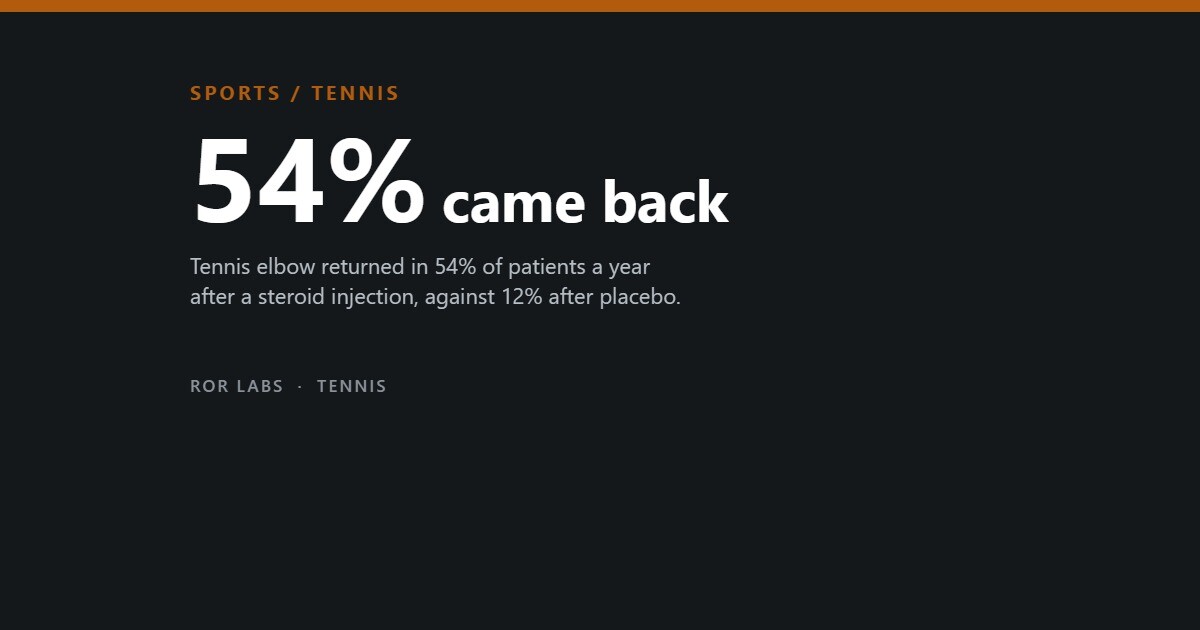
In a randomised trial of 165 people with tennis elbow, a steroid injection looked like the winner at first. A year later, 54% of those who had the injection had seen the pain come back, against 12% of those given a placebo. Fewer of the injected group had recovered at all.
That result sums up tennis and its injuries better than any injury rate. The game is moderately risky, mostly to ankles, backs and shoulders, and its best-known injury is one that mostly strikes people who do not play. The costly mistakes are usually made in a hurry — a quick fix, a sudden jump in playing time — rather than on the court itself.
This article follows the series format: what tennis players actually injure, where the risk concentrates, what has been measured to reduce it, and why the answer is not to put the racket away.
What actually gets injured
The steadiest numbers come from US college tennis. Over six seasons from 2009-10, the NCAA Injury Surveillance Program recorded 181 injuries in men’s tennis and 227 in women’s, at almost identical rates: 4.89 and 4.88 per 1,000 athlete-exposures. Lower limbs took about half of all injuries and the trunk about a sixth. A later five-season update for men found a lower rate, 4.41, with a sprained ankle the single most common injury and the trunk and shoulder the largest injury areas.
Tennis injury rates
Injuries per 1,000 athlete-exposures in NCAA tennis, with the 25-sport average for comparison.
Source: CDC, MMWR 64(48) (2015); Lynall et al., British Journal of Sports Medicine (2016); Robison et al., Journal of Athletic Training (2021).
Recreational players are harder to count, because they rarely log their hours. A survey of 218 club and recreational players aged 9 to 72 found 3.49 injuries per 1,000 hours of play. A 2025 review of 37 studies of high-level players found 2.1 to 3.5 per 1,000 hours in juniors and a wide range in adults, with lower-limb injuries 48% to 56% of the total and the lower back next.
Then there is the elbow. Tennis elbow, pain where the forearm muscles attach to the outside of the elbow, affects about 1% to 3% of adults. In a representative Finnish sample of 4,783 people aged 30 to 64, 1.3% had it. The risk factors were smoking, with an odds ratio of 3.4, and repetitive forceful arm work, 5.6. Tennis was not the story. The condition takes its name from the sport, but most people who have it have never played.
When the risk concentrates
Matches are riskier than practice. In the NCAA data, men were 2.32 times as likely to be injured in a match and women 1.77 times. That gap is smaller than in collision sports, where a single kind of play carries most of the risk, and it means there is no one moment in tennis to design out.
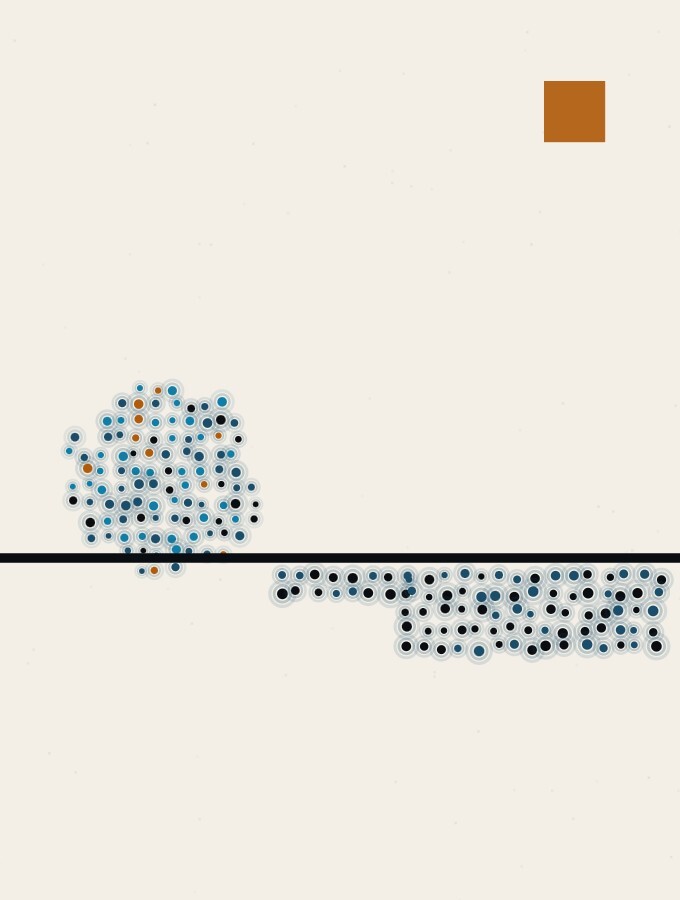
What does concentrate the risk is change. The 2025 review found the strongest external predictor of injury in high-level players was a sudden rise in training load, measured as an acute-to-chronic workload ratio above about 1.3 in juniors and 1.5 in adults — in plain terms, a week much harder than the previous month. Among recreational players, those training three or more times a week had 2.29 times the odds of injury, and those playing more than four and a half hours a week 2.04 times. A 2018 review of risk factors found the best-supported ones were a previous injury, fewer years of experience for upper-limb injuries, and more than six hours of play a week for back injuries.
Age matters in a different way. A US emergency department study of racket and paddle sports from 2000 to 2023 estimated 792,773 visits, 61.7% of them from tennis. Falls were the commonest cause. Among patients over 64, a quarter of visits were for a medical event such as a heart problem rather than an injury. Among players aged 60 and over, one earlier analysis found 21.5% of tennis visits were non-injury events.
Where the risk concentrates
Relative risk of injury in tennis, from NCAA and recreational studies.
Source: Lynall et al., British Journal of Sports Medicine (2016); Minghelli and Cadete, Journal of Sports Medicine and Physical Fitness (2020).
What has been measured to work
For prevention, the honest answer is disappointing. A 2006 review found no prevention trials in tennis at all, and a 2018 review found no randomised trials of prevention programmes. The one large trial since then, TennisReady, gave 579 adult recreational players a 12-week online exercise programme. Injury prevalence was 37% with the programme and 38% without, and only 8% of check-ins showed high adherence. The authors advised against rolling it out. What remains is load management: build playing time gradually and treat a previous injury with respect.
Tennis elbow: two treatment trials
Randomised trials comparing steroid injection with other approaches.
Success at 6 weeks: injection 78%, physio 65%, wait-and-see 27%
At 52 weeks: physio 94%, wait-and-see 90%
47 of 65 early injection successes relapsed
Recovered at 1 year: injection 83%, placebo 96%
Recurrence: 54% against 12%
Adding physiotherapy: no significant difference
Source: Bisset et al., BMJ 333:939 (2006); Coombes et al., JAMA 309(5):461–469 (2013).
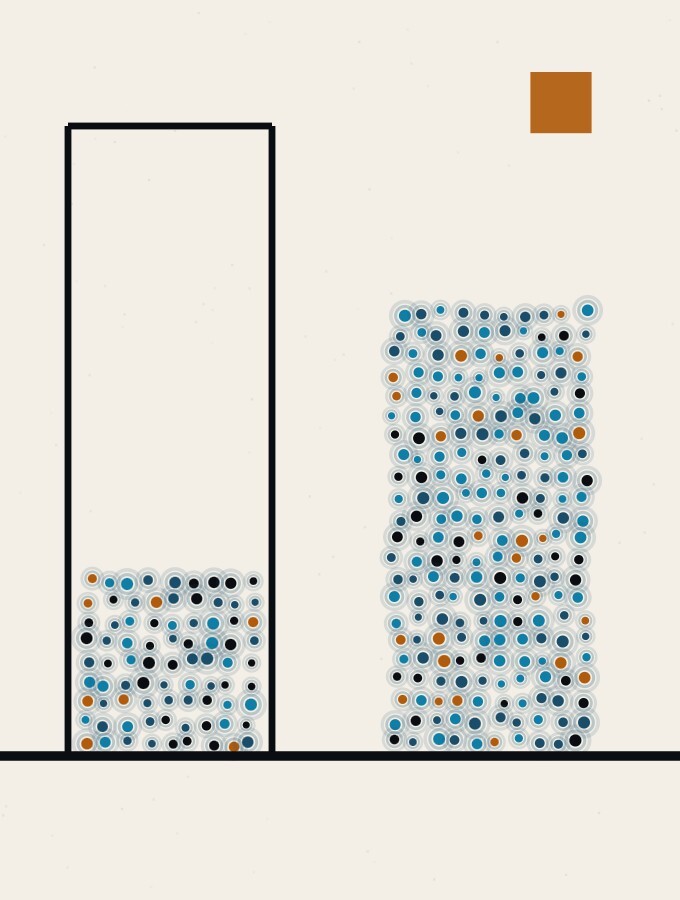
Tennis elbow has better trials, and they point one way. In the 2006 trial of 198 patients, an injection produced the best results at six weeks, but most of those early successes relapsed. By a year, 94% of the physiotherapy group and 90% of the wait-and-see group counted as successes. The 2013 trial found the injection worse than placebo at a year — 83% recovered against 96% — with four times the recurrence. An earlier Lancet trial found the same pattern: a large early benefit from injection and high recurrence afterwards.
The pattern is consistent enough to act on. Most tennis elbow resolves with time, and wait-and-see reached about 90% success in a year. Exercise-based treatment did better than injection on nearly every outcome except short-term pain in a 2021 review of 30 trials, though the effects were small and the certainty low. A forearm strap may help with daily tasks, according to a family medicine review, but the evidence is weak; in a 1979 survey of more than 500 players, changing technique or racket prevented recurrence better than the brace, which was the least successful option. Symptoms last more than a year in up to a fifth of people, which is when specialist review makes sense.
Why the answer is not to stop
Racket sports have some of the strongest associations with long life of any activity. In a British cohort of 80,306 adults, people who played racket sports had a 47% lower risk of death from any cause and a 56% lower risk of death from heart disease or stroke than those who did not. Swimming came in at 28% and cycling at 15% lower; running and football showed no significant link.
Tennis and longevity
Two observational studies. Hazard ratio below 1.00 means lower risk of death.
Source: Oja et al., British Journal of Sports Medicine 51(10):812–817 (2017); Schnohr et al., Mayo Clinic Proceedings 93(12):1775–1785 (2018).
In the Copenhagen City Heart Study, which followed 8,577 people for up to 25 years, tennis players lived an estimated 9.7 years longer than sedentary people — more than badminton at 6.2, soccer at 4.7, cycling at 3.7 or jogging at 3.2. The authors suggested that the social side of partner sports may be part of the explanation. They were also clear that the study cannot prove cause: people who play tennis tend to be wealthier and healthier to start with. The same caveat applies to the British cohort, whose authors argued separately that affluence did not explain their result.
Set against that, the cost is modest. Recreational players are hurt at around three to five injuries per 1,000 hours, mostly minor lower-limb and back problems. The risk is not fixed; it moves with how fast playing time rises, whether an old injury has been rehabilitated, and whether the elbow is given time rather than an injection. The answer is to change how you play, not whether you play.
Pickleball’s injury curve
Estimated US emergency department visits for pickleball injuries.
Source: McMillan et al., Sports Health (2025); Yu et al., Orthopaedic Journal of Sports Medicine 13(1) (2025).
Pickleball shows what happens when that is ignored at scale. As the game spread among older Americans, emergency department visits rose from about 1,300 in 2014 to more than 24,000 in 2023, most among players in their sixties and seventies. Falls caused about two thirds of injuries, and about a third were fractures, most of them in women. The courts did not become more dangerous; many more people started playing, later in life, with little build-up.
Questions people ask
How common are tennis injuries?
College players are injured at about 4.4 to 4.9 per 1,000 athlete-exposures, below the 6.0 average for all sports. Recreational players report around 3.5 per 1,000 hours.
Does playing tennis cause tennis elbow?
It can, but most people with tennis elbow do not play. In one population study, smoking and forceful repetitive arm work were the main risk factors.
Should I get a steroid injection for tennis elbow?
Trials found injections helped at six weeks but led to more recurrence and worse results at a year than placebo or waiting. Discuss the trade-off with your doctor.
Do tennis elbow braces work?
The evidence is weak. A strap may ease daily tasks, but technique and equipment changes did better in an older survey of players.
Is tennis good for older adults?
Racket sports are strongly associated with lower mortality. Older players should build up gradually and be aware that some court emergencies are cardiac rather than injuries.
The short version
- College tennis injury rates are 4.4 to 4.9 per 1,000 exposures, below the all-sport average of 6.0; ankles, back and shoulder lead.
- The strongest risk factor is a sudden rise in playing load, not playing itself.
- Tennis elbow affects 1% to 3% of adults, mostly non-players; most cases resolve within a year.
- Steroid injections helped at six weeks but recurred in 54% against 12% on placebo.
- Racket players had 47% lower all-cause mortality in a UK cohort — an association, not proof.
- Pickleball injuries rose sharply with older beginners: build up slowly.
This is a summary of published research, not medical advice. It does not replace assessment of a persistent injury by a doctor or physiotherapist. If you have heart disease or are returning to sport after a long break, talk to your doctor before starting.
Further reading: Coombes et al., JAMA 309(5):461–469 (2013), for the injection trial. Pas et al., British Journal of Sports Medicine 54:1036–1041 (2020), for the TennisReady prevention trial. Oja et al., British Journal of Sports Medicine 51(10):812–817 (2017), for sport type and mortality.
- The Master, Christopher Clarey (2021). A biography of Roger Federer built on two decades of interviews, and a good account of how a career lasting into a player’s late thirties was managed. Affectionate, as sports biographies tend to be.
- Exercised, Daniel Lieberman (2021). A Harvard evolutionary biologist on why humans move, and why we find it hard. Sceptical of fitness myths, including some about injury.
- Nudge: The Final Edition, Richard Thaler and Cass Sunstein (2021). On how small design choices steer behaviour — relevant to load management, where the hard part is not knowing what to do but doing it.
Sources
Centers for Disease Control and Prevention, MMWR 64(48) (2015), NCAA injury rates. — Lynall RC, Kerr ZY, Djoko A, et al. British Journal of Sports Medicine, doi:10.1136/bjsports-2015-095360 (2016). — Robison HJ, et al. Journal of Athletic Training, doi:10.4085/1062-6050-459-20 (2021). — Minghelli B, Cadete J. Journal of Sports Medicine and Physical Fitness, doi:10.23736/S0022-4707.19.09842-6 (2020). — Amor-Salamanca MS, et al. Sports 13(10):336 (2025). — Oosterhoff JHF, et al. Journal of Sports Sciences, doi:10.1080/02640414.2018.1485620 (2018). — Pluim BM, Staal JB, Windler GE, Jayanthi N. British Journal of Sports Medicine 40(5):415–423 (2006). — Ferguson K, et al. American Journal of Emergency Medicine, doi:10.1016/j.ajem.2026.06.040 (2026). — Weiss HB, Dougherty J, DiMaggio CJ. Injury Prevention 28(Suppl 2) (2022), conference abstract. — Shiri R, Viikari-Juntura E, Varonen H, Heliövaara M. American Journal of Epidemiology, doi:10.1093/aje/kwj325 (2006). — Pas HIMFL, Pluim BM, Kilic Ö, et al. British Journal of Sports Medicine 54:1036–1041 (2020). — Bisset L, et al. BMJ 333:939 (2006). — Coombes BK, Bisset L, Brooks P, Khan A, Vicenzino B. JAMA 309(5):461–469 (2013). — Smidt N, et al. Lancet (2002). — Karanasios S, et al. British Journal of Sports Medicine, doi:10.1136/bjsports-2020-102525 (2021). — Johnson GW, et al. American Family Physician (2007). — Gruchow HW, Pelletier D. American Journal of Sports Medicine 7(4) (1979). — Buchbinder R, Green S, Struijs P. BMJ Clinical Evidence (2008). — Oja P, Kelly P, Pedisic Z, et al. British Journal of Sports Medicine 51(10):812–817 (2017). — Schnohr P, O’Keefe JH, Holtermann A, et al. Mayo Clinic Proceedings 93(12):1775–1785 (2018). — McMillan PJ, et al. Sports Health, doi:10.1177/19417381251350671 (2025). — Yu J, et al. Orthopaedic Journal of Sports Medicine 13(1) (2025).