Indoor climbing chalk dust, and the gym air that reached 4,000 micrograms
Key takeaways · 10 min read
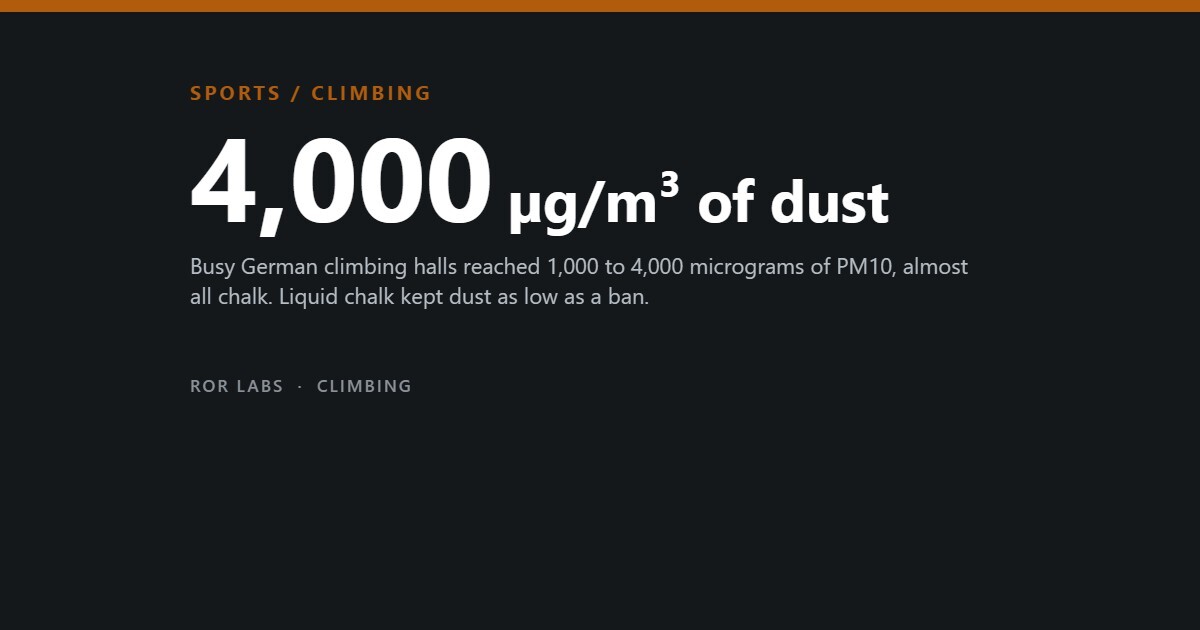
- Busy German climbing halls reached 1,000 to 4,000 micrograms of PM10 per cubic metre, almost all of it chalk; sports halls usually stayed below 100.
- A Romanian gym measured in 2026 had daily PM10 2.3 to 2.8 times the WHO guideline, yet climbers rated the air 8 out of 10.
- Lung function fell slightly after dusty sessions in 109 Austrian climbers, more in those with airway inflammation; long-term effects are unknown.
- Liquid chalk kept dust as low as a chalk ban; chalk balls and blocks did not help significantly.
A climbing gym that opened in Timișoara, Romania, in January 2025 gave air scientists a clean test case. Over its first winter they ran reference samplers for 24 hours at a time and found daily PM10, the coarse particles that reach the airways, at 104 and 127 micrograms per cubic metre: 2.3 and 2.8 times the World Health Organization’s 24-hour guideline. On busy evenings without the fans, short-term readings passed 2,500. The 61 climbers surveyed rated the air 8 out of 10.
Most of that dust starts on climbers’ hands. Climbing chalk is magnesia alba, a hydrated magnesium carbonate hydroxide, and German researchers showed in 2008 that it is a strong source of indoor dust. In 2025 a team in Vienna documented a second source: rubber worn off climbing-shoe soles, carrying some of the same additives found in car tyres.
This article covers how much dust chalk puts in the air and what it seems to do to the lungs, where and when levels peak, what has been measured to bring them down, and why the sensible response is to climb carefully rather than give up the gym. It draws on measurements from Germany, Austria, the Czech Republic, Romania and the United States.
What chalk dust does to the air and the lungs
Climbers chalk up to dry sweaty fingers, and the benefit is more modest than its reputation. In a 2001 laboratory test chalk actually lowered the friction between fingertips and rock, probably because it dried the skin and made it less pliable. A 2016 study of 19 experienced climbers found no change in friction or forearm muscle activity, yet after chalking they could hang from a hold for 62.9 seconds, against 49.3 without it.
The cost is airborne. Weinbruch and colleagues measured nine German climbing halls and five ordinary sports halls. Mean PM10 in the climbing halls was usually 200 to 500 micrograms per cubic metre, and during busy periods lasting several hours it reached 1,000 to 4,000. Virtually all the particles were chalk. They did not dissolve even at 100% humidity and were small enough to deposit in the airways. Gymnastics halls, where athletes also chalk, were as dusty.
Chalk dust in German climbing halls
PM10 in micrograms per cubic metre, measured with an optical particle counter in nine climbing halls and five sports halls. Bars show the upper end of each reported range.
Sources: Weinbruch et al., Journal of Environmental Monitoring 10:648 (2008); WHO global air quality guidelines (2021). The WHO value is a 24-hour average; the hall readings cover hours of activity.
What the dust does to climbers has been tested only in small studies. Austrian researchers measured lung function in 109 climbers before and after sessions averaging 1.8 hours in three halls. Higher dust levels meant a larger fall in lung function, small but statistically significant. The fall was bigger in climbers who started with high exhaled nitric oxide, a marker of the kind of airway inflammation seen in allergic asthma. The work was prompted by asthmatic climbers reporting worse symptoms during or after climbing.
Symptoms are common enough to notice. In the Romanian gym, 32.8% of the 61 climbers surveyed reported at least one respiratory or irritation symptom during or after climbing. Nobody has followed climbers or staff for years to see whether lasting harm results, and we found no published measurement of the personal exposure of route-setters or other gym staff.
Where the dust concentrates
Dust follows people. In the German halls PM2.5, the finer fraction, ran at 30 to 100 micrograms per cubic metre on ordinary days and rose as high as 500 when many users were present. A US comparison of two university climbing walls with low-cost monitors found “good” air at one and “unhealthy” to “very unhealthy” levels at the other. At the dusty wall, open climbing hours explained 75% of the variation in readings.
Buildings differ as much as crowds. A thesis comparing two Prague gyms recorded PM10 of 125 to 167 micrograms at one, a level that could quadruple at the busiest times, and peaks of 368 to 901 at the other; both exceeded daily limits for outdoor air. Competitions pack climbers in too. At a two-day Austrian event, PM10 at a central monitor rose steadily through the first day to 500 micrograms per cubic metre.
A new gym measured against the WHO guideline
Daily (24-hour) particle concentrations in a Romanian climbing gym, measured with reference gravimetric samplers on two days with mechanical ventilation running, as multiples of the WHO 24-hour guideline.
Source: Nicolici, Ionel & Bisorca, Applied Sciences 16(5):2269 (2026). One gym, late autumn and winter; no external funding.
These comparisons need care. WHO guidelines are built on outdoor air, dominated by combustion particles, and averaged over a day or a year, while a climber breathes gym air for a couple of hours. The Romanian authors flagged their own limits: optical sensors are calibrated on other aerosols, so their readings are only indicative, and chemical analysis found magnesium in just 0.031% of PM10 mass, so the claim that chalk dominated the dust was not directly quantified. It was also a single gym.
The second source is newer. The Vienna team sampled air in five bouldering gyms and tested 30 pairs of shoes, finding 15 rubber additives, including 6PPD, whose breakdown product has been linked to salmon deaths in rivers. The 15 compounds added up to 25 to 3,405 micrograms per gram of shoe sole, 2.6 to 37 in airborne particles and 1.5 to 55 in settled dust. In some gyms, modelled daily intake for climbers and staff exceeded known intake from other sources.
Rubber additives in climbing gyms
Sum of 15 rubber-derived compounds, micrograms per gram of material. Airborne samples came from five Vienna gyms; dust and shoes from nine gyms in four countries. Bars show the upper end of each range.
Source: Sherman et al., ACS ES&T Air 2(5):930 (2025). The authors declared no competing financial interests; health effects in people are unknown.
A 2026 follow-up by the same group analysed more than 200 samples of settled dust and foothold powder from 41 halls in 10 countries. The compounds turned up in every sample, and hall characteristics were only weakly associated with how much. The authors concluded that running a gym differently is unlikely to fix this, and that the answer lies in safer rubber for shoe soles.
What has been measured to work
The best-tested fix is liquid chalk. In a follow-up study, Weinbruch’s group ran controlled climbing sessions under seven different chalk arrangements and measured dust with three instruments whose PM10 readings agreed within 25%. Liquid chalk, magnesia suspended in ethanol, kept dust as low as banning chalk altogether. Chalk pressed into blocks, used as loose powder or sieved into coarse grains of 2 to 4 millimetres made no significant difference.
Neither did chalk balls, the porous bags of powder that feel cleaner in the hand. In the measurements they did not significantly reduce dust compared with loose chalk. The authors called liquid chalk a low-budget option: it needs no new building work, only a change of habit. Its benefit depends on everyone in the room switching, because the trial compared whole sessions run under one rule at a time.
Switching on mechanical ventilation in a busy gym
Change in particle levels during high-occupancy periods when the Romanian gym moved from natural to mechanical ventilation. Per-climber figures adjust for the number of people present.
Source: Nicolici, Ionel & Bisorca, Applied Sciences 16(5):2269 (2026). The system recirculated air through coarse pre-filters with no outdoor-air supply.
The pattern is instructive. The fans only recirculated air through coarse filters, and the authors attribute the rise in the finest particles to those filters and to airflow breaking chalk into smaller pieces. Carbon dioxide improved more clearly: peaks passed 3,500 parts per million under natural ventilation and stayed below 1,505 with the fans on. Outdoor air plus filters suited to fine particles is the logical upgrade, though no climbing study has yet tested it.
A 2020 review of air in indoor sports facilities ranked particles as the main concern in climbing halls and named mechanical ventilation with filters and suitable cleaning as the ways to reduce exposure. For rubber dust, the Vienna researchers suggested better ventilation and cleaning and avoiding peak times, while pressing manufacturers to use fewer additives.
Why the answer is not to stop climbing
Put the numbers in proportion. The German team reported that even its busiest readings stayed below the German workplace limits of the time, 3,000 micrograms per cubic metre for respirable dust and 10,000 for inhalable dust, though above guide values for workplaces without hazardous substances. US limits for magnesium carbonate are 15 milligrams of total dust and 5 of respirable dust over an eight-hour shift. Magnesia itself is regarded as low in toxicity; the worry is the particle load.
Climbing does a lot of good, and its main risks involve fingers and falls, as our earlier article on climbing injuries showed. For most healthy climbers, a dusty evening is a short exposure. The people with most reason to think harder are those with asthma, whose airways reacted more in the Austrian study, and staff who spend whole working weeks in the air.
Gym dust next to the limits
Micrograms per cubic metre. Workplace limits are shift averages set for healthy adult workers; the WHO value is a 24-hour average for the public. Gym readings are PM10.
Sources: OSHA Occupational Chemical Database, magnesite; Weinbruch et al. (2008); Nicolici et al. (2026); Moshammer et al. (2016); WHO (2021).
The practical list is short. Gyms can offer or require liquid chalk, run ventilation that brings in outdoor air through decent filters, clean where dust settles and check readings at peak times. Climbers can switch to liquid chalk, climb off-peak if dust bothers them and wash their hands after a session. Climbers with asthma should keep their reliever inhaler close and treat a gym that leaves them wheezing as a reason to see a doctor, not to quit.
What to do
Steps sorted by when they matter. Each one says how strong the evidence is: Measured Official advice Untested
Before
- If you have asthma, agree a plan with your doctor and keep your reliever inhaler with you when you climb. Official advice see Sources
- Choose quieter, well-ventilated sessions if dust bothers you. Busy German halls reached 1,000 to 4,000 micrograms of PM10 per cubic metre. Measured see Sources
If it happens
- Use liquid chalk. In controlled sessions it kept dust as low as a chalk ban; chalk balls did not help significantly. Measured see Sources
Afterwards
- Wash your hands after a session, and see a doctor if indoor climbing leaves you coughing, wheezing or breathless. Official advice see Sources
What not to do
- Do not rely on a chalk ball to keep the air clean. Official advice see Sources
Not medical advice. If a severe asthma attack does not ease with the reliever inhaler, call emergency services.
Questions people ask
Is climbing chalk toxic?
Magnesium carbonate is regarded as low in toxicity; US workplace limits for it are 15 milligrams per cubic metre of total dust. The concern is the amount in the air: busy German halls reached 1,000 to 4,000 micrograms of PM10 per cubic metre.
Is liquid chalk better for air quality?
Yes, on the best evidence available. In controlled sessions, liquid chalk kept dust as low as banning chalk. Chalk balls, blocks and coarse grains made no significant difference.
Can I climb indoors if I have asthma?
Many people with asthma climb. In an Austrian study, climbers with signs of airway inflammation lost more lung function after dusty sessions. Agree a plan with your doctor, carry your reliever and favour quieter, well-ventilated sessions.
Are chemicals from climbing shoes a health risk?
Nobody knows yet. Levels in gym dust and air were high, and several of the compounds have shown toxicity in laboratory and animal studies, but effects in people have not been studied.
The short version
- Busy German climbing halls reached 1,000 to 4,000 micrograms of PM10 per cubic metre, almost all of it chalk; sports halls usually stayed below 100.
- A Romanian gym measured in 2026 had daily PM10 2.3 to 2.8 times the WHO guideline, yet climbers rated the air 8 out of 10.
- Lung function fell slightly after dusty sessions in 109 Austrian climbers, more in those with airway inflammation; long-term effects are unknown.
- Liquid chalk kept dust as low as a chalk ban; chalk balls and blocks did not help significantly.
- Shoe-rubber additives are a newer finding with unknown health effects. Climb carefully: liquid chalk, good ventilation, off-peak sessions.
This is a summary of published research, not medical advice. If you have asthma or another lung condition, or you cough, wheeze or feel breathless when climbing indoors, talk to your doctor; a physiotherapist can help you plan training around symptoms. If someone has a severe asthma attack that does not ease with their inhaler, call emergency services.
Further reading: Weinbruch et al., Journal of Environmental Monitoring 14:2114 (2012), for the test of liquid chalk and chalk balls. Nicolici, Ionel & Bisorca, Applied Sciences (2026), for a full air-quality survey of one gym. Sherman et al., Environmental Science: Processes & Impacts (2026), for rubber compounds in 41 halls.
Sources
- Nicolici VS, Ionel I, Bisorca D. Indoor air quality in climbing gyms: multi-zone assessment of particulate matter, CO2 accumulation, and user perception. Applied Sciences 16(5):2269 (2026), doi:10.3390/app16052269.
- Weinbruch S, Dirsch T, Ebert M, Hofmann H, Kandler K. Dust exposure in indoor climbing halls. Journal of Environmental Monitoring 10:648–654 (2008), doi:10.1039/B719344K.
- Sherman A, Masset T, Wimmer L, Maruschka LK, Dailey LA, Hüffer T, Breider F, Hofmann T. The invisible footprint of climbing shoes: high exposure to rubber additives in indoor facilities. ACS ES&T Air 2(5):930–942 (2025), doi:10.1021/acsestair.5c00017.
- University of Vienna. Concerning chemicals from the wear of climbing shoes cause trouble in indoor halls. Press release, 29 April 2025.
- Li FX, Margetts S, Fowler I. Use of ‘chalk’ in rock climbing: sine qua non or myth? Journal of Sports Sciences (2001), doi:10.1080/026404101300149375.
- Kilgas MA, Drum SN, Jensen RL, Phillips KC, Watts PB. The effect of magnesium carbonate (chalk) on geometric entropy, force, and electromyography during rock climbing. Journal of Applied Biomechanics (2016), doi:10.1123/jab.2016-0009.
- World Health Organization. WHO global air quality guidelines: particulate matter (PM2.5 and PM10), ozone, nitrogen dioxide, sulfur dioxide and carbon monoxide (2021); 24-hour values as cited by Nicolici et al. (2026).
- Moshammer H, Shahraki Sanavi S, Mondel T, Gebhart P. Lung function and dust in climbing halls: two pilot studies. Reviews on Environmental Health (2016), doi:10.1515/reveh-2016-0024; Gebhart P, Mondel T, Moshammer H. Acute respiratory effects of magnesia dust in climbing halls. European Respiratory Journal congress abstract PA2021 (2015).
- Zajchowski CAB, Rabinowitz E, Davis JK. Canaries at the climbing wall: a comparative study of particulate matter at two university climbing walls (2020), doi:10.1177/1558866120952772.
- Bartošová N. PM exposure in climbing gyms: case study of two climbing walls in Prague. Thesis (2018), Czech National Repository of Grey Literature, nusl-380888.
- Weinbruch S, Dirsch T, Kandler K, Ebert M, Heimburger G, Hohenwarter F. Reducing dust exposure in indoor climbing gyms. Journal of Environmental Monitoring 14:2114 (2012), doi:10.1039/C2EM30289F.
- Salonen H, Salthammer T, Morawska L. Human exposure to indoor air contaminants in indoor sports environments. Indoor Air (2020), doi:10.1111/ina.12718.
- Sherman A, Lotteraner L, Maruschka LK, Hofmann T. Minor influence of climbing hall characteristics on rubber-derived compound contamination highlights a need for material-level solutions. Environmental Science: Processes & Impacts 28(2):468–480 (2026), doi:10.1039/d5em00812c.
- US Occupational Safety and Health Administration. Occupational Chemical Database: Magnesite (magnesium carbonate).