Do Economic Sanctions Work? What the Evidence Shows
Key takeaways · 11 min read
- The best-known sanctions success rate, 34%, fell to about 4% when Pape re-examined the same cases.
- Larger datasets that count threats put success between 37.5% and 56.3%, depending on the definition.
- Sanctions that damage an economy tend to harm health; one study estimated 1.2 to 1.4 years of life expectancy lost under UN sanctions.
- Studies disagree on whether UN or US sanctions do more harm, and most have serious design limits.
In this article
Economic sanctions have become the tool governments reach for when they want to act against another country without going to war. The United States, the European Union, the United Kingdom and the United Nations together maintain sanctions on dozens of countries and thousands of people and companies. They freeze assets, block trade, cut banks out of the payment system and ban travel.
Two questions hang over every one of them. Do they change what the targeted government does? And who actually pays? The answers matter for anyone who lives in, trades with, sends money to or travels to a sanctioned country, and for voters in the countries that impose them.
Researchers have argued about the first question for forty years, and the most famous success rate, 34%, fell to about 4% when another scholar re-examined the same cases. On the second question the evidence is more consistent: sanctions that bite hard tend to harm ordinary people’s health, although how much, and which sanctions do it, is still disputed. This article sets out what the research finds and where it divides.
The 34% figure and the 4% reply
The modern debate starts with a book, Economic Sanctions Reconsidered, by Gary Clyde Hufbauer, Jeffrey Schott and Kimberly Ann Elliott, first published in 1985. They coded every sanctions episode they could find from 1914 onwards and judged whether each had achieved its goal and whether sanctions had contributed. In the edition covering cases to 1990, 40 of 115 cases, or 34%, counted as at least partly successful.
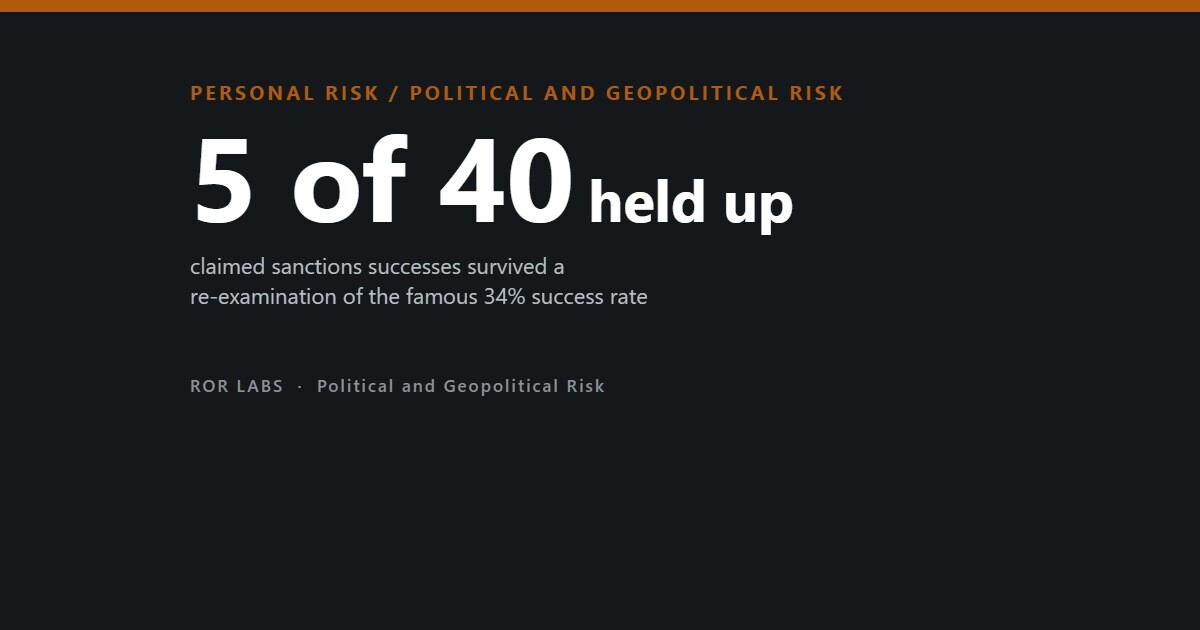
That figure helped move expert opinion from deep pessimism to cautious optimism. Then, in 1997, the political scientist Robert Pape went back through the 40 successes in the journal International Security. He argued that most were not really sanctions successes at all: in many, military force did the work, the target made no real concession, or the outcome was not what the sanctions had demanded. By his reading, only 5 of the 40 held up, a success rate of about 4% across all 115 cases.
Elliott replied, Pape replied to the reply in 1998, and the disagreement was never settled. Lee Jones and Clara Portela, reviewing the field in 2020, noted that the heart of the dispute was not the data but how to prove that sanctions, rather than something else, caused a government to change course. That is still the hardest problem in the field.
How often do sanctions succeed?
Share of sanctions episodes judged successful, depending on the dataset and the definition of success.
Hufbauer GC, Schott JJ, Elliott KA, Economic Sanctions Reconsidered, 1990; Pape RA, International Security, 1997;22(2):90–136.
Bigger datasets, wider answers
Later researchers built larger datasets. The best known, Threat and Imposition of Economic Sanctions, or TIES, run by T. Clifton Morgan, Navin Bapat and Yoshiharu Kobayashi, covers more than a thousand cases from 1945 to 2005 and includes threats as well as sanctions actually imposed.
How successful sanctions look in TIES depends on how success is defined. Using the strictest definition, sanctions succeeded in 37.5% of the episodes with known outcomes; using the most relaxed definition, 56.3%. Part of the reason these figures are higher is that threats which work are counted: a government that backs down before sanctions are imposed never appears in a list of imposed sanctions.
One question, four answers
Share of sanctions cases counted as successful.
Pape RA, 1997; Hufbauer GC et al, 1990; TIES dataset as summarised by Onder M, Economies, 2020. TIES includes threats as well as imposed sanctions.
Across these studies, a few patterns recur. Sanctions tend to work better when the demand is modest, when the sender and target are close trading partners, and when the threat alone is enough. They rarely work when the aim is to overthrow a government or to force it to give up something it sees as vital to its survival. A 2025 meta-analysis of the determinants of success by Binyam Demena and Peter van Bergeijk found that many of these conclusions depend heavily on which dataset and model a study uses.
Who pays: the health evidence
The humanitarian cost of sanctions became a public issue in the 1990s, through Iraq, Haiti and the former Yugoslavia. We looked separately at the disputed estimates of child deaths in Iraq. Since then, researchers have tried to measure the effect across many countries at once.
Susan Hannah Allen and David Lektzian, in the Journal of Peace Research in 2013, found that sanctions with a large economic effect on the target had public health consequences comparable to those of major armed conflicts. Sanctions with little economic effect had no measurable health effect. The harm, in other words, follows the economic damage.
Jerg Gutmann, Matthias Neuenkirch and Florian Neumeier, in the Journal of Development Studies in 2021, studied 98 less developed and newly industrialised countries from 1977 to 2012. They estimated that an average episode of UN sanctions reduced life expectancy by about 1.2 to 1.4 years, and US sanctions by 0.4 to 0.5 years. Women were affected more than men, and the damage built up the longer sanctions lasted.
Life expectancy under sanctions
Estimated effect of an average sanctions episode, 98 countries, 1977–2012.
Gutmann J, Neuenkirch M, Neumeier F, Journal of Development Studies, 2021;57(1):139–162. Women were affected more than men.
The studies disagree about which sanctions do the harm
A newer study reversed part of that picture. Francisco Rodríguez, Sílvio Rendón and Mark Weisbrot, in The Lancet Global Health in 2025, analysed age-specific death rates in 152 countries from 1971 to 2021 using several methods designed to separate cause from correlation. They found the strongest effects for unilateral, economic and US sanctions, and no statistical evidence of an effect for UN sanctions. The effect was largest for children under five. As summarised later in the same journal, the estimate amounted to more than 560,000 deaths a year associated with unilateral sanctions.
Both studies are careful, and they point in different directions on a key question. A 2023 systematic review in BMJ Global Health by Matteo Pinna Pintor, Marc Suhrcke and Christoph Hamelmann explains why. Of 27 studies it synthesised, 21 reported consistent adverse effects of sanctions. But almost all had important limitations, only one used a quasi-experimental design, and sanctioned countries differ from others in ways that are hard to adjust for: they are often already in conflict, under autocratic rule or in economic decline. The review concluded that more evidence is needed on which sanctions cause how much harm.
Reza Majdzadeh added a further caution in 2026, writing about Iran, one of the most heavily sanctioned countries. Life expectancy there kept rising through long periods of sanctions. He argued that life expectancy is a late and blunt signal, and that harm can show up first in medicine shortages, delayed treatment and household poverty long before it moves national averages.
Cross-country studies of sanctions and health
Main findings, in order of publication.
| Study | Countries and years | Main finding |
|---|---|---|
| Allen and Lektzian, 2013 | Cross-national | Harm only when the economic effect is large |
| Gutmann and colleagues, 2021 | 98 countries, 1977–2012 | UN sanctions cost more years than US ones |
| Pinna Pintor and colleagues, 2023 | Review of 27 studies | 21 found harm; most had serious limitations |
| Rodríguez and colleagues, 2025 | 152 countries, 1971–2021 | US and unilateral strongest; no effect found for UN |
Allen SH, Lektzian DJ, J Peace Res, 2013; Gutmann J et al, J Dev Stud, 2021; Pinna Pintor M et al, BMJ Global Health, 2023; Rodríguez F et al, Lancet Glob Health, 2025.
Why exemptions do not fully protect people
Partly in response to Iraq, the UN and Western governments shifted from the late 1990s towards targeted or ‘smart’ sanctions: asset freezes and travel bans on named leaders, companies and sectors rather than whole economies. The idea is to put pressure on the people making decisions while sparing everyone else. The evidence that targeted sanctions work better is limited, and when they hit a central bank, oil exports or access to international payments, as many now do, the line between targeted and comprehensive becomes thin.
Almost every modern sanctions programme exempts food, medicine and humanitarian aid. The problem is that trade in exempt goods still needs banks, shipping, insurance and paperwork, and each company in the chain has to decide whether the risk of a mistake is worth the business.
Many decide it is not. Researchers describe this as over-compliance, or de-risking: banks refuse transfers to anyone connected to a sanctioned country, and suppliers stop selling even permitted goods. Reviews of the Iranian experience describe medicines that were technically allowed becoming scarce and expensive because payments could not be processed. The same pattern affects migrants who send money home, charities working in sanctioned areas and ordinary people with the wrong country on their passport.
Sanctions can also strengthen the governments they target. Reed Wood, in International Studies Quarterly in 2008, found that sanctions between 1976 and 2001 were followed by increased state repression, as leaders tightened their grip in response to the threat. A 2023 review of 31 quantitative studies by Francisco Rodríguez in the Journal of Economic Studies found that 30 reported negative effects on outcomes ranging from income and poverty to mortality and human rights.
What the quantitative studies report
Studies that measured the effect of sanctions on living conditions in target countries.
Rodríguez F, Journal of Economic Studies, 2023; Pinna Pintor M, Suhrcke M, Hamelmann C, BMJ Global Health, 2023.
Recent cases: Russia and Syria
The sanctions imposed on Russia after its full-scale invasion of Ukraine in February 2022 are the largest ever placed on a major economy. They froze a large part of the central bank’s reserves, cut major banks from the SWIFT messaging system, banned many exports and later capped the price of Russian oil sold with Western shipping and insurance.
Their economic effect was real but smaller than many predicted. Official Russian figures showed a contraction of about 1% in 2022 and growth of more than 3% in 2023, driven by military spending and oil sold through other routes. By 2024 the sanctions had not ended the war, which was their central aim. Supporters argue that their goal was also to raise the cost of the war and degrade Russia’s military supply chains over time, which is harder to measure.
Syria shows the reverse question. After the fall of the Assad government in December 2024, the European Union and the United States moved in 2025 to lift most economic sanctions, arguing that they now blocked recovery more than they pressured anyone. Researchers will be able to measure what happens to health and incomes when sanctions end, which is rarer and in some ways more informative than studying when they begin.
What this means for individuals
For most readers, sanctions are something that happens to other people. But they reach ordinary life in practical ways. Money transfers to relatives in some countries can be blocked or delayed. Travel insurance may exclude sanctioned destinations. Buying from or selling to a sanctioned person, even unknowingly, can freeze a payment or an account.
Official sanctions lists are public, and governments publish guidance on humanitarian exemptions and licences. If you send money to family, work for a charity or run a small business with links to a sanctioned country, it is worth checking the rules that apply to your bank and your country before a payment is stuck, not after.
Questions people ask
Do economic sanctions work?
Sometimes, for modest goals. Estimates of success range from about 4% to 56%, depending on the dataset and how success is defined.
What is the 34% sanctions success rate?
It comes from Hufbauer, Schott and Elliott, who judged 40 of 115 cases to 1990 as at least partly successful. Pape argued only 5 of those 40 held up.
Do sanctions harm ordinary people?
Most studies find that sanctions with a large economic effect worsen health and living standards, especially for children and women.
Are UN or US sanctions more harmful?
Studies disagree. One found larger effects for UN sanctions; a 2025 study found the strongest effects for US and unilateral sanctions and none for UN ones.
Are medicines exempt from sanctions?
Usually, but banks and suppliers often avoid sanctioned countries altogether, so exempt medicines can still become scarce.
The short version
- The best-known sanctions success rate, 34%, fell to about 4% when Pape re-examined the same cases.
- Larger datasets that count threats put success between 37.5% and 56.3%, depending on the definition.
- Sanctions that damage an economy tend to harm health; one study estimated 1.2 to 1.4 years of life expectancy lost under UN sanctions.
- Studies disagree on whether UN or US sanctions do more harm, and most have serious design limits.
- Exemptions for food and medicine often fail in practice because banks and suppliers avoid the risk.
This article summarises published research on economic sanctions. It does not take a position on any particular sanctions programme or the conflicts behind them, and it is not legal or financial advice. If you need to send money or goods to a sanctioned country, check the official guidance for your country or speak to your bank.
Further reading. Pape, ‘Why Economic Sanctions Do Not Work’, International Security, 1997, and Pinna Pintor and colleagues, ‘The impact of economic sanctions on health and health systems in low-income and middle-income countries’, BMJ Global Health, 2023, are good starting points.
- The Economic Weapon, Nicholas Mulder (2022). A historian on how sanctions were invented after the First World War as an alternative to war, and what they did to civilians.
- Chokepoints, Edward Fishman (2025). A former US sanctions official on how financial sanctions were built and used against Iran and Russia.
- Backfire, Agathe Demarais (2022). An economist on how US sanctions can hurt allies and push targets towards other partners.
Sources
- Hufbauer GC, Schott JJ, Elliott KA. Economic Sanctions Reconsidered: History and Current Policy. 2nd ed. Institute for International Economics, 1990.
- Pape RA. Why economic sanctions do not work. International Security, 1997;22(2):90–136. doi:10.1162/isec.22.2.90.
- Pape RA. Why economic sanctions still do not work. International Security, 1998;23(1):66–77. doi:10.1162/isec.23.1.66.
- Morgan TC, Bapat N, Kobayashi Y. Threat and imposition of economic sanctions 1945–2005: updating the TIES dataset. Conflict Management and Peace Science, 2014;31(5):541–558. doi:10.1177/0738894213520379.
- Onder M. Regime type, issue type and economic sanctions: the role of domestic players. Economies, 2020;8(1):2. doi:10.3390/economies8010002.
- Jones L, Portela C. Evaluating the success of international sanctions: a new research agenda. Revista CIDOB d’Afers Internacionals, 2020;125:39–60. doi:10.24241/rcai.2020.125.2.39.
- Demena BA, van Bergeijk PAG. A meta-analysis of determinants of success and failure of economic sanctions. Econometrics, 2025;13(2):16. doi:10.3390/econometrics13020016.
- Allen SH, Lektzian DJ. Economic sanctions: a blunt instrument? Journal of Peace Research, 2013;50(1):121–135. doi:10.1177/0022343312456224.
- Gutmann J, Neuenkirch M, Neumeier F. Sanctioned to death? The impact of economic sanctions on life expectancy and its gender gap. Journal of Development Studies, 2021;57(1):139–162. doi:10.1080/00220388.2020.1746277.
- Rodríguez F, Rendón S, Weisbrot M. Effects of international sanctions on age-specific mortality: a cross-national panel data analysis. The Lancet Global Health, 2025;13(8):e1358–e1366. doi:10.1016/S2214-109X(25)00189-5.
- Majdzadeh R. Life expectancy is a late signal of sanctions-related harm. The Lancet Global Health, 2026. doi:10.1016/j.langlo.2026.104046.
- Pinna Pintor M, Suhrcke M, Hamelmann C. The impact of economic sanctions on health and health systems in low-income and middle-income countries: a systematic review and narrative synthesis. BMJ Global Health, 2023;8(2):e010968. doi:10.1136/bmjgh-2022-010968.
- Rodríguez F. The human consequences of economic sanctions. Journal of Economic Studies, 2024;51(4):942–963. doi:10.1108/JES-06-2023-0299.
- Wood RM. ‘A hand upon the throat of the nation’: economic sanctions and state repression, 1976–2001. International Studies Quarterly, 2008;52(3):489–513. doi:10.1111/j.1468-2478.2008.00512.x.