Workplace Bullying: What the Evidence Shows
Key takeaways · 11 min read
- About 11% to 18% of workers report bullying in pooled studies, but the figure depends heavily on how the question is asked.
- Bullying predicts later anxiety and depression, and poor mental health also predicts later bullying.
- Most anti-bullying interventions have not been tested well; the Cochrane review rated the evidence very low quality.
- Organisation-wide programmes led from the top look more promising than one-off training.
Workplace bullying rarely looks dramatic. It is a manager who criticises every piece of work in front of colleagues, a team that stops inviting one person to meetings, a stream of impossible deadlines, jokes that are never quite jokes. Any one of these can be shrugged off. What turns them into bullying is repetition over months, and a target who finds it harder and harder to defend themselves.
Researchers in Scandinavia began studying it systematically in the late 1980s, and the field now spans dozens of countries. The results are consistent on some points and surprisingly unsettled on others. Bullied employees are clearly more likely to become anxious, depressed and ill. But how common bullying is depends heavily on how the question is asked, poor mental health also seems to make people more likely to be bullied later, and there is very little good evidence that the anti-bullying programmes employers buy actually work.
This article looks at what the evidence shows about how often bullying happens, what it does to people, which way the arrows point, and what has been tested as a remedy.
What counts as bullying
Most researchers use a definition developed in Norway and Britain: bullying is repeated and persistent negative treatment, usually over at least six months, that the target finds hard to stop because of an imbalance of power. A single conflict, however unpleasant, is not bullying in this sense. Nor is a disagreement between equals who both give as good as they get.
The negative acts themselves fall into two broad groups. Work-related bullying includes excessive monitoring, withholding information, unreasonable workloads and constant criticism. Person-related bullying includes humiliation, gossip, social exclusion and insulting remarks. Physical intimidation is the least common form. Most bullying comes from people with more power, often a direct manager, but it can also come from peers or even subordinates.
How common it is depends on the question
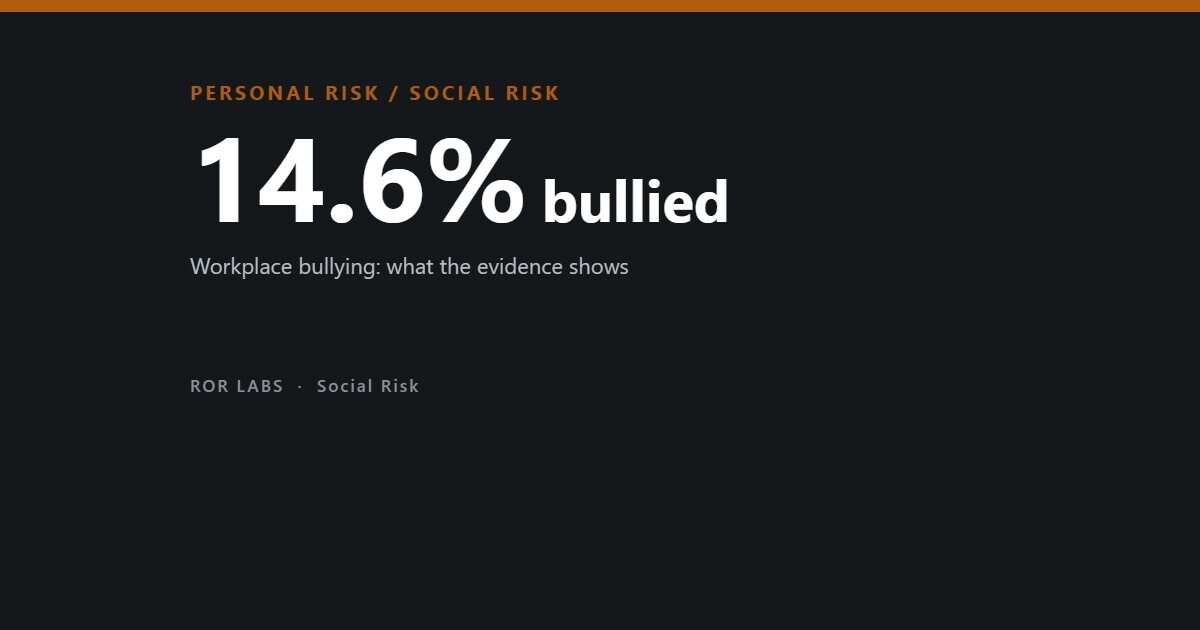
In 2010, Morten Birkeland Nielsen, Stig Berge Matthiesen and Ståle Einarsen pooled 102 prevalence estimates from 86 samples covering 130,973 workers. The average was 14.6%. But the method mattered a great deal.
When workers were given a definition of bullying and asked whether it applied to them, 11.3% said yes. When they were asked about specific negative acts, such as being ignored or humiliated, and researchers applied a threshold, the rate was 14.8%. When they were asked whether they had been bullied without being given a definition, it rose to 18.1%. Studies with non-random samples reported rates 8.7 percentage points higher than random ones.
How the question changes the answer
Share of workers classed as bullied, by measurement method. 86 samples, 130,973 workers.
Nielsen MB, Matthiesen SB, Einarsen S, Journal of Occupational and Organizational Psychology, 2010;83(4):955–979.

The same effect shows up inside a single survey. A representative study of 2,539 Norwegian employees, published in 2009, produced estimates from 2% to 14.3% depending on the method. The researchers judged a statistical method called latent class cluster analysis the most reliable, giving 6.8%. Only 2% described themselves as victims of severe bullying.
International surveys use broader definitions. In 2022, the International Labour Organization, Lloyd’s Register Foundation and Gallup published the first global survey of violence and harassment at work, based on interviews in 121 countries. It found that 22.8% of people in employment had experienced at least one form in their working life, with psychological violence and harassment, at 17.9%, the most common. That figure includes single incidents, so it is not directly comparable with the research definition of bullying.
Violence and harassment at work, worldwide
First global survey, 121 countries, people in employment.
International Labour Organization, Lloyd’s Register Foundation and Gallup, 2022. Includes single incidents, so it is broader than the research definition of bullying.
That second number matters as much as the first. Nearly half of those affected had never told anyone, and the most common reasons given in the survey were that it would be a waste of time and fear for their reputation. Whatever the true rate of bullying, official complaints capture only part of it.
One survey, several answers
Norwegian employees, representative sample of 2,539, by estimation method.
| Method | Share bullied |
|---|---|
| Self-labelled victims of severe bullying | 2.0% |
| Self-reported victimisation | 4.6% |
| Latent class cluster analysis | 6.8% |
| Broadest operational method | 14.3% |
Nielsen MB et al, European Journal of Work and Organizational Psychology, 2009;18(1):81–101.
What bullying does to people
The cross-sectional evidence is extensive. In a 2012 meta-analysis in Work & Stress, Nielsen and Einarsen combined 137 effect sizes from 66 samples with 77,721 people. Exposure to bullying was associated with mental and physical health problems, symptoms of post-traumatic stress, burnout, intentions to leave, and lower job satisfaction and commitment. Links with absenteeism, performance and sleep were weak or not significant.
Cross-sectional studies cannot show direction. A person who is already depressed might perceive colleagues as more hostile, or might become an easier target. So the same meta-analysis also looked at 13 longitudinal samples with 62,916 people, followed over time. Bullying predicted later mental health problems. But mental health problems at the start also predicted later reports of being bullied, to a similar degree.

A 2014 meta-analysis of prospective studies in the journal of the Norwegian Medical Association put numbers on this two-way relationship. Exposure to bullying raised the odds of later mental health problems by about two thirds, with an odds ratio of 1.68, and of later somatic symptoms, with an odds ratio of 1.77. Mental health problems raised the odds of later exposure to bullying by a similar amount, 1.74.
The authors did not conclude that bullying is harmless. They concluded that it is part of a vicious circle. Being bullied makes people ill; being ill makes them more vulnerable to being singled out; and each makes the other worse. That matters for how organisations respond. Treating a bullied employee’s distress as evidence that they are the problem gets the causal story half right and the moral story wrong.
Which way do the arrows point?
Pooled odds ratios from prospective studies of workplace bullying and health.
Nielsen MB, Magerøy N, Gjerstad J, Einarsen S, Tidsskrift for Den norske legeforening, 2014;134(12–13):1233–1238. Somatic symptoms: 1.77.
What has been tried, and what the trials show
Employers have many options: policies, training for managers, awareness campaigns, confidential reporting routes, mediation, investigation and disciplinary procedures. Very few have been tested properly.
In 2014, Margaret Hodgins, Sarah MacCurtain and Patricia Mannix-McNamara searched 11 databases and 5,364 records for evaluated interventions against workplace bullying or incivility. They found 12 that had been published in peer-reviewed journals. Eight were so weak in design that the reviewers classed them as inconclusive, including every observational and uncontrolled before-and-after study. Only three reached a moderate quality rating.
The Cochrane Collaboration reached a similar verdict. Its review of interventions to prevent workplace bullying, led by Patricia Gillen and updated in 2017, found only a handful of eligible studies and rated the evidence as very low quality. A 2024 meta-analysis of 19 studies by Alfredo Rodríguez-Muñoz and colleagues in Work & Stress found that interventions such as cognitive rehearsal, education and training for supervisors were associated with fewer bullying incidents, but warned of a high risk of bias and a possible Hawthorne effect, in which people behave differently simply because they know they are being studied.
One early evaluation shows why caution is needed. A six-month programme in five UK public sector organisations, reported by Helge Hoel and Sabir Giga in 2006 and described in a later review by Iain Coyne and Marilyn Campbell, combined policy communication with stress awareness and training about negative behaviour. Reported bullying rose slightly, from 13.6% to 14.3%. Training can make people better at recognising bullying, which may raise reported rates even if actual behaviour improves.
The evidence on anti-bullying interventions at work
Systematic reviews and meta-analyses.
| Review | Studies | Verdict |
|---|---|---|
| Hodgins and colleagues, 2014 | 12 appraised | 8 inconclusive, 3 of moderate quality |
| Cochrane, Gillen and colleagues, 2017 | A handful | Very low quality evidence |
| Rodríguez-Muñoz and colleagues, 2024 | 19 | Some reductions; high risk of bias |
Hodgins M et al, Int J Workplace Health Manag, 2014;7(1):54–72; Gillen PA et al, Cochrane Database Syst Rev, 2017; Rodríguez-Muñoz A et al, Work & Stress, 2024.
The more recent reviews point to a pattern rather than a single answer. Programmes that are organisation-wide, supported by senior leaders, run for a long time and change how work is organised seem more promising than one-off training for individuals. That fits with what researchers have long found about the causes of bullying: role conflict, heavy workloads, poor leadership and restructuring all raise the risk.
Why some workplaces have more of it
Early explanations focused on personalities: difficult bosses and vulnerable victims. Research since the 1990s, summarised by Ståle Einarsen, Helge Hoel, Dieter Zapf and Cary Cooper, has shifted the emphasis to the work environment. Bullying is more common where roles are unclear or contradictory, workloads are heavy, leaders avoid dealing with conflict, and organisations are going through cuts or restructuring.
This is sometimes called the work environment hypothesis. It does not excuse individual behaviour, but it explains why bullying clusters in some teams and not others, and why replacing one bully sometimes changes little. When stress is high and nobody enforces standards, hostile behaviour becomes a way of coping, competing or passing pressure down the line.
It also explains why a common employer response, sending the target or the accused on a course, tends to disappoint. If the conditions that produced the bullying stay the same, the pattern can resume with different people. The more promising programmes in the reviews treated bullying as a feature of how the organisation works, not only as a problem between two individuals.

A recent case
In April 2023, the UK deputy prime minister Dominic Raab resigned after an independent investigation by the lawyer Adam Tolley found that he had acted in an intimidating way towards civil servants on some occasions. Raab disputed the findings and argued that the threshold for bullying had been set too low. The case showed how contested the line between demanding management and bullying can be, even after a formal inquiry, and how much depends on the definition being applied.
Legal protection varies widely by country. Some, such as France and Sweden, have specific laws or regulations covering moral or psychological harassment at work. Many others, including the United Kingdom and most US states, have no general law against workplace bullying; targets must rely on discrimination, harassment, health and safety or constructive dismissal rules, which cover only some situations.
What this means if it is happening to you
The research suggests three practical points. First, keep a record: dates, what was said or done, who saw it, and any emails or messages. Bullying is a pattern, and patterns are hard to prove from memory. Second, look after your health early. The link between bullying and later depression runs in both directions, so getting support is not a sign of weakness; it may break the cycle. Third, find out what your organisation’s procedure actually is and who, apart from the person involved, can act on it.
Leaving is sometimes the right answer, and the evidence does not suggest that people who stay and endure recover by themselves. We looked at the wider link between work and health in our article on long working hours and burnout.
For managers, the evidence points the other way round. The cheapest intervention is to deal with conflict early and fairly, set clear roles and realistic workloads, and treat a complaint as information about the team rather than a nuisance. Surveys that ask about specific behaviours, not just the word ‘bullying’, give a truer picture of what is happening.
Questions people ask
How common is workplace bullying?
About 11% to 18% of workers in pooled studies, depending on the method. Rigorous estimates in single countries are often lower, around 5% to 7%.
What is the difference between bullying and conflict?
Bullying is repeated over months, and the target finds it hard to defend themselves because of a power imbalance. A one-off clash between equals is not bullying.
Does workplace bullying cause depression?
Prospective studies show that bullying predicts later mental health problems, with an odds ratio of about 1.7. Earlier mental health problems also predict later bullying.
Do anti-bullying programmes work?
The evidence is weak. Reviews found few well-designed studies; some programmes reduced reported bullying, but the risk of bias was high.
Is workplace bullying illegal?
It depends on the country. Some have specific laws; others cover it only when it overlaps with discrimination, harassment or safety law.
The short version
- About 11% to 18% of workers report bullying in pooled studies, but the figure depends heavily on how the question is asked.
- Bullying predicts later anxiety and depression, and poor mental health also predicts later bullying.
- Most anti-bullying interventions have not been tested well; the Cochrane review rated the evidence very low quality.
- Organisation-wide programmes led from the top look more promising than one-off training.
- Keeping a record and seeking support early are the most useful steps for targets.
This article summarises published research on workplace bullying. It is not legal or medical advice and is not a tool for assessing a specific situation. If bullying is affecting your health, speak to a doctor or a qualified counsellor, and for legal questions seek advice from a trade union, an employment adviser or a lawyer in your country.
Further reading. Nielsen and Einarsen, ‘Outcomes of exposure to workplace bullying: A meta-analytic review’, Work & Stress, 2012, is the key synthesis. Hodgins and colleagues, 2014, explains why so little is known about what works.
- Jerks at Work, Tessa West (2022). A social psychologist on the types of difficult colleagues, from credit-stealers to bulldozers, and how to deal with them.
- The Burnout Epidemic, Jennifer Moss (2021). A journalist on why burnout is an organisational problem rather than a personal failing.
- Right Kind of Wrong, Amy Edmondson (2023). A Harvard professor on psychological safety and how workplaces can make it safe to speak up.
Sources
- Nielsen MB, Matthiesen SB, Einarsen S. The impact of methodological moderators on prevalence rates of workplace bullying: a meta-analysis. Journal of Occupational and Organizational Psychology, 2010;83(4):955–979. doi:10.1348/096317909X481256.
- Nielsen MB, Skogstad A, Matthiesen SB, and colleagues. Prevalence of workplace bullying in Norway: comparisons across time and estimation methods. European Journal of Work and Organizational Psychology, 2009;18(1):81–101. doi:10.1080/13594320801969707.
- Nielsen MB, Einarsen S. Outcomes of exposure to workplace bullying: a meta-analytic review. Work & Stress, 2012;26(4):309–332. doi:10.1080/02678373.2012.734709.
- Nielsen MB, Magerøy N, Gjerstad J, Einarsen S. Workplace bullying and subsequent health problems. Tidsskrift for Den norske legeforening, 2014;134(12–13):1233–1238. doi:10.4045/tidsskr.13.0880.
- Hodgins M, MacCurtain S, Mannix-McNamara P. Workplace bullying and incivility: a systematic review of interventions. International Journal of Workplace Health Management, 2014;7(1):54–72. doi:10.1108/IJWHM-08-2013-0030.
- Gillen PA, Sinclair M, Kernohan WG, and colleagues. Interventions for prevention of bullying in the workplace. Cochrane Database of Systematic Reviews, 2017;(1):CD009778. doi:10.1002/14651858.CD009778.pub2.
- Rodríguez-Muñoz A, Díaz-Guerra A, Antino M, and colleagues. Interventions against bullying at work: a meta-analysis. Work & Stress, 2025;39(1):1–30. doi:10.1080/02678373.2024.2435677.
- Einarsen S, Hoel H, Zapf D, Cooper CL, eds. Bullying and Harassment in the Workplace: Developments in Theory, Research, and Practice. 2nd ed. CRC Press, 2011.
- Coyne I, Campbell M. Preventing bullying in school and work contexts. Oxford Research Encyclopedia of Criminology and Criminal Justice, 2017. doi:10.1093/acrefore/9780190264079.013.14.
- International Labour Organization, Lloyd’s Register Foundation, Gallup. Experiences of Violence and Harassment at Work: A Global First Survey. ILO, 2022.
- Tolley A. Investigation into formal complaints about the conduct of the Rt Hon Dominic Raab MP. UK Cabinet Office, April 2023.