American football heat illness, and the cold tub that saves lives
Key takeaways · 9 min read
- Exertional heatstroke has killed 73 American football players since 1996, mostly high school players and linemen, most often in August.
- Heat illness clusters in the first two to three weeks of preseason; in one Florida study the first 19 practices carried 23.7 times the risk.
- Cooling in cold water on site is the key treatment: at one road race all 274 heatstroke patients treated that way survived.
- States that mandated gradual preseason acclimatisation saw 55% lower heat illness rates, though the estimate rests on few cases.
On 14 August 2024, under a heat advisory in suburban Kansas City, the Shawnee Mission Northwest football team lifted weights and then, at 4:40 in the afternoon, ran four 120-yard sprints and six 40-yard sprints. Ovet Gomez Regalado, a 15-year-old, 384-pound lineman, was pale, sweating heavily and asking for water when he collapsed. His temperature was 104.6°F when staff began cooling him. He died two days later, and the medical examiner recorded complications of heatstroke.
His death fits a pattern that researchers have described for decades. The University of North Carolina’s catastrophic-injury centre counts 73 American football players killed by exertional heatstroke since 1996, most of them in high school. The deaths come in late summer, early in practice, and mostly among the biggest players. They are also, in the medical literature, close to fully preventable: at one Massachusetts road race, every one of 274 heatstroke patients cooled in cold water survived.
This article covers what heat does to a player in pads, where the risk concentrates, what has been measured to work, from state acclimatisation rules to the cold-water tub, why the records are thinner than the confident claims about them, and why the answer is to play carefully in the heat rather than stop.
What heat actually does to a football player
Exertional heat illness runs from cramps and fainting to heat exhaustion and, at the far end, exertional heatstroke: a core temperature above about 40°C (104°F) together with a brain that stops working properly, with confusion, collapse or odd behaviour. Muscles at work make heat faster than a body in hot, humid air can shed it, and equipment that covers the skin slows the sweat that should carry heat away. Damage depends on how long the temperature stays high.
Mild cases are common. Athletic trainers working with 34 college programmes over the 2012 to 2014 seasons logged 1.67 heat illnesses per 10,000 athlete-exposures, one player at one session; in high school the rate was 0.57, in youth football 1.82. In every group the preseason rate was higher. In a study of 60 colleges, about three in four heat illnesses were cramps, not the life-threatening kind.
Deaths are rare, and heat is not the commonest cause. Of 182 non-traumatic football deaths of known cause in high school and college from 1998 to 2018, sudden cardiac arrest accounted for 58% and exertional heatstroke for 24%. Collapse linked to sickle cell trait accounted for 12%. Since 2000 such medical deaths have outnumbered deaths from collisions, which is why CPR and defibrillators matter at every practice too.
Why football players die when no tackle is involved
Causes of 182 non-traumatic deaths of known cause among US high school and college football players, 1998 to 2018.
Source: Boden et al., Orthopaedic Journal of Sports Medicine (2020), from the National Registry of Catastrophic Sports Injuries.
Where the risk concentrates

The early days of preseason carry most of the danger. Athletic trainers at 13 high schools in north-central Florida recorded every heat illness at varsity football practice from 2013 to 2018. Of 54 cases, 51 came in the first 19 practices of the season, and nearly half in the first six. The rate in those first 19 sessions was 23.7 times the rate in the 44 practices that followed, when the players’ bodies had adapted to working in the heat.
Size matters too. A study of 58 heat deaths among football players from 1980 to 2009 found them concentrated in the eastern United States and most common in August, with over half during morning practices, when humidity was high. Of the players, 86% were linemen and 79% had a body mass index above 30. Every death came at a reading the American College of Sports Medicine classes as high or extreme on the wet-bulb globe temperature scale, though the heat index often rated those days lower.
The third factor is the drill. A 2024 clinical review reported that linemen made up 97% of football heatstroke deaths and that, in recent reports, every high school and college death came during conditioning, often with drills not tailored to position or exertion used as punishment. The North Carolina centre put seven of 12 heat deaths from 2016 to 2020 in conditioning. The Kansas lineman, who also had sickle cell trait, fits the pattern.
When heat illness strikes in high school football
Heat illnesses per 10,000 athlete-exposures, 13 high schools in north-central Florida, August to October, 2013 to 2018.
Source: Tripp et al., Orthopaedic Journal of Sports Medicine (2021). WBGT is the wet-bulb globe temperature, which combines heat, humidity, sun and wind.
Thresholds should also differ by place. A 2018 study of 61 football players who died of heatstroke between 1980 and 2014 found that the wet-bulb globe temperature on the day of death fell the further north the death occurred. Players in cooler states are less used to heat and get into trouble at readings a southern team would train through, so the authors argued for regional thresholds rather than one national number.
What has been measured to work

Treatment comes first because it decides who lives. Cooling the whole body in a tub of cold water is the fastest method studied, and the guidance is to cool first and transport second, bringing the temperature down on site before the ambulance leaves. At the Falmouth Road Race in Massachusetts, 274 runners with exertional heatstroke were treated this way over 18 years. Their average temperature on arrival was 41.4°C, it fell about 0.22°C a minute, and all 274 survived.
Being ready is a different matter. In a 2017 survey of 910 athletic trainers working in high school football, 57% said an immersion tub was filled with ice water before practice began, and 53% measured the wet-bulb globe temperature on site. Only 28% reported all six recommended preparations. Readiness was highest in the hottest southern states and lowest in the mild north, where a heat death can seem unlikely until the day it happens.
How ready high school football was for heatstroke
Share of 910 athletic trainers reporting each measure in the 2017 preseason. Self-reported survey with a 12.7% completion rate.
Source: Kerr et al., Journal of Athletic Training 54(9):921 (2019).
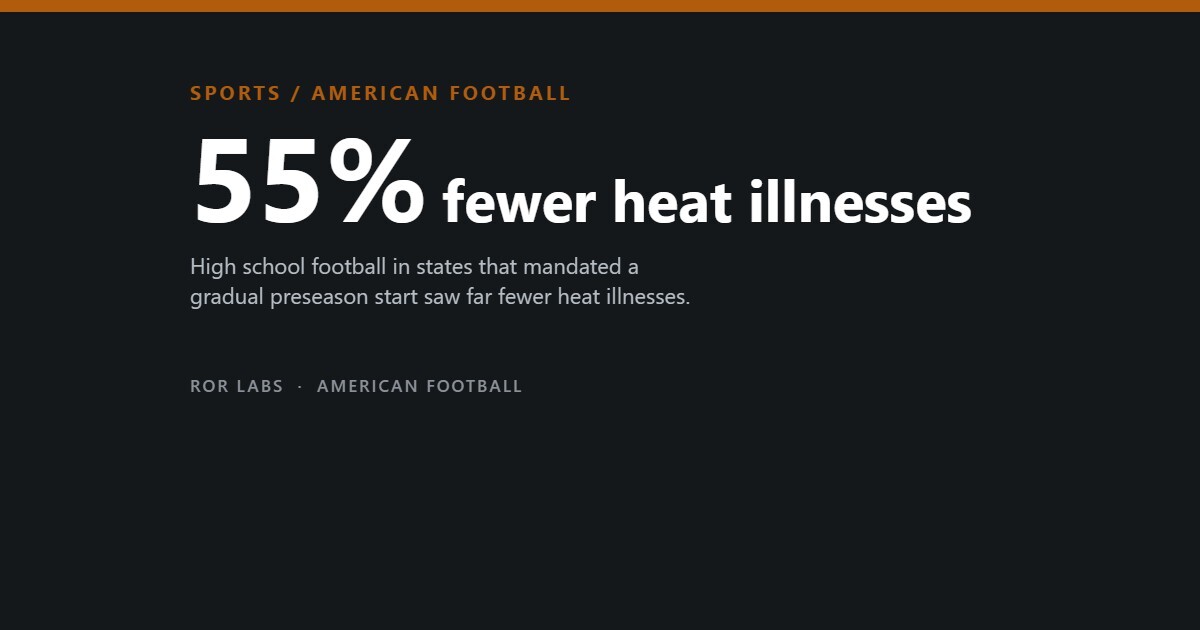
Prevention starts with acclimatisation: a gradual first week or two in which practice length, equipment and double sessions build up step by step. A national task force published guidelines for high schools in 2009. Comparing state-years from 2005 to 2017, researchers found heat illness rates in preseason practice of 0.42 per 10,000 athlete-exposures in states that mandated the guidelines and 0.72 in states that did not, a 55% reduction after adjusting for August temperatures and trends. The study was observational.
Preseason heat illness, with and without a state mandate
Heat illnesses per 10,000 athlete-exposures in high school football preseason practice, 2005/06 to 2016/17.
Source: Kerr et al., Environmental Health Perspectives (2019), doi:10.1289/EHP4163.
Here the evidence is weaker than the story often told. Only eight states, and 32 of 455 state-years, met the guidelines, so the mandate figure rests on seven cases. Colleges are the starker example. The 2001 death of Korey Stringer, the Minnesota Vikings tackle, helped prompt heat policies at every level, and in 2003 the NCAA required five days of single practices with equipment added gradually. A 2020 analysis found no significant change in college heat deaths afterwards, and four of six later deaths came outside that five-day window.
Why the answer is not to stop playing

Set against the roughly 1.1 million high school players, the risk to any one of them is small. From 1998 to 2018 the rate of fatal heatstroke was about 0.15 per 100,000 high school players a year, roughly one in 700,000. College players faced about four times that rate, still under one in 100,000. The national count fell from 12 deaths in 2016 to 2020 to fewer in the five years since.
The risk is not fixed. It is a distribution that rules and habits move: the first two weeks, the biggest players, the hottest hour and conditioning drills hold most of it, and each can be changed. Texas has just made on-site measurement of the wet-bulb globe temperature and a rapid-cooling tub or tarp mandatory for school sport from August 2026, after a 15-year-old in Lancaster died of heatstroke in 2025. California went the other way in September 2026, requiring a yearly review of its thresholds after a legislator argued that desert communities, used to the heat, were losing too many practices.
For parents and players the list is short. Ask whether the school has an athletic trainer, measures the wet-bulb globe temperature and has a tub filled before practice. Treat the first fortnight as the dangerous part of the season. Linemen, and anyone with sickle cell trait, need closer watching. Confusion, stumbling or collapse in the heat means cold water at once, then the ambulance.
How rare a heat death is in football
Fatal exertional heatstroke per 100,000 players a season, before and after the NCAA’s 2003 acclimatisation rule.
Source: Boden et al., Orthopaedic Journal of Sports Medicine (2020), National Registry of Catastrophic Sports Injuries, 1998 to 2018. Differences were not statistically significant.
Questions people ask
How many football players die of heatstroke each year?
In the United States, a few a year. The North Carolina catastrophic-injury centre counts 73 football heatstroke deaths since 1996, most in high school: 12 in the five years from 2016 to 2020, and fewer since.
Is exertional heatstroke survivable?
Almost always, if the player is cooled quickly. At one road race all 274 heatstroke patients treated in cold-water tubs survived. Cooling should start on site, before transport.
Why are linemen at higher risk?
They are the biggest players, and a 2024 review notes that linemen heat up faster and cool down more slowly than others. In two case series, linemen were 86% and 97% of football heatstroke deaths.
What is the wet-bulb globe temperature?
A heat-stress reading that combines air temperature, humidity, sunshine and wind. It is more useful for sport than air temperature or the heat index, and thresholds differ by region.
The short version
- Exertional heatstroke has killed 73 American football players since 1996, mostly high school players and linemen, most often in August.
- Heat illness clusters in the first two to three weeks of preseason; in one Florida study the first 19 practices carried 23.7 times the risk.
- Cooling in cold water on site is the key treatment: at one road race all 274 heatstroke patients treated that way survived.
- States that mandated gradual preseason acclimatisation saw 55% lower heat illness rates, though the estimate rests on few cases.
- The risk to any one player is about one in 700,000 a year in high school. Play carefully: start slowly, measure the heat, fill the tub.
This is a summary of published research, not medical advice. Anyone who becomes confused, stumbles or collapses while exercising in the heat needs emergency care: start cooling with cold water at once and call emergency services. Talk to a doctor or physiotherapist about returning to sport after heat illness, and about your own risks.
Further reading: Kerr et al., Environmental Health Perspectives (2019), for state heat-acclimatisation mandates. DeMartini et al., Medicine & Science in Sports & Exercise (2015), for cold-water immersion at the Falmouth Road Race. Boden et al., Orthopaedic Journal of Sports Medicine (2020), for a sceptical look at the NCAA rule.
- The Heat Will Kill You First, Jeff Goodell (2023). A journalist’s tour of what extreme heat does to bodies and places, including why heat kills faster than people expect.
- Exercised, Daniel E. Lieberman (2021). A Harvard biologist on how the body evolved to move, sweat and cope with heat, and what that means for training.
- Burn, Herman Pontzer (2021). How the body really spends energy; useful background on why big, hard-working bodies make so much heat.
Sources
- Kucera KL, Colgate B, Cantu RC. Annual Survey of Football Injury Research, 1931–2025. National Center for Catastrophic Sport Injury Research, University of North Carolina at Chapel Hill (March 2026).
- Boden BP, Fine KM, Breit I, Lentz W, Anderson SA. Nontraumatic exertional fatalities in football players, part 1: epidemiology and effectiveness of National Collegiate Athletic Association bylaws. Orthopaedic Journal of Sports Medicine (2020), doi:10.1177/2325967120942490.
- Grundstein AJ, Ramseyer C, Zhao F, et al. A retrospective analysis of American football hyperthermia deaths in the United States. International Journal of Biometeorology (2010), doi:10.1007/s00484-010-0391-4.
- Grundstein A, Hosokawa Y, Casa DJ. Fatal exertional heat stroke and American football players: the need for regional heat-safety guidelines. Journal of Athletic Training (2018), doi:10.4085/1062-6050-445-16.
- Anderson SA, Eichner ER, Bennett S, et al. Preventing exertional heat stroke in football: time for a paradigm shift. Sports Health (2024), doi:10.1177/19417381241260045.
- Yeargin SW, Kerr ZY, Casa DJ, et al. Epidemiology of exertional heat illnesses in youth, high school, and college football. Medicine & Science in Sports & Exercise (2016), doi:10.1249/MSS.0000000000000934.
- Cooper ER, Ferrara MS, Casa DJ, et al. Exertional heat illness in American football players: when is the risk greatest? Journal of Athletic Training (2016), doi:10.4085/1062-6050-51.8.08.
- Tripp BL, Winkelmann ZK, Eberman LE, Smith MS. Factors affecting incidence rate of exertional heat illnesses: analysis of 6 years of high school football practices in North Central Florida. Orthopaedic Journal of Sports Medicine (2021), doi:10.1177/23259671211026627.
- DeMartini JK, Casa DJ, Stearns RL, et al. Effectiveness of cold water immersion in the treatment of exertional heat stroke at the Falmouth Road Race. Medicine & Science in Sports & Exercise (2015), doi:10.1249/MSS.0000000000000409.
- Casa DJ, McDermott BP, Lee EC, et al. Cold water immersion: the gold standard for exertional heatstroke treatment. Exercise and Sport Sciences Reviews (2007), doi:10.1097/jes.0b013e3180a02bec.
- Roberts WO, Armstrong LE, Sawka MN, et al. ACSM expert consensus statement on exertional heat illness: recognition, management, and return to activity. Current Sports Medicine Reports (2021), doi:10.1249/JSR.0000000000000878.
- Kerr ZY, Scarneo-Miller SE, Yeargin SW, et al. Exertional heat-stroke preparedness in high school football by region and state mandate presence. Journal of Athletic Training 54(9):921 (2019), doi:10.4085/1062-6050-581-18.
- Kerr ZY, Register-Mihalik JK, Pryor RR, et al. The association between mandated preseason heat acclimatization guidelines and exertional heat illness during preseason high school American football practices. Environmental Health Perspectives (2019), doi:10.1289/EHP4163.
- Grundstein A, Knox JA, Vanos J, et al. American football and fatal exertional heat stroke: a case study of Korey Stringer. International Journal of Biometeorology (2017), doi:10.1007/s00484-017-1324-2.
- Medical staffs prepare for new football model. NCAA News, 14 April 2003 (NCAA News Archive).
- Zeff S. Shawnee Mission football player died of heat stroke. HPPR / Kansas News Service, 14 October 2024.
- High school football player dies after ‘medical emergency’ during practice. ABC7, 21 August 2025.
- Kite A. Texas high schools face mandatory heat safety rules for outdoor activities starting Aug. 1. FOX 4 News, 27 July 2026.
- Newsom signs law that could allow student athletes to play in higher temperatures. EdSource, 1 September 2026.