Basketball sudden cardiac arrest, the screening fight and the defibrillator on the wall
Key takeaways · 10 min read
- Division I men’s basketball has the highest sudden cardiac death rate in US college sport, about one in 8,188 athlete-years over 20 years.
- Hypertrophic cardiomyopathy is the most common identified cause, but many deaths show a normal heart at autopsy.
- Italy’s famous 89% fall after ECG screening started from an unusually high baseline; Israel saw no change after its 1997 law.
- When a defibrillator was used on campus, 85% of high-school athletes who arrested during exercise survived.
On 27 January 2026 a 16-year-old junior from Teaneck High School in New Jersey went to get a drink of water during a varsity basketball game and fell to the floor. The athletic trainer at the host school used a defibrillator to shock his heart back into rhythm and gave CPR, and two doctors came down from the stands to help. He was found to have hypertrophic cardiomyopathy, had a small defibrillator implanted, and was expected back at school within weeks.
Basketball keeps turning up at the top of these tables. In a ten-year review of every death among US college athletes, men in Division I basketball died suddenly from cardiac causes at about one in 5,200 a year, roughly ten times the college average. In July 2023 LeBron James’s son Bronny, then 18, collapsed during a workout at the University of Southern California; his family later blamed a congenital heart defect.
This article covers what stops a young athlete’s heart, where the risk concentrates and why the figures are shakier than they look, the long argument over screening with an electrocardiogram (ECG), the evidence that defibrillators and rehearsed emergency plans save most of those who collapse, and why the sensible response is to play carefully rather than to stop.
What happens when a young athlete’s heart stops
Sudden cardiac arrest is an electrical failure: the heart’s lower chambers quiver instead of pumping, and the person collapses and stops breathing normally within seconds. Without CPR and a shock, death follows within minutes. In young athletes it is often the first sign of a heart condition nobody knew about. Exertion does not create the fault but can trigger it; in a large US surveillance study, 74% of arrests happened during exercise.
That study, run through the National Center for Catastrophic Sports Injury Research from 2014 to 2018, reviewed 331 confirmed arrests and deaths in competitive athletes, 158 of whom survived. Basketball accounted for 28.7% of cases, more than American football. Hypertrophic cardiomyopathy, an inherited thickening of the heart muscle, was the most common identified cause, followed by idiopathic left ventricular hypertrophy, a thickened heart that falls short of that diagnosis.
What lies behind sudden cardiac arrest in young athletes
Share of cases. Rows come from two US studies and different subgroups, as labelled; they are not meant to add up.
Sources: Peterson et al., British Journal of Sports Medicine (2021), 331 arrests and deaths; Harmon et al., Circulation (2015), NCAA deaths 2003–2013.
The causes change with age. Anomalous coronary arteries, which a resting ECG usually misses, explained 28% of cases in middle-school athletes, while cardiomyopathies explained 47% in college and professional athletes. Among college deaths from 2003 to 2013, the most common finding was a heart that looked normal at autopsy, which points to electrical diseases that leave no visible trace. Records to establish a cause were missing in 37% of the surveillance cases, so every percentage here is provisional.
Where the risk concentrates
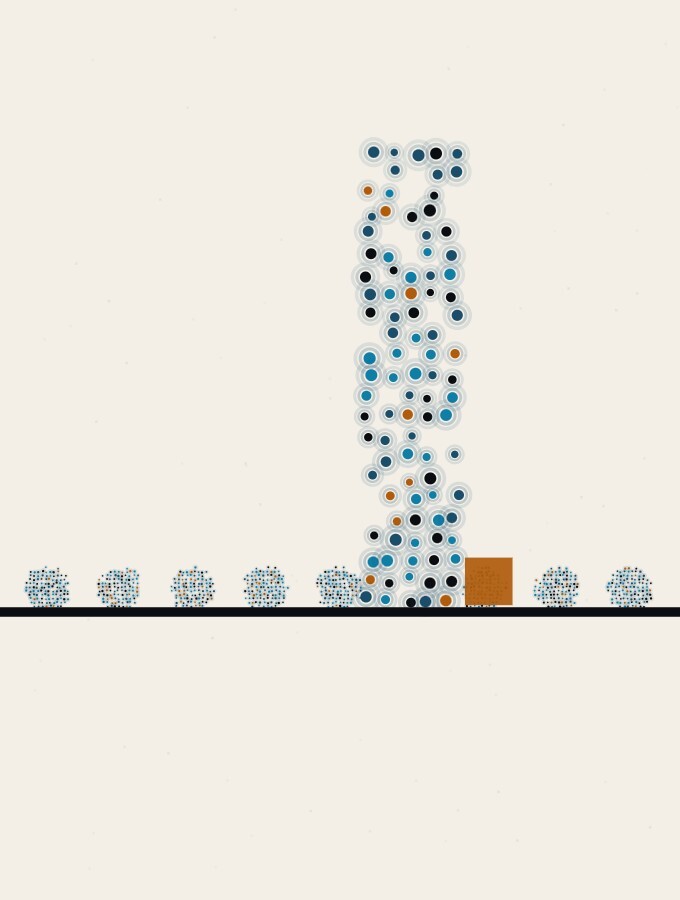
The best US data come from the National Collegiate Athletic Association (NCAA), because it knows how many athletes it has each year. A 20-year study covering 2002 to 2022 searched four independent sources and found 143 sudden cardiac deaths among 1,102 athlete deaths, over about 9.1 million athlete-years. The overall rate was one in 63,682 a year. Men carried about four times the risk of women, and Black athletes nearly three times the risk of white athletes.
Division I men’s basketball stood out in every analysis, at one death in 8,188 athlete-years across the 20 years. In the 2014–2018 surveillance, which counted survivors as well as deaths, Black men in Division I basketball had arrests or deaths at one in 2,087 athlete-years, 21 times the rate in an average male high-school athlete. Nobody has established why basketball carries this excess; the review that first highlighted it said it requires further investigation.
Sudden cardiac death rates in US college athletes
Per 100,000 athlete-years (one athlete on a roster for one season). The “1 in” figure each rate was converted from is in brackets.
Sources: Petek et al., Circulation (2023) and its conference abstract; Harmon et al., Circulation (2015, 2011); Peterson et al., BJSM (2021). The last row includes survivors.
These are small numbers dressed as precise ones. An athlete-year is one person on a roster for one season, and Division I men’s basketball contributes relatively few, so a handful of deaths moves the rate a long way. The same group’s figure went from one in 3,100 for 2004–2008 to one in 8,188 over 20 years, partly because sudden cardiac death fell by roughly 29% per five-year period. In the 20-year conference abstract, white players’ rate, one in 5,848, was higher than Black players’, one in 7,696.
Counting matters too. A 2014 review found that studies relying on news reports or insurance claims underestimate the risk, and judged one in 50,000 a year a reasonable overall estimate for young athletes. No single source catches everything: in the 20-year NCAA study the association’s own list found 82% of cases, media reports 62% and insurance claims 19%.
What has been measured to work
Screening is where the field has argued for four decades. Italy made a pre-participation check including a 12-lead ECG compulsory for competitive athletes in 1982. In 2006 Domenico Corrado’s team in Padua reported that in the Veneto region, sudden cardiovascular deaths among screened athletes aged 12 to 35 fell from 3.6 per 100,000 person-years in 1979–80 to 0.4 in 2003–04, a decline of 89%, while the rate in unscreened non-athletes did not change significantly.
The fall was driven by fewer deaths from cardiomyopathies, and about 2% of screened athletes were disqualified on cardiovascular grounds. The European Society of Cardiology and the International Olympic Committee went on to endorse screening modelled on the Italian system. In 2007 an American Heart Association panel recommended against adopting it in the United States, citing a lack of infrastructure, providers and expertise, and kept to a history and physical examination.
Before and after compulsory ECG screening
Sudden cardiac deaths (Israel: deaths and arrests) per 100,000 athlete-years or person-years, as reported.
Sources: Corrado et al., JAMA 296:1593 (2006); Maron et al., American Journal of Cardiology (2009); Steinvil et al., JACC 57:1291 (2011). All observational.
The 89% figure is the most quoted number in the debate, and it rests on a high starting point taken from the two years before the programme began. Critics have noted that the baseline was unusually high and suggested the later fall may partly reflect regression to the mean. Israel made ECG screening compulsory in 1997 and saw no change: 2.54 events per 100,000 athlete-years before, 2.66 after, from newspaper-based counts. Minnesota, screening without ECGs, had a lower rate than Veneto overall.
Screening also misses people. The English Football Association screened 11,168 adolescent players with an ECG and an echocardiogram between 1996 and 2016; eight later died suddenly of heart disease, and six of them had had normal screening. Where the ECG does help is detection. Among 3,620 US high-school athletes, it flagged 15 of 16 conditions linked to sudden death; the American Heart Association’s 14-point questionnaire flagged seven.
ECG against a history questionnaire
Detection and false alarms. Top four rows: one prospective study of 3,620 high-school athletes; bottom two: a 2026 meta-analysis of 27,891 college athletes.
Sources: Williams et al., Journal of the American Heart Association (2019); Conway et al., BJSM 60(5):379 (2026).
Detection is not the same as prevention, and none of these studies was randomised. Several authors of the high-school study are medical advisers to the Nick of Time Foundation, the screening charity that made it possible, which they disclosed. What has clearly been measured is survival once an arrest happens. Across 641 arrests in young US athletes from 2014 to 2023, 49% survived, and survival rose from 48% in 2014–15 to 72% in 2022–23.
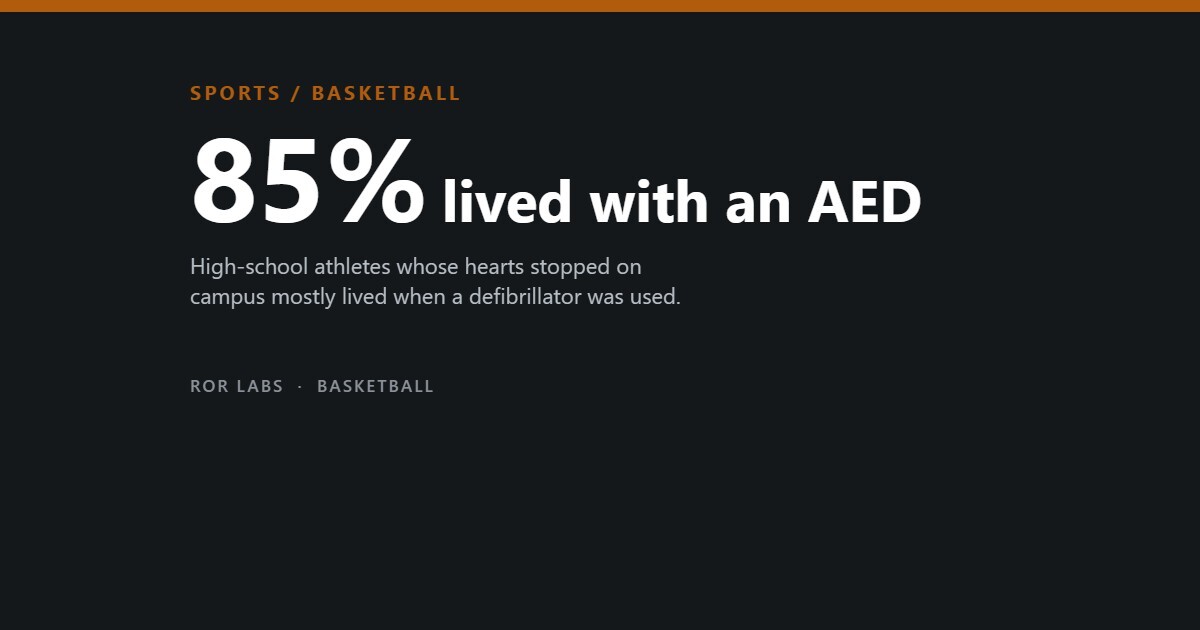
Schools show why. Among 111 high-school athletes who collapsed during exercise on campus between 2014 and 2018, 68% survived: 80% when bystanders gave CPR and 85% when an on-site defibrillator was used. Nationally, children whose hearts stop outside hospital survive about 8% of the time. Yet in a survey of 1,710 high schools with defibrillators, only 40% practised their emergency plan at least once a year.
Who survives a sudden cardiac arrest
Survival to hospital discharge or as reported, young US athletes. Observational surveillance data.
Sources: Schattenkerk et al., BJSM 56(3):138 (2022); Petek et al., JACC (2025) and ACC press release, March 2025.
The gaps are a warning. Black athletes who arrested during exertion survived 43% of the time against 68% for white athletes, and in high schools the difference was not fully explained by school income. The NCAA’s interassociation consensus asks every member school for an emergency action plan and defibrillators at all sporting facilities, and says any ECG screening should be read with modern athlete-specific standards.
Why the answer is to play carefully, not to stop
Even in the group at highest risk the absolute numbers are small. One death in 8,188 athlete-years means a Division I squad of 15 would, on simple arithmetic, expect one death in roughly 550 seasons. The trend also runs the right way: sudden cardiac death among college athletes fell over 20 years and survival after arrest climbed. Bronny James made his debut for USC on 10 December 2023, less than five months after his arrest, and was drafted by the Los Angeles Lakers in 2024.
A diagnosis is no longer an automatic end to sport. In LIVE-HCM, a multinational observational study of people aged 8 to 60 with hypertrophic cardiomyopathy followed for a median of 38 months, those who exercised vigorously had arrhythmic events or died at 15.9 per 1,000 person-years, against 15.3 for those who did not. Activity was self-reported and nobody was randomised, but guidelines have moved towards shared decisions with a specialist.
What players and parents can do is concrete. Tell the doctor about fainting or chest pain during exercise, and about any relative who died suddenly of heart disease before 50. Learn hands-only CPR. Ask where the defibrillator is in every gym, and whether coaches have rehearsed the plan. A player who collapses and is not breathing normally should be treated as a cardiac arrest: call emergency services, start compressions and shock as soon as possible.
Questions people ask
Should every young basketball player have an ECG?
Expert bodies disagree. European and Olympic bodies favour it; US cardiology societies have preferred a history and examination. Modern athlete-specific criteria have cut false positives to around 5% or less, but screening still misses some conditions, and it works only where experienced readers are available.
Why is basketball riskier than other sports?
No one knows for certain. The excess appears consistently in men’s basketball, especially Division I, but the reasons have not been established, and the small number of players makes the estimates unstable.
What does a cardiac arrest look like on court?
A sudden collapse, no response and no normal breathing, sometimes only gasping. Call emergency services, start chest compressions and use the nearest defibrillator as soon as it arrives.
Can someone with a heart condition keep playing?
Sometimes. Decisions are now made case by case with a cardiologist. In one observational study, people with hypertrophic cardiomyopathy who exercised vigorously had no more arrhythmic events than those who did not.
The short version
- Division I men’s basketball has the highest sudden cardiac death rate in US college sport, about one in 8,188 athlete-years over 20 years.
- Hypertrophic cardiomyopathy is the most common identified cause, but many deaths show a normal heart at autopsy.
- Italy’s famous 89% fall after ECG screening started from an unusually high baseline; Israel saw no change after its 1997 law.
- When a defibrillator was used on campus, 85% of high-school athletes who arrested during exercise survived.
- The risk is small and falling. Play carefully: know the warning signs, learn CPR and know where the defibrillator is.
This is a summary of published research, not medical advice. If you have fainted or had chest pain during exercise, or a relative died suddenly young, talk to your doctor before training hard. CPR and a defibrillator save lives: if someone collapses and is not breathing normally, call emergency services straight away.
Further reading: Petek et al., Circulation (2023), for 20 years of NCAA deaths. Schattenkerk et al., British Journal of Sports Medicine 56(3):138 (2022), for survival in high-school athletes. Malhotra et al., New England Journal of Medicine 379(6):524 (2018), for what screening misses.
- Calling Bullshit, Carl T. Bergstrom and Jevin D. West (2020). Two scientists on how numbers mislead, from base rates to selection effects. The athlete-year denominators in this article are a textbook case.
- The Data Detective, Tim Harford (2021). Ten rules for reading statistics without being fooled or becoming cynical. Useful for weighing famous figures like Italy’s 89%.
- Noise, Daniel Kahneman, Olivier Sibony and Cass R. Sunstein (2021). Why experts reading the same evidence reach different verdicts. Background for why ECG reading standards matter; it is not about cardiology.
Sources
- Peterson DF, Kucera KL, Thomas LC, et al. Aetiology and incidence of sudden cardiac arrest and death in young competitive athletes in the USA: a 4-year prospective study. British Journal of Sports Medicine (2021), doi:10.1136/bjsports-2020-102666.
- Harmon KG, Asif IM, Maleszewski JJ, et al. Incidence, etiology, and comparative frequency of sudden cardiac death in NCAA athletes: a decade in review. Circulation (2015), doi:10.1161/CIRCULATIONAHA.115.015431.
- Harmon KG, Asif IM, Klossner D, Drezner JA. Incidence of sudden cardiac death in National Collegiate Athletic Association athletes. Circulation (2011), doi:10.1161/CIRCULATIONAHA.110.004622.
- Petek BJ, Churchill TW, Moulson N, et al. Sudden cardiac death in National Collegiate Athletic Association athletes: a 20-year study. Circulation (published online November 2023), PMC10843024; and conference abstract 13427, Circulation 148(Suppl 1) (2023), doi:10.1161/circ.148.suppl_1.13427.
- Harmon KG, Drezner JA, Wilson MG, Sharma S. Incidence of sudden cardiac death in athletes: a state-of-the-art review. British Journal of Sports Medicine 48(15):1185 (2014).
- Corrado D, Basso C, Pavei A, Michieli P, Schiavon M, Thiene G. Trends in sudden cardiovascular death in young competitive athletes after implementation of a preparticipation screening program. JAMA 296:1593–1601 (2006); ScienceDaily summary, October 2006.
- Seto CK, Pendleton ME. Preparticipation cardiovascular screening in young athletes: current guidelines and dilemmas. Current Sports Medicine Reports (2009), doi:10.1249/JSR.0b013e31819ccdaf.
- La Gerche A, Calkins HG. T-wave subtleties in screened athletes. European Heart Journal (2016), doi:10.1093/eurheartj/ehv612.
- Steinvil A, Chundadze T, Zeltser D, et al. Mandatory electrocardiographic screening of athletes to reduce their risk for sudden death: proven fact or wishful thinking? Journal of the American College of Cardiology 57:1291–1296 (2011); ACC journal scan, March 2011.
- Maron BJ, Haas TS, Doerer JJ, Thompson PD, Hodges JS. Comparison of U.S. and Italian experiences with sudden cardiac deaths in young competitive athletes. American Journal of Cardiology (2009), doi:10.1016/j.amjcard.2009.03.037.
- Malhotra A, Dhutia H, Finocchiaro G, et al. Outcomes of cardiac screening in adolescent soccer players. New England Journal of Medicine 379(6):524–534 (2018).
- Williams EA, Pelto HF, Toresdahl BG, et al. Performance of the American Heart Association 14-point evaluation versus electrocardiography for the cardiovascular screening of high school athletes. Journal of the American Heart Association (2019), doi:10.1161/JAHA.119.012235.
- Conway JJ, Bennett D, Asif IM, Teramoto M, Toresdahl BG. Pre-participation cardiovascular screening among NCAA athletes: a systematic review and meta-analysis of 27 891 athletes. British Journal of Sports Medicine 60(5):379 (2026), doi:10.1136/bjsports-2025-110791.
- Hainline B, Drezner JA, Baggish A, et al. Interassociation consensus statement on cardiovascular care of college student-athletes. British Journal of Sports Medicine 51(2):74 (2017).
- Petek BJ, Churchill TW, Moulson N, et al. Survival outcomes after sudden cardiac arrest in young competitive athletes from the United States. Journal of the American College of Cardiology (2025), doi:10.1016/j.jacc.2025.03.006; American College of Cardiology press release, 30 March 2025.
- Schattenkerk J, Kucera KL, Peterson DF, Huggins RA, Drezner JA. Socioeconomic factors and outcomes from exercise-related sudden cardiac arrest in high school student-athletes in the USA. British Journal of Sports Medicine 56(3):138 (2022), doi:10.1136/bjsports-2021-104486.
- Drezner JA, Rao AL, Heistand J, Bloomingdale M, Harmon KG. Effectiveness of emergency response planning for sudden cardiac arrest in United States high schools with automated external defibrillators. Circulation (2009), doi:10.1161/CIRCULATIONAHA.109.855890.
- Lampert R, Ackerman MJ, Marino BS, et al. Vigorous exercise in patients with hypertrophic cardiomyopathy (LIVE-HCM). JAMA Cardiology (2023), doi:10.1001/jamacardio.2023.1042.
- Harris B. Bronny James has a congenital heart defect that caused his cardiac arrest, a spokesperson says. Associated Press, 25 August 2023; Associated Press reports on his USC debut (10 December 2023) and the 2024 NBA draft.
- NJ teen went into cardiac arrest during a basketball game. Quick thinking helped save his life. NBC New York, 3 February 2026.