Basketball Achilles ruptures, from the 2025 NBA cluster to the weekend court
Key takeaways · 10 min read
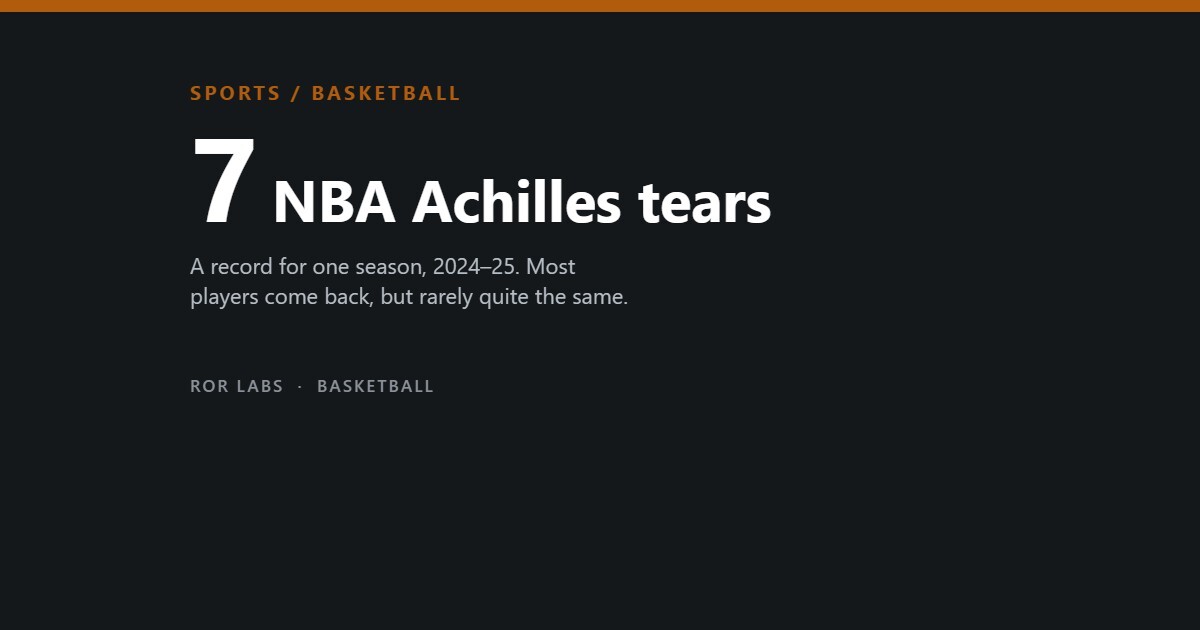
- The NBA recorded seven Achilles tears in 2024–25, including Haliburton, Tatum and Lillard; the previous record was four, and the next season had one.
- Between 61% and 87% of NBA players return after a rupture, usually within 11 months, but minutes, scoring and starts tend to fall.
- Away from the NBA, basketball causes more Achilles ruptures than any other sport in the US, and incidence peaks in men aged 30 to 49.
- In large trials, non-surgical treatment with early movement gave similar function to surgery, with more re-ruptures but fewer nerve injuries.
Seven minutes into Game 7 of the 2025 NBA Finals, Tyrese Haliburton of the Indiana Pacers collapsed on the court. He had torn his right Achilles tendon, and Indiana later ruled him out of the whole 2025–26 season. He was the third star to rupture an Achilles in those playoffs, after Damian Lillard in the first round and Jayson Tatum in the second. Across the 2024–25 season the league counted seven Achilles tears, the most on record; the previous high was four.
Tatum came back on 6 March 2026, 298 days after his injury, with 15 points, 10 rebounds and seven assists against Dallas. That is roughly what the research predicts: most NBA players do return, usually within a year. The less comfortable part of the prediction is what comes after. Returning players tend to play fewer minutes, score less and start fewer games, and a sizeable minority never play in the league again.
This article covers how the tendon fails, why the ordinary pick-up player in their thirties or forties is the person most at risk, whether the 2025 cluster was more than bad luck, what randomised trials found about surgery and bracing, and why the sensible response is to prepare better rather than stop playing. Ankle sprains and knee ligament injuries have their own article on this site.
What happens when the Achilles tears
The Achilles joins the calf muscles to the heel bone, and in basketball it usually fails during an explosive start rather than a collision. Lemme and colleagues reviewed NBA ruptures from 1969–70 to 2017–18 and analysed footage of 12. All were noncontact, most often just as a player pushed off from a stopped position, with the foot flexed upwards, the knee slightly bent and the hip extended.
A later analysis of 13 videos found the ankle flexed upwards in every case, after a “false step”: a short step backwards before driving forward. The tendon is often not healthy beforehand. When Kannus and Józsa examined 891 spontaneously ruptured tendons, 397 of them Achilles, none had a healthy structure and 97% of the changes were degenerative. Two-thirds of matched tendons from people who had died in accidents were healthy.
The consequences in the NBA have been measured several times, always with small numbers because ruptures are rare. Amin and colleagues, writing in 2013 about 18 players repaired between 1988 and 2011, found that 39% never played another NBA game. Those who returned lost more than four points of Player Efficiency Rating in each of the next two seasons. Later studies report higher return rates.
How many NBA players returned after an Achilles rupture
Share who played at least one more NBA game, by study. Samples are small, so one or two players move each percentage noticeably.
Sources: Amin et al., AJSM 41(8) (2013); Khalil et al., OJSM (2020); Lemme et al., AJSM 47(10) (2019), as tabulated by Allahabadi et al. (2021); Maman et al., OJSM (2026); Zellers et al., BJSM (2016).
The newest study, by Maman and colleagues in 2026, counted 22 confirmed ruptures between 2000 and 2025. Of the 15 players followed long enough, 13 returned, after an average of 10.8 months. Their first full season back still looked different from their last full season before. Scoring fell even after allowing for fewer minutes, while steals, blocks and defensive rebounds per 48 minutes held up.
What changed when NBA players came back
Last full season before the rupture against the first full season after return, 2000–2025. All changes statistically significant. Bars scaled to the largest change.
Source: Maman et al., Orthopaedic Journal of Sports Medicine (2026), doi:10.1177/23259671261461403.
Where the risk concentrates
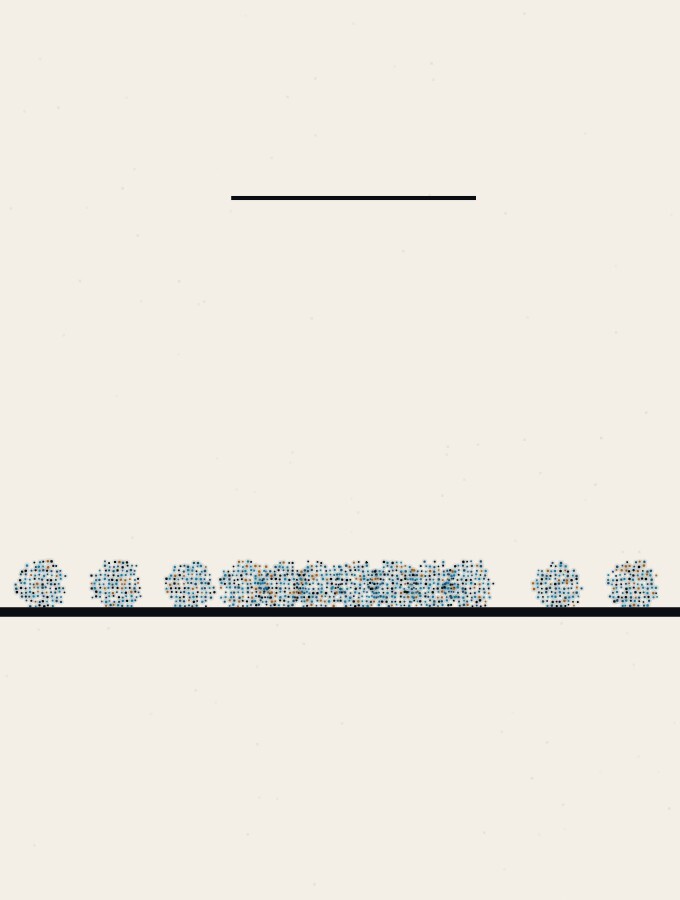
Outside the NBA, the person most likely to tear an Achilles is a man in his thirties or forties playing pick-up basketball. A study of American emergency departments from 2012 to 2016 estimated nearly 33,000 ruptures. About 82% happened during sport or recreation, and basketball caused 42.6% of the sport-related ones, more than four times as many as soccer. It was the leading cause in every age group under 60, and men made up 77% of patients.
The incidence is rising. In the same American data it climbed from 1.8 to 2.5 per 100,000 people a year within five years, and the steepest rise, 78%, was among people aged 40 to 59. A 2026 meta-analysis of population studies worldwide estimated an average increase of 2.7% a year since 1979, with the peak among men aged 30 to 49. Emergency-department counts miss patients seen elsewhere, which helps explain why they sit far below registry figures.
Achilles ruptures per 100,000 people a year
Pooled estimates from a 2026 meta-analysis of population registries and representative samples, with one US emergency-department figure for comparison.
Sources: Kotsifaki et al., Sports Medicine 56(6):1467 (2026); Lemme et al., OJSM (2018).
What people were doing when the tendon tore
Share of sport-related Achilles ruptures seen in US emergency departments, 2012–2016 (national estimates). Bars scaled to basketball.
Source: Lemme et al., Orthopaedic Journal of Sports Medicine (2018), based on the NEISS database. Among men, basketball accounted for 46.9%.
The professional game adds its own pattern. In Lemme’s 2019 review of NBA ruptures, 27% happened in the early regular season and another 18% in preseason. In Amin’s series the average player was 29.7 years old with 7.6 seasons in the league. The toll was heavy: in Lemme’s series, 21% of ruptures ended in retirement.
Was 2025 a warning or a fluke? Two NBA studies published in the same journal in July 2026 show how slippery the counting is: one found 22 ruptures in 25 seasons, fewer than one a year, while a conference abstract from another team reported 1.36 a season between 1990 and 2023. On either baseline, a simple calculation shows seven in one season would be very unlikely by chance alone. Yet the following season produced one, Donte DiVincenzo’s, in the April 2026 playoffs.
Whether heavy minutes are to blame is disputed. Kumar and colleagues looked at 19 NBA ruptures from 2014–15 to 2024–25 and found players averaged 29.0 minutes in the 10 games before injury against 27.4 across their season, about a minute and a half more. They compared players with their own averages, not with uninjured players. The NBA’s director of sports medicine, John DiFiori, said the league’s own review found no link between minutes and Achilles injuries.
A third 2026 study offers a more practical signal. Among NBA players, a previous calf strain was associated with about two and a half times the odds of a later Achilles rupture, and in most players with both injuries they were on the same leg, about two years apart. The design was unusual and the numbers small, so treat it as a warning light rather than a measured cause.
What has been measured to work
For a ruptured tendon, the big question used to be whether to operate. The largest trial so far, run at four Norwegian centres and published in the New England Journal of Medicine in 2022, randomised 554 adults, average age 40, to non-operative treatment, open repair or minimally invasive surgery. After a year, scores on a 100-point Achilles questionnaire had changed by −17, −16 and −14.7 points, with no evidence of a difference.
The trade-off lay elsewhere. The tendon re-ruptured in 6.2% of the non-operative group and 0.6% of each surgical group, while nerve injuries ran at 0.6%, 2.8% and 5.2%. A British trial, UKSTAR, then tested how best to treat ruptures without surgery: 540 patients at 39 NHS hospitals, average age 48.7 and 70% injured in sport, received either a plaster cast or a functional brace that allows early weight-bearing.
Re-rupture and nerve injury in two large trials
Share of patients. Myhrvold: 554 randomised, 12 months. UKSTAR: 540 randomised, all treated without surgery, 9 months. Bars scaled to the largest value.
Sources: Myhrvold et al., NEJM (2022), doi:10.1056/NEJMoa2108447, as summarised in American Family Physician (2022); Costa et al., Lancet 395:441 (2020), and the NIHR trial report (2020).
UKSTAR found no meaningful difference in Achilles scores at nine months, a better score in the brace group at eight weeks, and costs that were marginally, though not significantly, lower with the brace. Pooled analyses tell a consistent story: a 2025 meta-analysis of randomised trials found surgery cut the risk of re-rupture by more than half but raised the risk of infection and nerve injury. It also found a modestly higher return to sport after surgery, based on only four trials.
Practice has shifted. The 2026 meta-analysis found that surgical repair rates peaked in 2003 and have fallen since. The trial patients were ordinary adults, not professionals, and the NBA studies above were mostly of surgically repaired players. For a recreational player, the decision is a conversation about re-rupture against wound and nerve risk, and either way the rehabilitation matters. Across 108 studies, about 80% of patients returned to their sport.
Why the answer is not to stop playing
Put the risk in proportion. Even in the peak group, men aged 30 to 49, the pooled rate is about 43 ruptures per 100,000 a year, roughly one in 2,300, and that figure covers all men of that age, not only those who play. Inactivity carries a larger and quieter risk: the World Health Organization estimates that people who are insufficiently active have a 20% to 30% higher risk of death than people who are active enough.
No trial has shown that a particular exercise prevents Achilles ruptures, so practical advice follows the patterns rather than proof. NBA ruptures concentrated in preseason and the early season, which argues for building back gradually after time off rather than going straight into full games. A calf strain, or an Achilles that stays sore, is a reason to ease off and have it assessed instead of playing through it.
If the tendon does go, get it assessed promptly; UKSTAR, for example, enrolled patients only within 14 days of injury. Then expect a long road. NBA players with the best support in the world needed close to 11 months. The weekend player has one advantage over Tatum or Haliburton: nobody needs them back at full speed by next season, and a patient return is the one most studies reward.
Questions people ask
Can NBA players come back from a torn Achilles?
Most do. Studies report that 61% to 87% played again in the NBA, typically after 10 to 11 months, but minutes, scoring and starts were usually lower in the first full season back.
Why does it happen to people in their thirties and forties?
Ruptured tendons almost always show degenerative changes, and explosive sports like basketball load them hard. Population incidence peaks in men aged 30 to 49.
Do I need surgery for a ruptured Achilles?
Not necessarily. In large trials, function a year later was similar with and without surgery. Surgery lowered the re-rupture rate but added wound and nerve risks. It is a decision to make with an orthopaedic surgeon.
Did heavy minutes cause the 2025 NBA tears?
Unproven. One small study found slightly more minutes in the weeks before ruptures; the NBA says its own data show no link, and the next season had one tear.
The short version
- The NBA recorded seven Achilles tears in 2024–25, including Haliburton, Tatum and Lillard; the previous record was four, and the next season had one.
- Between 61% and 87% of NBA players return after a rupture, usually within 11 months, but minutes, scoring and starts tend to fall.
- Away from the NBA, basketball causes more Achilles ruptures than any other sport in the US, and incidence peaks in men aged 30 to 49.
- In large trials, non-surgical treatment with early movement gave similar function to surgery, with more re-ruptures but fewer nerve injuries.
- No exercise has been proven to prevent ruptures; build up gradually after time off, take calf strains seriously and keep playing.
This is a summary of published research, not medical advice. If you feel a sudden pop or blow at the back of the ankle, or have persistent Achilles or calf pain, see a doctor or physiotherapist, and talk to them before returning to sport.
Further reading: Myhrvold et al., New England Journal of Medicine (2022), for the three-way trial of surgery and non-surgical care. Maman et al., Orthopaedic Journal of Sports Medicine (2026), for NBA returns from 2000 to 2025. Kotsifaki et al., Sports Medicine (2026), for worldwide incidence trends.
- Built to Move, Kelly Starrett and Juliet Starrett (2023). A physical therapist and his co-author set out ten simple daily habits for mobility, including ankle range and balance. Practical, not about Achilles ruptures specifically.
- Outlive, Peter Attia (2023). A physician argues for training strength and stability to stay active into old age. Persuasive on why to keep playing; some claims run ahead of the evidence.
- The Comeback Quotient, Matt Fitzgerald (2020). An endurance-sports writer on the mental side of setbacks and returns. About runners rather than basketball, but relevant to a year-long comeback.
Sources
- Maman D, Steinfeld Y, Ginesin E, Yonai Y, Berkovich Y. Achilles tendon rupture in the NBA: return to play, performance decline, and temporal trends (2000–2025). Orthopaedic Journal of Sports Medicine (2026), doi:10.1177/23259671261461403.
- Amin NH, Old AB, Tabb LP, et al. Performance outcomes after repair of complete Achilles tendon ruptures in National Basketball Association players. American Journal of Sports Medicine 41(8):1864–1868 (2013).
- Lemme NJ, Li NY, Kleiner JE, et al. Epidemiology and video analysis of Achilles tendon ruptures in the National Basketball Association. American Journal of Sports Medicine 47(10):2360–2366 (2019).
- Khalil LS, Jildeh TR, Tramer JS, et al. Effect of Achilles tendon rupture on player performance and longevity in National Basketball Association players. Orthopaedic Journal of Sports Medicine (2020), doi:10.1177/2325967120966041.
- Allahabadi S, Su F, Lansdown DA. Systematic review of orthopaedic and sports medicine injuries and treatment outcomes in WNBA and NBA players. Orthopaedic Journal of Sports Medicine (2021), doi:10.1177/2325967120982076.
- Petway AJ, Jordan MJ, Epsley S, Anloague PA. Mechanisms of Achilles tendon rupture in National Basketball Association players. Journal of Applied Biomechanics (2022), doi:10.1123/jab.2022-0088.
- Kannus P, Józsa L. Histopathological changes preceding spontaneous rupture of a tendon. Journal of Bone and Joint Surgery (American) (1991), doi:10.2106/00004623-199173100-00009.
- Lemme NJ, Li NY, DeFroda SF, Kleiner J, Owens BD. Epidemiology of Achilles tendon ruptures in the United States: athletic and nonathletic injuries from 2012 to 2016. Orthopaedic Journal of Sports Medicine (2018), doi:10.1177/2325967118808238.
- Kotsifaki A, Malliaras P, Byron C, Marques JB, Korakakis V, et al. Incidence, temporal trends, and surgical shift of Achilles tendon rupture: a systematic review and meta-analysis. Sports Medicine 56(6):1467–1487 (2026).
- Kumar VS, Sang LL, David W, Pandya NK. Short-term workload patterns before Achilles tendon rupture in National Basketball Association players. Orthopaedic Journal of Sports Medicine 14(7) (2026), doi:10.1177/23259671261463385; and conference poster 120, OJSM (2026).
- Elsabbagh Z, Le Y, Bcharah G, et al. Prior calf strain as a risk factor for Achilles tendon rupture in National Basketball Association players. Orthopaedic Journal of Sports Medicine (2026), doi:10.1177/23259671261449170.
- Myhrvold SB, Brouwer EF, Andresen TKM, et al. Nonoperative or surgical treatment of acute Achilles’ tendon rupture. New England Journal of Medicine (2022), doi:10.1056/NEJMoa2108447; trial summary in American Family Physician, September 2022.
- Costa ML, Achten J, Marian IR, et al. Plaster cast versus functional brace for non-surgical treatment of Achilles tendon rupture (UKSTAR). Lancet 395:441–448 (2020); full NIHR Health Technology Assessment report (2020).
- Yang Z, Ge Z, Zheng J, Zhang L, Yang Z. Surgical treatment versus conservative management for acute Achilles tendon rupture: a systematic review and meta-analysis. Journal of Orthopaedic Surgery and Research (2025), doi:10.1186/s13018-025-05990-y.
- Zellers JA, Carmont MR, Grävare Silbernagel K. Return to play post Achilles tendon rupture: a systematic review and meta-analysis. British Journal of Sports Medicine (2016), doi:10.1136/bjsports-2016-096106.
- World Health Organization. Physical activity fact sheet (accessed October 2026).
- NBC Sports / Associated Press. Tyrese Haliburton suffers torn Achilles in Pacers’ Game 7 loss, 23 June 2025; Front Office Sports, 23 July 2025; NBC Sports, Jayson Tatum returns from Achilles injury against the Mavericks, 6 March 2026.
- Donnelly P. Timberwolves lose Anthony Edwards and Donte DiVincenzo to leg injuries in Game 4 against Nuggets. Associated Press, 25 April 2026.
- Rapp T. NBA responds to study that relates heavy workloads to Achilles injuries. Bleacher Report, 3 August 2026.