Utility Shutoffs and Energy Insecurity: What the Evidence Shows
Key takeaways · 11 min read
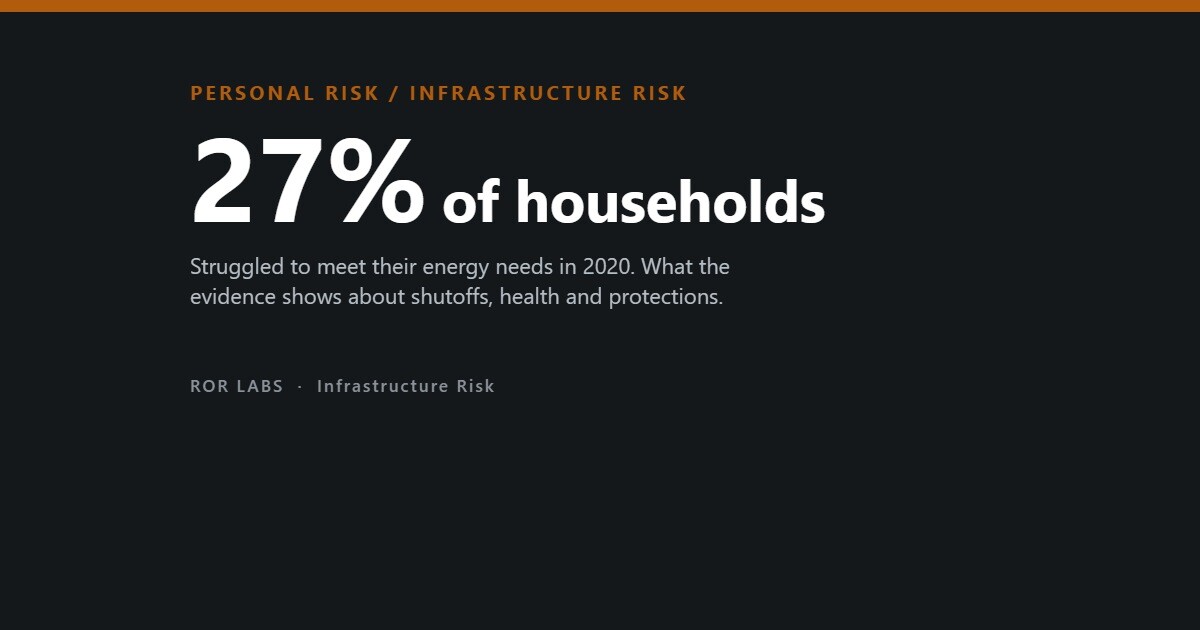
- 27% of US households, 34 million, had difficulty meeting their energy needs in 2020.
- Poor households cut food spending during unusually cold weather, in both the US and UK.
- Young children in severely energy-insecure homes had about three times the odds of food insecurity.
- Utility disconnection moratoria were estimated to cut COVID-19 deaths by 7.4% across US counties.
A power cut caused by a storm is news. A power cut caused by an unpaid bill is not. It happens quietly, one household at a time, usually after a series of notices, and it can leave a family without heating, cooling, refrigeration or the electricity that runs a medical device.
Researchers call the wider problem energy insecurity: being unable to meet a household’s basic energy needs. It includes struggling to pay bills, keeping a home at an unsafe temperature to save money, and being disconnected. It is far more common than most people assume, and it tends to fall on the same households that struggle with rent, food and medical bills.
This article looks at what the evidence shows about how many households are affected, what it does to health, whether protections against disconnection work, and where the research is still thin. The starting number comes from the US Energy Information Administration: in 2020, 27% of American households, 34 million, reported difficulty meeting their energy needs.
How many households are affected?
The best national data come from the Residential Energy Consumption Survey, run by the US Energy Information Administration. In its 2020 round, 34 million households, 27% of the total, reported difficulty paying energy bills or keeping their home at a safe temperature because of cost. That was down from 31% in 2015.
The survey breaks this down further. About 10% of households received a disconnection notice in 2020, down from 14% in 2015. Around 5 million could not use their heating equipment because it was broken and they could not afford repairs or fuel, and around 6 million could not use their air conditioning for the same reasons. About 1.4 million households, 1%, reported that someone needed medical attention because their home was too hot or too cold.
Energy insecurity was higher among lower-income households, families with children, renters, and Black and Hispanic households. The EIA has also reported that energy-insecure households tend to be billed more per unit of floor space, often because they live in older, less efficient homes.
Energy insecurity in US homes, 2020
Households reporting each problem, Residential Energy Consumption Survey.
US Energy Information Administration, ‘In 2020, 27% of U.S. households had difficulty meeting their energy needs’, 2022.
Heat or eat
When energy bills rise, something else has to give. For poor households, it is often food.
Jayanta Bhattacharya, Thomas DeLeire, Steven Haider and Janet Currie studied this in the United States. They found that poor parents and their children spent less on food and ate less during cold-weather budget shocks, and that existing social programmes did not fully protect them. They called it the heat or eat dilemma.
In their analysis, published in the American Journal of Public Health in 2003, a drop of 10°F below normal temperatures was enough to show the effect. Poor families reduced food spending by roughly the same amount as their fuel spending rose, and poor adults and children took in roughly 200 fewer calories a day during winter months. Richer families, by contrast, increased their food spending. The fall in food spending was largest outside the South.
Timothy Beatty, Laura Blow and Thomas Crossley tested the same idea in the United Kingdom, using decades of household spending records merged with local weather data. The poorest older households could not smooth their spending when the weather turned unusually cold. Their food spending fell significantly in months two or more standard deviations colder than expected, which happen about one winter month in forty, and the cuts were larger in poorer households. Better-off households, by contrast, spent more on food in cold weather.
The trade-off is not only between heating and food. Families also describe choosing between energy bills and medicine, rent, or phone bills. And in hot weather, the same arithmetic applies to air conditioning.
Heat or eat, in two countries
What unusually cold weather does to food in poor households.
Bhattacharya J and colleagues, American Journal of Public Health, 2003; Beatty TKM and colleagues, Journal of the Royal Statistical Society A, 2014.
Three kinds of insecurity
Diana Hernández, a sociologist at Columbia University, has argued that energy insecurity has three dimensions, not one. In a widely cited 2016 paper in Social Science and Medicine, she described an economic dimension, the cost of energy relative to income; a physical dimension, the condition of the home, its insulation, heating system and appliances; and a behavioural dimension, the ways people cope.
The behavioural dimension is where some of the most direct health risks lie. To save money or keep warm after a disconnection, households may use ovens or unvented space heaters for heat, run extension cords from neighbours, or use candles for light. Each carries its own risks of fire, burns and carbon monoxide poisoning.
The physical dimension explains why energy insecurity is not only about income. A household in a draughty older home with an inefficient boiler can spend a far larger share of its income on energy than a neighbour on the same income in a newer building. That is one reason why weatherisation programmes, which insulate and repair homes, are often grouped with bill assistance.
What it does to children
The most cited study of energy insecurity and child health comes from Children’s HealthWatch, a network of paediatric researchers in emergency departments and clinics.
John Cook and colleagues, in Pediatrics in 2008, surveyed the caregivers of 9,721 children under three years old at five urban medical centres in Baltimore, Boston, Little Rock, Minneapolis and Philadelphia between 2001 and 2006. They classified 11% of households as moderately energy insecure and 23% as severely energy insecure.
After adjusting for other factors, children in severely energy-insecure households had about three times the odds of household food insecurity, and about three and a half times the odds of child food insecurity, compared with those in energy-secure homes. They were more likely to be reported in fair or poor health and to be flagged for developmental concerns. Moderately energy-insecure households had higher odds of a child having been hospitalised since birth.
The study was cross-sectional, so it cannot show that energy insecurity caused these outcomes. Families that struggle with energy bills often struggle with much else. But it established energy insecurity as a distinct hardship, separate from food insecurity, that paediatricians could screen for.
Energy insecurity and young children
Adjusted odds compared with energy-secure households, children under 3.
| Outcome | Moderate insecurity | Severe insecurity |
|---|---|---|
| Household food insecurity | 2.37 | 3.06 |
| Child food insecurity | 1.79 | 3.46 |
| Fair or poor health | 1.34 | 1.36 |
| Developmental risk | no difference | 1.82 |
Cook JT and colleagues, Pediatrics, 2008. 9,721 children at five urban medical centres, 2001 to 2006.
Do shutoff protections work?
Most US states have some rules limiting disconnections, such as bans during extreme cold or heat, or protections for households with a medical certificate. Matthew Flaherty, Sanya Carley and David Konisky have documented how much these rules vary between states, and how small differences in design can produce large differences in who is protected.
The COVID-19 pandemic created a natural experiment. In spring 2020 many states imposed temporary moratoria on utility disconnections, then lifted them at different times.
Kay Jowers and colleagues, in a 2021 National Bureau of Economic Research working paper, used this variation across US counties. They estimated that utility disconnection moratoria reduced COVID-19 infection rates by 4.4% and death rates by 7.4%. Had such moratoria applied nationwide from March to November 2020, they estimated, infections could have been 8.7% lower and deaths 14.8% lower. Eviction moratoria had similar or larger effects.
Trevor Memmott, Sanya Carley, Michelle Graff and David Konisky, in iScience in 2023, used the same state-by-state variation to look at household outcomes. Protections reduced disconnections and reduced the need for households to forgo other essentials. The benefits were largest for people of colour and households with young children.
Utility disconnection moratoria and COVID-19
Estimated effects across US counties, March to November 2020.
Jowers K and colleagues, National Bureau of Economic Research working paper 28394, 2021.
Help with bills, and what happened to it
The main federal support in the United States is the Low Income Home Energy Assistance Program, or LIHEAP. It received about $4.1 billion in fiscal year 2024 and helps roughly six million low-income households a year pay heating and cooling bills. It reaches only a fraction of the households that qualify.
On 1 April 2025, as part of wider staff cuts at the Department of Health and Human Services, the entire federal staff that ran LIHEAP was laid off. Energy assistance groups warned that about $378 million of already-approved money had not yet been sent to states, and the administration’s budget request for the following year proposed ending the programme.
Congress continued to fund it. After a federal government shutdown that ran into November 2025, HHS released $3.6 billion for the 2026 heating season on 1 December 2025, later than usual. About two-thirds of LIHEAP recipients also receive food assistance, which was disrupted during the same shutdown.
The episode showed how exposed energy-insecure households are to decisions far away from them. For a family relying on assistance to keep the heat on, a few weeks’ delay can be the difference between a warm home and a disconnection notice.
The Low Income Home Energy Assistance Program
Federal support for home energy bills in the United States.
Utility Dive, April 2025; LeadingAge, December 2025. All LIHEAP federal staff were laid off on 1 April 2025.
The other side of the argument
Utilities and some regulators argue that disconnection is a necessary last resort. When customers do not pay, the costs are usually spread across everyone else’s bills, including other low-income customers. Blanket bans on disconnection, they argue, can let debts build up to levels that households can never repay.
That is a real concern, and it is one reason researchers such as Carley and Konisky favour targeted protections, such as bans during dangerous weather, medical exemptions and bill assistance, over indefinite moratoria.
The evidence on health effects also has limits. The Jowers study is observational, comparing counties that did and did not have protections at different times. Other policies changed at the same time. The Cook study is cross-sectional. And there are few studies that follow households through a disconnection and measure what happens to their health afterwards.
Other countries show that the alternative to disconnection can carry its own problems. In Britain, suppliers can switch customers in arrears to prepayment meters, which cut off supply automatically when credit runs out. After a newspaper investigation in early 2023 revealed that agents working for a supplier had forced entry into vulnerable customers’ homes to fit such meters, the energy regulator Ofgem told suppliers to stop forced installations and later tightened the rules. Self-disconnection, when a prepayment customer simply cannot top up, is much harder to count than a formal shutoff.
What the evidence does not show
It does not show that every disconnection causes harm to health. Most studies measure associations, not the effect of a single shutoff.
It does not show that moratoria are free. Unpaid bills are usually recovered from other customers or build up as household debt.
It does not measure the problem precisely. Estimates of energy insecurity vary with how questions are asked, and the 2020 survey fell during an unusual year.
And it does not cover most of the world. Almost all the research here is from the United States and the United Kingdom.
Questions people ask
How many households struggle to pay energy bills?
In 2020, 34 million US households, 27%, reported difficulty paying energy bills or keeping their home at a safe temperature.
What is the heat or eat dilemma?
The trade-off poor households face between paying for heating and buying food. Studies in the US and UK found food spending falls in unusually cold months.
Does energy insecurity affect children’s health?
A study of 9,721 young children found severe energy insecurity was linked to about three times the odds of food insecurity and more reports of poor health.
Did disconnection moratoria help during COVID-19?
One study estimated they cut COVID-19 infections by 4.4% and deaths by 7.4% across US counties.
What help is available with energy bills?
In the US, the Low Income Home Energy Assistance Program helps about six million households a year. Many utilities and states also offer payment plans and seasonal protections.
The short version
- 27% of US households, 34 million, had difficulty meeting their energy needs in 2020.
- Poor households cut food spending during unusually cold weather, in both the US and UK.
- Young children in severely energy-insecure homes had about three times the odds of food insecurity.
- Utility disconnection moratoria were estimated to cut COVID-19 deaths by 7.4% across US counties.
- LIHEAP helps about six million households a year; its entire federal staff was laid off in April 2025.
This article summarises published research and public data on energy insecurity. It is not financial or legal advice. If you are struggling with energy bills, contact your utility about payment plans and ask your local community action agency or state LIHEAP office about assistance.
Further reading. Cook and colleagues, ‘A Brief Indicator of Household Energy Security’, Pediatrics, 2008, is the foundational health study. Memmott, Carley, Graff and Konisky, iScience, 2023, is open access and shows what disconnection protections achieved during the pandemic.
- Broke in America, Joanne Samuel Goldblum and Colleen Shaddox (2021). A survey of the basic needs that go unmet when money runs short, including utilities.
- Weathering, Arline T. Geronimus (2023). A public health researcher on how social and economic hardship wears down health over time.
- The Heat Will Kill You First, Jeff Goodell (2023). A journalist on extreme heat, including why access to cooling has become a health issue.
Sources
- US Energy Information Administration. In 2020, 27% of U.S. households had difficulty meeting their energy needs. Today in Energy, 2022.
- US Energy Information Administration. U.S. energy insecure households were billed more for energy than other households. Today in Energy, 2023.
- Bhattacharya J, DeLeire T, Haider S, Currie J. Heat or eat? Cold-weather shocks and nutrition in poor American families. American Journal of Public Health, 2003;93(7):1149–1154. doi:10.2105/AJPH.93.7.1149. Working paper version: NBER w9004, 2002.
- Hernández D. Understanding ‘energy insecurity’ and why it matters to health. Social Science and Medicine, 2016;167:1–10. doi:10.1016/j.socscimed.2016.08.029.
- Beatty TKM, Blow L, Crossley TF. Is there a ‘heat-or-eat’ trade-off in the UK? Journal of the Royal Statistical Society: Series A, 2014;177(1):281–294.
- Cook JT, Frank DA, Casey PH, and colleagues. A brief indicator of household energy security: associations with food security, child health, and child development in US infants and toddlers. Pediatrics, 2008;122(4):e867–e875. doi:10.1542/peds.2008-0286.
- Flaherty ML, Carley S, Konisky DM. Electric utility disconnection policy and vulnerable populations. The Electricity Journal, 2020;33(10):106859.
- Jowers K, Timmins C, Bhavsar N, Hu Q, Marshall J. Housing precarity and the COVID-19 pandemic: impacts of utility disconnection and eviction moratoria on infections and deaths across US counties. National Bureau of Economic Research working paper 28394, 2021.
- Memmott T, Carley S, Graff M, Konisky DM. Utility disconnection protections and the incidence of energy insecurity in the United States. iScience, 2023;26(3):106244. doi:10.1016/j.isci.2023.106244.
- Baker SH, Carley S, Konisky DM. Energy insecurity and the urgent need for utility disconnection protections. Energy Policy, 2021;159:112663.
- Utility Dive. Trump guts LIHEAP, threatening $378M in energy assistance already approved by Congress. April 2025.
- LeadingAge. LIHEAP funds: HHS releases $3.6 billion in delayed utility assistance funding. December 2025.