Soccer goal tip-overs, and the anchor that stops them
Key takeaways · 9 min read
- Of 27 people hurt by falling soccer goals in US safety files from 1979 to 1993, 18 died. Their average age was ten.
- In 25 of those cases the goal tipped forward and the crossbar struck the victim; 18 of the goals were not anchored at all.
- Most falls happen outside games, when children climb, swing on the crossbar or move a goal, or when the wind catches an unsecured frame.
- Standards and laws exist, but the evidence is thin: running tallies, one five-region Danish correlation and two withdrawn US specifications.
On a Friday evening in April 2026, after a floodlit tournament match at a sand-filled community ground in Guyana, children were playing near one of the goals when it collapsed onto a seven-year-old boy. He died in hospital about half an hour later. His mother said she thought the wet sand had let the post sink forward. In February a ten-year-old died at a South African primary school during break, and in May an 11-year-old died in Brazil under a movable goal reported to be unsecured.
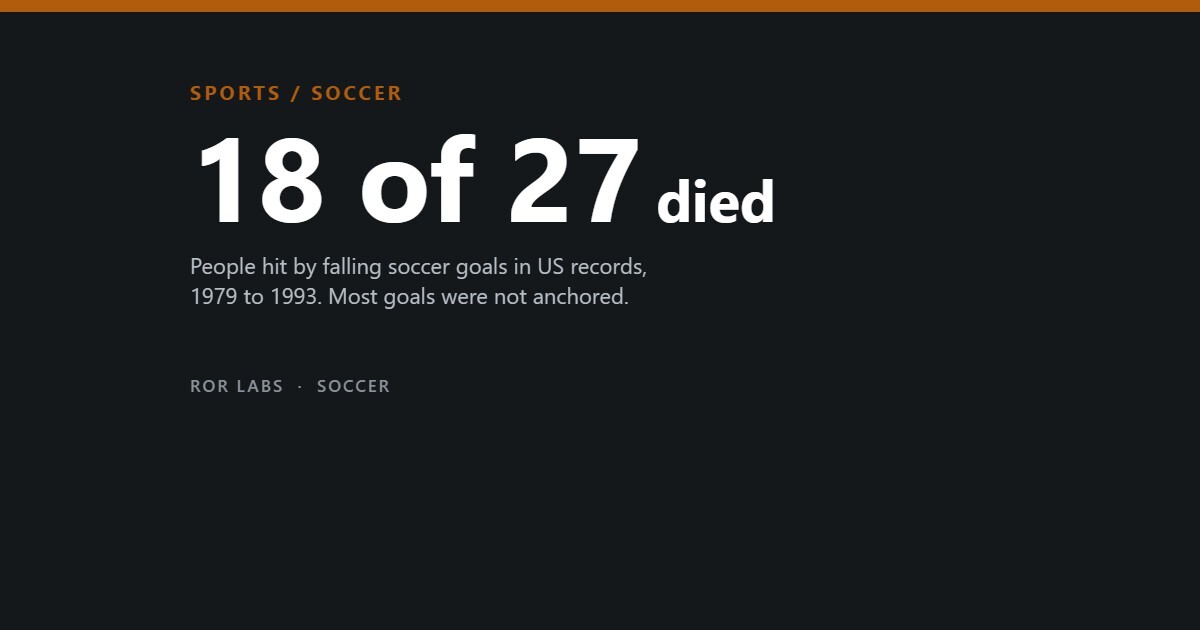
These deaths are not freak events. When the US Centers for Disease Control and Prevention reviewed every falling-goal case in federal safety files from 1979 to 1993, it found 27 people hurt, and 18 of them had died. Their average age was ten. In 25 cases the goal fell forward and the crossbar struck the victim. In 18, the goal had not been anchored at all.
This article covers what happens when a goal tips, who it falls on and when, what standards and laws have tried, why the numbers behind them are thinner than they look, and why the fix is a few stakes and a rule about hanging from the crossbar, not giving up the game.
What happens when a goal tips over
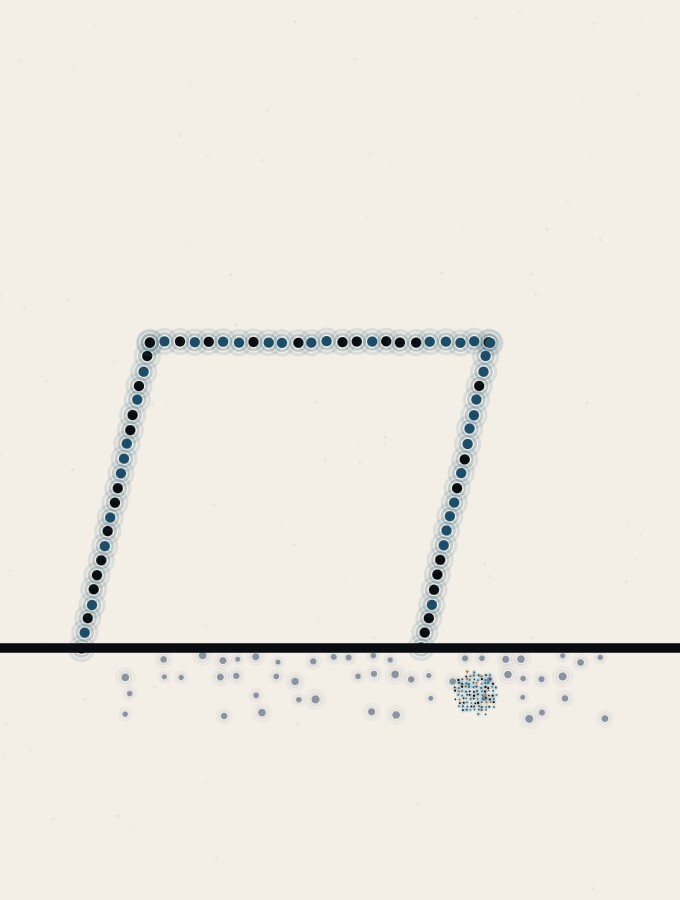
A full-size movable goal is a heavy steel or aluminium frame standing on a light base. The US Consumer Product Safety Commission (CPSC) puts most metal movable goals at 150 to 500 pounds; the CDC report gave 250 to 800 for regulation goals. The crossbar sits high at the front while the base runs back along the ground, so a pull or a swing at the top can lever the whole frame forward if nothing holds the back down.
The injuries follow from that geometry. In the CDC series, head trauma was the main cause of death in 14 of the 18 fatal cases. A Japanese team that dropped goals in a laboratory measured peak impact forces of 18,980 newtons for an aluminium goal and 29,283 for an iron one, forces equal to the weight of roughly two and three tonnes. A child’s skull is not built for either.
How the goals came down
What set off the fall in the 27 US cases of people injured or killed by falling goals that the CDC analysed, 1979 to 1993. The remaining cases had other or unrecorded causes.
Source: CDC, MMWR 43(9):153 (1994), based on Consumer Product Safety Commission investigations.
The CPSC’s own case files read like a list of ordinary moments. An eight-year-old was killed climbing a goal. A 20-year-old pulled one onto himself doing chin-ups. A three-year-old died when his father lifted the back of a goal to fix the net. A nine-year-old was killed when wind tipped a goal over, and a 19-year-old goalkeeper broke both legs the same way.
Where the risk concentrates
The pattern is consistent across countries. In the US series, 23 of the 27 people hurt were male, 15 cases happened on school fields, and only eight happened during a game or practice. Most falls happened outside games and practices, while people were climbing, swinging on or moving the frame. An adult was directly supervising in only six of the cases.
In Denmark, an analysis of hospital casualty records from five cities found 117 people injured by falling goalposts between 1989 and 1997, six of them admitted to hospital, and 88% were under 15. Half of the 42 who were interviewed said the goal had come down because someone was hanging from the crossbar. A Japanese school-injury database logged 29 pupils hurt by unanchored goals tipping over in a single year, 2014.
Were the goals anchored?
Anchoring status of the goals in the 27 US cases investigated by the CPSC and reviewed by the CDC, 1979 to 1993.
Source: CDC, MMWR 43(9):153 (1994).
Homemade goals add to the risk. The CPSC found that most of the goals in its tip-over cases had been built by school workshops, caretakers or local welders, and were often heavy and unstable. England’s Football Association tells clubs that homemade or altered goals should not be used under any circumstances, and that no child or adult should be allowed to climb or swing on any goal.
Deaths from falling goals in four countries
Known deaths from goals tipping or collapsing. Periods differ and each count covers only cases that reached the authority named, so these are not rates.
Sources: CDC, MMWR (1994); Hansard, Westminster Hall debate, 25 January 2000; Australian Competition and Consumer Commission, moveable soccer goals guide; Blønd and Hansen, British Journal of Sports Medicine (1999).
In Britain, a 2000 Westminster Hall debate heard that at least nine children had been killed by falling goalposts since 1986, five of them aged two to 13 since 1994. The sports minister also cited 1,943 injuries in goalpost accidents from 1990 to 1997, a figure that included fixed goals and incidents not caused by faulty equipment.
What has been measured to work
The first fix was a label and a rule. In 1999 the CPSC announced a provisional voluntary standard requiring movable goals, other than very light ones, not to tip over when weighted downwards or pulled horizontally, and to carry a warning to always anchor the goal. It became ASTM F2056, based on the European standard EN 748. A later specification, F2673, tested special tip-resistant goals by simulating two boys of up to 12 swinging together from the crossbar.
Some places made it law. Illinois passed the Movable Soccer Goal Safety Act, also known as Zach’s Law, in August 2011. It requires organisations that own movable goals to adopt a safety policy and, from a year later, bars the sale of full-size goals that do not meet the tip-resistance standard. Australia made a standard mandatory under a 2010 consumer protection notice for movable goals of 28 kilograms or more.
The forces involved
Newtons. The Australian test pulls the crossbar of an anchored goal for 60 seconds; the goal must stay upright. Impact forces were measured when unanchored goals were tipped onto the ground in a laboratory.
Sources: Yamanaka et al., Injury Prevention 24 (Suppl 2) (2018), conference abstract; Australian Competition and Consumer Commission, moveable soccer goals mandatory standard (Consumer Protection Notice No. 28 of 2010).
Anchoring itself has never been tested in a trial, and probably never will be; the case for it rests on physics and case series. The best real-world signal is Danish. Across the five regions studied, those where more goals were secured with counterweights had fewer accidents, with a correlation of −0.9. That is striking, but it rests on five data points and cannot rule out other differences between the regions.
Counting the dead: a tally that keeps growing
Cumulative US deaths from soccer goal tip-overs since 1979, as reported at each date. Each figure counts only cases that reached the group named.
Sources: CPSC news releases 92-133 (1992) and 99-106 (1999); Consumer Reports, March 2011; Yamanaka et al., Injury Prevention (2018), citing Anchored for Safety.
The rest of the evidence is thinner than the confident warnings suggest. No agency publishes a current death rate. US figures are running tallies of cases someone reported: 15 deaths known to the CPSC by 1992, 23 by 1999, 36 by 2011 and 42 by 2017 according to a parents’ group. Emergency-department figures are estimates from a hospital sample. And both ASTM specifications were withdrawn, in 2017 and 2018, with no replacement, although the Illinois law still names one.
Why the answer is an anchor, not an empty pitch
Set against the game as a whole, tip-overs are a small share of harm. US emergency departments treated an estimated 119,831 soccer injuries a year among children aged seven to 17 between 1990 and 2014, mostly sprains, fractures and bruises. The CPSC estimated about 120 emergency visits a year from falling goals in the early 1990s, and about 1,800 in all from 1998 to 2008. The difference is that goal deaths are almost entirely avoidable.
The fix is cheap. Anchor every movable goal at all times, at the back, with augers, stakes or, on artificial turf, enough sandbags or counterweights. Before play, make sure no children are nearby, then shake the goal and push it from behind; if it moves, do not use it. Nobody climbs the net or hangs from the crossbar, adults included. After use, take the nets down and chain the goals face to face, to a fence, or fold them face down.
Move goals with enough adults, and never use homemade or altered frames. Small portable goals have their own hazards: in December 2024 the CPSC told owners of one brand to stop using it after a high-school student died falling onto an exposed metal pole tip. For the injuries that come with the game itself, such as knees and heads, see our look at what the trials found. The game is worth playing; the frame just has to stay down.
Questions people ask
How heavy is a soccer goal?
Full-size metal movable goals usually weigh 150 to 500 pounds, about 70 to 230 kilograms, according to the CPSC. Heavy is not the same as stable: the crossbar sits high at the front, so an unanchored goal can tip when a child hangs from it.
Are sandbags enough to anchor a goal?
On hard surfaces such as artificial turf, where stakes cannot be driven, the CPSC recommends sandbags or counterweights heavy enough for the goal’s size. Australian guidance suggests a simple check with no children around: shake the goal and push it from behind. If it moves, secure it before anyone plays.
Is anchoring required by law?
It depends where you are. Illinois has required goal-safety policies since 2011, and Australia requires movable goals of 28 kilograms or more to meet a mandatory stability and labelling standard. Elsewhere, much of the guidance comes from sports bodies, such as England’s Football Association.
What should I do if I see an unanchored goal in a park or school?
Keep children off it and tell whoever runs the field, whether the school, club or council. In the US, falling-goal incidents can be reported to the CPSC at SaferProducts.gov.
The short version
- Of 27 people hurt by falling soccer goals in US safety files from 1979 to 1993, 18 died. Their average age was ten.
- In 25 of those cases the goal tipped forward and the crossbar struck the victim; 18 of the goals were not anchored at all.
- Most falls happen outside games, when children climb, swing on the crossbar or move a goal, or when the wind catches an unsecured frame.
- Standards and laws exist, but the evidence is thin: running tallies, one five-region Danish correlation and two withdrawn US specifications.
- Anchor every movable goal at all times, never climb or hang on the frame, and chain or lay goals face down after use.
This is a summary of published research and official guidance, not medical or legal advice. If a child is hit by a falling goal, call emergency services, and seek medical care for any blow to the head, even if they seem fine at first. For questions about injuries after play, talk to a doctor or physiotherapist.
Further reading: CDC, MMWR 43(9):153 (1994), for the US case series. Blønd and Hansen, British Journal of Sports Medicine 33(2):110 (1999), for the Danish counterweight study. CPSC, Guidelines for Movable Soccer Goals, for practical anchoring and storage.
- The Data Detective, Tim Harford (2021). Ten rules for judging statistics, useful for running tallies and counts with no denominator.
- The Anxious Generation, Jonathan Haidt (2024). A case for more outdoor, unstructured play, and a reminder that safety means managing real hazards, not avoiding play.
- How to Win the Premier League, Ian Graham (2024). Liverpool’s former head of research on data in football; a different, lighter side of the game’s numbers.
Sources
- Kaieteur News. Seven-year-old dies after goalpost collapses on him. 8 April 2026.
- News24. School tragedies: boy killed by falling goalpost, 15 pupils injured in transport crash. February 2026.
- McGee W. Boy, 11, killed by falling goalpost after watching dad play football. Need To Know (Jam Press), 13 May 2026.
- Centers for Disease Control and Prevention. Injuries associated with soccer goalposts – United States, 1979–1993. MMWR 43(9):153 (1994).
- US Consumer Product Safety Commission. Guidelines for Movable Soccer Goals (publication 5118).
- Yamanaka T, Kitamura K, Oono M, Nishida Y. Importance of anchoring soccer goal posts based on scientific evidence. Injury Prevention 24 (Suppl 2) (2018), conference abstract, doi:10.1136/injuryprevention-2018-safety.33.
- Blønd L, Hansen LB. Injuries caused by falling soccer goalposts in Denmark. British Journal of Sports Medicine 33(2):110 (1999).
- The Football Association. Goalpost safety guidelines, updated June 2018.
- Hansard. Football Safety, Westminster Hall debate, 25 January 2000.
- US Consumer Product Safety Commission. Fifteen deaths prompt warning: movable soccer goals can tip over on children. Release 92-133, 30 September 1992.
- US Consumer Product Safety Commission. New standard for soccer goals helps prevent tip-over deaths linked to unanchored goals. Release 99-106, 4 May 1999.
- ASTM International. F2056-09, Standard Safety and Performance Specification for Soccer Goals (withdrawn 2018); F2673-08, Standard Safety Specification for Special Tip-Resistant Movable Soccer Goals (withdrawn 2017).
- Illinois General Assembly. Public Act 97-0234, Movable Soccer Goal Safety Act (Zach’s Law), effective 2 August 2011.
- Australian Competition and Consumer Commission, Product Safety Australia. Moveable soccer goals mandatory standard (Consumer Protection Notice No. 28 of 2010) and moveable soccer goals guide.
- Consumer Reports. Soccer goals need to be anchored. March 2011.
- US Consumer Product Safety Commission. CPSC offers tips for back to school safety. 19 August 2008.
- Smith NA, Chounthirath T, Xiang H. Soccer-related injuries treated in emergency departments: 1990–2014. Pediatrics (2016), doi:10.1542/peds.2016-0346.
- US Consumer Product Safety Commission. CPSC warns consumers to immediately stop using Sport Nets 4×8 portable soccer goals due to impalement hazard. Warning 25-075, 19 December 2024.