Soccer injuries: knees, heads, and what the trials found
Key takeaways · 10 min read
- Football runs 8.0 injuries per 1,000 exposures for men and 8.4 for women, against a 6.0 average across 25 NCAA sports.
- Football is one of the sports where the women’s rate exceeds the men’s, and ACL tears run more than three times higher.
- Two thirds of concussions do not involve the ball; the ball accounts for about a third in both collegiate and national data.
- Matches carry roughly 3.4 times the practice rate — between basketball at 2.2 and American football at 6.8.
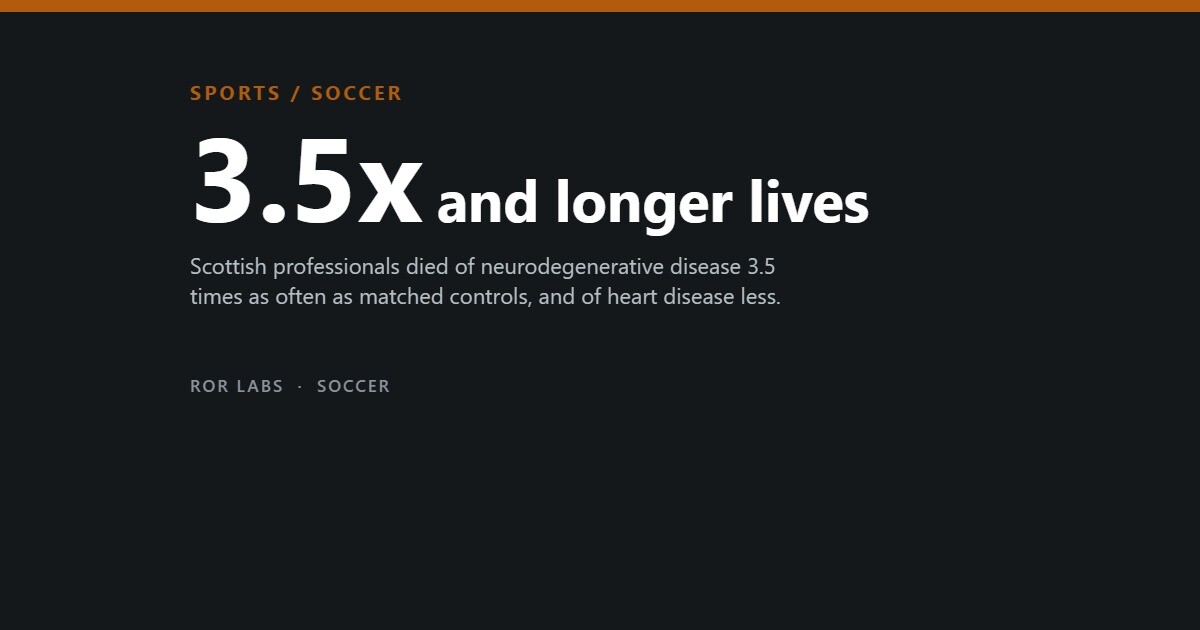
A study of 7,676 former Scottish professional footballers, matched against 23,028 people from the general population and followed for a median of eighteen years, found that they died of neurodegenerative disease three and a half times as often. It is the single most alarming number in the sport, and it is real.
The same study found that they died less often of almost everything else. Ischaemic heart disease, hazard ratio 0.80. Lung cancer, 0.53. Overall mortality was lower than the matched controls until about age 70. Both halves came out of one dataset, and any honest account of playing football has to carry both.
This article is about what actually gets hurt in football, when, and what the randomised trials found — including on the two interventions people argue over most, the heading rule and the warm-up. One of them has a randomised trial behind it. The other does not.
What actually gets injured, and in whom
The cleanest comparison available is the NCAA injury surveillance data pooled by the CDC across five seasons and twenty-five sports, because every sport in it shares a denominator: injuries per 1,000 athlete-exposures, where an exposure is one athlete in one practice or one game.
Injuries per 1,000 athlete-exposures
NCAA Injury Surveillance Program, 2009-10 to 2013-14. 1,053,370 injuries over 176.7 million exposures.
Source: CDC, MMWR 64(48), 2015, NCAA Injury Surveillance Program.
Football sits above the twenty-five-sport average and below American football, roughly level with men’s basketball. The line worth pausing on is that the women’s rate is higher than the men’s, 8.4 against 8.0. That is not the general pattern: in basketball the women’s rate is 6.5 against 8.5 for men. Football is one of the sports where the direction reverses.
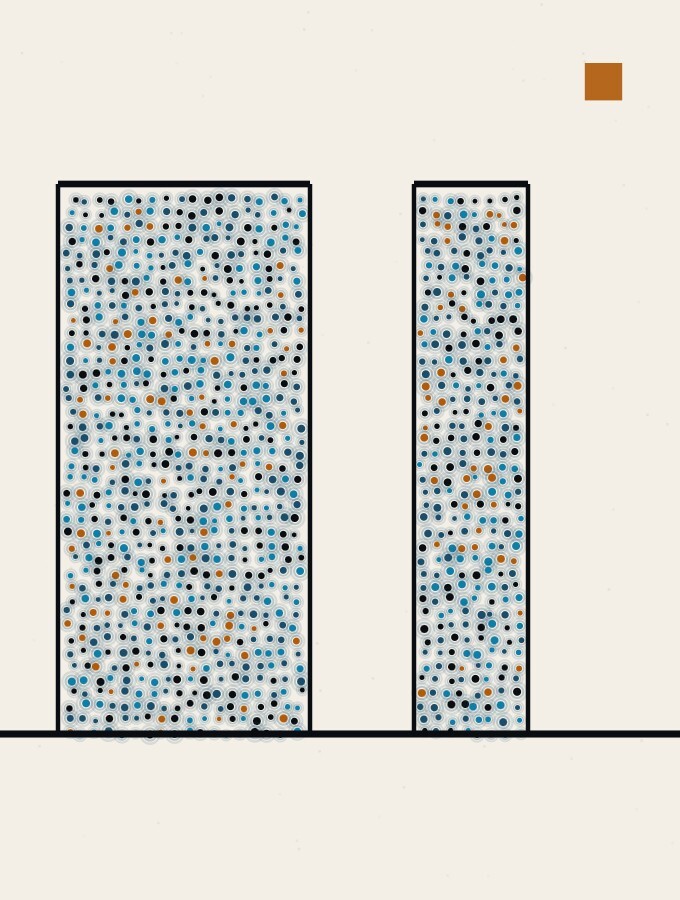
The reason is mostly one joint. Across ten NCAA seasons, knee injury rates were 38 per cent higher in women’s football than in men’s, and the rate of anterior cruciate ligament tears was more than three times higher: an injury rate ratio of 3.10, with a confidence interval from 2.20 to 4.35. An earlier analysis of the same surveillance system found that the odds of a knee injury requiring surgery were also higher in women, and that they lost more time when it happened.
Everything else in football is ordinary sports injury. Sprains and strains are about half of the total across all NCAA sports; roughly a fifth of injuries cost seven days or more, and four per cent lead to surgery. The parts of football that frighten people are not the parts that fill the injury tables.
The ball is a third of it, and the third that has not moved
Concussion is where public argument concentrates, and where the data is most often described backwards. The largest prospective study of the question followed 391 football concussions across thirty universities between 2014 and 2020 and classified each one by what the head actually hit.
What the head hit, in 391 collegiate football concussions
Source: Jo et al., CARE Consortium, 2024. 30 universities, 2014–2020; 56.8% of the injured players were women.
Two thirds of concussions in football do not involve the ball at all. A separate national dataset of 80,582 youth concussions treated in United States emergency departments between 2013 and 2022 put head-to-ball at 31.0 per cent, which is close enough to the collegiate figure to be reassuring about both.
And the ball contacts that do cause concussion are mostly not the ones people picture. An early collegiate surveillance study reported that no concussion in its sample came from a routine, purposeful, successfully executed header — the injuries came from head-to-head collisions in the air and from balls that arrived unexpectedly. What hurts is the mistimed contest, not the technique.
When it concentrates
Football’s risk is concentrated in matches, but less extremely than American football’s. Men’s football runs 17.9 injuries per 1,000 exposures in competition against 5.3 in practice, a ratio of about 3.4. The women’s figures are 17.2 and 5.6, a ratio of about 3.1.
How much a match concentrates the risk
Competition rate divided by practice rate, same surveillance programme.
Source: CDC, MMWR 64(48), 2015. Rates are per 1,000 athlete-exposures.
That matters for what kind of intervention can work. American football could move a large share of its concussions by changing one play, because one play carried them. Football has no such play. Its risk is spread across ninety minutes of contested running, which leaves only interventions the player carries onto the pitch.
Concussion follows the same shape more sharply: in a prospective collegiate cohort, concussions were about two and a half times more likely in competition than in practice, and about one and a half times more likely in women than in men.
What has actually been tested
Structured neuromuscular warm-ups — balance, landing mechanics, knee alignment, hamstring strength, done before training rather than instead of it — are the most tested intervention in the sport. Three randomised trials define what is and is not known.
The one that succeeded on its primary endpoint is the largest. Two hundred and thirty Swedish clubs, 4,564 female players aged 12 to 17, randomised by club and followed for one season. Seven players in the intervention group tore an anterior cruciate ligament, against fourteen in the control group — a 64 per cent reduction, rate ratio 0.36, confidence interval 0.15 to 0.85.
Note what that took. Four and a half thousand players, a full season, and the whole result rests on twenty-one events. Anterior cruciate ligament tears are severe and rare at the same time, which is why smaller trials of the same idea keep coming back inconclusive.
Three randomised warm-up trials
Sources: BMJ 344:e3042 (2012); BMJ 337:a2469 (2008); American Journal of Sports Medicine 36(8) (2008).
The middle card is the honest one. The Norwegian trial is cited everywhere as proof that warm-ups prevent football injuries, and its prespecified primary outcome — lower-limb injury — did not reach significance. What reached significance were the secondary outcomes, including a 53 per cent reduction in overuse injuries and a 45 per cent reduction in severe ones. Those are worth having. They are not what the trial set out to show.
Read together, the three say something defensible: a structured warm-up reduces injuries in youth football, the effect on the specific injury everyone cares about is real but was only demonstrated at very large sample size, and the programmes work in proportion to how often they are actually done.
The rule that may not have worked, and the one that did
Announced in 2015 under litigation and in force from the following year, the United States Soccer Federation’s rule banned heading for players aged ten and under and limited players aged 11 to 13 to thirty minutes of heading practice a week. It is the closest thing football has to American football’s kickoff rule, and the evidence that it worked is mixed.
One analysis compared 7,496 emergency department visits by players aged 10 to 13 in 2013-14 against 2016-17 and found concussion, as a share of all soccer injuries, had gone up rather than down: odds ratio 1.286, confidence interval 1.090 to 1.517. Its authors were careful to say that increased recognition and reporting could explain the whole thing, and that they could not adjust for it.
A longer look at the same national database found the opposite direction: concussion fell from 8.2 per cent of all youth soccer injuries in 2012-15 to 6.1 per cent in 2020-23. But a third study of the same decade showed where the fall came from. Head-to-body concussions declined by about 169 a year and head-to-ground by about 155 a year, both significantly. Head-to-ball concussions did not change at all.
That is the uncomfortable sentence. Over the decade in which heading was restricted for young players, the category of concussion the restriction was aimed at is the one that did not move, while the categories it was not aimed at did. The warm-up has a randomised trial. The heading rule has a natural experiment that points several ways at once.
Why the answer is not to stop
Which brings back the Scottish cohort. Neurodegenerative disease was the primary cause of death in 1.7 per cent of former professionals against 0.5 per cent of matched controls, hazard ratio 3.45. Alzheimer’s disease specifically ran at 5.07, Parkinson’s at 2.15, and dementia medications were dispensed to former players about five times as often.
The same cohort, two directions
7,676 former Scottish professional footballers against 23,028 matched controls, median 18 years of follow-up. Hazard ratios; 1.00 is no difference.
Source: Mackay et al., New England Journal of Medicine 381(19):1801–1808, 2019.
And overall mortality among those players was lower than in the matched population until roughly age 70. They were, by the ordinary measures, healthier for most of their lives, and then a specific risk arrived late. The authors noted the study was retrospective and said plainly that the findings need confirming in prospective matched cohorts.
There is also a question the cohort cannot answer: these men played from the 1930s onwards, with different balls, training loads and concussion management. Whether a player starting today carries the same risk is not something a follow-up of retired professionals can tell you.
What the evidence supports is narrower and more useful than either “football causes dementia” or “the scare is overblown.” The specific hazard is head impact accumulated over a professional career. The best-tested way to reduce the injuries that actually fill the tables is a fifteen-minute warm-up done twice a week. And the risk profile of football — a sport played outdoors at an aerobic intensity for decades — is why those same players outlived their neighbours for seventy years first.
Questions people ask
Should children be allowed to head the ball?
The restrictions are in force in several countries and are not unreasonable given what is unknown. What the data does not yet show is that they reduce concussion: the mechanism they target is the one category that did not decline over the decade they were introduced. That is a reason to keep measuring, not a reason to drop them.
Why do female players tear their ACLs so much more often?
The measured gap is more than threefold in collegiate football, and the explanation is not settled — landing mechanics, hip and knee geometry, neuromuscular control and hormonal cycle have all been studied. The practical point is that the warm-up trials showing the largest reductions were run in exactly this population.
Does a headgear or a padded band help?
Not on the evidence available. A cluster randomised trial of 2,766 high school players over 3,050 participant-years found no difference in concussion rate — hazard ratio 0.86 (0.54 to 1.36) in females, 2.00 (0.63 to 6.43) in males — and no difference in days lost, 13.5 against 13.0.
Is the warm-up worth it for an adult recreational player?
The randomised evidence is in adolescents, so extrapolating upward is a judgement rather than a finding. The mechanism — better landing and deceleration control — does not obviously stop applying with age, and the intervention costs fifteen minutes.
What actually matters most if I only change one thing?
Do the warm-up, and do it consistently. Across this literature the programmes that were done as prescribed produced the large effects and the ones done occasionally produced almost nothing. Adherence, not programme choice, is the variable that moves.
The short version
- Football runs 8.0 injuries per 1,000 exposures for men and 8.4 for women, against a 6.0 average across 25 NCAA sports.
- Football is one of the sports where the women’s rate exceeds the men’s, and ACL tears run more than three times higher.
- Two thirds of concussions do not involve the ball; the ball accounts for about a third in both collegiate and national data.
- Matches carry roughly 3.4 times the practice rate — between basketball at 2.2 and American football at 6.8.
- The largest warm-up trial cut ACL injuries 64% (rate ratio 0.36), but the most-cited one missed its own primary endpoint.
- Former professionals died of neurodegenerative disease 3.45 times as often — and of heart disease and lung cancer less often, with lower overall mortality until about 70.
This describes what published research has reported about a sport, not advice about any individual. Head injury is a clinical matter: a suspected concussion means leaving the pitch and being assessed, and return-to-play decisions belong to a clinician, not to an article or a coach.
Further reading: Mackay et al., New England Journal of Medicine 381(19):1801–1808 (2019), for the Scottish cohort. Waldén et al., BMJ 344:e3042 (2012), for the knee-control trial. Soligard et al., BMJ 337:a2469 (2008), for the trial that missed its primary endpoint and is quoted as though it did not.
- Up to Speed, Christine Yu (2023). On how little of sports science was ever run on women, which is the background to the ACL gap above. A reported book, not a review.
- Expected Goals, Rory Smith (2022). How football learned to measure itself, and what it still does not count. About performance data rather than injury, which is itself the point.
- Calling Bullshit, Carl Bergstrom and Jevin West (2020). The clearest short account of why a secondary outcome is not a primary one — the distinction this article turns on twice.
Sources
CDC, MMWR 64(48):1330–1336 (2015), NCAA Injury Surveillance Program 2009-10 to 2013-14: sport-by-sport rates per 1,000 athlete-exposures, competition and practice counts, severity distribution.
Mackay DF, Russell ER, Stewart K, MacLean JA, Pell JP, Stewart W. Neurodegenerative disease mortality among former professional soccer players. N Engl J Med 2019;381(19):1801–1808.
Waldén M, Atroshi I, Magnusson H, Wagner P, Hägglund M. Prevention of acute knee injuries in adolescent female football players: cluster randomised controlled trial. BMJ 2012;344:e3042.
Soligard T, Myklebust G, Steffen K, et al. Comprehensive warm-up programme to prevent injuries in young female footballers: cluster randomised controlled trial. BMJ 2008;337:a2469.
Gilchrist J, Mandelbaum BR, Melancon H, et al. A randomized controlled trial to prevent non-contact anterior cruciate ligament injury in female collegiate soccer players. Am J Sports Med 2008;36(8):1476–1483.
Jo J, Boltz AJ, Williams KL, et al. Mechanisms of injury leading to concussions in collegiate soccer players: a CARE Consortium study. Am J Sports Med 2024 (30 universities, 391 concussions, 2014–2020).
Chun AG, Snyder EM, Obana KK, et al. The 10-year decreasing trend of youth soccer head injuries and concussions presenting to U.S. emergency departments. Phys Sportsmed 2024.
Sullivan G, Lin E, Hoffer AJ, et al. Pediatric concussion injuries in soccer: emergency department trends in the United States from 2012 to 2023. Orthop J Sports Med 2024;12(12).
Lalji R, Snider H, Chow N, Howitt S. The 2015 U.S. Soccer Federation header ban and its effect on emergency room concussion rates in soccer players aged 10–13 (NEISS, 7,496 attendances).
McGuine TA, Post EG, Pfaller AY, et al. Does soccer headgear reduce the incidence of sport-related concussion? A cluster, randomised controlled trial of adolescent athletes. Br J Sports Med 2020;54(7):408–413.
Chandran A, Rao N, Boltz AJ, et al. Knee and ACL injury rates in NCAA soccer players: an epidemiological study of 10 consecutive seasons. Science and Medicine in Football 2025.