Nobody Skips the Car Seat. The Deaths Are in the Exceptions.
In This Series: Road, Transit & Child Safety
- Half of the People Who Die in Crashes Were Not Wearing a Belt
- Three Quarters of Pedestrian Deaths Happen After Dark. Your Reflective Vest Is in the Wrong Place.
- A Child Physically Cannot See a Car Coming at 30 mph. Start There.
- Sixty-Four Per Cent of Seriously Injured British Bus Passengers Were Never in a Crash. And the Bus Is Still About Four Times Safer Than the Car.
Disclosure: this article contains affiliate links, marked (paid link). If you buy through one we may earn a commission, at no extra cost to you. As an Amazon Associate I earn from qualifying purchases. It costs you nothing and it does not change what we recommend.
Key takeaways · 8 min read
- Child restraints cut fatal injury risk by 71% for infants and 54% for toddlers in passenger cars.
- In 2024, 550 children under 13 died as vehicle occupants; 167 were unrestrained.
- Observation surveys find near-universal use — the deaths cluster in the exceptions and the misuse.
- Rear-facing as long as the seat allows, harness to at least 4, booster until the belt fits at about 4 ft 9 in.
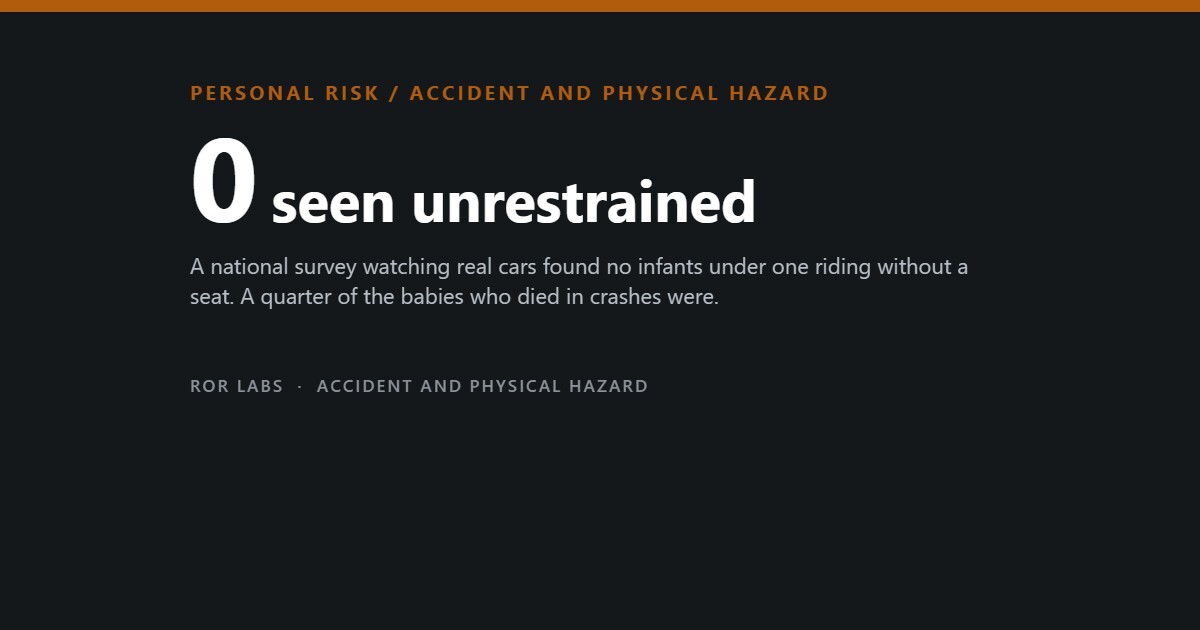
There is a gap in the child car seat data that says almost everything about this subject. In a national observation survey, researchers watching real cars found no infants under one year riding unrestrained. In the fatality records for the following year, a quarter of the babies who died in crashes were unrestrained.
Almost everyone uses a car seat almost all of the time. The deaths are concentrated in the exceptions — the quick trip, the other car, the borrowed lift, the day the seat was in the other vehicle. And beneath that sits a second, quieter problem: seats that are being used, but used wrong.

How much a car seat is actually worth
Reduction in risk of fatal injury from a child restraint
Versus no restraint. NHTSA / National Safety Council figures, 2024 data.
Source: National Safety Council, Injury Facts — Child Restraint, drawing on NHTSA data (2024).
Child occupant deaths, and how many were unrestrained
Children under 13, United States, 2024.
Source: National Safety Council, Injury Facts — Child Restraint (2024 data).
The stages, and the pressure to skip them
Every transition in this sequence is a downgrade in protection, traded for convenience or for a child’s sense of being grown up. Each one is worth delaying as long as the seat allows.
The four stages, per the American Academy of Pediatrics
The rule throughout is the same: stay in each stage until the child outgrows the manufacturer’s height or weight limit, not until a birthday.
| Stage | How long | Why it matters |
|---|---|---|
| Rear-facing | As long as possible — to the seat’s top height or weight limit. Most convertible seats allow past age 2. | Spreads crash force across the whole back and supports the head and neck. A young child’s head is disproportionately heavy and the neck cannot hold it. |
| Forward-facing harness | After outgrowing rear-facing. Keep the harness at least to age 4, and longer if the seat allows. | A five-point harness spreads load across the strongest parts of the body and keeps the child in position. |
| Booster seat | Until the adult belt fits properly — typically about 4 ft 9 in, usually between 8 and 12 years old. | A booster does one job: it raises the child so the adult belt crosses the shoulder and the hip bones, not the neck and the abdomen. |
| Seat belt alone | When the belt genuinely fits. Most children are 10 to 12 before that is true. | A lap belt riding on a soft abdomen instead of the pelvis is a recognised injury pattern in crashes. |
Source: American Academy of Pediatrics, car safety seat guidance (HealthyChildren.org).
The rear-facing stage is where most of the argument happens, usually because a toddler’s legs look cramped. Bent legs against the seat back are not a safety problem; children sit cross-legged comfortably in ways adults find alarming. Leg fractures in rear-facing children are rare. Head and neck injuries in forward-facing toddlers are not.
The five mistakes that matter
Installation errors are common enough that most fire stations and many hospitals will check a seat for free. These are the ones that recur.
What to check tonight, in two minutes
Each of these is a documented common error.
Sources: NHTSA child passenger safety guidance; American Academy of Pediatrics installation guidance.
Harness and clip position
The two adjustments most often wrong.
Source: NHTSA and AAP child passenger safety guidance.
Buying a seat (paid link)
The expensive seat and the cheap seat both pass the same crash standard. Fit and correct use are what vary.
Browse on Amazon →
Browse on Amazon →
Browse on Amazon →
Two categories we will not link. Second-hand car seats — a seat involved in a crash can be structurally compromised invisibly, plastic degrades, and you cannot verify a stranger’s history or recall status. And aftermarket strap covers, head supports, seat protectors and inserts that did not come with the seat: they were not crash-tested with it, they can introduce slack or change how the harness sits, and many manufacturers state that using them voids the seat’s certification. The seat was tested as it was sold.
Questions people ask
Do car seats really expire?
Manufacturers print an expiry date, typically six to ten years from manufacture, and it is stamped on the shell rather than the box. The reasoning is plastic degradation from temperature cycling in a car, standards moving on, and labels and instructions becoming illegible. It is also convenient for manufacturers, which is a fair objection — but the temperature cycling is real, and a seat that has spent eight summers in a hot car is not the seat that was tested.
Is the middle of the back seat best?
If you can get a solid installation there, yes — it is furthest from any impact point. But many cars have a raised or narrow middle seat, or no lower anchors for it. A tight install in an outboard seat beats a loose one in the middle. Position is a smaller factor than installation quality.
Does an expensive seat protect better?
Every seat sold legally meets the same federal crash standard. Price buys easier installation, better fabrics, longer height and weight limits, and side-impact features that go beyond the minimum. Easier installation is not a trivial benefit given how common misuse is — but a cheap seat installed correctly outperforms an expensive one installed badly.
My child insists they are too big for a booster.
Use the test rather than the argument. Sit them on the vehicle seat: do their knees bend at the edge, does the lap belt sit low across the hip bones, does the shoulder belt cross mid-shoulder, and can they stay that way for the whole trip? If any answer is no, the belt does not fit yet. Showing a child the actual test tends to work better than an instruction, and backless boosters are far less conspicuous to a self-conscious eight-year-old.
The short version
- Child restraints cut fatal injury risk by 71% for infants and 54% for toddlers in passenger cars.
- In 2024, 550 children under 13 died as vehicle occupants; 167 were unrestrained.
- Observation surveys find near-universal use — the deaths cluster in the exceptions and the misuse.
- Rear-facing as long as the seat allows, harness to at least 4, booster until the belt fits at about 4 ft 9 in.
- Every child under 13 in the back seat.
- Two-minute check: harness passes the pinch test, chest clip at armpit level, no bulky coats, under an inch of movement at the belt path.
- Free car seat checks are available at many fire stations and hospitals.
- Avoid second-hand seats and aftermarket inserts that did not come with the seat.
On the links above: some are affiliate links, marked (paid link). If you buy through one we may earn a commission at no additional cost to you. As an Amazon Associate I earn from qualifying purchases. We link to product searches rather than specific items so recommendations do not break as models change, and we say plainly when we are choosing not to link something. Full policy: Affiliate Disclosure.
Sources
- National Safety Council. Injury Facts — Child Restraint (2024 data, drawing on NHTSA fatality and observation surveys).
- American Academy of Pediatrics. Car safety seat guidance for families, HealthyChildren.org.
- National Highway Traffic Safety Administration. Car seats and booster seats guidance; Evaluation of Child Restraint System Effectiveness.