Your Voice Is No Longer Proof That It Is You
In This Series: Fraud & Digital Security
- Nobody Updates the Router. The FBI Says Criminals Are Living in the Old Ones.
- A Credit Freeze Blocks the Rarer Kind of Identity Theft. Here Is What Blocks the Rest.
- Four Points Identify You. That Is Why Your Location Is Worth Selling.
- The Two-Factor Code on Your Phone Will Not Stop This
- Changing Your Password Every 90 Days Made It Easier to Guess. The Standard That Started the Rule Now Says to Stop.
- They Asked 422 Burglars What Made Them Walk Away. The Locks Did Not Come First.
- Romance Scam Victims Were Better Educated Than People Who Never Fell for One. The Newest Version Never Asks for Money.
- The Same Offer Went From 11% Acceptance to 42%. Only the Buttons Changed.
Further reading: Cultish — Amanda Montell (Harper Wave, 2021). No trade book yet covers AI voice-cloning or pig-butchering scams specifically; this is the closest available account of how persuasive, manipulative language actually works on a target. Find it on Amazon (paid link)
Disclosure: this article contains affiliate links, marked (paid link). If you buy through one we may earn a commission, at no extra cost to you. As an Amazon Associate I earn from qualifying purchases. It costs you nothing and it does not change what we recommend.
Key takeaways · 8 min read
- Reported losses to cyber-enabled crime reached about $21 billion in 2025, from over a million complaints.
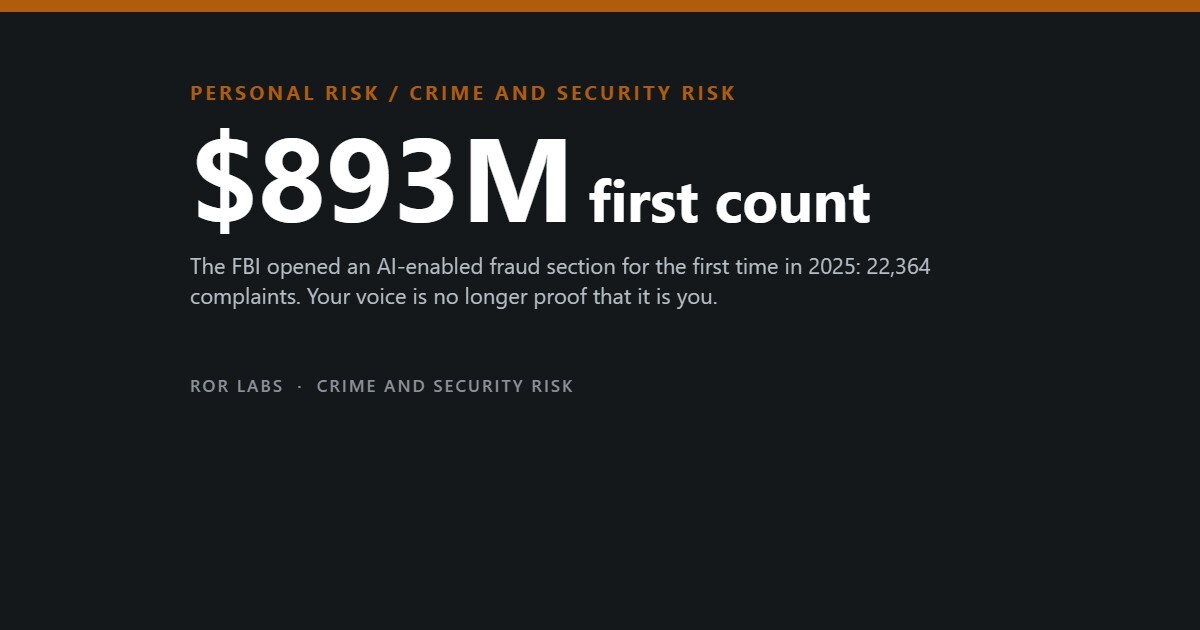
- The FBI’s first AI-fraud category recorded 22,364 complaints and roughly $893 million.
- Adults over 60 lost about $7.7 billion, up 37% — because they hold assets and are targeted, not because of poor judgement.
- A convincing voice clone needs only seconds of public audio.
For most of human history, recognising someone’s voice was reliable evidence that you were talking to them. That stopped being true recently enough that most people have not adjusted, and the adjustment is the entire subject of this article.
A few seconds of audio — a video posted to social media, a voicemail greeting, a work presentation — is now enough to produce a convincing imitation of a specific person saying something they never said. The FBI logged its first dedicated category for this in 2025.

The numbers, and who is losing
FBI Internet Crime Report, 2025
Released 6 April 2026. Over one million complaints, up from 859,532 the year before.
Source: Federal Bureau of Investigation, “Cryptocurrency and AI Scams Bilk Americans of Billions,” IC3 2025 Internet Crime Report, 6 April 2026.
Where the losses landed
By age group and category, 2025.
Source: FBI IC3 2025 Internet Crime Report (April 2026).
It is worth being careful with the older-adults figure, because it is usually reported in a way that implies gullibility. The likelier explanations are duller and more actionable: older adults hold more assets, are more often home to answer a phone, and are targeted deliberately for both reasons. Being defrauded is not evidence of poor judgement when the attack is built specifically to defeat good judgement.
How the voice scam is built

The structure has been the same for decades — it used to be called the grandparent scam, and it worked with a stranger and a bad phone line. What AI changed is that the voice now matches.
The four moves, in order
Recognising the shape is more durable than recognising any particular script.
Source: U.S. Federal Trade Commission, “Scammers use AI to enhance their family emergency schemes” consumer alert; FBI IC3 reporting.
The FTC’s advice is one sentence long and it defeats the entire category: do not trust the voice — call the person back on a number you already have. A cloned voice cannot answer a phone you dial. That is the whole defence, and it costs nothing.
Why calling back works when listening does not
The attacker controls the inbound call. They do not control a number you already have.
Source: FTC consumer guidance on family emergency scams.
What actually protects you
All of it is free, and most of it is a conversation
There is no product for this. There is a habit.
Sources: FTC consumer alerts on AI family-emergency scams; FBI IC3 2025 report.
The small amount of hardware that helps (paid link)
Nothing here detects a fake voice. These reduce how often the call reaches someone in the first place.
Browse on Amazon →
Browse on Amazon →
We are not linking “AI deepfake detector” apps or identity-theft monitoring subscriptions. Consumer voice-detection tools are unreliable and improving far more slowly than the generators they are chasing — trusting one could make you more confident about a fake. Identity monitoring tells you after your data has leaked; it does nothing about a phone call. A code word costs nothing and works better than both.

Questions people ask
Can I tell a cloned voice by listening?
Increasingly, no — and the scam is designed around that. Distress is chosen partly because crying explains away any oddness in the audio. Building your defence on your own ear is building it on the one thing the attacker has already optimised against.
What if I have already paid?
Act immediately, because a small window sometimes exists. Call your bank — wire transfers can occasionally be recalled within hours. For gift cards, call the issuer with the card numbers; funds are sometimes frozen if reported fast. Report to the FBI’s IC3 at ic3.gov and to the FTC at reportfraud.ftc.gov. And tell someone. Shame is the reason most of this goes unreported, and unreported fraud is what lets the same operation keep running.
Is my bank going to reimburse me?
It depends heavily on jurisdiction and on whether you authorised the payment yourself. Fraud where someone takes your money without permission is usually covered; fraud where you were persuaded to send it often is not, though rules in several countries are shifting toward reimbursement. Report it anyway and in writing — the outcome frequently depends on how quickly and how formally it was raised.
My parent will not use a code word. It feels ridiculous.
Frame it as protecting you rather than them — people accept a rule for someone else’s benefit much more readily than one that implies they might be fooled. “If someone rings you pretending to be me, I want you to have a way to check” lands very differently from “you might fall for this.”
The short version
- Reported losses to cyber-enabled crime reached about $21 billion in 2025, from over a million complaints.
- The FBI’s first AI-fraud category recorded 22,364 complaints and roughly $893 million.
- Adults over 60 lost about $7.7 billion, up 37% — because they hold assets and are targeted, not because of poor judgement.
- A convincing voice clone needs only seconds of public audio.
- The shape is always: known voice → emergency → secrecy → irreversible payment.
- Gift cards, wire transfers and crypto are the tell. No legitimate emergency ends there.
- The defence is hang up and call back on a number you already have. A clone cannot answer your call.
- Agree a family code word in person, today. It is free and it beats every detection product on the market.
If you or someone you know has been targeted, report it to IC3 at ic3.gov and the FTC at reportfraud.ftc.gov. Reporting quickly occasionally allows funds to be stopped, and it is how these operations get traced.
On the links above: some are affiliate links, marked (paid link). If you buy through one we may earn a commission at no additional cost to you. As an Amazon Associate I earn from qualifying purchases. We link to product searches rather than specific items so recommendations do not break as models change, and we say plainly when we are choosing not to link something. Full policy: Affiliate Disclosure.
Sources
- Federal Bureau of Investigation. “Cryptocurrency and AI Scams Bilk Americans of Billions.” IC3 2025 Internet Crime Report, 6 April 2026.
- Federal Trade Commission. “Scammers use AI to enhance their family emergency schemes.” Consumer alert.
- FBI Internet Crime Complaint Center (ic3.gov); FTC report fraud portal (reportfraud.ftc.gov).