Emergency Phone Alerts: What the Evidence Shows
Key takeaways · 13 min read
- After the 2023 US national test, a survey of 80,161 adults estimated that 91% of those with working phones got the alert; older and rural people were less likely to.
- Most people do not act on an alert straight away; they check it first. After Hawaii’s false missile alert in 2018, only 28% of surveyed residents believed it at once and 73% checked other sources.
- A single false alarm did less damage to trust than officials fear, but frequent alerts push people to switch some off: 17.5% of US adults have opted out of at least one alert type.
- The deadliest failures were about delivery and timing: in Lahaina in 2023 the phone network failed, and in Valencia in 2024 the alert arrived after 8 pm, when towns were already flooding.
When a disaster is minutes away, the fastest way to reach people is now the phone in their pocket. Most wealthy countries can push an alert to every handset in an area at once, with a loud tone that overrides silent mode: Wireless Emergency Alerts in the United States, EU-Alert systems in Europe, Emergency Alerts in the UK, and Japan’s alerts relayed by J-Alert and the mobile carriers. The technology is impressive. The harder question is whether it works when it matters.
Working means three things: the alert has to reach people, arrive in time and lead them to act. Decades of warning research, going back to sociologists such as Dennis Mileti and John Sorensen, say people rarely act on a warning the moment they get it. They look for confirmation first. Phone alert systems were built by engineers to deliver text quickly; how people respond to that text was studied later.
This article looks at reach measured in national tests, what people did after real and false alerts, the evidence on message length and false alarms, earthquake alerts that give only seconds, and the failures in Maui and Valencia. It is about alerts pushed to phones, not about calling emergency numbers, which another article on this site covers. Most of the evidence on behaviour comes from surveys taken after the event, and that limits what it can show.
How phone alerts work
Most national systems use cell broadcast. Instead of sending millions of individual text messages, which can jam a network, operators broadcast one message from every mast in a chosen area, and every compatible phone in range displays it. US alerts were limited to 90 characters when the system launched in 2012 and can now run to 360. The European Union required its member states to have a mobile public warning system in place by June 2022.
A second route is growing fast. Google’s Android operating system uses the motion sensors in ordinary phones to detect earthquakes and sends its own alerts in dozens of countries. Whichever route is used, a phone alert depends on two things that can fail: a working mobile network and someone deciding, in time, to press send.
Do alerts reach people?
The best measurements come from national tests. After the US test on 4 October 2023, RAND researchers surveyed 80,161 adults drawn from six online panels. They estimated that 91% of adults with working mobile phones received the alert. The odds of receiving it were lower for people over 65, for rural residents, for customers of some carriers and for owners of less common phone brands, so reach was weakest among some of the people who most need time to act.
Did the test alert get through?
Reach of national phone alert tests, %. Each country measured something different.
Sources: Parker AM et al., RAND RR-A2451-1 (2024); ABC News (27 July 2026); UK Parliament written statement HCWS740 (25 April 2023). Survey, network and government estimates are not directly comparable.
Other countries measure differently. After the UK’s first national test in April 2023, the government said the vast majority of compatible 4G and 5G phones, an estimated 80% of all mobile phones in the country, received it, but a fault at one network, Three, meant some of its customers did not. In Australia’s first national test in July 2026, 94% of targeted towers broadcast the alert, yet some regional communities said nothing arrived.
Reach also depends on people leaving alerts switched on. In the RAND survey, 17.5% of adults had opted out of at least one type of alert, most often AMBER alerts for missing children. States that had sent more AMBER alerts in the past had higher opt-out rates, which the authors read as a sign of alert fatigue. That link is correlational, but it suggests that how often alerts are used shapes whether the next one is heard.
What people do first
In 1990 Mileti and Sorensen reviewed more than 200 studies of how people respond to warnings. What a warning says, who sends it and whether it matches other information all strongly affect whether people heed it, they found, and several popular beliefs, including mass panic and the idea that warnings should be kept simple, were myths. Later researchers named the delay before acting milling: people seek confirmation, talk to others and watch what neighbours do.
The clearest real-world test came by accident. On 13 January 2018, during a drill, a worker at Hawaii’s emergency management agency sent a ballistic missile warning to phones across the state, ending with the words “THIS IS NOT A DRILL”. A correction followed 38 minutes later. Rich Ling and Brett Oppegaard surveyed 418 residents in the following weeks.
Hawaii 2018: the first reaction
Residents’ response to the false ballistic missile alert, % of 418 survey respondents.
Source: Ling R, Oppegaard B, Social Media + Society (2021), doi:10.1177/2056305121999661. Online convenience sample, surveyed 2–7 weeks later; not representative of the state.
Only 28% believed the alert at first; 45% were unsure and 27% did not believe it. Most, 73%, checked it against other sources, often television or radio, which were showing normal programmes. About 70% of the phone calls people described went to close family. Some sheltered under tables; others drove across town to be with relatives. The sample was a non-random online panel recalling a frightening morning, so these shares are indicative, not estimates for the whole state.
Does message length matter?
If people check because an alert says too little, a fuller message should help. In 2018 Michele Wood, Mileti and colleagues tested warning messages of different lengths and found that longer ones reduced people’s urge to search for and confirm information, shortening the delay before they acted. Many warning researchers came to believe that longer alerts generally work better.
A 2024 experiment by Elizabeth Carlson and colleagues challenged that consensus. Among 481 people shown a mock alert, both the 90- and the 360-character versions produced fairly high stated compliance, and the longer one did no better. Whether people felt personally at risk, and whether they had lived through the hazard before, mattered more. Among those who felt less at risk, the short message did slightly better.
What alerts contain may matter more than their maximum length. Michele Olson, Jeannette Sutton and colleagues coded 6,080 US alerts sent between 2012 and 2022 for five elements: hazard, location, guidance, time and source. Only 8.5% contained all five, and source and timing were the ones most often left out. Both experiments measured what people said they would do, not what they did, the main limit of this research.
False alarms and crying wolf
Officials worry that every false alarm teaches people to ignore the next one, the cry wolf effect. Mileti and Sorensen listed it among the myths, and later evidence is mixed. In a study of US tornado warnings, Joseph Trainor and colleagues found that a county’s actual false alarm rate did not predict whether residents thought warnings were often false, but did predict how they responded. In a German field experiment, false alarms in a warning app lowered users’ trust and their intention to keep using it.
A real false alarm offers some reassurance. On 26 October 2024 Israel’s earthquake warning system mistook a large military detonation for a magnitude 5.2 earthquake and alerted about a million people in the north through sirens, the media and a phone app. Gony Yagoda-Biran and colleagues surveyed 1,043 adults within days.
After an unnecessary earthquake alert
Israel, October 2024. What people did, % of 462 who received the alert; future intentions, % of all 1,043 respondents.
Source: Yagoda-Biran G, Nof RN, Zwebner Y, Scientific Reports (2026), doi:10.1038/s41598-026-37958-1. Online panel during wartime, when missile alerts were near daily.
Of the 462 who received the alert, 79.1% did something, most often moving to a reinforced room. Getting the false alert made no measurable difference to trust or to willingness to follow future alerts, which 91.5% said they would. The authors caution that this population was used to near-daily missile alerts and that intentions may not hold. In Hawaii, a study of 1.2 million tweets found expressed anxiety rose 3.4% every 15 minutes while the false alert stood.
Earthquake alerts: seconds, not minutes
Earthquakes are the hardest case, because shaking can arrive within seconds. A 2025 paper in Science by Richard Allen and Google colleagues described the Android system’s first three years: about 18 million alerts a month in 98 countries. Of users who answered a feedback prompt, 85% felt shaking; 36% said the alert came before it, 28% during and 23% after. The authors were evaluating their own system, and only some recipients reply.
When did the alert arrive?
Timing of Android earthquake alerts relative to shaking, % of users who answered the feedback survey, first three years of operation.
Source: Allen RM et al., Science (2025), doi:10.1126/science.ads4779. Self-selected feedback from alert recipients; the remaining replies are not shown.
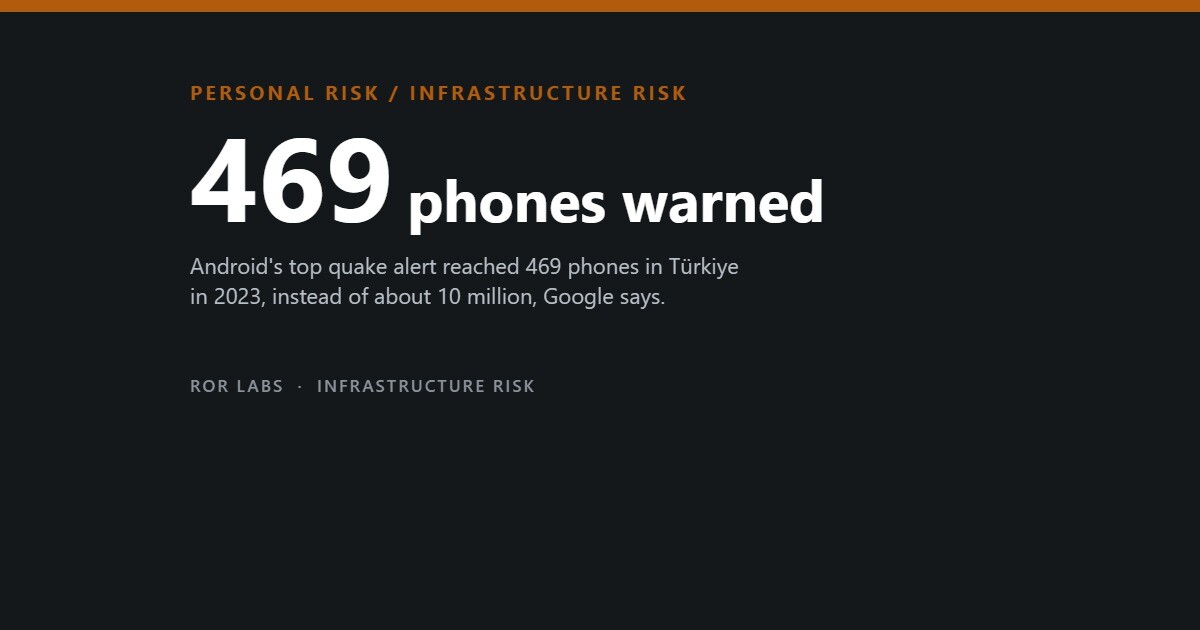
The same paper reported the system’s worst miss. In the magnitude 7.8 Kahramanmaraş earthquake in Türkiye in February 2023, which struck at 4:17 am, the algorithm estimated a magnitude of 4.5 to 4.9. It sent its most urgent alert to 469 phones when about 10 million people within 158 km should have had one. Google has since changed the algorithm, and a Google-authored preprint reports alerts to over 16 million users in a magnitude 6.2 quake near Istanbul in 2025.
Getting an alert is not the same as acting on it. Japan has issued public earthquake warnings since 2007. When Kazuya Nakayachi and colleagues surveyed residents after two real warnings in 2018, most had stayed still and braced themselves mentally rather than taking cover. Asked why warnings were useful, more than eight in ten chose mental preparation and fewer than a third said they could protect themselves.

When the alert never came
The deadliest failures were not about wording. On 8 August 2023 fire swept through Lahaina on Maui, killing 101 people. A report for Hawaii’s attorney general found that with no mobile service, residents and visitors could not receive emergency alerts. Maui County later sued four carriers, saying at least 14 text alerts never arrived because all 21 cell sites serving West Maui failed; the carriers dispute this. Outdoor sirens were not sounded.
When the alert did not do its job
Selected failures of phone alerts, 2023–2024.
| Event | What went wrong | Scale |
|---|---|---|
| Lahaina wildfire, Maui, August 2023 | Mobile network down; county says at least 14 alerts never arrived | 101 deaths |
| Kahramanmaraş earthquake, Türkiye, February 2023 | Android estimated M4.5–4.9 for an M7.8 quake; top alert reached 469 phones | About 10 million people should have been warned |
| DANA floods, Valencia, October 2024 | ES-Alert sent at 20:11, after flooding had begun | More than 220 deaths |
| UK national test, April 2023 | A network fault meant some Three customers missed it | Test only |
Sources: Hawaii Department of the Attorney General, Phase 1 report (April 2024), via NPR; Maui County lawsuit (May 2024), via AP/PBS; Allen RM et al., Science (2025); Martin-Moreno JM et al., Public Health Rev (2025); UK Parliament HCWS740 (2023).
In Valencia, Spain, on 29 October 2024, torrential rain sent floodwater through towns south of the city. The regional government’s ES-Alert reached phones at 20:11, when large areas were already under water. More than 220 people died, many of them aged 70 or over. The investigating judge called the alert late and wrong, noting that more than half of the bodies were found in enclosed spaces, mainly houses and garages.
These failures show the limits of test results. A test goes out on a calm day, over a working network, at an announced time. Real alerts compete with power cuts, damaged masts, sleep and confusion, and their timing depends on officials’ judgement under pressure. A phone alert can only help if someone sends it while there is still time to act.
What the evidence suggests
Phone alerts reach most people when networks work: about nine in ten adults in the best national test survey, fewer among older and rural people. Most recipients check before acting, and incomplete messages invite more checking. A single false alarm seems to harm trust less than feared, though frequent alerts lead people to switch some off. The worst outcomes came from alerts never delivered or sent too late. Nearly all the evidence on behaviour comes from surveys and experiments, not observed actions.
Questions people ask
Why didn’t I get the emergency alert?
Common reasons are an older or uncommon phone, out-of-date software, being outside the target area, a network fault, or having switched that alert type off.
Can I turn emergency alerts off?
Usually some types, such as missing-child alerts, but not the highest-level national alerts in most systems. Opting out means missing warnings.
Are longer alert messages better?
Longer alerts reduced checking in one experiment but did not raise compliance in another. Including the hazard, place, action, time and sender matters most.
Do false alarms make people ignore alerts?
Evidence is mixed. One false alert did not dent trust in Israel, but frequent or poorly targeted alerts are linked to people opting out.
How much warning does an earthquake alert give?
From none to a minute or more, depending on distance from the epicentre. People close to it may get the alert as or after shaking starts.
The short version
- After the 2023 US national test, a survey of 80,161 adults estimated that 91% of those with working phones got the alert; older and rural people were less likely to.
- Most people do not act on an alert straight away; they check it first. After Hawaii’s false missile alert in 2018, only 28% of surveyed residents believed it at once and 73% checked other sources.
- A single false alarm did less damage to trust than officials fear, but frequent alerts push people to switch some off: 17.5% of US adults have opted out of at least one alert type.
- The deadliest failures were about delivery and timing: in Lahaina in 2023 the phone network failed, and in Valencia in 2024 the alert arrived after 8 pm, when towns were already flooding.
- Earthquake alerts give seconds, not minutes. In Google’s Android data, 36% of people who answered a feedback prompt got the alert before shaking began; most of the evidence on behaviour comes from surveys, not observation.
This article summarises research and official reports for general information. It is not professional safety advice. Keep emergency alerts switched on, learn how your local authority issues warnings, and follow official instructions in an emergency rather than waiting for confirmation from other sources.
Further reading: Mileti DS, Sorensen JH (1990), for the classic review of how people respond to warnings. Ling R, Oppegaard B, Social Media + Society (2021), for the Hawaii false alert. Parker AM et al., RAND (2024), for the most detailed measurement of who received a national test alert.
- Mobile Technology and the Transformation of Public Alert and Warning, Hamilton Bean (2019). A communication scholar tells the inside story of how phone alerts were built in the US and compares Japan, Australia, Canada and the Netherlands. Thorough and research-based; written before the 360-character era settled.
- Paradise, Lizzie Johnson (2021). A reporter reconstructs the 2018 Camp Fire in California, including how warnings failed to reach many residents in time. Gripping and humane; a narrative of one town rather than a study of alert systems.
- The Devil Never Sleeps, Juliette Kayyem (2022). A former US homeland security official argues that disasters should be planned for as recurring events, not surprises. Practical on preparedness; broad, with little on phone alerts as such.
Sources
- Mileti DS, Sorensen JH. Communication of emergency public warnings: a social science perspective and state-of-the-art assessment. Oak Ridge National Laboratory (1990), doi:10.2172/6137387
- Wood MM, Mileti DS, Bean H et al. Environ Behav (2018), doi:10.1177/0013916517709561
- Carlson EJ, Bean H, Ratcliff CL, Pokharel M, Barbour JB. J Contingencies Crisis Manag 32(2) (2024), doi:10.1111/1468-5973.12587
- Olson MK, Sutton JN, Cain LB, Waugh N. J Contingencies Crisis Manag (2023), doi:10.1111/1468-5973.12518
- Ling R, Oppegaard B. Social Media + Society (2021), doi:10.1177/2056305121999661
- Jones NM, Silver RC. Am Psychol (2020), doi:10.1037/amp0000495
- Trainor J, Nagele D, Philips B, Scott B. Weather Clim Soc (2015), doi:10.1175/WCAS-D-14-00052.1
- von der Linde M, Göcke M, Hirschfeld GHF, Thielsch MT. Saf Sci (2025), doi:10.1016/j.ssci.2024.106724
- Yagoda-Biran G, Nof RN, Zwebner Y. Sci Rep (2026), doi:10.1038/s41598-026-37958-1
- Allen RM, Barski A, Berman M et al. Science (2025), doi:10.1126/science.ads4779
- Mousavi SM, Robertson P, Allen RM et al. arXiv preprint 2607.08975 (2026)
- Nakayachi K, Becker JS, Potter SH, Dixon M. Risk Anal (2019), doi:10.1111/risa.13306
- Becker JS, Potter SH, Vinnell LJ et al. Humanit Soc Sci Commun (2020), doi:10.1057/s41599-020-00613-9
- Smith KR, Grant S, Thomas RE. Nat Hazards (2022), doi:10.1007/s11069-022-05241-x
- Martin-Moreno JM, Garcia-Lopez E, Guerrero-Fernandez M, Alfonso-Sanchez JL, Barach P. Public Health Rev 46 (2025), doi:10.3389/phrs.2025.1608297
- Parker AM, Steratore R, Bradley MA et al. Assessing public reach of the 2023 national test of the Wireless Emergency Alerts system. RAND RR-A2451-1 (2024)
- UK Parliament. Written statement HCWS740, Emergency Alerts test (25 April 2023)
- Hawaii Department of the Attorney General. Lahaina fire Phase 1 report (April 2024), as reported by NPR (17 April 2024)
- AP via PBS NewsHour (May 2024), Maui County lawsuit against mobile carriers
- Reuters (2025), Spanish court to investigate former Valencia emergency services head
- Euronews (28 July 2025), Google earthquake alert system in Türkiye
- ABC News Australia (27 July 2026), AusAlert national test.