Ninety Per Cent of Emergency Calls From One Indoor Spot Missed the Dispatcher. Ordinary Calls From the Same Spot Connected in Six Seconds.
Key takeaways · 13 min read
- Four in five significant European telecom outages are the network failing on its own or someone misconfiguring it. Deliberate attacks were 8 per cent in 2024.
- In 2012, the first full reporting year, almost 40 per cent of the 79 reported incidents took the 112 emergency number down as a side effect.
- The February 2024 US outage came from one unreviewed configuration on one element. It dropped 125 million devices in three minutes, was rolled back in two hours, and took twelve to clear.
- More than 25,000 911 calls failed that night. The report does not say how many succeeded, so the failure rate is unknown.
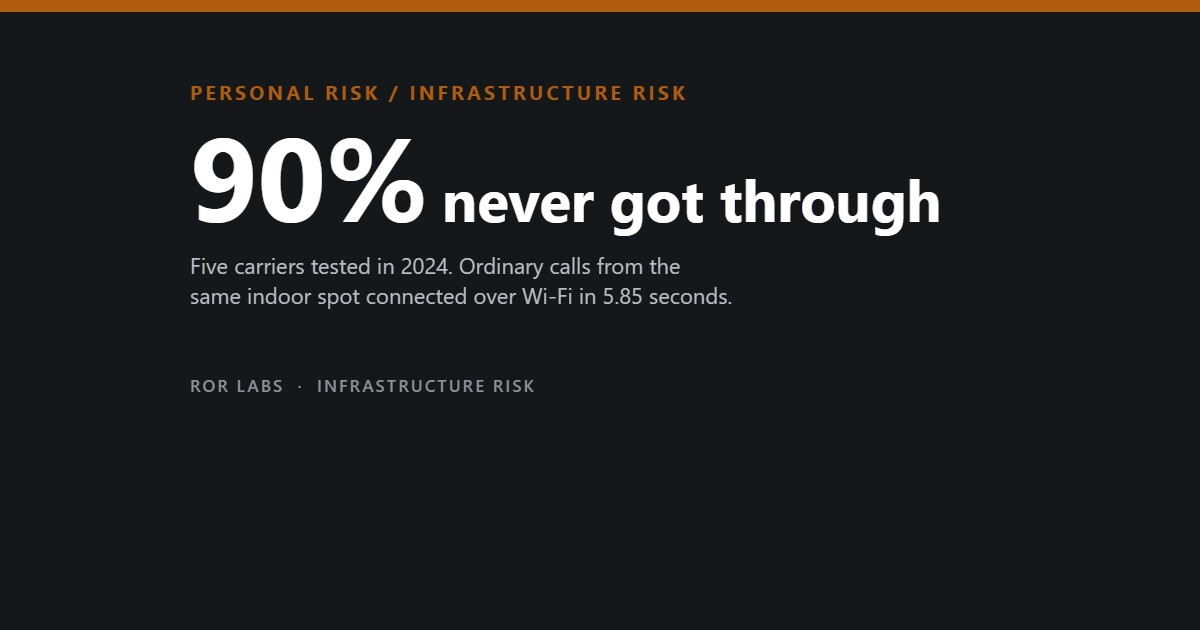
At a single indoor spot on a university campus, researchers dialled an ordinary number and the call connected over Wi-Fi in an average of 5.85 seconds. Then they dialled the emergency number from the same spot, on the same phones, on the same networks. Ninety per cent of those calls had still not reached a dispatcher after two minutes, when the experimenters stopped waiting.
Nothing was broken. The Wi-Fi was strong, the handsets were carrier-certified, and the software was doing exactly what the international standard says: an emergency call must prefer the mobile network over Wi-Fi, because mobile networks can guarantee bandwidth and give emergency traffic priority under congestion. That is a reasonable rule. In a building with one bar and good Wi-Fi, it is also why the call does not go through.
This is an article about how telephone networks actually fail, and about what fails first when they do. Almost none of it looks like the picture most people carry — a mast down in a storm, or a foreign intelligence service. In the European figures, deliberate attacks are eight per cent of significant incidents. The rest is equipment, software, and people typing the wrong thing at two in the morning.
What actually takes a network down
Twenty-eight European countries report their significant telecom outages to a common register, and the aggregate is published annually. For 2024 the register holds 188 incidents. System failures — hardware and software faults inside the operator’s own equipment — account for 113 of them, or 60 per cent. Human errors account for 35, or 19 per cent. Natural phenomena, which is where storms and floods live, account for 25, or 13 per cent. Malicious actions account for 15, or 8 per cent.
What caused Europe’s significant telecom outages in 2024
ENISA, Telecom Security Incidents 2024. 188 incidents reported by 26 EU member states and 2 EFTA countries.
Sixty and nineteen make seventy-nine. Four incidents in five are the network breaking itself or somebody breaking it by accident. That ratio has been broadly stable for over a decade, and it is the most useful fact in the subject, because it is the opposite of where public attention goes.
The same register, in its first full year, recorded something never published as cleanly since: of the 79 incidents reported for 2012, almost 40 per cent affected the ability to dial 112. Not 40 per cent of emergency-service outages — 40 per cent of ordinary outages took the emergency number down as a side effect, because it rides on the same equipment as everything else.
One element, three minutes, twelve hours
On 22 February 2024, at 2:42 in the morning, an employee at a large American carrier loaded a configuration onto a single network element as part of routine maintenance. The regulator’s subsequent report is blunt about what was wrong with it: the configuration “did not conform to AT&T’s established network element design and installment procedures, which require peer review”. Nobody had checked it.
Three minutes later the network detected an inconsistency and did what it is designed to do, which is enter a protective mode and disconnect rather than propagate corruption. It disconnected more than 125 million registered devices across all fifty states, the District of Columbia, Puerto Rico and the US Virgin Islands.
The engineers rolled the bad element back by about 4:45 — two hours. The outage did not end at 4:45. It ended around 12:30 that afternoon, because when protection mode lifted, all 125 million devices tried to register at once and the registration systems were, in the regulator’s phrase, “overwhelmed with the high volume of requests”. Two hours to fix the fault; another eight to recover from the fix.
The night of 22 February 2024, by the clock
FCC, February 22, 2024 AT&T Mobility Network Outage: Report and Findings, July 2024.
Two details there are worth keeping. Protection mode was not the failure; it was the safety feature working, because a network running on a corrupt configuration does more damage than one that stops. And the recovery took four times as long as the repair, delayed by the network’s own customers — which you cannot test in a laboratory, because you cannot borrow 125 million phones.
Twenty-five thousand failed calls, and the number nobody published
The headline figure from that night is that more than 92 million voice calls were blocked and more than 25,000 calls to 911 failed. Both numbers come from the regulator, both are large, and neither can be turned into a rate, because the report does not say how many 911 calls succeeded in the same window.
The best national count available puts US 911 volume at about 213.7 million calls in 2021, reported by 45 states, with roughly 89 per cent from mobile phones. Spread evenly that is around 24,000 calls an hour for the whole country across every carrier, or near 290,000 over twelve hours. One carrier’s share of that is a fraction, and this outage’s worst hours fell between two and five in the morning, the quietest of the night. Done honestly, the arithmetic says 25,000 failures is a large share of what that carrier’s customers would have attempted. Done dishonestly it says whatever you want.
A numerator in search of a denominator
FCC report, July 2024; National 911 Program, 2021 National 911 Profile Database Report (213.7 million calls, 45 states reporting; 5 states unknown, 6 did not submit).
That national count carries its own warnings: five states marked their totals unknown, six submitted nothing, and the report says tracking total 911 calls “requires input from many entities that may include estimates”. The denominator is soft even where it exists. The failure count is real and specific; the failure rate is unknown, and nobody holding the data has published it.

The call that fails with full bars
The outage story is the dramatic one. The quieter finding is that emergency calls fail on networks that are working perfectly, and researchers have now measured it.
A 2024 study built a model checker for the emergency-specific parts of the mobile standard, ran it against the specification, then took the failures it predicted into the field. Eleven design defects came out; nine were confirmed on real networks, using three American carriers, two Taiwanese carriers, campus Wi-Fi and four carrier-certified handsets.
The clearest of them is the one in the opening paragraph. Because the standard requires an emergency call to prefer the mobile network, a phone sitting in a weak-signal indoor spot will exhaust its attempts on the weak mobile network before it considers the strong Wi-Fi beside it. At one such location, ordinary calls connected over Wi-Fi in 4 to 7 seconds, averaging 5.85. Eighteen of twenty emergency calls from the same location hit the two-minute ceiling the researchers had set.
The second is stranger. A phone with no SIM may grab whichever network has the best signal, having no home network to prefer; a paying subscriber must try its own carrier first. Where coverage was uneven, subscribed phones took 61.3, 70.2 and 77.4 seconds to set up an emergency call on three networks. SIM-less phones in the same spot took 4.6 seconds in the United States and 3.7 in Taiwan.
Emergency call setup time, measured at the same locations
Hu et al., ACM CCS 2024. Three US and two Taiwan carriers, four handset models. 120 s was the experimenters’ own cut-off, not a natural endpoint; subscriber figure is the mean of 61.3, 70.2 and 77.4 s.
A third defect is about movement. The standard forbids certain handovers during an emergency call — from an older network generation up to a newer one, and between carriers. In the validation walk, a call handed down from 4G to 3G kept going, then failed to hand back up when 3G weakened, and dropped at 112 seconds while a 4G signal of around −112 dBm was sitting right there unused.
Camp-on, and forty seconds of silence
Several countries have a rule for exactly the case where your own carrier cannot carry your emergency call: the phone should camp on to any other available network and place the call there. It is a good rule and it exists because of outages like these.
An independent review of an Australian carrier’s September 2025 emergency-call failure, published in December 2025, put a number on how long camp-on takes. For many calls, it found, it may take 40 to 60 seconds. The reviewer’s comment on that is the part worth quoting: in an emergency, people are unlikely to hang on for that length of time, “especially when the only response they are getting is silence on the line”.
The same review found a configuration detail that shows how fine the margins are. At the time of the outage the carrier’s emergency inactivity timer was set to ten seconds, introduced to work around a problem with one handset model. It has since gone back to 600, in line with other networks at 150 to 600. One timer, changed for a good local reason, sitting between a caller and a dispatcher.
Two settings and a silence
Schott review of the 18 September 2025 Optus Triple Zero outage, published December 2025.
The same carrier’s November 2023 nationwide outage taught a different lesson, about counting. More than ten million services were down for about twelve hours. The number of failed Triple Zero calls was first given as 228, then revised to roughly 2,696 after the company said a further 2,468 customers had tried unsuccessfully. The first number was not a lie; it was what the operator could see. An eleven-fold revision is what happens when the thing you are counting is calls that never arrived.
What the evidence does not show
Three things should be said against the account above, and the first two come from the people who produced the numbers.
The European register warns that trend conclusions “have to be made with caution, as national reporting thresholds change over the years”, and that only the most significant incidents are reported. Twenty-eight countries decide separately what counts as significant, and revise it. The year-on-year count measures reporting rules at least as much as reliability. The cause breakdown survives better, because a misconfiguration is a misconfiguration whatever the threshold.
The emergency-call study is a model-checking exercise with small-scale field validation, not an incidence study. It shows these failures exist and reproduce; it does not say how often a real caller meets one, and nobody has measured that. The researchers also blocked every test call from reaching a dispatcher, so their setup times were measured to the moment the signalling was intercepted and understate the real thing by a few seconds, and the two-minute ceiling was their own stopping rule. The rule that produced the worst result — prefer the mobile network — exists to guarantee bandwidth and priority under congestion, a real benefit the study did not weigh against the cost it measured.
The third point is the largest: networks are not getting worse. The European register holds 1,930 incidents across 2012 to 2024, and although the annual count has risen, the user-hours lost in 2024 — 1,743 million — are back at the level of a decade earlier and 55 per cent below 2023. More incidents reported, each costing less. And the question this subject implies, whether any of it costs lives, is almost entirely unanswered: the studies linking telecom outages to health outcomes are simulation models of cascading failure, not counts of anybody. The counting stops at the call.
Questions people ask
Does a phone with no SIM really call emergency services? Yes, in most countries, and that is deliberate: regulators require carriers to carry emergency calls from any handset regardless of subscription. The finding above is that this freedom makes the SIM-less phone faster in a patchy-coverage spot, because it is not obliged to try one particular carrier first.
Should I turn Wi-Fi calling off, or on? The evidence does not support a general answer and anyone who gives you one is guessing. The measured defect is that the standard prefers the mobile network for emergency calls whatever the Wi-Fi is doing, so the setting is not the lever people assume. What is worth knowing is that indoors, on one bar, an emergency call may take far longer than an ordinary one, and silence on the line does not mean it has failed.
Is a landline more reliable? It used to be reliable in a different way: powered from the exchange, so it survived a household power cut. Most modern fixed lines run over broadband and die with the router. The European figures show fixed internet rising as a share of affected services, 16 per cent in 2023 to 26 per cent in 2024. No category here is simply safe.
How would I know an outage was happening? Often you would not, and that is part of the problem. In a core-network or routing failure the masts keep transmitting, so the phone shows full bars and the user has no signal that anything is wrong — which is also why a phone may not look for another network to camp on to.
Are attacks going to become the main cause? Not so far: 8 per cent of reported European incidents in 2024, 6 per cent in 2022. They may be worse per incident, and the register does not capture espionage that causes no outage. On the measure that exists, the network’s main adversary is itself.
The short version
- Four in five significant European telecom outages are the network failing on its own or someone misconfiguring it. Deliberate attacks were 8 per cent in 2024.
- In 2012, the first full reporting year, almost 40 per cent of the 79 reported incidents took the 112 emergency number down as a side effect.
- The February 2024 US outage came from one unreviewed configuration on one element. It dropped 125 million devices in three minutes, was rolled back in two hours, and took twelve to clear.
- More than 25,000 911 calls failed that night. The report does not say how many succeeded, so the failure rate is unknown.
- At one indoor test location, 90 per cent of emergency calls did not reach a dispatcher within two minutes, while ordinary calls from the same spot connected in 5.85 seconds.
- A phone with no SIM set up an emergency call in under five seconds where a paying subscriber took over a minute, because the subscriber must try its own network first.
- Camping on to another carrier may take 40 to 60 seconds of silence, and people hang up.
- Nobody has measured how often real callers hit any of this, or what it costs in outcomes. The counting stops at the call.
This describes what published incident reports and peer-reviewed measurements have found about telecom outages and emergency calling. It is not safety advice and not a guide to what to do in an emergency; if you need emergency services, dial the number for your country and stay on the line. Incident figures come from the official reports named below and reflect what those investigations could establish, which in several cases changed after publication. Where the evidence cannot settle a question — how often these failures reach real callers, above all — that is said rather than resolved.
Further reading: the FCC’s report on the February 2024 outage is fifteen pages, written for a general reader, and is the clearest published account of how a single configuration becomes a national event. ENISA’s annual telecom incident reports are free, short, and the only place the cause breakdown is published consistently. The 2024 emergency-call paper is written for specialists but its figures 6 to 10 can be read on their own.
- Doom, Niall Ferguson (2021). Why institutions built to prevent catastrophe so often fail to.
- Noise, Daniel Kahneman, Olivier Sibony & Cass Sunstein (2021). On unwanted variability in expert judgment during a crisis response.
- The Data Detective, Tim Harford (2020). Ten rules for reading numbers in the news skeptically.
Sources
- Federal Communications Commission, February 22, 2024 AT&T Mobility Network Outage: Report and Findings, Public Safety and Homeland Security Bureau, July 2024. (Configuration loaded at 2:42 a.m. ET that “did not conform to AT&T’s established network element design and installment procedures, which require peer review”; outage began 2:45. More than 125 million registered devices disconnected across all 50 states, DC, Puerto Rico and the US Virgin Islands. More than 92 million voice calls blocked, more than 25,000 calls to 911 failed. Rollback complete by approximately 4:45 a.m.; FirstNet restored 5:00 a.m.; registrations normalised about 12:30 p.m. after all devices attempted simultaneous re-registration. Referred to the Enforcement Bureau for potential violations of parts 4 and 9.)
- European Union Agency for Cybersecurity (ENISA), Telecom Security Incidents 2024, July 2025. (188 incidents, 26 EU member states and 2 EFTA countries, against 156 in 2023. System failures 113 incidents / 60%; human errors 35 / 19%; natural phenomena 25 / 13%; malicious actions 15 / 8%. Total 1,743 million user hours lost, 55% below 2023. Fixed internet affected in 26% of incidents against 16% in 2023. 1,930 incidents recorded 2012–2024. States that trend conclusions “have to be made with caution, as national reporting thresholds change over the years” and that reporting “only covers the most significant incidents”.)
- ENISA, Annual Incident Reports 2012. (79 significant incidents; system failures 75%. “Almost 40% of the incidents affected the possibility of dialling the emergency number 112.”)
- ENISA, Telecom Security Incidents 2022. (155 incidents; system failures 72%, human errors 15%, malicious actions 6%, natural phenomena 6%. Of 10,481 million user hours lost to system failures, 1,048 million were power cuts. Third-party failures flagged in 23% of incidents.)
- Hu, Y., Chen, M.-Y., Yan, H., Cheng, C.F., Tu, G.-H. and Li, C.-Y., “Uncovering Problematic Designs Hindering Ubiquitous Cellular Emergency Services Access”, ACM CCS, 2024. (11 design defects, 9 validated across three US and two Taiwan carriers, campus Wi-Fi and four carrier-certified handsets. At location P7, 4G no stronger than −120 dBm and Wi-Fi no weaker than −55 dBm: non-emergency calls connected over Wi-Fi in 4–7 s, mean 5.85 s, while 18 of 20 emergency calls hit the 120-second ceiling — 90% not connected within two minutes. Subscribed handsets took 61.3, 70.2 and 77.4 s at uneven-coverage locations against 4.6 s (US) and 3.7 s (Taiwan) for SIM-less handsets. A call handed to 3G dropped at 112 s despite a 4G signal of about −112 dBm, because 3G-to-4G escalation during a call is forbidden. Test calls were blocked from reaching PSAPs, so measured setup times understate the real ones.)
- Schott, K., independent review of the Optus Triple Zero outage of 18 September 2025, December 2025. (“For many calls it may take 40–60 seconds to camp-on”. Optus had set its emergency inactivity timer to 10 seconds to work around an issue with Google Pixel 6A devices, since reverted to 600 s against other networks’ 150–600. Notes that people are unlikely to wait “especially when the only response they are getting is silence on the line”.)
- Bean, R., Review into the Optus outage of 8 November 2023, Australian Department of Infrastructure, Transport, Regional Development, Communications and the Arts, 2024. (More than 10 million services affected for about 12 hours; 18 recommendations. Failed Triple Zero calls first reported as 228; Optus later stated a further 2,468 customers had tried unsuccessfully, giving approximately 2,696.)
- National 911 Program, 2021 National 911 Profile Database Report. (45 states reported approximately 213.7 million 911 calls to primary PSAPs in 2021; 40 states reported 138.1 million wireless against 17.7 million wireline; 4,637 primary and 656 secondary PSAPs. Five states marked totals unknown, six did not submit; tracking total calls “requires input from many entities that may include estimates”.)
- O’Reilly, G.P., Richman, S.H. and Kelic, A., “Power, telecommunications, and emergency services in a converged network world”, DRCN, 2007. (A dynamic simulation of power outages cascading into telecom and then into 911 access and injury severity. Cited here as an example of what kind of evidence exists on the health question: a model, not a count.)