Baseball foul-ball injuries, where the risk sits and what netting changed
Key takeaways · 10 min read
- In first-aid records from three Major League stadiums, a foul ball hurt a fan badly enough to seek care about once every two or three games.
- Most injuries are bruises, but ball strikes are overrepresented among fans sent to hospital, and deaths, though rare, still happen.
- Risk concentrates in seats close to the field along the baselines just beyond the net, and children are overrepresented among the worst cases.
- Since 2018 every Major League park has netting past the dugouts, and many go further. No before-and-after injury data have been published.
On a Friday night in May 2026, Jamie Golla was sitting a couple of rows above the visitors’ dugout at T-Mobile Park in Seattle, filming herself with friends, when a foul ball came into the frame and hit her in the head. She left by ambulance for Harborview Medical Center. The net in front of her section stood 13.5 feet high; the ball cleared it. Her clip passed 27 million views, and some of the comments told her to pay attention.
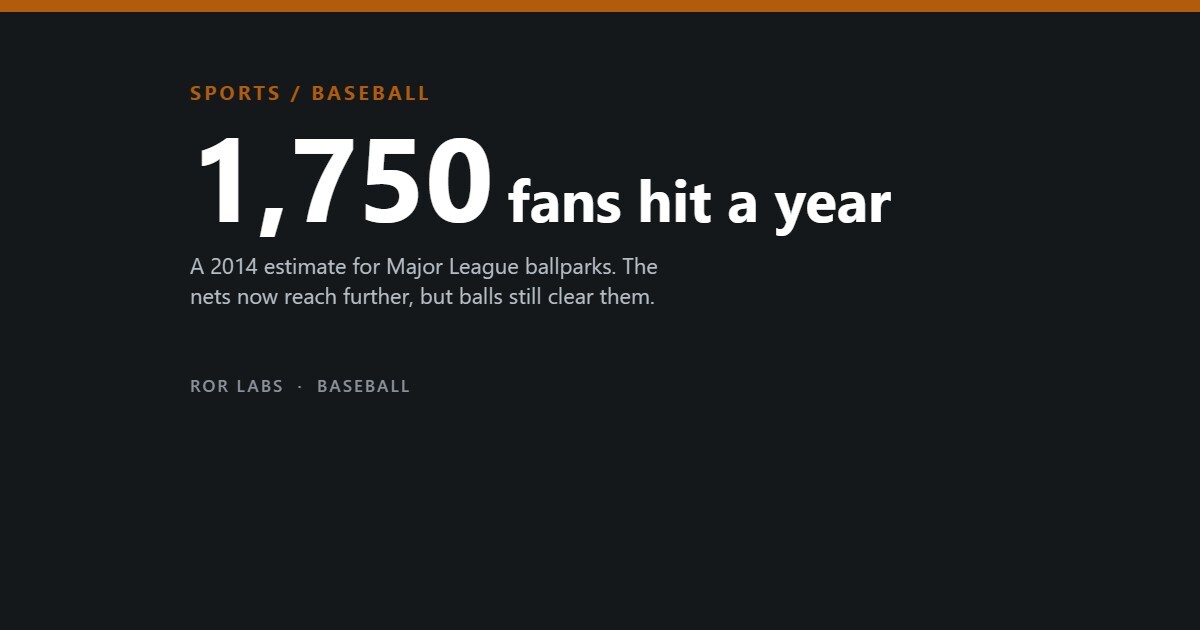
How often does this happen? The best peer-reviewed estimate, built from first-aid records at three Major League stadiums, works out to roughly one fan every two or three games hurt badly enough by a foul ball to seek medical help. A 2014 Bloomberg News analysis scaled similar records up to about 1,750 spectators a season, more than the 1,536 times batters were hit by pitches that year.
This article covers what a batted ball or a broken bat actually does to a spectator, which seats and which fans carry most of the risk, what the netting extensions of 2018 to 2020 and the broken-bat rules changed, why the injury counts are shakier than they look, and why the sensible answer is a better seat, not an empty one.
What actually happens when a ball leaves the field
Andrew Milsten and colleagues used freedom-of-information requests to obtain medical reports from three Major League stadiums across 11 non-consecutive seasons between 2005 and 2016. They counted 0.42 to 0.55 foul-ball injuries per game serious enough to reach a first-aid station, or 0.13 to 0.23 patients per 10,000 fans. Most were minor, often bruises or head injuries treated with painkillers. Fans were most often hit in the abdomen, arms, face or head.
How often a batted ball sends a fan to first aid
Injuries per game from stadium first-aid records. The Korean figure is calculated from the study’s counts.
Sources: Milsten et al., Prehospital and Disaster Medicine 37(2):277 (2022); Glovin, Bloomberg News (2014); Oh et al., Korean Journal of Sports Medicine (2015).
The rare serious case is what matters. In Milsten’s data foul balls made up only 5.2% of first-aid patients, against 42% to 49% for other injuries, yet fans hit by a ball were more likely to need a higher level of care and a trip to hospital. Asian stadiums show the same pattern. At Jingu Stadium in Tokyo, direct ball strikes caused 70% of the injuries serious enough for hospital referral over eight seasons; at Jamsil in Seoul, ambulance cases were mostly facial and oral injuries.
The ball is a small share of the caseload, a large share of the serious cases
Share of first-aid or hospital caseload in three stadium studies.
Sources: Milsten et al. (2022); Oh et al. (2015), 324 injuries among 448 first-aid visits; Ishikawa et al. (2007), 93 hospital referrals over 1996 to 2003.
Deaths are rare but real. In August 2018 Linda Goldbloom, at Dodger Stadium for her 79th birthday, was hit by a 93-mph foul ball that went over the netting while she sat in the third row of the loge level. She died four days later of bleeding inside the skull. Bats are the other projectile: in June 2015 a woman at Fenway Park suffered life-threatening facial injuries when a broken bat flew into the seats behind the on-deck circle.
Where the risk concentrates
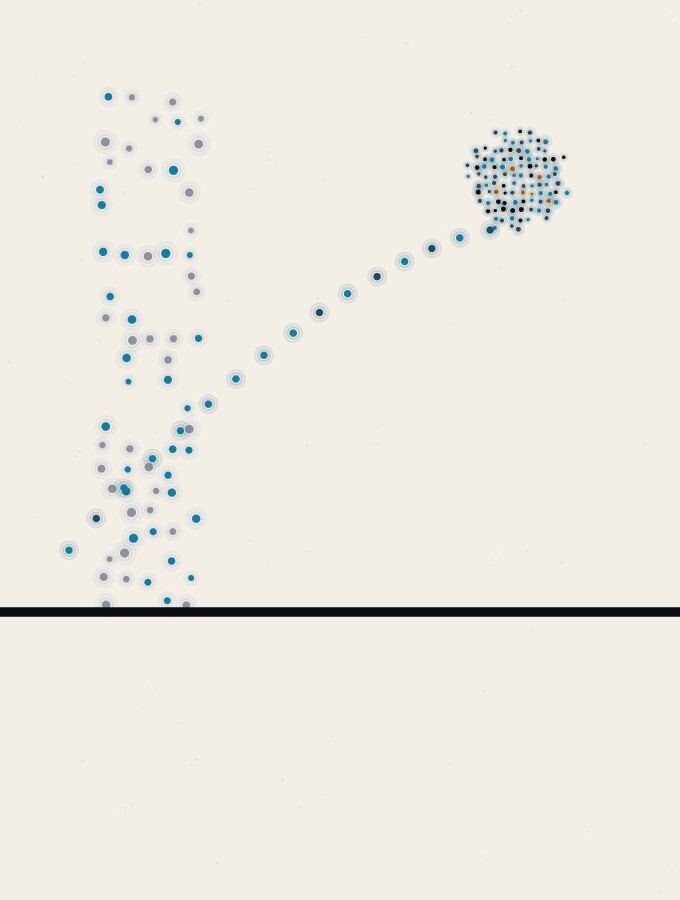
The danger sits in the seats close to the field along the baselines, particularly just past the end of the netting. A line drive off a professional bat can leave at more than 100 mph, and at even 80 mph a ball covers 117 feet every second. NBC News put it plainly in 2019: a ball reaches fans about a second after leaving the bat. That is barely enough time to see it, let alone duck, and far less for anyone holding a child or a phone.
Children are overrepresented among the worst cases. A review of media reports of seriously injured or killed spectators at Major League games from 2009 to 2014 found 33 cases, aged 4 to 69, and 15% were 13 or younger. In May 2019 a two-year-old girl sitting on her grandfather’s lap at Minute Maid Park in Houston was hit in the head by a line drive. Section 111, just beyond the third-base dugout, was the first section without netting. Her family’s lawyer later likened her injuries to a stroke.
Attention matters too, though the evidence is thinner than the online comments suggest. Milsten’s team found foul-ball injuries appeared to rise over the study years, in step with the spread of smartphones. That is a coincidence in timing, not proof that phones caused the injuries. In Seoul, serious injuries clustered at weekend games rather than weekday ones.
What has been measured to work

Netting is the main measure, and it arrived in steps. In December 2015 Major League Baseball recommended screens in front of field-level seats between the near ends of both dugouts. After a two-year-old was struck in the face by a 105-mph foul at Yankee Stadium in September 2017, the league announced in February 2018 that every park would have netting to at least the far ends of both dugouts by Opening Day. The Houston injury in 2019 pushed several clubs further, towards the foul poles.
In December 2019 the commissioner, Rob Manfred, said all 30 teams would extend netting substantially beyond the dugouts for 2020, with seven or eight running all the way to the foul poles. Not every park is built for it. A Sports Illustrated audit in August 2021 counted only six parks with netting from pole to pole, 17 that stopped at the elbows of the stands, and two with minimal coverage. Fans were still being hit that summer, at Fenway Park and in Pittsburgh.
How far the nets reach
Major League parks by extent of protective netting, from league announcements and a 2021 magazine audit.
Sources: MLB.com, 1 February 2018; NBC News, December 2019; Martell, Sports Illustrated, 10 August 2021.
The bat rules have a firmer before-and-after record. Over three months of the 2008 season, 2,232 bats broke in Major League games and 756 of them shattered into several pieces. Maple bats were about three times as likely as ash to fail this way, and steep grain in the wood was a major cause. The league tightened rules on wood density, grain angle and the hitting surface, and required a grain mark on each handle so inspectors can check it.
Broken bats before and after the 2008 to 2009 rules
Multi-piece failures, when a bat breaks into flying pieces. Three groups of researchers report three different reductions.
Sources: Drane et al., Procedia Engineering (2012); Ruggiero et al., Procedia Engineering (2012); USDA Forest Products Laboratory release, 12 July 2013; Fortin-Smith et al., Applied Sciences 9(18):3733 (2019); Campshure et al., Applied Sciences 12(7):3494 (2022).
Japan adds a cheaper layer: stadium volunteers blow whistles or sound handheld noisemakers whenever a foul or home run heads for the stands, a practice Reuters described at the Tokyo Olympics in 2021. No study has measured how many injuries the warnings prevent. A Japanese court has also taken a different line: in 2016 the Sapporo High Court held the Fighters liable after a woman invited on a parent-and-child programme lost the sight of an eye to a foul ball in an unnetted infield seat.
Here the counting is weaker than the story. No one has published a before-and-after comparison of injuries across the netting extensions; Major League Baseball does not release fan injury data, and researchers rely on records pried loose one stadium at a time. NBC News obtained records from only four of 30 parks. Bloomberg’s 1,750 rests on first-aid logs, which miss fans who never report, and its author noted that the number of people sitting out of range in upper decks could skew it.
Where the injury counts come from
Two data sets behind the headline numbers, by source. Shares calculated from published counts.
Sources: Nguyen, NBC News, October 2019, 808 reports from 2012 to 2019; Zonfrillo et al., Current Sports Medicine Reports (2016), causes of death not limited to batted balls.
Why the answer is not to stay home
Set against attendance, the risk to any one fan is small. Milsten’s rate of 0.13 to 0.23 first-aid visits per 10,000 fans works out at roughly one foul-ball injury for every 43,000 to 77,000 tickets, and most of those injuries are bruises. The same first-aid stations see many more people for other injuries. The aim is to put yourself and your children where the rare hard liner cannot reach, not to give up an afternoon at the ballpark.
Seat choice does most of the work. With small children, sit behind the netting, or high enough or far enough down the line that line drives cannot reach. Close to the field past the net, keep your eyes on every pitch, keep phones down while the ball is in play, and bring a glove. Every Major League park now has netted seats well past the dugouts. If someone is hit on the head, take it seriously, even if they seem fine.
Know what the ticket says. For more than a century, courts in many US states have applied what lawyers call the Baseball Rule: a team that screens the most dangerous seats, behind home plate, has generally met its duty, and fans elsewhere are treated as accepting the risk. Some states, Illinois among them, have written similar protection into law. For the players’ own risks, see our article on pitch counts and sliding.
Questions people ask
How often are fans hurt by foul balls?
In first-aid records from three Major League stadiums, about one fan every two or three games was hurt badly enough to seek care, or 0.13 to 0.23 per 10,000 fans. Most injuries were minor.
Where are the safest seats with children?
Behind the netting, which now reaches at least past the dugouts at every Major League park, or in upper decks. The riskiest seats are close to the field along the baselines just beyond the end of the net.
Does netting stop every ball?
No. The ball that killed Linda Goldbloom in 2018 and the one that hit a Seattle fan in 2026 both went over nets. Netting cuts exposure; it does not end it.
Can I sue if I am hit?
In many US states, the Baseball Rule makes this hard if the team screened the most dangerous seats. Rules differ by state and by country, so ask a lawyer about your own case.
The short version
- In first-aid records from three Major League stadiums, a foul ball hurt a fan badly enough to seek care about once every two or three games.
- Most injuries are bruises, but ball strikes are overrepresented among fans sent to hospital, and deaths, though rare, still happen.
- Risk concentrates in seats close to the field along the baselines just beyond the net, and children are overrepresented among the worst cases.
- Since 2018 every Major League park has netting past the dugouts, and many go further. No before-and-after injury data have been published.
- Bat rules after 2008 cut shattered bats by 30% to 65%, depending on the study. Pick a netted seat, watch every pitch and keep phones down.
This is a summary of published research, not medical advice. Anyone hit on the head by a ball or bat should be checked by first-aid staff; call emergency services for loss of consciousness, vomiting, confusion or worsening headache, and see a doctor for any injury to the eye or face.
Further reading: Milsten et al., Prehospital and Disaster Medicine 37(2):277 (2022), for foul-ball injury rates from stadium records. Drane et al., Procedia Engineering (2012), for the 2008 study of broken bats. Nguyen, NBC News (2019), for how hard it is to count fan injuries.
- The Art of Uncertainty, David Spiegelhalter (2024). A Cambridge statistician on how to think about chance and risk; good for reading rates like one injury per 50,000 tickets.
- Why We Love Baseball, Joe Posnanski (2023). A warm history of the game’s great moments, a reminder of why the answer is a better seat, not staying home.
- Everything Is Predictable, Tom Chivers (2024). An accessible book on Bayesian thinking, handy for weighing rare but vivid events against base rates.
Sources
- Milsten AM, Bradley WF, Hill M, Sacco W, Henes M. Foul ball rates and injuries at Major League Baseball games: a retrospective analysis of data from three stadiums. Prehospital and Disaster Medicine 37(2):277–283 (2022), doi:10.1017/S1049023X22000383.
- Glovin D. Baseball caught looking as fouls injure 1,750 fans a year. Bloomberg News, September 2014, as reported by Insurance Journal, 12 September 2014.
- Ishikawa H, Hori S, Aikawa N. The incidence of sickness/trauma in spectators of professional baseball at the Meiji Jingu Baseball Stadium. Keio Journal of Medicine 56(3):85 (2007).
- Oh JH, Kim JY, Jo BC, Sung GY. The epidemiology of spectator injury and illness in the Korean professional baseball league: 2 consecutive seasons (2011–2012) at the Jamsil Stadium. Korean Journal of Sports Medicine (2015), doi:10.5763/kjsm.2015.33.1.6.
- Zonfrillo MR, Janigian NG, Maron BA. Death or severe injury at the ball game. Current Sports Medicine Reports (2016), doi:10.1249/JSR.0000000000000256.
- Dodgers fan killed after being struck by foul ball in 2018. ABC7 Los Angeles, 5 February 2019.
- Woman seriously hurt by broken bat at Fenway Park. CBS News, 5 June 2015.
- Nguyen V. Foul balls hurt hundreds of fans at MLB ballparks. NBC News, October 2019.
- Girl hit by foul ball at Houston Astros game likely has permanent injuries, lawyer says. NBC News, January 2020.
- Associated Press audio reports on a two-year-old struck at Yankee Stadium, 21–22 September 2017 (Internet Archive).
- All Major League ballparks to have expanded netting for 2018 season. MLB.com, 1 February 2018.
- Every Major League Baseball team will expand netting to protect fans from foul balls. NBC News, December 2019.
- Martell M. Crying foul over ballpark injuries. Sports Illustrated, 10 August 2021.
- Drane PJ, Sherwood JA, Colosimo R, Kretschmann D. A study of wood baseball bat breakage. Procedia Engineering (2012).
- Ruggiero E, Sherwood JA, Drane PJ, Kretschmann DE. An investigation of bat durability by wood species. Procedia Engineering (2012), doi:10.1016/j.proeng.2012.04.073.
- USDA. Forest Service research helps reduce shattered baseball bats. News release, 12 July 2013.
- Fortin-Smith J, Sherwood JA, Drane PJ, et al. A finite element investigation into the effect of slope of grain on wood baseball bat durability. Applied Sciences 9(18):3733 (2019).
- Campshure B, Drane PJ, Sherwood JA. An investigation of wood baseball bat durability as a function of bat profile and slope of grain. Applied Sciences 12(7):3494 (2022).
- Dave P. Foul-ball watchdogs sound their sirens, though few around to hear. Reuters, 1 August 2021, via nippon.com.
- Sapporo High Court judgment of 20 May 2016 (Sapporo Dome foul-ball case), as summarised in a Westlaw Japan legal column, 4 August 2016.
- Epstein TL. Baseball Rule may be near the end after 100 years. SSRN (2017); Breton C. The seventh-inning stretch[er]. University of Denver Sports and Entertainment Law Journal (2024); Beebe J. Injuries from foul balls, broken bats, and railing fall-overs: who is liable? Northern Illinois University (2017).
- Mariners fan hit in head by foul ball dealing with social media backlash. Tribune News Service, via The Daily Gazette, May 2026; Fox News (OutKick), 17 May 2026.